









10 Best Practices for Remote Work in 2026
The shift to remote work is more than a trend; it's a fundamental change in how we collaborate, produce, and innovate. While the flexibility is a major draw, thriving outside the traditional office requires a deliberate and strategic approach. It's not enough to simply have a laptop and an internet connection. True success hinges on establishing robust systems for communication, productivity, and well-being. This guide moves beyond the obvious advice to provide a comprehensive roundup of the 10 most impactful best practices for remote work, packed with actionable insights and real-world examples from pioneering remote-first companies.
We will explore concrete strategies that address the unique challenges and opportunities of distributed teams. You will learn how to structure your day for peak performance, communicate with clarity and intent, and build strong professional connections from a distance. For managers, we'll cover how to foster a vibrant culture and measure what truly matters: outcomes, not hours spent at a desk. Each point is designed to be immediately applicable, offering practical steps you can take to refine your remote work habits.
Whether you're an individual contributor aiming to excel, a manager leading a distributed team, or an organization building a sustainable remote framework, these proven strategies will help you create a high-performing environment. This article provides a definitive blueprint for mastering the art of remote work, ensuring both individual success and collective achievement. By implementing these best practices, you can build a work-life that is not only productive but also fulfilling and sustainable for the long term.
Jump To Section

Earn As You Learn
Earn 25% commission when your network purchase Uplyrn courses or subscribe to our annual membership. It’s the best thing ever. Next to learning,
of course.
1. Establish a Dedicated Workspace
Creating a physical boundary between your professional and personal life is one of the most fundamental best practices for remote work. A dedicated workspace acts as a powerful psychological trigger, signaling to your brain that it’s time to focus. This separation is crucial for maintaining productivity and preventing the burnout that can occur when work bleeds into every corner of your home life.
This doesn't require a separate room, although that's ideal. It can be a specific corner of your living room or a desk in a guest bedroom. The key is consistency: this spot is for work, and only work. For example, a graphic designer might use a specific desk with an external monitor and drawing tablet that they only use for client projects, never for personal browsing. Companies like Google and Basecamp have long recognized this, offering stipends for employees to create effective home office setups. This investment pays off in sustained focus and higher-quality output from their teams.
How to Implement This Practice
To create a space that supports deep work and minimizes strain, focus on ergonomics and organization.
- Invest in Your Health: Prioritize an ergonomic chair and an adjustable desk. Your long-term physical health is paramount, and a comfortable setup prevents a host of musculoskeletal issues.
- An actionable insight is to use a monitor stand or a stack of books to raise your screen so the top is at eye level, preventing neck strain.
- Control Your Environment: Use proper lighting to reduce eye strain and consider noise-canceling headphones, especially in a shared living space.
- A practical example is an employee living in a small apartment who uses a folding screen to visually partition their workspace from the living area, signaling to family members that they are "at work".
- Set Clear Boundaries: At the end of the day, physically leave your workspace. If you have a door, close it. If your desk is in a common area, put your laptop in a drawer. This simple act reinforces the end of your professional duties and helps you mentally switch off.
Key Insight: Your physical environment directly shapes your mental state. A cluttered, multi-purpose space leads to a scattered mind, while an organized, dedicated workspace fosters a focused, productive mindset.
For a deeper dive into managing your work environment, you can learn more about how to cope with at-home distractions and boost your efficiency.

2. Maintain a Consistent Schedule
The flexibility of remote work is a major benefit, but without the structure of an office commute and set business hours, it's easy for your workday to expand or become unpredictable. Maintaining a consistent schedule is one of the most effective best practices for remote work because it creates routine, manages expectations, and establishes a clear boundary between your professional and personal time. This consistency helps prevent the twin dangers of remote work: burnout from overworking and a drop in productivity from lack of structure.
This practice is not about mimicking a rigid 9-to-5 schedule but about creating a predictable rhythm that works for you and your team. Leading remote-first companies like GitLab and Automattic champion this approach. For example, a team at Automattic spread across European and US time zones might establish "core hours" from 9 AM to 12 PM EST for synchronous collaboration, leaving the rest of the day for focused, individual work. This approach provides both autonomy and the necessary structure for effective teamwork.
How to Implement This Practice
A consistent schedule helps you reclaim control over your day and align with your team's rhythm.
- Block Your Calendar: Proactively schedule blocks of time for focused work, meetings, and breaks.
- A practical example is to create a recurring two-hour "Deep Work" block every morning and color-code it on your shared calendar, so colleagues know not to schedule meetings during that time.
- Establish a "Start of Day" Ritual: Begin your workday at the same time with a consistent activity. This could be brewing a cup of coffee, spending five minutes reviewing your task list, and then posting a "Good morning" message with your top priorities in the team's chat channel. This ritual signals to your brain and your team that your workday has begun.
- Create an "End of Day" Routine: Just as important as starting your day is ending it.
- A powerful actionable insight is to create a shutdown routine: spend the last 15 minutes of your day tidying your desk, reviewing tomorrow's schedule, and updating your status on Slack to "Away". This helps you mentally disconnect and avoid answering "just one more" email late into the evening.
Key Insight: Consistency creates momentum. A predictable schedule reduces decision fatigue about when to work, freeing up mental energy to focus on what you need to accomplish.
For a deeper dive into building effective daily structures, you can learn more about the power of routine and how it can transform your productivity.

3. Over-Communicate with Team Members
In a traditional office, context is absorbed through overhearing conversations, joining spontaneous discussions, and reading body language. Remote work removes these organic touchpoints, making intentional and frequent communication one of the most vital best practices for remote work. The mantra "over-communicate" means being more explicit, transparent, and frequent in your interactions to prevent misunderstandings and ensure everyone remains aligned.
This proactive approach fills the gaps left by the absence of physical proximity. For instance, a software developer might post a daily update in their team's channel: "Morning all! Today I'm focused on debugging the payment gateway issue (Ticket #451). I've hit a small snag with the API authentication but am trying a new approach. Will post an update by EOD." This brief message prevents management from wondering about progress and allows teammates to offer help. Companies like GitLab and Basecamp have built their success on this principle, emphasizing extensive documentation and asynchronous written updates. For effective collaboration and connection in a remote setting, mastering top internal communication best practices is paramount.
How to Implement This Practice
Adopting an over-communication mindset requires building new habits around transparency and documentation.
- Make Your Work Visible: Share daily or weekly progress updates in a public channel. This isn't about micromanagement; it's about providing context.
- An actionable insight is to create a simple, repeatable format for your updates, such as "Yesterday I did X, Today I am doing Y, Blockers are Z."
- Prioritize Asynchronous Communication: Use tools like Slack or project management boards for most updates.
- A practical example: instead of calling a quick meeting to get feedback on a design, post the mockup in the relevant channel with specific questions and a deadline for comments. This respects different time zones and focus periods.
- Use Video Strategically: Reserve video calls for complex, sensitive, or relationship-building conversations. Always follow up with a written summary of key decisions and action items in a shared document or project ticket. This creates a lasting record and ensures clarity for those who couldn't attend.
Key Insight: In a remote environment, what feels like over-communication is likely just the right amount. It’s better to provide too much context than to leave your team guessing, which can lead to mistakes and stalled progress.
To further refine your approach, you can learn more about how to improve your communication skills for any professional setting.

4. Use Appropriate Technology and Tools
Selecting and properly implementing the right suite of tools is essential for remote work efficiency. The right tech stack acts as the digital headquarters for a distributed team, enabling seamless communication, collaboration, and project management despite physical distance. This is a critical component of the best practices for remote work, as the wrong tools can create friction, while the right ones foster a connected and productive environment.
This goes beyond just having video conferencing software. A practical example of a well-rounded tech stack could be: Slack for daily chat, Zoom for meetings, Asana for project tracking, Notion for documentation, and Figma for collaborative design. Companies like Slack and Microsoft have built entire ecosystems around centralized communication, while platforms like Asana and Notion provide the structure needed for complex project tracking and knowledge sharing. Selecting the right software and applications is paramount for success; explore essential remote work productivity tools that can enhance collaboration and efficiency.
How to Implement This Practice
To build an effective remote toolkit, focus on integration, training, and clear guidelines to maximize adoption and impact.
- Audit and Integrate: Regularly review your current tools to eliminate redundancy.
- An actionable insight is to create a "Tool Audit" survey for your team every six months to identify what’s being used, what’s not, and where workflows are breaking. Choose platforms that integrate well together, such as connecting Asana notifications to a specific Slack channel.
- Establish Clear Guidelines: Don't just provide tools; create a playbook. For example, a "Communication Guide" document could state: "Use Slack for urgent, quick questions (<2 hr response); use Asana comments for project-specific feedback; use email for formal, external communication."
- Prioritize Training and Security: Ensure every team member receives proper training on core tools. A great tip is to record short video tutorials (using a tool like Loom) for common processes and store them in a shared knowledge base for easy access by new hires.
Key Insight: Technology is the backbone of remote work, but it's only as effective as the strategy behind it. A well-chosen, integrated, and clearly governed tech stack transforms from a simple utility into a powerful enabler of culture and productivity.
For more insights, you can learn more about how to collaborate effectively in a virtual setting and ensure your team stays connected.
5. Set Clear Boundaries Between Work and Personal Life
The biggest challenge of remote work is the disappearance of the natural barriers between your job and your personal time. Without the daily commute or the physical act of leaving an office, work can easily spill over, blurring the lines and leading to chronic stress. Setting intentional boundaries is one of the most critical best practices for remote work to protect your mental health and prevent burnout.
This means consciously creating rules and rituals that signal when the workday begins and, more importantly, when it ends. This practice is gaining institutional recognition, with France implementing a "right to disconnect" law and companies like Daimler introducing policies that automatically delete emails sent to employees on vacation.
- A practical example of this at an individual level is a remote worker who physically changes clothes at the start and end of their workday—from "work clothes" to "home clothes"—to mentally transition between roles.
How to Implement This Practice
Creating a hard stop between your professional and personal self requires a multi-faceted approach that combines digital discipline, clear communication, and physical separation.
- Establish a Shutdown Ritual: Create a consistent end-of-day routine.
- An actionable insight is to write down your top three priorities for the next day on a physical notepad before you log off. This externalizes your work thoughts, preventing them from lingering in your mind overnight.
- Manage Digital Intrusion: Turn off work notifications on your phone and computer after your designated work hours. A great tip is to use features like "Focus Modes" on iOS or Android to create a "Work" profile that silences personal apps during the day, and a "Personal" profile that silences work apps (like Slack and Outlook) in the evening.
- Communicate Your Availability: Clearly state your working hours in your email signature and Slack profile. For example: "My working hours are 9:00 AM - 5:30 PM EST. I will respond to messages outside these hours on the next business day." This manages expectations and empowers you to disconnect without guilt.
Key Insight: Boundaries are not about working less; they are about working smarter. By protecting your personal time, you ensure you return to work each day rested, focused, and more engaged, ultimately improving the quality of your output.
For those who operate with even more autonomy, such as freelancers, mastering this separation is key to a sustainable career. You can explore more strategies for balancing work and personal life to build a healthier professional routine.
6. Implement Regular One-on-One Meetings
In a remote environment, the informal check-ins and casual conversations that happen in an office disappear. Regular one-on-one meetings are a critical best practice for remote work, serving as a dedicated channel for managers and employees to build rapport, align on priorities, and proactively address challenges before they escalate. This structured time ensures that direct reports feel seen, heard, and supported.
This practice goes beyond simple status updates; it's a forum for meaningful conversation. Tech giants like Google and Slack have embedded regular one-on-ones into their management culture, recognizing them as essential tools for engagement and performance.
- A practical example is a manager who uses a recurring agenda template in a shared document with sections for "Employee Topics", "Manager Topics" and "Action Items", ensuring the conversation is balanced and productive every week.
How to Implement This Practice
To make one-on-one meetings effective, managers must approach them with intention and consistency. The goal is to create a safe space for open dialogue.
- Establish a Consistent Cadence: Schedule weekly or bi-weekly recurring meetings.
- An actionable insight is to never cancel a one-on-one; if a conflict arises, reschedule it immediately. This signals to your employee that this time is a non-negotiable priority.
- Share Agenda Ownership: Use a shared document for the agenda that both parties can add to throughout the week. A manager might add, "Discuss Q3 project timeline" while the employee adds, "Questions about new design software" and "Career path opportunities". This ensures both needs are met.
- Focus on Connection and Growth: Always use video to foster a stronger human connection. Start the meeting with a non-work question like, "How was your weekend?" or "What's one thing you're excited about this week?" before diving into business. Dedicate time not just to project updates but also to discussing career development and well-being.
- Document and Follow Up: Take brief notes on key discussion points and action items.
- An actionable tip is to end the meeting by reviewing the action items aloud: "Okay, so my action item is to get you an answer on the budget, and yours is to mock up the initial design by Friday. Does that sound right?" This confirms alignment and builds accountability.
Key Insight: Remote one-on-ones are not a replacement for office small talk; they are a strategic tool for intentional relationship-building, proactive problem-solving, and personalized coaching.
7. Foster Intentional Company Culture and Connection
When teams are physically separate, the organic interactions that build company culture disappear. Intentional effort is required to recreate the sense of community and belonging that keeps teams cohesive and motivated. Fostering culture in a remote setting is one of the most critical best practices for remote work, as it directly impacts employee engagement, retention, and overall morale.
This means deliberately creating opportunities for connection that go beyond work-related tasks. Remote-first pioneers like GitLab and Automattic have built their entire operational models around this principle.
- A practical example from GitLab is their "virtual coffee breaks" where employees can opt-in to be randomly paired with a colleague for a 15-minute non-work chat, automatically scheduled by a bot. This simple initiative helps build cross-departmental relationships that wouldn't otherwise form.
How to Implement This Practice
Building connection requires a multi-faceted approach that combines structured programs with informal spaces for spontaneous interaction.
- Create Social Spaces: Dedicate specific channels in your communication platform (like Slack or Teams) for non-work topics. Channels like #pets-of-company, #cooking-club, or #book-lovers give employees a place to share personal interests and build rapport.
- Host Regular Virtual Events: Organize a variety of virtual gatherings.
- An actionable insight is to move beyond the standard "virtual happy hour". Try a virtual escape room, a guided meditation session, or a "show and tell" where team members share a hobby. This caters to different personalities and interests.
- Implement Connection Programs: Use tools like Donut to randomly pair colleagues for virtual coffee chats.
- A practical example of a buddy program is to pair a new hire with a seasoned employee from a different department for their first 90 days, with weekly check-ins to answer questions about company culture and unwritten rules.
- Celebrate and Recognize: Publicly celebrate wins. Create a #wins or #shoutouts channel where anyone can post praise for a colleague. For example: "Big shoutout to @JaneDoe for staying late to help me fix that critical bug before the client demo. You saved the day!" This makes employees feel seen and valued.
Key Insight: In a remote environment, company culture is not something that just happens; it must be actively and continuously built. Every virtual event, social channel, and recognition initiative is a brick in the foundation of your distributed team's identity.
8. Prioritize Cybersecurity and Data Protection
Transitioning to remote work expands a company's digital footprint, introducing significant security risks as employees access sensitive data from various networks and personal devices. Prioritizing cybersecurity is a non-negotiable best practice for remote work. A robust security strategy protects intellectual property, prevents costly data breaches, and ensures regulatory compliance, safeguarding both the company and its clients.
The shift away from a centralized, protected office network requires a new security paradigm. Companies like Microsoft and GitHub lead by example, promoting multi-layered security frameworks and zero-trust models that assume no user or device is inherently trustworthy.
- A practical example of a zero-trust model in action is requiring employees to re-authenticate their identity through a multi-factor app on their phone every time they access a critical internal system, even if they are already connected via the company VPN.
How to Implement This Practice
Building a resilient security posture for a distributed team involves a combination of technology, policy, and ongoing education.
- Secure Access and Authentication: Mandate the use of a Virtual Private Network (VPN) for accessing the company network and enforce multi-factor authentication (MFA) on all accounts.
- An actionable insight is to use app-based authenticators (like Google Authenticator or Okta Verify) instead of SMS, as they are more secure against SIM-swapping attacks.
- Empower Employees with Tools and Training: Provide a company-wide subscription to a reputable password manager (e.g., 1Password or LastPass) to eliminate weak or reused passwords. Conduct quarterly phishing simulation tests where you send a fake phishing email to employees; those who click receive immediate, targeted training.
- Manage and Protect Devices: Implement endpoint security on all company-issued devices.
- An actionable step is to configure devices to automatically lock after 5 minutes of inactivity and require a password to unlock, preventing unauthorized access if a laptop is left unattended in a public space.
- Establish Clear Policies: Create and communicate clear policies for data handling. For example: "Confidential client data must never be downloaded to personal devices and should only be accessed through our secure cloud portal." Every team member should know the exact steps to take if they suspect a security breach.
Key Insight: In a remote-first world, cybersecurity is a shared responsibility, not just an IT problem. A strong security culture, built on clear policies and continuous employee education, is your most effective defense against evolving threats.
9. Enable Asynchronous Communication and Work
Adopting asynchronous communication is one of the most transformative best practices for remote work, especially for globally distributed teams. This approach decouples communication from real-time presence, allowing team members to collaborate effectively across different time zones without the pressure of immediate responses. It prioritizes thoughtful, well-documented communication over constant, synchronous meetings, fostering deeper focus and autonomy.
This model allows individuals to structure their workday around their most productive hours rather than a rigid 9-to-5 schedule. Companies like GitLab have built their entire operational philosophy on this.
- A practical example of this is their "handbook-first" culture. Before asking a question, an employee is expected to search the company's extensive public handbook. If the answer isn't there, they ask in a public channel, and the answer is then added to the handbook, benefiting everyone in the future.
How to Implement This Practice
Transitioning to an async-first model requires intentional changes to team habits and a reliance on clear, written documentation.
- Document Everything: Make it a habit to document key decisions in a centralized, accessible location. For example, after a project kickoff, the project lead creates a summary page in Notion detailing the goals, stakeholders, timeline, and a link to the meeting recording. This provides clarity and reduces repetitive questions.
- Replace Meetings with Alternatives: Before scheduling a meeting, ask if the goal can be achieved asynchronously.
- An actionable insight: for a design review, instead of a 30-minute meeting, the designer can record a 5-minute Loom video walking through the prototype and share it in a channel, asking for feedback in a threaded conversation by a specific deadline.
- Set Clear Expectations: Establish and communicate expected response times (e.g., "Our team aims for a 24-hour response time on non-urgent matters"). Ensure all critical meetings are recorded and a summary is posted. For instance, an all-hands meeting recording and a bulleted list of key announcements should be shared in a company-wide channel within a few hours of the event.
Key Insight: Asynchronous work isn't about ignoring colleagues; it's about respecting their time and focus. It shifts the default from "let's meet" to "let's write", leading to more intentional communication and greater productivity.
10. Measure Outcomes, Not Presence
One of the most transformative best practices for remote work involves shifting the focus from presence to performance. Instead of measuring productivity by the hours an employee is online, a results-oriented approach values the quality and completion of work. This model builds trust, empowers employees to manage their own time, and directly aligns individual efforts with company objectives.
This philosophy is central to the success of many leading remote-first companies. For instance, Netflix's culture of "freedom and responsibility" trusts employees to deliver high-impact work without tracking hours.
- A practical example of this in action is a marketing team whose success is measured not by hours worked, but by metrics like "increase lead generation by 15% this quarter" or "launch three new content campaigns by their deadlines". How and when they achieve this is up to them.
How to Implement This Practice
Transitioning to a results-driven culture requires clear goals, transparent tracking, and a foundation of trust.
- Define Clear, Measurable Goals: Use a framework like OKRs (Objectives and Key Results).
- An actionable example for a customer support team could be: Objective = "Improve Customer Satisfaction". Key Results = "1. Reduce first-response time from 2 hours to 1 hour. 2. Increase CSAT score from 85% to 90%. 3. Create 5 new knowledge base articles based on common tickets."
- Track Deliverables, Not Time: Utilize project management tools like Asana or Trello to maintain visibility on project progress. The focus of check-ins should be on progress toward goals. Instead of asking, "What did you do yesterday?" a manager should ask, "What progress have you made on KR #1, and are there any blockers I can help with?"
- Provide Autonomy and Trust: Empower your team to decide how and when they accomplish their work. A simple way to put this into practice is to allow flexible schedules, as long as employees meet their deadlines and are available for critical, pre-scheduled meetings. This encourages innovative problem-solving and increases ownership.
Key Insight: When you measure what matters (results), you get what matters. Focusing on presence incentivizes looking busy, while focusing on outcomes incentivizes genuine productivity and innovation.
To learn more about implementing goal-setting frameworks, you can explore in-depth guides on creating effective OKRs.
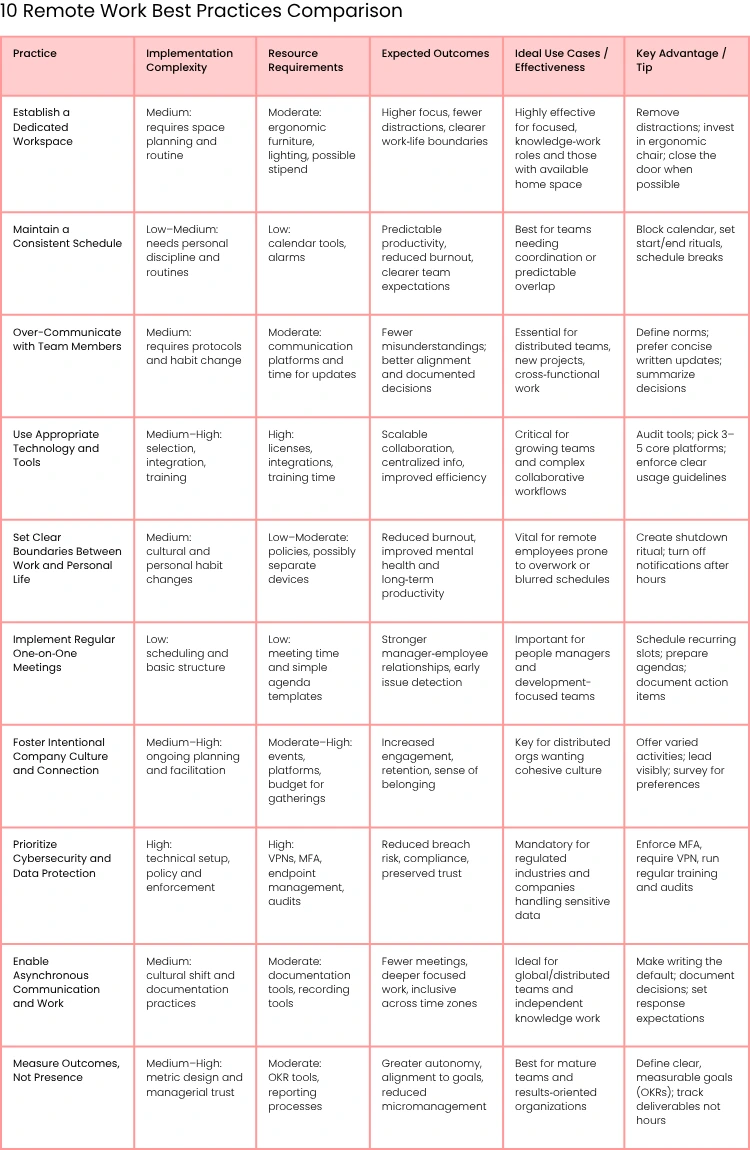
Putting It All Together: Your Blueprint for Remote Success
Navigating the landscape of remote work is not about finding a single, magic solution. Instead, it’s about architecting a personalized and organizational framework built on a foundation of intentionality, trust, and clear communication. The journey from surviving to thriving in a distributed environment is paved with the deliberate application of the best practices for remote work we’ve explored. This isn't a checklist to be completed once, but a continuous cycle of implementation, assessment, and refinement.
The principles discussed, from establishing a dedicated workspace to measuring outcomes instead of hours, are not isolated tips. They are interconnected pillars that support a sustainable and high-performing remote ecosystem. Forgetting one can weaken the others. For example, enabling asynchronous work (Item 9) is far more effective when you also over-communicate context (Item 3) and use the right technology stack (Item 4) to support it.
Your Actionable Roadmap Forward
To avoid feeling overwhelmed, don't try to implement everything at once. Instead, adopt a phased approach. Start by identifying the most significant friction point for you or your team right now.
- For Individuals: Is a blurred line between your professional and personal life causing burnout? If so, start with Item 5: Set Clear Boundaries. Your first step could be as simple as scheduling a hard "end-of-day" event on your calendar that you commit to honoring for one week.
- For Managers: Are you worried about team cohesion and morale? Focus on Item 7: Foster Intentional Company Culture. Begin by scheduling a non-work-related virtual event, like a 15-minute "coffee chat" or a team-based online game, to rebuild social connections.
- For Organizations: Is there a sense that productivity is difficult to gauge without physical oversight? Your priority should be Item 10: Measure Outcomes, Not Presence. Task a team with defining clear, results-oriented key performance indicators (KPIs) for a single department as a pilot program.
By implementing these practices, you move beyond simply managing tasks remotely. You begin to cultivate an environment where autonomy, accountability, and well-being are paramount. This shift is what separates struggling remote teams from those that excel, innovate, and attract top talent.
The True Value of Mastering Remote Work
Ultimately, mastering the best practices for remote work is an investment in resilience and future-readiness. The world of work is no longer tethered to a central office. Building these skills and systems ensures that whether your team is fully distributed, hybrid, or co-located, you have the operational muscle and cultural foundation to succeed. It fosters a workforce that is more engaged, empowered, and capable of delivering exceptional results, regardless of physical location.
The goal is to create a work environment so effective and supportive that location becomes an advantage, not a hindrance. By embracing these strategies, you are not just adapting to a trend; you are building a more flexible, human-centric, and powerful way of working that will define the most successful organizations for years to come. Your blueprint is ready, the tools are at your disposal, and the path to remote excellence is a matter of taking that first, intentional step.
Ready to deepen your expertise and lead the charge in modern work environments? Explore the professional development courses at Uplyrn to gain advanced skills in digital collaboration, leadership, and productivity. Visit Uplyrn to discover how our expert-led programs can help you master the future of work today.


Leave your thoughts here...
All Comments
Reply