









Your Guide to a Modern Color Theory Class
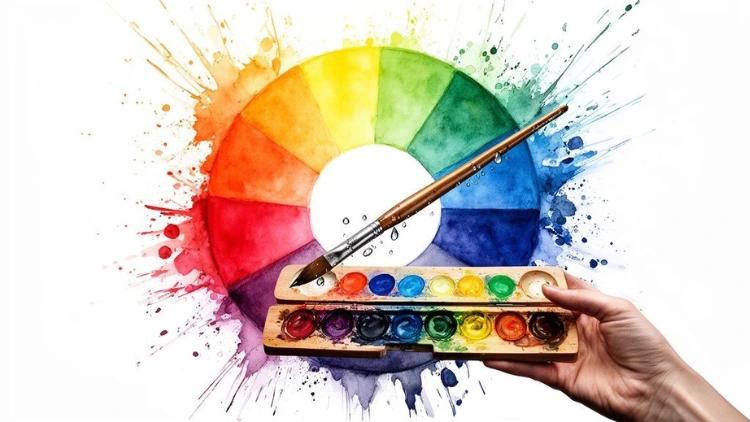
A color theory class is designed to teach you the science and language of color. It completely changes how you see and work with it, whether you're in a creative field or a professional one. It’s that one foundational course that finally explains why certain color combinations just work, while others fall flat. It’s about moving your skills from pure guesswork to intentional, powerful design.
Jump To Section

Earn As You Learn
Earn 25% commission when your network purchase Uplyrn courses or subscribe to our annual membership. It’s the best thing ever. Next to learning,
of course.
Why a Color Theory Class is a Career Game Changer
Let's be honest—just picking colors that "look nice" together isn't a real strategy. To do professional-level work, you have to understand that color is a silent language. A color theory class gives you the essential grammar to speak it fluently, turning your subjective taste into an objective, marketable skill.
Think about it like a chef who's mastered flavor. They don't just toss ingredients together hoping for the best. They know exactly which spices add warmth, what acids to use to cut through fat, and how to build a perfectly balanced dish. That's what color theory does for you—it empowers you to stir up specific emotions and guide a viewer's eye with absolute precision.
From Guesswork to Intentional Design
Without any formal training, a lot of creatives just go with their gut, but intuition isn't always reliable. A color theory class replaces that hit-or-miss approach with a solid framework you can count on. You’ll learn repeatable principles to create harmony, build contrast, and establish a visual hierarchy that works every single time.
This knowledge has an immediate impact on the quality of your work. Here are some practical examples:
- Web Designers: Use a high-contrast complementary color (like orange on a blue background) for a "Buy Now" button. This makes it visually pop, drawing the user's eye and increasing the likelihood of a click.
- Marketers: When creating a brand palette for a wellness app, use analogous colors—those sitting next to each other on the color wheel, like green and blue-green. This creates a serene and trustworthy vibe that aligns with the brand's message of calm.
- Artists: To create a sense of depth and mood in a painting, manipulate value and saturation. Use desaturated, darker colors (low value) in the background and more saturated, brighter colors (high value) in the foreground to pull the viewer's focus to a specific point.
The real benefit here is that you stop being just a color user and become a color strategist. You learn how to make choices that aren't just easy on the eyes, but are also psychologically effective and strategically smart.
The Professional Advantage in a Crowded Market
In today's world, mastering color is a skill that absolutely separates the amateurs from the pros. It's a loud and clear signal to clients and employers that you know your craft on a deeper level. This skill is a core pillar of any solid visual arts education, and you can see exactly how these principles are put into practice in this guide to a comprehensive graphic design course.
At the end of the day, putting your time into a color theory class is a direct investment in your career. It gives you the confidence and the technical skill to create unforgettable brand identities, compelling marketing campaigns, and powerful art, giving you a serious edge.
Mastering the Building Blocks of Color
So, you’re ready to finally speak the language of color. A proper color theory class will take you way beyond just picking colors you like and get you into the nitty-gritty rules that make visuals work. It all starts with the color wheel—not as some dusty chart, but as the alphabet you'll use to spell out every visual message you create.
Think of the color wheel as home base. It’s where you’ll meet your primary, secondary, and tertiary colors. But the real magic happens when you learn how to create color harmony, which are essentially time-tested recipes for putting colors together in a way that just works.
Creating Intentional Color Harmonies
Color harmony isn’t about stumbling into combinations that look good together. It’s a deliberate craft, where you pick specific palettes to create a specific feeling or drive a specific action. Each type of harmony has its own personality and impact.
- Analogous Harmony: This is when you use colors that are neighbors on the color wheel, like a trio of blue, blue-green, and green.
- Practical Example: A designer building a wellness app might lean on a calm, analogous scheme. The soft shifts between colors feel serene and trustworthy, keeping the user experience smooth and undistracted.
- Complementary Harmony: Here, you’re grabbing two colors from directly opposite sides of the wheel—think orange and blue. This duo creates the strongest possible contrast.
- Actionable Insight: Ever wonder why so many "Buy Now" or "Sign Up" buttons pop off the page? They’re often a complementary color. That high contrast is like a magnet for the user’s eye, practically begging to be clicked. Use this when you want to guide a user to a specific, critical action.
- Triadic Harmony: This one uses three colors spaced out evenly on the wheel, like the classic trio of red, yellow, and blue.
- Practical Example: A kids' toy brand could use a triadic scheme to look fun, energetic, and exciting. It feels vibrant and full of life, but still balanced and not totally chaotic. Burger King's old logo is a classic example of this in action.
Unpacking the Core Properties of Color
Beyond just pairing colors, any good color theory class will have you dissect the three core properties of every single color. Getting a handle on these is what separates the amateurs from the pros, giving you surgical precision over your palettes.
Hue, Value, and Saturation are the three dimensions of color. Mastering them is like a musician learning to control volume, pitch, and tempo. It gives you complete command over the final composition.
Hue is the first thing we think of—it’s the pure, unadulterated color itself. It's what we mean when we just say "red", "blue" or "green".
Value is all about how light or dark that hue is. When you add white to a color, you get a "tint". Add black, and you get a "shade".
- Practical Example: A photographer can create a dramatic, moody portrait by playing with low-value colors, leaning heavily on shades and dark tones. On the flip side, a scene filled with high-value tints can feel bright, airy, and optimistic.
Saturation describes a color's intensity or purity. A highly saturated color is loud and vivid, while a desaturated one is more muted, subtle, and grayish.
- Actionable Insight: If you want a brand to feel energetic and youthful, use highly saturated colors like Coca-Cola's vibrant red. To communicate sophistication and luxury, use desaturated tones. For example, a high-end perfume brand might use muted beiges and grays to appear more timeless and elegant.
Ultimately, mastering these concepts means you can confidently pick colors for any job, whether you're learning how to choose paint colors for a client’s living room or designing a digital ad. If you want to go even deeper into the science behind it all, check out this guide on how color works in a variety of settings.
So, what actually happens inside a color theory class? It’s not about staring at color charts and memorizing rules. A good course is built to take you from the "what" to the "how", turning abstract ideas into skills you can actually use.
Think of it as a journey. You start with the absolute fundamentals—the color wheel, harmony, the basic language of color. But you don't stay there for long. The real learning begins when you start applying those concepts to hands-on projects. This is where theory stops being just theory and starts becoming a tool.
From Foundations to Practical Projects
The backbone of any decent syllabus is its project-based approach. Your first assignments will be designed to train your eye and build your creative instincts.
- Practical Example: Color Storytelling Analysis: An instructor might have you analyze a film scene. You could compare the warm, dreamy pastels in La La Land to the grim, desaturated world of The Batman and break down exactly how those color choices drive the story and your emotional response.
- Actionable Insight: Value and Saturation Studies: You might get a single image and be asked to create three completely different moods just by tweaking the value and saturation. One version could be light and serene (high value, low saturation), another bold and electric (high saturation), and a final one somber and dramatic (low value). This is a powerful exercise for learning to control a viewer's feelings with intent.
As you move through the course, the projects get bigger and more aligned with what you’d do in a real job.
The point isn't just to get a grade; it's to build a portfolio. Every project you complete should be a piece you can show to a potential employer or client, demonstrating a specific, valuable skill.
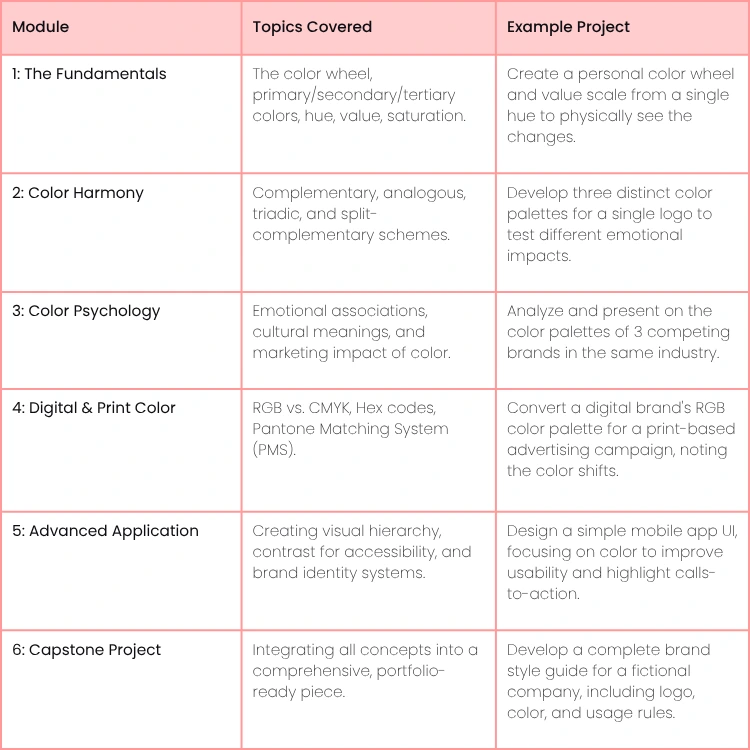
To give you a clearer picture, here’s what a typical module-by-module breakdown might look like. You can see how the course builds on itself, starting with the basics and moving toward complex, real-world applications.
Typical Color Theory Class Module Breakdown
This structure ensures that by the end, you're not just familiar with the terms—you're fluent in the language of color and ready to apply it professionally.
Advanced Applications and Essential Tools
In the later stages of a color theory class, you’ll tackle assignments that directly mirror professional work.
- Practical Example: Redesigning a Product Package: Imagine being handed a bland, generic-looking bag of coffee. Your task? Redesign it to appeal to a younger, more eco-conscious market. You'd likely use earthy tones (greens, browns) in an analogous harmony to signal 'natural' and use a high-contrast accent for the "Organic" label to make it pop.
- Actionable Insight: Developing a Brand Style Guide: A final project often involves creating a full brand identity guide from scratch. You’ll choose primary and secondary palettes, define the exact Hex codes for web and CMYK values for print, and write clear rules for how the colors should be used. This document becomes an actionable tool for a whole company, ensuring a consistent brand image across all marketing materials.
To get these projects done, you’ll work with the tools of the trade. This includes digital resources like Adobe Color for building and testing palettes, and for print designers, physical tools like Pantone swatch books are a must. The way these projects and tools are woven into the syllabus is crucial, and it’s a big part of what makes a course truly effective.
Many online programs condense this entire learning arc into an efficient format. For example, you can find a top-tier professional color theory course that packs 30 hours of project-based learning into just a few weeks. This hands-on approach is critical, especially when you consider that studies show up to 90% of our snap judgments about products are based on color alone.
How Color Psychology Drives Real World Decisions
Okay, so we’ve covered the technical side of color—the wheel, harmonies, and values. But here's where it gets really interesting: the why. This is the part where you learn how color actually shapes human perception and influences decisions.
This isn’t just fluffy theory. It's the secret weapon behind some of the most successful marketing and design choices you see every day.
Take the color red. It’s no accident that you see it plastered all over sale signs and “Buy Now” buttons. Red creates a feeling of urgency and excitement, tapping into a psychological trigger that makes us want to act fast before we miss out.
On the flip side, think about your bank's website or the logo for a financial company. You’ll probably see a lot of blue. That's because blue communicates trust, security, and dependability—exactly what you want to feel when you're trusting someone with your money. These aren't just happy accidents; they are very deliberate choices.
Color in Branding and Environment
Nowhere is this more obvious than in branding. Think about Tiffany & Co. They literally built an entire luxury empire around a single color. That iconic robin's egg blue—officially Tiffany Blue—screams elegance and exclusivity before you even read the name on the box.
This is a core lesson you’ll walk away with from any good color theory class: Your color palette isn’t just decoration. It’s a strategic asset that builds brand recognition and speaks volumes about who you are.
This idea goes way beyond logos and packaging. It's used to engineer the entire mood of a physical space. Interior designers are masters at this.
- Practical Example in Healthcare: Hospitals often paint patient rooms in soft greens and blues. Why? These colors are proven to have a calming, soothing effect that can help lower stress and anxiety.
- Practical Example in Restaurants: Ever notice how many fast-food joints use red and yellow? Those high-energy colors are believed to stimulate appetite and encourage quicker table turnover.
- Actionable Insight for Offices: A splash of green isn't just for looks. Research suggests it's associated with creativity and focus. If you're designing a collaborative workspace or a home office, consider adding green elements to help foster a more productive atmosphere.
Each example is a real-world application of color psychology. To see how deep this rabbit hole goes, you can learn more about what brand essence is and why it's so important.
Cultural Meanings and Global Markets
Here’s something absolutely critical for anyone working in design or marketing today: color doesn’t mean the same thing everywhere.
In Western cultures, white is the color of weddings, purity, and new beginnings. But in many parts of Asia, white is the traditional color of mourning and funerals. Imagine launching a product in a white package meant to feel fresh and pure, only to have it completely miss the mark—or worse, offend your audience.
- Actionable Insight: Before launching a global campaign, create a "color localization chart". List your primary brand colors and research their meaning in your top 3 target markets. If a color has a negative connotation (like white for mourning), plan a regional alternative to avoid a costly cultural mistake.
Understanding these cultural nuances is non-negotiable in a global market. For anyone in a creative field, this knowledge is just as vital as knowing how to use Photoshop. For more on this, Mastering Colour Theory in Fashion offers some fantastic insights. Getting your colors right is a huge part of making a genuine connection with people, wherever they are in the world.
Finding the right color theory class can feel like wading through an ocean of options. It's easy to get distracted by slick websites and flashy promises, but the real key is to tune out the noise and figure out what you actually need.
Before you even start browsing, take a minute to get clear on your "why". Are you a digital designer trying to nail down UI that people love to use? A painter wanting to bring more life and emotion to your canvas? Or maybe you're in marketing, trying to build brands that stick. Your end goal is the best compass you have.
Evaluating Instructors and Curriculum
The quality of any class really boils down to two things: who's teaching it, and what they're teaching. Don't just settle for a pretty landing page; you need to dig a little deeper.
- Look for Real-World Experience: Find instructors who have actually worked in the field. A graphic designer with 10 years of agency experience or a brand strategist with a portfolio of killer campaigns has practical wisdom that you just can't get from a textbook. Academics are great, but you want someone who has solved real problems.
- Analyze the Curriculum's Focus: Get your hands on the syllabus and scrutinize it. Is it all about digital (UI/UX, web design), or does it lean into print (packaging, CMYK)? If you’re an aspiring web developer, a course that spends weeks on print production just isn't the best use of your time.
The demand for good color education is global. There's a massive ecosystem of over 20 specialized programs spread across more than 10 countries, from Master's degrees in Europe to programs in Asia focused on interiors and fashion. This just shows how important it is to find a color theory class that fits your specific career.
Key Questions to Ask Before You Enroll
To make sure you're putting your money and time in the right place, you need to ask some hard questions. The answers will tell you if a course is built to deliver real skills or just a certificate.
A great color theory class shouldn't just teach you the rules; it should arm you with portfolio-ready projects and direct feedback that actually helps you grow. Look for a program that bridges the gap between knowing the theory and being able to apply it on the job.
Here are the critical questions to get answered before you click "enroll":
- Will I build portfolio-ready projects? A good course will have you finish with something tangible, like a complete brand style guide that you can show to a potential employer. Theory is useless without application.
- Is instructor feedback included? Getting a pro's eyes on your work is priceless. Find out if you'll get one-on-one critiques or if you're just being thrown into a peer-review forum.
- What is the learning format? Be honest with yourself. Do you have the discipline for a self-paced online course, or do you need the structure of live classes and direct interaction with an instructor and classmates?
- Are practical tools taught? Will the course get you comfortable with software like Adobe Color? If you're heading into print, will they cover physical tools like Pantone books?
Answering these questions will give you the confidence to pick a color theory class that doesn't just educate you, but gives you a real, practical boost in your career.

Putting Your Color Knowledge into Practice Today
The best part about learning color theory is that you don't have to wait for a class to begin. You can start thinking like a color expert today, simply by looking at the world around you with new eyes. This is a journey of observation and practice, and it starts now.
A fantastic, practical first step is to do a quick "color audit" on something you've already made. This could be your personal website, a design portfolio, or even your social media feed. It's all about looking at your own work critically.
Perform a Simple Color Audit
Take a hard look at one of your projects and really think about the emotional vibe it gives off. Does the color palette feel like it was chosen with purpose, or is it just a random mix of colors you like? Look for the visual hierarchy. Do your most important elements—like a "Buy Now" or "Contact Me" button—pop off the page? They should.
- Practical Example: Look at your Instagram grid as a whole. Does it tell a consistent color story, or does it feel chaotic and disjointed? A cohesive palette immediately makes a feed look more professional and curated.
- Actionable Insight: Pinpoint one color in your project that feels off. Use a free tool like Adobe Color to find a better alternative. Upload your main color and try the "Analogous" or "Triadic" harmony rules to instantly generate professional palettes. You'll be surprised how a single, informed change can elevate the entire design.
Boost Your Learning with Color
Color isn't just for aesthetics; it’s a powerful tool for learning and organizing information. You can use this to your advantage in your own studies. For example, color-coding your notes helps your brain categorize information, making it much easier to remember later.
It's not just a hunch—research backs this up. One study showed that color-coding important text boosted its use among students by an average of 33%. This is a simple, direct application of color theory that sharpens recall, as you can see in the full research on how color impacts student learning.
These small, practical exercises are what build real creative confidence. Once you're ready to make these skills official, taking a dedicated color theory class is the perfect next step. It’s a direct investment in your career, turning this newfound awareness into a professional, marketable skill.
And if you’re feeling inspired to get hands-on right away, you might love this guide on how to make an interior design mood board.

Frequently Asked Questions
Thinking about diving into a color theory class? It’s normal to have a few questions before you jump in. Let's clear up some of the most common ones to help you figure out if this is the right path for you.
Do I Need Artistic Skills To Take A Class?
Absolutely not. In fact, most introductory color theory classes are designed for people with zero artistic background.
Think of it less like a born-with-it talent and more like learning a science. You'll be taught the foundational principles of how color works, which is a skill anyone can develop with a bit of practice. A practical class will focus on rules and application, not on your ability to draw freehand.
What Career Benefits Can I Expect After A Class?
The career boost can be huge, and it stretches across a surprising number of fields. When you truly get how color works, you can make things that genuinely connect with people on an emotional level.
- A practical example is a UI/UX designer who uses color accessibility principles to design a product usable by more people, making them a more valuable hire. For marketers, an actionable insight is using A/B testing with different colored call-to-action buttons to gather data on which color converts better, directly impacting company revenue.
What Is The Difference Between Online And In-Person?
This really comes down to what works best for you. Online classes give you incredible flexibility—you can learn from anywhere and fit the lessons around your own schedule.
On the other hand, in-person classes offer that immediate, hands-on feedback from an instructor. You also get the chance to network with your classmates, which can be super valuable. Your best bet is to weigh your learning style, your schedule, and your budget.
Ready to turn your color instincts into professional skills? At Uplyrn, we offer courses designed to give you practical knowledge you can apply immediately. Explore our courses and start building your creative confidence today.


Leave your thoughts here...
All Comments
Reply