









Mastering Critical Thinking Skills Training

Training someone in critical thinking isn't about teaching them to just "think harder". It's a structured process for building a repeatable mental framework that they can use to systematically pull apart information, spot biases, weigh arguments, and ultimately, make a reasoned call.
Jump To Section

Earn As You Learn
Earn 25% commission when your network purchase Uplyrn courses or subscribe to our annual membership. It’s the best thing ever. Next to learning,
of course.
Getting the Foundations Right
Before jumping into exercises and practice, everyone needs to be on the same page about what critical thinking actually is. It’s far more than a fluffy corporate buzzword; it’s the disciplined cognitive engine that drives smart problem-solving, strategic planning, and solid decision-making.
Laying this groundwork is vital. It takes critical thinking from an abstract idea and turns it into a tangible skillset. Instead of just telling your team to "be more critical", you're giving them specific tools for analysis, inference, and evaluation. This way, everything that follows is built on a solid, shared understanding.
The Core Components of Critical Thinking
At its heart, critical thinking really comes down to a few interconnected skills. When you get good at these, you can move past surface-level reactions and engage with information on a much deeper, more meaningful level.
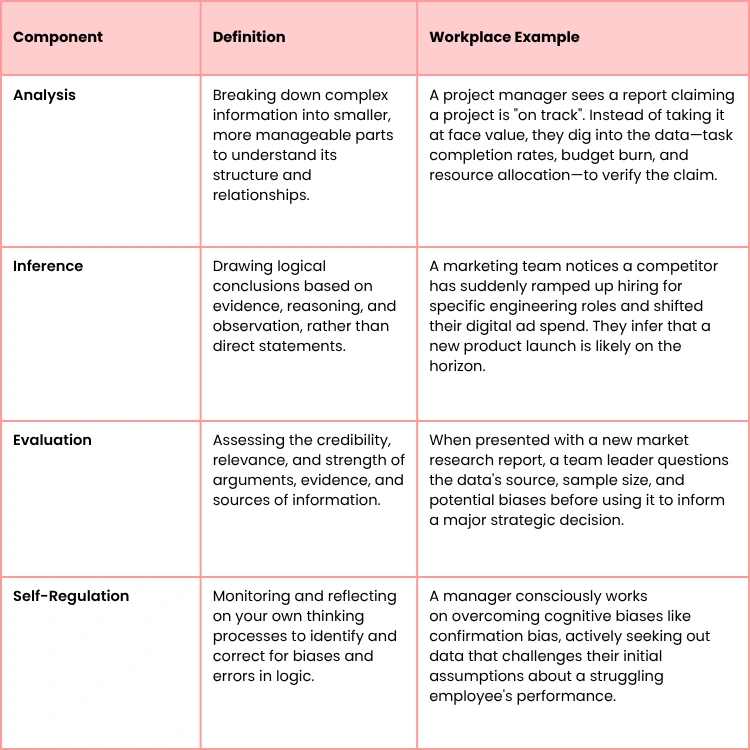
So, what are we actually talking about here? Let's break down the essential components and what they look like in a real-world workplace setting.
These skills aren’t just nice-to-haves; they’re becoming essential. Employers around the world consistently rank analytical thinking as the top core skill, with seven out of ten companies calling it a must-have.
Even more telling, employers predict that by 2030, 39% of workers’ core skills will have changed. That shift is being driven by the need for advanced cognitive abilities that can keep up with a workplace that’s constantly evolving.
One of the biggest mistakes we see is treating critical thinking as a single, monolithic skill. The reality is, it's a suite of interconnected abilities that have to be developed together. Being a master analyst doesn't help much if your evaluation skills are weak—you’ll just end up dissecting flawed information perfectly.
Nailing these fundamentals is the only way to start an effective critical thinking skills training program. It aligns everyone on what "good thinking" looks like and gives you the building blocks for more advanced practice.
To really get under the hood of how these cognitive processes work, this guide on how the brain learns and processes new information is a great next step. With that foundation, every practical exercise you introduce will have a clear and powerful purpose.
How to Build a Progressive Skill Development Roadmap
You can't teach critical thinking in a single afternoon workshop. It's a journey, one that takes learners from grasping the basics to deploying complex reasoning skills when the pressure is on. A progressive roadmap is absolutely essential because it stops people from getting overwhelmed. It builds their competence and confidence in stages, making sure every new skill is built on a solid foundation.
Think about it like learning a language or picking up a guitar. You start with the fundamental vocabulary or chords before you even think about tackling complex conversations or difficult songs. Rushing the process just leads to frustration and a shaky, unreliable skillset.
The table above breaks down the core flow of the critical thinking process, from the first analysis to the final evaluation.
By breaking it all down into these distinct stages, you allow learners to really focus on mastering one piece at a time before putting it all together.
Starting with Foundational Awareness
The first leg of the journey is all about awareness. The goal here is simple: help people recognize the basic parts of an argument and spot the most common flaws you see in everyday communication. The exercises need to be relatable, simple, and low-stakes.
Practical Examples for Beginners:
- Spotting Assumptions: Hand out a few company emails or project updates. The task? Highlight every single unstated assumption the sender is making. For instance, an email that says, "We need to move our deadline up to beat a competitor to market" is packed with assumptions—that the competitor's timeline is accurate, that speed is the most critical factor for success, and that your team can actually move faster without quality dropping.
- Identifying Logical Fallacies: Pull up some recent news articles or online ads. Have your team identify common fallacies like "ad hominem" (attacking the person, not their argument) or "straw man" (twisting an opponent's position to make it easier to attack). This builds a practical vocabulary for taking apart weak arguments.
These first steps are non-negotiable. They train the brain to hit the pause button and question information that we usually just accept without a second thought. This is the bedrock for everything else.
The biggest initial hurdle in critical thinking training is shifting people from passively consuming information to actively interrogating it. The moment someone starts asking, "Wait, what's not being said here?"—that's when you know real progress has begun.
Progressing to Intermediate Application
Once your team can consistently spot the building blocks of arguments, it's time to move on to active deconstruction and evaluation. This is where theory starts to become a real, repeatable skill. The exercises get a bit tougher now, involving more complex, real-world business materials.
The World Economic Forum has flagged critical and analytical thinking as top skills for the future. In fact, roles that lean heavily on these abilities are projected to grow nearly three times faster than others. This isn't just a buzzword; it reflects a real need for human minds that can cut through complexity in ways automation simply can't.
Actionable Insights for Intermediate Learners:
- Deconstruct a Business Proposal: Give them a sample business case or a new project proposal. Their job is to map out the core argument, identify the key pieces of evidence being used, and evaluate how well it all hangs together.
- For example, they could analyze a proposal to invest in new software, questioning if the projected ROI is based on solid data or optimistic guesswork.
- Evaluate Evidence Quality: Using something like a market research report, have your team rate the quality of the evidence. They need to look at the source's credibility, how recent the data is, and if the sample size is even relevant. Is a multi-million dollar recommendation really being based on a tiny 20-person survey?
- Argument Mapping: Introduce them to argument mapping, which is a fantastic visual tool for diagramming how an argument is structured. This exercise forces learners to see exactly how different premises are supposed to support a conclusion, making it easy to spot the weak links in the chain.
This intermediate phase is where people go from just spotting issues to systematically breaking them down. This hands-on practice is crucial for skill development, a concept we explore more in this guide on how action-based learning is shaping the future.
Advancing to Expert Integration
The final stage is all about integrating critical thinking into high-stakes, dynamic situations. The focus shifts from analyzing static documents to applying these skills in real-time, often in unpredictable and collaborative settings. You know someone has reached mastery when critical thinking becomes their default way of operating, not just something they do in an exercise.
Advanced Practices for Skill Mastery:
- Socratic Questioning in Meetings: Train your leaders and team members to use Socratic questioning to gently probe assumptions and dig into complex problems together. Instead of just stating opinions, they learn to ask questions like, "What's the evidence for that claim?" or "What would the consequences be if we were wrong about this?"
- Practical example: During a project post-mortem, a team lead asks, "What unstated assumptions did we make at the start that turned out to be false?"
- Role-Playing High-Stakes Scenarios: Run a simulation of a tough business negotiation or a crisis management meeting. Participants have to use their critical thinking skills on the fly to analyze new information, anticipate counterarguments, and build a persuasive, evidence-based case under pressure. This is what turns the skill from a theoretical concept into a powerful tool for getting better results.
- Actionable insight: Record the sessions and have participants review their own performance, identifying moments where a critical question could have changed the outcome.
Crafting a Corporate Training Program That Actually Works
Rolling out critical thinking skills training across an entire organization is a different beast than running a single workshop. To make a real impact, you need a structured, adaptable curriculum that speaks to the unique challenges of different teams and business goals. After all, a one-size-fits-all approach just doesn’t cut it; what a sales team needs from this training is worlds away from how an engineering department will apply it.
The secret is starting with a solid foundation that’s built to be tailored. Before you even think about designing a single module, you have to conduct a thorough assessment to figure out where your people actually are. We break down exactly how to do this in this guide to a training needs analysis for learning and development—it’s the only way to pinpoint the specific skill gaps you need to address.
Once you have that data, you can build a program that truly hits the mark. And the timing couldn't be better. The global push for upskilling is massive—by 2025, it's expected that half of the global workforce will need reskilling, a huge jump from 41% in 2023. Industries like tech and telecom are feeling this pressure the most, with over 62% of companies seeing a high demand for new training focused on cognitive skills. You can get the full rundown on these trends from the analysis over at Human Resources Online.
What Great Training Modules Look Like
An impactful program isn't just one long lecture. It's broken down into specific, actionable modules, each with clear objectives, activities that feel like real work, and outcomes you can actually measure.
Here’s a sample structure an L&D manager could easily adapt for their own teams:
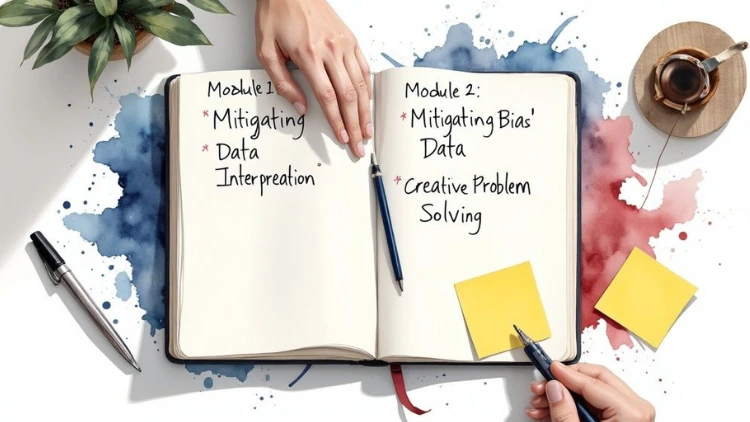
Module 1: Sidestepping Hidden Biases in Our Decisions
- The Goal: Teach participants to spot and counteract at least three common cognitive biases (like confirmation bias or anchoring) in their everyday work.
- The Activity: Dive into a case study of a famous business failure. In small groups, people would dissect the timeline to pinpoint where biases likely steered decisions off course and then pitch strategies that could have saved the day.
- The KPI: A post-training quiz where participants correctly identify biases in written scenarios with 85% accuracy.
Module 2: Making Sense of Data for Leaders
- The Goal: Give leaders the tools to draw solid, evidence-backed conclusions from messy or incomplete datasets.
- The Activity: Hand teams a messy, real-world dataset from a fictional product launch. Their mission? Clean it up, analyze it, and build a compelling business case for a strategic pivot based on what they find. This gets them out of the textbook and into practical application.
- The KPI: The strength and clarity of their final recommendation, scored by a panel of senior leaders using a simple, standardized rubric.
We've always found that the most effective training doesn't feel like training at all. It feels like you're solving a real, pressing business problem. When the stakes feel authentic, the learning sticks.
Making It Relevant: Tailoring for Different Teams
Customization is where the magic really happens. The core principles of critical thinking are universal, but how you apply them depends entirely on your job.
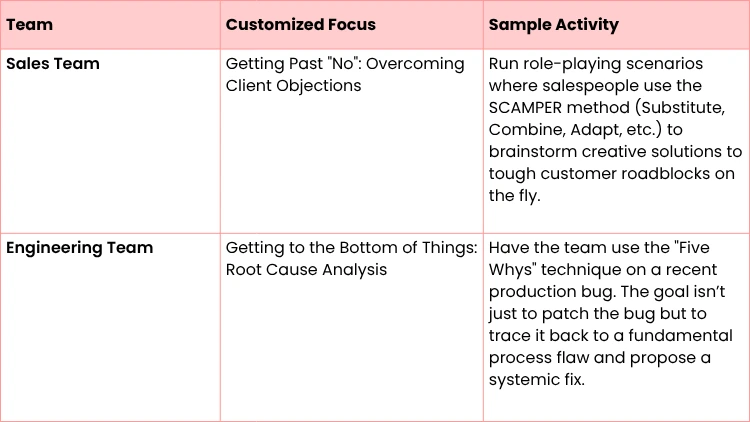
Here’s a quick look at how you could adapt a single module, like "Creative Problem-Solving Frameworks" for two completely different departments.
By designing your program with this kind of modularity and focus on customization, you make sure the training is more than just an academic exercise. It becomes a practical toolkit employees can start using immediately to drive better business outcomes. That’s how your critical thinking skills training becomes a powerful investment in your company’s future.
How to Measure the ROI of Your Training
You wouldn't launch a major marketing campaign without tracking metrics, right? The same logic applies here. Investing in critical thinking skills training without a solid plan to measure its impact is just guessing. To really prove the value of your efforts, you need to go way beyond simple "Did you enjoy the workshop?" surveys.
The best approach combines both qualitative and quantitative methods. This gives you the full story: the hard data and the real-world behavioral changes that show the training is actually working.
Qualitative assessments are all about observing skills in action. They capture the nuanced, on-the-ground shifts in how your team approaches problems. Think of this as the "story" behind the numbers.
On the other hand, quantitative measures deliver the cold, hard data you need to track progress objectively. These are structured, standardized, and perfect for before-and-after comparisons. To get the full picture, you really need to understand how to measure training effectiveness and ROI properly.
Capturing Growth Through Qualitative Insights
This is where you see the training come to life. Qualitative data isn't about spreadsheets; it's about spotting tangible shifts in how employees think, communicate, and solve problems in their day-to-day work. You're looking for the quality of their thinking.
Here are a few practical ways to do this:
- Review their work. Pull a few project proposals or technical reports from before the training and compare them to new ones.
- Practical example: Compare a pre-training sales proposal that relies on vague claims ("best-in-class solution") with a post-training one that uses specific data points and customer testimonials to build a stronger case.
- Observe them in meetings. Watch how people behave during team discussions or brainstorming sessions. Are they asking deeper, more probing questions? Are they respectfully challenging assumptions instead of just accepting things at face value? This is direct evidence of the skills in practice.
- Talk to their managers. Set up structured interviews with managers to get their take. Ask for specific, concrete examples of an employee using better judgment or analytical skills since the training.
- Actionable insight: Give managers a simple "observation checklist" with behaviors like "Asks 'why' before accepting a new task" or "Offers an alternative perspective" to guide their feedback.
These methods help you draw a direct line from the training course to improved job performance.
Using Quantitative Data to Prove Impact
While stories are powerful, leaders often need numbers to justify budgets. Quantitative data provides that objective proof, showing a clear, measurable improvement in cognitive skills.
One of the most effective tools here is a pre- and post-training assessment. By getting a baseline score before the training starts, you can measure the exact "distance traveled" for every single participant.
We cover how to build these in this guide on pre- and post-training survey questions and templates.
Some great quantitative tools include:
- Standardized Tests: Using a validated assessment like the Watson-Glaser Critical Thinking Appraisal gives you a credible benchmark. It measures core skills like inference, deduction, and evaluating arguments.
- Situational Judgment Tests (SJTs): You can create your own custom SJTs that drop employees into realistic workplace scenarios. Their responses can be scored against a key of optimal, acceptable, and poor choices, tailored to your company's needs.
- Key Performance Indicators (KPIs): Look at the business metrics that should improve with better thinking. For a customer service team, this might be a drop in escalated tickets or a jump in first-call resolution rates.
The real win isn't just proving that learning happened. It's showing that the learning mattered to the business. That connection between skill development and tangible outcomes is how you demonstrate a powerful training ROI.
Assessment Methods for Critical Thinking Skills
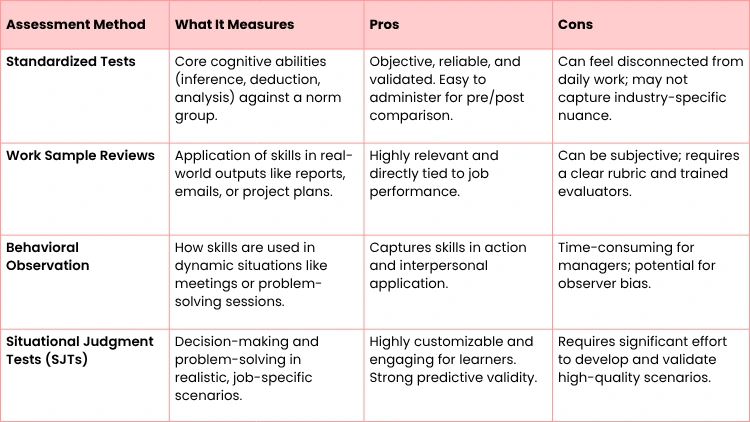
Choosing the right assessment tool is key. Each method offers a different lens through which to view skill development. Some are great for seeing on-the-job application, while others provide standardized, objective scores.
Here’s a quick comparison of some common techniques used to measure critical thinking abilities.
Ultimately, a mix-and-match approach often works best. Using a standardized test for baseline data and supplementing it with manager observations gives you a robust, well-rounded picture of progress.
Practical Coaching Techniques for Team Leaders
A culture of critical thinking isn't something you can build in a single training session. It’s forged in the daily interactions between you and your team. As a manager, you are the single most important catalyst for embedding these skills into your team’s workflow, turning abstract ideas into rock-solid habits.
This isn't about you having all the answers. Far from it. It's about learning to ask the right questions—the kind that force a pause, prompt deeper analysis, and push your team to look beyond the obvious. Your role naturally shifts from being a director to being a guide.
That transition is everything. When you become a coach who develops skills, not just a manager who assigns tasks, you start building a truly high-performing team. We dig into this dynamic much more in this guide on how managers can become effective coaches.
Master the Art of Probing Questions
Hands down, the most powerful tool in your coaching toolkit is the question. When a team member brings you a problem, your first instinct is probably to give them an immediate answer or a quick thumbs-up. You have to resist that urge.
Instead, get comfortable using questions to gently challenge their thinking and encourage them to build a stronger case on their own. This simple practice makes critical thinking a routine part of how they solve problems.
Actionable Questioning Techniques:
- Instead of asking: "Are you sure this will work?"
- Try asking: "What evidence supports that conclusion?" This immediately forces a shift from opinion to fact.
- Instead of saying: "I don't think that's the right approach."
- Try asking: "What’s an alternative way we could look at this?" This opens the door to other angles without shutting them down.
- Practical Example: A team member suggests a new marketing campaign. Instead of approving it, you ask, "What are the three biggest assumptions we're making for this campaign to be successful?"
These subtle shifts in language aren't confrontational. They’re collaborative tools that invite your team to dig deeper and really own their conclusions.
Use One-on-Ones for Metacognition
Your regular one-on-one meetings are the perfect place to coach metacognition—the crucial skill of thinking about your own thinking. This is where you help people reflect on their decision-making process, spot their own biases, and recognize patterns in their work.
Don't let these meetings become simple project status updates. Carve out time for real developmental conversations.
A Practical Example: Let's say an employee, Alex, just navigated a tough client issue. In your next one-on-one, you could say:
"Walk me through how you handled that situation with Client X last week. What was the very first thing you focused on? What assumptions did you make right at the start, and did any of them change as you got more information?"
This line of questioning isn't about judging the outcome; it's about deconstructing the process. By helping Alex reflect, you’re training them to self-correct and sharpen their approach for the next challenge that comes their way.
Implement the Five Whys Technique
When a problem pops up, teams often stop at the first, most obvious cause. This leads to quick fixes that fall apart a week later. The Five Whys is a deceptively simple technique to guide someone from a surface-level issue all the way down to its root cause.
It's a straightforward diagnostic tool you can pull out in any conversation.
How It Works in Practice:
- The Problem: A key report was delivered late.
- Why #1? Because the data wasn't ready on time.
- Why #2? Because the analytics team was backlogged.
- Why #3? Because a new, unscheduled request from another department took priority.
- Why #4? Because we don't have a clear system for prioritizing these ad-hoc requests.
- Why #5? Because we haven't actually defined an intake process for cross-departmental work.
Just like that, you've gone from blaming an individual to identifying a systemic process failure. By coaching your team member through this exercise, you empower them to find real, lasting solutions instead of just slapping a bandage on the symptoms. It's these kinds of practical habits that make your critical thinking skills training a sustainable, everyday practice.

Answering the Tough Questions About Critical Thinking Training
Even with the best-laid plans, you're going to get questions. When you start talking about a critical thinking skills training program, people naturally get curious and a little skeptical. Getting ahead of these common concerns makes the whole process smoother for everyone, from the folks on the ground to the leaders championing the change.
Let's dig into some of the most frequent questions we hear from leaders.
How Long Does It Really Take to See Improvement?
This is always one of the first questions, and for good reason. Leaders want to know when they'll see a return on their investment. While you might see some small sparks right after a workshop—maybe someone asks a few deeper questions in a meeting—real, sustainable change takes time.
Think of it like building muscle. You don't walk out of the gym ripped after one workout.
- The First Few Months (1-3): With consistent effort, you’ll start seeing the early wins.
- Practical example: Team members might catch themselves making assumptions or use a simple framework like the Five Whys to get to the root of a problem instead of just treating symptoms.
- Making It Stick (6-12 months): This is where the magic happens. After six months or so of actively applying these skills, it stops feeling like a chore and starts becoming second nature. You'll see it in the quality of their analysis, their input during strategy sessions, and their confidence in tackling tricky problems without needing their hand held.
- True Mastery (Ongoing): Honestly, this never really stops. The ultimate goal isn’t a finish line; it’s about weaving critical thinking so deeply into your culture that it becomes "just how we do things here".
A one-off workshop might create a buzz, but don't mistake that for real learning. Lasting change only comes from consistent reinforcement and applying the skills to actual, on-the-job challenges.
Can You Really Teach This to Everyone?
Absolutely. But—and this is a big but—not everyone will learn the same way or at the same speed. The ability to think critically isn't some innate talent you're born with. It's a collection of skills, and like any skill, it can be developed with the right approach.
That said, a few things need to be in place for it to work:
- The Right Mindset: People have to be willing to question their own thinking. If someone isn't open to being challenged, you're facing an uphill battle.
- Make It Relevant: Training has to connect directly to their day-to-day work. A software developer needs to see how this helps them debug code, not just solve abstract puzzles. A marketer needs to see how it sharpens their analysis of campaign data.
- Room to Practice: People need a safe space to try out these new skills without the fear of messing up.
Actionable insight: Start with a "coalition of the willing". Find those naturally curious team members who are hungry to improve and make them your champions. Their success stories will do more to convince the skeptics than any top-down mandate ever could.
Won't AI Just Make Critical Thinking Obsolete?
This question is popping up more and more, but it comes from a misunderstanding of what AI actually is. In fact, recent studies have shown a troubling trend: heavy use of AI tools can actually weaken critical thinking skills, especially in younger users.
AI is a fantastic tool for crunching data and spitting out information. What it can't do is replicate human judgment.
An AI can give you an answer, but it can't:
- Weigh the ethical implications of a major business decision.
- Read between the lines and grasp the unspoken context of a client's frustration.
- Question the inherent biases baked into its own programming.
The future isn't about people competing against AI. It’s about people who can use their critical thinking skills to direct, question, and ultimately validate what AI produces.
Here's how to put that into practice: Teach your team to treat AI as a super-powered research assistant, not an all-knowing oracle. Have them use it to gather initial research or brainstorm ideas. But then, the real work begins. They must use their own minds to analyze, verify, and build on that foundation.
Practical example: Ask them to use an AI to summarize three different market analyses. Then, facilitate a debate about which report is the most credible and why. This uses AI for its strengths without letting it atrophy your team's most valuable cognitive skills.
Ready to move beyond theory and build a team of sharp, analytical thinkers? Uplyrn offers a complete ecosystem of courses and expert coaching designed to embed critical thinking into your organization's DNA. Explore our programs and discover how we can help you turn your team into your greatest competitive advantage.


Leave your thoughts here...
All Comments
Reply