









How to Become a Freelance Writer: A Practical Career Starter

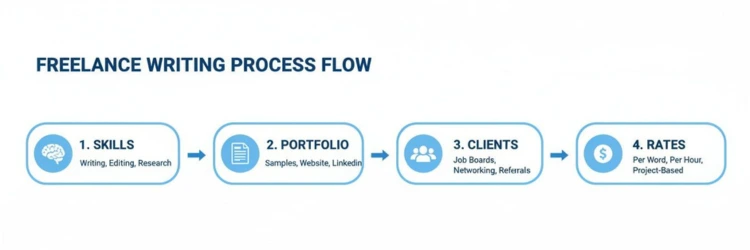
So, you want to become a freelance writer? It all boils down to building four key pillars: sharpening marketable skills, crafting a portfolio that actually sells, landing those first few clients, and figuring out how to charge what you're worth. It's less about getting lucky and more about having a smart, strategic plan to turn your writing talent into a real business.
Jump To Section

Earn As You Learn
Earn 25% commission when your network purchase Uplyrn courses or subscribe to our annual membership. It’s the best thing ever. Next to learning,
of course.
Laying the Groundwork for Your Writing Career
First things first: you have to stop thinking like an employee and start thinking like a business owner. This is a huge mindset shift. You're not just a writer anymore; you're the CEO, the marketing director, and the accountant of your own little empire. That means taking complete control of everything from skill development to chasing down new clients.
For a deeper dive into this transition, this complete guide on how to start a freelance business is a must-read.
Think about it this way: say you have a background in marketing. Instead of just offering "blog posts", you can pitch strategic content designed to drive traffic and boost conversions. Right away, you've positioned yourself as a high-value partner who solves problems, not just another writer on the market. That strategic thinking is your most valuable asset.
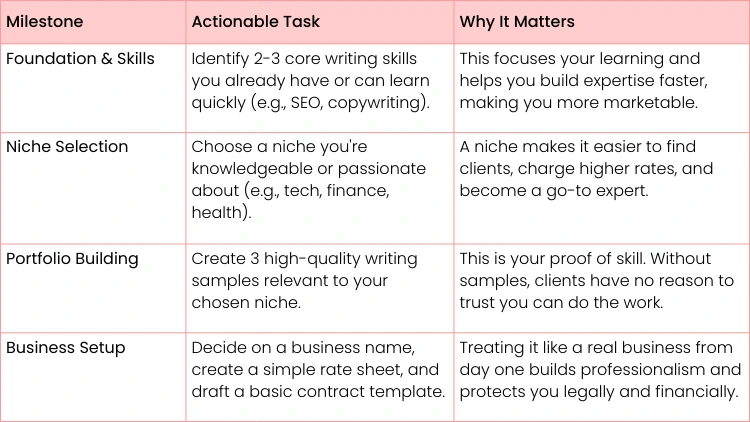
This whole process is a journey, and each step builds on the last. As you can see, you can't jump ahead. A solid foundation is everything.
Embracing a Growing Market
The good news? You’re entering a booming industry. The freelance economy is exploding, and that means massive opportunities for writers who know what they're doing. Freelancers brought in an estimated $1.5 trillion in 2024, and by 2027, about 86.5 million Americans are expected to be freelancing.
This isn't just a trend; it's a fundamental shift in how work gets done. More companies are relying on independent talent, and their budgets reflect that.
This shift means that becoming a freelance writer isn't just a side hustle; it's a legitimate and potentially lucrative career path. Your success depends on treating it like a real business from day one.
If you're looking for a specialized and often high-paying path, it's worth learning how to become a ghostwriter and land high-paying gigs. The core idea is the same: see yourself as a strategic service provider who solves a specific problem for your clients. Do that, and you'll thrive.
Developing Skills That Clients Actually Pay For
Let's get one thing straight: being a good writer is the price of admission, but it’s not what high-value clients are actually buying. They’re paying for business results—more traffic, higher conversions, a stronger brand voice. If you want to be the freelance writer who commands top rates, you have to think beyond just crafting nice sentences and start mastering the skills that directly fatten a client's bottom line.
Think of it this way. A generalist writer delivers a well-written blog post. A specialist, on the other hand, delivers a blog post optimized to rank on Google, pull in qualified leads, and establish the client as the authority in their space. That's the difference clients will happily pay a premium for.
From Generalist to In-Demand Specialist
The first move is to get strategic about your development. Forget trying to learn everything at once. Instead, pick one or two high-impact skills that genuinely excite you and align with the kind of work you want to land.
Here are a few skills that are always in demand:
- SEO Writing: Knowing how to weave keywords into content naturally, understand what a searcher is really looking for, and structure an article for Google isn't just a bonus anymore—it's table stakes for most online content gigs.
- Conversion Copywriting: This is the art of writing to get a reader to do something specific—sign up for a newsletter, download a guide, or click "buy now". It's a powerful (and highly paid) skill.
- Brand Voice Adaptation: Clients need writers who can be chameleons. You have to be able to jump from a formal, technical tone for a B2B software company to a witty, playful voice for a fashion brand without missing a beat.
Here's a practical way to start: Dedicate a few hours each week to reverse-engineering success. Find the top-ranking articles in your dream niche and tear them apart. What makes them work? The headlines? The structure? The calls-to-action? Try rewriting sections to see if you can make them even better. This simple exercise sharpens both your analytical eye and your practical writing chops at the same time.
Upskilling for Long-Term Success
In the freelance world, measurable expertise is gold. It’s no surprise that roughly 50% of global freelancers are doing skilled work; clients are actively hunting for specialists, not jacks-of-all-trades. The market is also shifting, with 54% of freelancers now reporting they have advanced AI skills. Getting comfortable with AI-assisted writing and data-driven SEO doesn't just make you more efficient—it opens up entirely new and lucrative opportunities.
This isn't a one-and-done task; the best writers are always learning. For a more structured path, this guide on how to improve writing skills is packed with exercises to help you level up.
Ultimately, deciding to specialize—whether in long-form B2B tech articles or snappy e-commerce email sequences—is what allows you to position yourself as an expert and justify higher rates right from the start.

Building a Portfolio That Wins Clients
Your portfolio is, without a doubt, your single most important sales tool. It’s the tangible proof you send to clients that says, "I can do the work, and I can do it well."
But the classic newbie dilemma is real: how do you build a portfolio with no clients? It’s a common hurdle, but it's far from a dead end.
Here's the secret: you don't need a client's permission to create fantastic work. The goal isn't to have a hundred random articles; it's to build a small, curated collection of writing samples that shows you understand your ideal client's industry and can speak to their audience.
Create Samples From Scratch
If your portfolio is completely empty, the fastest way forward is to create speculative pieces (or "spec pieces"). You simply write a sample as if you were already working for your dream client.
- Pick a Target Client: Choose a real company in a niche you want to work in. Let's say it's a B2B SaaS company that sells project management software.
- Study Their Content: Go deep into their blog. What's their tone? Who are they talking to? Look for a content gap or a topic they haven’t covered yet.
- Write the Article: Craft a killer blog post that perfectly matches their style and delivers real value. This immediately shows you’re proactive and you get their content strategy.
We know a writer who landed a high-paying SaaS client this way. He wrote a deep-dive analysis of a competitor’s content strategy, published it on his own blog, and then sent the link over to his target company. They were so impressed they hired him for a long-term contract.
The golden rule for portfolios is quality over quantity. Three stellar samples that speak directly to your target client are infinitely more powerful than a dozen mediocre, unrelated clips.
Host Your Work Professionally
Once you have a few solid samples, you need a professional home for them. A clean, easy-to-navigate portfolio site is non-negotiable in today's market. It’s more than just a place to dump your links; it's a huge part of your professional image and a cornerstone of your personal brand. For a deeper dive, check out this guide on what is personal branding and the golden rules to follow.
You don't need anything complicated. Here are some great options:
- A personal website or blog: This offers the most control over your brand and look.
- Contently or Journo Portfolio: These are platforms designed specifically for creating slick writing portfolios.
- Medium: A super simple way to publish articles and potentially get them seen by a wider audience.
And remember, your portfolio is a living document. As you land jobs and create better work, keep swapping out older pieces for your best and most recent projects.

How to Price Your Writing Services Confidently
Let's talk about the elephant in the room: money. For many new freelance writers, this is the scariest part of the job. But setting your rates doesn’t have to be intimidating. Think of it as a skill—something you learn and get better at over time. Your pricing will absolutely change as you grow, so don't get hung up on finding the "perfect" number right out of the gate.
The biggest mental shift you can make is to stop thinking about what you deserve and start thinking about the value you create. A 1,000-word blog post is so much more than words on a page. For your client, it's a lead-generating machine, a traffic driver, and an authority-building tool. That's the real value they're paying for.
Common Pricing Models Explained
Most freelance writers stick to one of three pricing models. Knowing which one to use for a given project is key to maximizing your income and landing the clients you actually want to work with.
- Per-Word Rate: This is the most straightforward model and where many writers start. If you charge $0.15 per word for a 1,000-word article, you make $150. Simple. It’s easy for everyone to understand, which is a big plus when you're new.
- Per-Hour Rate: This is your best friend for projects with a fuzzy scope. Think editing, content strategy calls, or ongoing consulting work where the exact deliverables aren't set in stone. The downside? It can punish you for being fast and efficient. The better you get, the less you make for the same task.
- Per-Project (Flat Fee): This is where the pros play. You quote one fixed price for the entire project—say, $2,000 for a white paper or $800 for a deep-dive case study. This model completely shifts the focus from your time to the project's value, which is exactly where you want it to be.
When you're just starting, a per-word rate is a practical way to get your feet wet. But your goal should be to move toward per-project fees as soon as you feel confident. It anchors your price to the results you deliver, not just the words you type.
Setting Your Baseline Rate
Don't just pull a number out of thin air. Your pricing should be based on real data. While rates are all over the map, global benchmarks show the average freelancer hourly rate hovers around $101. This is a great reference point, but keep in mind that specialized writers (like technical or conversion copywriters) can charge much more, while beginners often start lower. For a deeper look, you can find a solid breakdown of freelance marketing rate statistics in 2025.
Here's a simple way to figure out your starting rate: work backward.
- Decide your target annual income.
- Add in business expenses and taxes (setting aside 30% for taxes is a safe bet).
- Calculate the hourly rate you need to charge to hit that number.
Once you have that target hourly rate, you can easily translate it into a per-word or per-project price. A huge part of learning how to make money writing is mastering this jump from pricing your time to pricing your value.
Finding Your First High-Quality Clients
So, you've got a killer portfolio and your pricing is locked in. Now for the fun part: finding clients who will actually appreciate—and pay for—your work. Forget endlessly scrolling through low-paying job boards that feel like a race to the bottom. The secret is a two-pronged attack: combining polished profiles on key platforms with proactive, smart outreach.
While freelance platforms have their place, think of them as a magnet for inbound leads, not your main hunting ground. It's smart to understand how clients find ghostwriters on freelance platforms to get inside their heads and optimize your profile. But your real focus? Direct outreach. That's where you take control of the conversation.
Mastering Proactive Outreach
Proactive outreach is simple: you find clients you want to work with and approach them with a solution to a problem they already have. This flips the script entirely. You’re not just another writer asking for a gig; you’re a strategic partner offering tangible value from the very first email.
A winning pitch isn't about you—it's about them. It zeroes in on a client's specific needs and shows them you've done your homework.
Let's look at a real-world example. A writer we know was targeting B2B SaaS companies and noticed a huge content gap on one of her dream client's blogs.
- The Gap She Found: The company had zero articles comparing their software to competitors. They were missing out on a goldmine of "vs" and "alternative" keywords that attract buyers who are ready to make a decision.
- Her Pitched Solution: Instead of a generic "Hi, I'm a writer" email, she sent a sharp, concise pitch. In it, she suggested three specific, SEO-friendly article titles like "[Company] vs. [Competitor A]: An Honest Feature-by-Feature Breakdown."
- The Result: The marketing manager was blown away. She didn't just land a contract for those three articles; she was hired for a long-term monthly retainer to build out their entire comparison content hub.
This approach works because you’re demonstrating expertise before they even hire you. You’re not asking for a job; you’re offering a business solution.
Leveraging LinkedIn for Genuine Connections
LinkedIn is so much more than a digital resume. When used correctly, it’s the most powerful networking tool you have. Stop just applying for jobs posted on the platform and start building real relationships.
Your target audience is on there—content marketing managers, heads of marketing, and founders in your niche. Find them. Engage with their posts with thoughtful comments. Share their content. Then, send a personalized connection request. The goal is to become a helpful, familiar name long before you ever slide into their DMs with a pitch.
And once you do land a client, you need to manage that relationship like a pro. A great starting point is knowing the top 5 questions freelancers need to ask their clients to set clear expectations from day one.

Scaling Your Business and Increasing Your Income
Landing that first client feels amazing, doesn't it? But the real game begins now. The goal isn't just to be a writer-for-hire, jumping from one project to the next. It's about building a sustainable business with predictable income.
To do that, you need to start thinking less like a gig worker and more like a strategic business partner. The best place to start? Your existing clients. A happy client is your single greatest asset for growth. Don't just wait for them to hand you more work—proactively show them how you can deliver even more value.
From One-Off Projects to Retainers
That one-off blog post you just nailed? It's the perfect audition for a long-term relationship. Enter the retainer: an agreement where a client pays you a set fee each month for a specific scope of work.
This is the holy grail for freelancers. Retainers create stable, recurring revenue, smoothing out the feast-or-famine cycle that plagues so many in this field.
Here’s a simple way to pitch a retainer:
- Suggest a Content Calendar: After you deliver a fantastic one-off piece, follow up with a proposal. Outline a three-month content plan with specific blog post ideas that directly support their marketing goals.
- Show the Value: Frame your offer as a solution. You're giving them consistent, high-quality content without the constant hassle of finding, vetting, and onboarding a writer for every single project.
- Offer a Slight Discount: Bundling your services often justifies a small discount on your hourly or per-word rate. This small incentive can make it a no-brainer "yes" for the client.
The key is to shift from being a reactive service provider to a proactive partner. Don't just deliver what's asked. Anticipate what your client will need next and present a solution before they even realize they need it.
Upselling and Productizing Your Services
Beyond locking in retainers, you can boost your income by upselling clients on higher-value services. If you're writing their blog posts, could they also use help with their email newsletter? What about a lead magnet to capture more subscribers? Maybe they need a full-blown content strategy to tie it all together.
Another game-changing strategy is to productize your services. This just means packaging what you do into clear, fixed-price offerings.
Instead of creating a custom quote every single time, you could offer something like a "Blog Post Starter Pack". This package might include four SEO-optimized articles, keyword research, and custom social media snippets, all for one flat fee.
Productizing your work streamlines your own workflow and makes it incredibly easy for clients to understand your value and hit "buy". It removes the guesswork and positions you as a polished professional with a clear, confident offering.
Common Questions About Freelance Writing
Look, even with the best roadmap in hand, some questions are bound to pop up as you're figuring this whole freelance writing thing out. Getting straight, no-fluff answers can be the final push you need to really get going. Let's tackle a few of the big ones we hear all the time.
Do I Need a Niche Right Away?
While niching down is absolutely the fastest way to command higher rates, you don't need to have it all figured out on day one. Seriously, don't let it paralyze you.
Just start with what you know. If you’ve spent the last five years in retail, your first few portfolio pieces could be about customer service strategies or inventory management tips. Your niche will often find you. After a handful of projects, you’ll get a feel for what you genuinely enjoy writing about and, just as importantly, what clients are actually paying good money for.
Your first goal is momentum, not perfection. Get the ball rolling.
What if My Income Is Inconsistent?
The classic "feast or famine" cycle. It's a real fear for new freelancers, but it's manageable. The trick is to stop thinking from one project to the next and start building a consistent client pipeline.
Always be marketing. Yes, even when you're swamped with work. Carve out a little time each week to send a few pitches or connect with interesting people on LinkedIn. This keeps new leads simmering on the back burner, ready for when your current projects wrap up.
Getting a retainer client on your roster as soon as you can is a game-changer. Even just one client paying you a set amount each month provides a predictable income baseline. It’s what turns a stressful side-hustle into a stable business.
One more practical tip: from your very first payment, get in the habit of stashing money aside for taxes and savings. A good rule of thumb is to set aside 30%. This discipline is a lifesaver—it prevents nasty surprises and builds a cash cushion for those inevitable slower months.
Ready to build the skills that high-paying clients are looking for? At Uplyrn, we have expert-led courses designed to help you turn your writing talent into a real business. Explore our courses and start your journey today.


Leave your thoughts here...
All Comments
Reply