









How to Develop Entrepreneurial Mindset: A Practical Guide

To truly build an entrepreneurial mindset, you have to fundamentally change how you see the world. It’s a shift from being a passive observer to an active opportunity hunter—someone who doesn't just see problems but gets excited by them. This means cultivating a relentless sense of resilience, a deep-seated curiosity, and a powerful bias for action that pushes you to bring ideas to life.
Jump To Section

Earn As You Learn
Earn 25% commission when your network purchase Uplyrn courses or subscribe to our annual membership. It’s the best thing ever. Next to learning,
of course.
What is an Entrepreneurial Mindset Really
Let’s be honest, the term "entrepreneurial mindset" gets thrown around a lot. But it's not some exclusive trait reserved for tech founders in hoodies. It’s a practical, powerful way of thinking that helps you find opportunity, navigate chaos, and create real value, no matter what your job title is. It's the engine that separates the dreamers from the doers.
Someone with this mindset doesn't just see a product on a shelf; they mentally deconstruct the entire system behind it—the supply chain, the marketing, the customer experience. When they run into a frustrating process, their immediate instinct isn't to complain, but to start sketching out a better way. At its heart, it’s about taking ownership.
- A practical example: Instead of just being annoyed by a confusing checkout process on a website, they might think, "I could design a one-click-to-buy button that saves user data securely."
Mindset in the Real World
This isn't just feel-good theory; it's becoming a survival skill. Recent data shows that Total Entrepreneurial Activity in the U.S. has hit a historic high of 19%. What’s really telling is why. Over two-thirds of these founders said job scarcity was a key reason for starting their own thing.
This proves that an entrepreneurial mindset isn't a luxury—it's a practical response to a changing world. It's about seeing problems not as obstacles, but as the raw material for innovation and value creation.
Ultimately, it all comes down to reframing your relationship with challenges. Once you make that shift, you’ll start to see exactly how problems are an entrepreneur’s best friend—because every single one holds the seed of an opportunity.
The Four Pillars of the Entrepreneurial Mindset
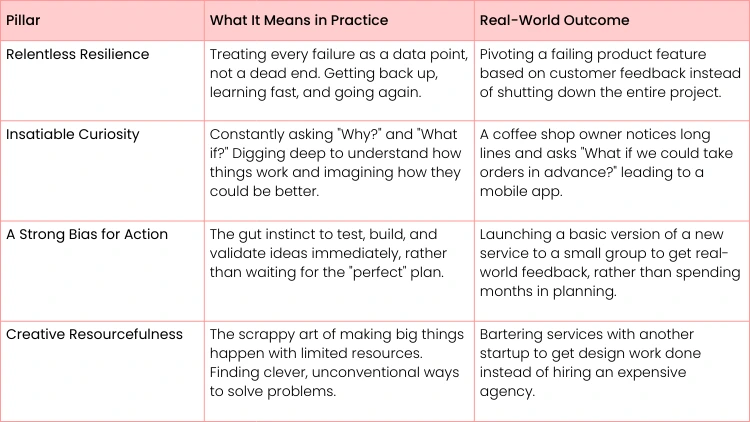
When you boil it all down, this way of thinking is supported by four core pillars. These aren’t just nice-to-have personality traits; they are active, daily practices that drive results.
Thinking about these pillars isn't just a theoretical exercise. They provide a solid framework for every decision you'll make on your entrepreneurial journey.
- Relentless Resilience: This is all about seeing failure as tuition, not defeat. It’s the grit that lets you get knocked down, learn a valuable lesson, and immediately apply it to your next move. A huge part of this is the conscious effort to develop a lasting growth mindset, where you genuinely see challenges as chances to get smarter and stronger.
- Insatiable Curiosity: Real entrepreneurs are fueled by a constant need to know why. This drive to understand the inner workings of things—and how they could be improved—is what sparks true innovation. For example, instead of just accepting that "marketing is expensive", a curious mind asks, "What are the most cost-effective channels for our specific customer?" leading them to discover niche blogs or community forums.
- A Strong Bias for Action: This might be the most important one. It’s the impulse to build a prototype, run a small experiment, or just try something instead of getting trapped in endless analysis. An entrepreneur would rather get an imperfect solution into the world and learn from it than wait for a flawless plan that never gets executed.
- Actionable Insight: The next time you have an idea, give yourself a 24-hour deadline to take one small, physical step toward making it real—buy the domain name, create a survey, or sketch the logo.
- Creative Resourcefulness: Call it being scrappy, call it being clever—it’s the art of doing more with less. This is about finding non-obvious solutions when you're short on cash, talent, or time. For instance, needing a promotional video but having no budget might lead you to collaborate with a local film student who needs to build their portfolio.
To give you a clearer picture, here’s how these pillars look in the real world:
Cultivating the Core Traits of a Founder
Knowing what an entrepreneurial mindset looks like is one thing. Actually building one is where the real work begins. This isn't about some massive personality overhaul. Think of it more like installing new mental software—deliberate, repeatable practices that fundamentally shift how you see challenges and opportunities.
Let's get past the theory and dig into some actionable techniques to forge the core traits you’ll need on this journey: resilience, curiosity, decisiveness, and resourcefulness. These are the muscles you need to start strengthening right now.
Turning Failures Into Actionable Data
Resilience isn't about just getting back up; it's about getting back up smarter. Every single setback, missed target, or flat-out failure is packed with valuable data. The trick is learning to extract the lesson without letting the sting of failure cloud your judgment.
Actionable Insight: Try this practical exercise I call the "Failure Post-Mortem":
- Describe the Failure Objectively: Just the facts. Write down exactly what happened as if you were a neutral reporter.
- Practical Example: “My social media ad campaign for the new webinar spent $200 and brought in only one sign-up.”
- Identify Your Assumptions: What did you believe was going to happen? “I assumed my Instagram audience was ready for this content and that my ad creative was a home run.”
- List the Unexpected Variables: What actually happened that caught you off guard? “The click-through rate was great, but the conversion rate on the landing page was almost zero. The problem wasn’t the ad; it was the page.”
- Extract the Key Lesson: What’s the single most important thing you learned? “I need to A/B test my landing pages before throwing a real budget at ads.”
- Define the Next Action: What specific, concrete step will you take now? “I’ll build two different landing pages and run a small $20 test to see which one actually converts.”
This simple, structured process flips a painful "I failed" moment into a powerful "I learned" insight. That shift is the absolute core of entrepreneurial resilience.
Uncovering Root Causes with Insatiable Curiosity
Entrepreneurs don't just put bandages on problems; they dig until they find the root cause. A fantastic tool for this is the "Five Whys" technique, which famously came out of Toyota's manufacturing process. It’s a deceptively simple way to get past the symptoms.
Here's a practical example: Let’s take a common business headache: customer churn is creeping up.
- Why #1: Why are customers leaving? (They’re complaining about slow support.)
- Why #2: Why is support so slow? (The team is swamped with tickets.)
- Why #3: Why is the team swamped? (They spend most of their day answering the same few basic questions.)
- Why #4: Why are they getting so many basic questions? (Our onboarding guide and help docs are confusing.)
- Why #5: Why are the docs confusing? (We wrote them at launch and haven’t touched them since.)
Actionable Insight: All of a sudden, the solution isn't "hire more support reps". It's "rewrite the help documentation and make it easier to find." This kind of deep-seated curiosity saves a massive amount of time and money by making sure you’re solving the right problem. This is exactly how strong business acumen is built—by relentlessly asking these foundational questions. If you want to dive deeper into this, check out this guide on how to develop business acumen.
Making Decisions with Incomplete Information
If you wait for 100% certainty, you'll be waiting forever. Great founders understand that speed is a weapon, so they get comfortable making confident decisions even when they don't have all the facts. This is where the "70% Rule" is so powerful.
Actionable Insight: The idea is straightforward: once you have roughly 70% of the information you need to make a reasonably informed decision, you pull the trigger. You act. Waiting to get to 90% or 100% is a classic recipe for analysis paralysis, and by the time you get there, the opportunity has likely vanished.
A good plan violently executed now is better than a perfect plan executed next week. — George S. Patton
This isn't about being reckless. It's about trusting your judgment and accepting that you can always course-correct as you go. You make a calculated bet, you move, and you adjust. It's a hallmark of effective leadership.
Practicing Extreme Resourcefulness
If there’s one trait that defines an entrepreneur, it’s resourcefulness—that gritty ability to make big things happen with limited means. It’s about seeing assets where other people only see constraints. This skill is everything, especially in the early days.
True founders think beyond simply trading their time for money; they embody the concept of the leveraged entrepreneur, focusing on building systems that can scale.
- A practical example: Look at the story of Airbnb's founders. They famously sold novelty cereal boxes ("Obama O's" and "Cap'n McCain's") to keep the company alive in its most desperate moments. You won't find that move in any business textbook; it was pure, creative resourcefulness born from necessity.
By consistently working these exercises into your routine, you aren’t just reading about traits; you’re actively wiring them into your brain.
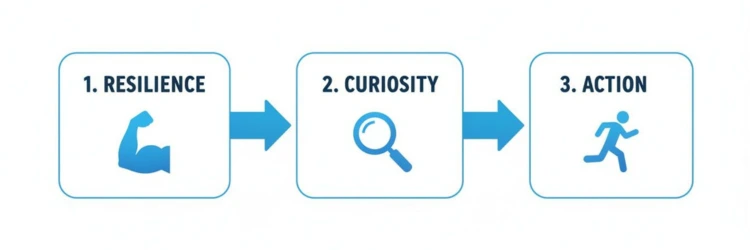
This simple flow chart really captures how these elements work together. It’s a cycle, not a checklist.
Resilience isn't just about being tough; it's the fuel that ignites your curiosity to try a different approach, which naturally leads you right back into action.
Daily Habits That Rewire Your Thinking
Your mindset isn't set in stone. Think of it as a muscle—it gets stronger with the right workout. Building the mental framework of an entrepreneur really comes down to the small, consistent actions you take every single day. These habits are your training program, designed to rewire your brain to automatically seek opportunities, solve problems, and embrace action.
Don't see these as chores. They're daily exercises that make entrepreneurial thinking feel like second nature. By committing to these routines, you shift from passively letting your day happen to you, to actively shaping it yourself. You can dig deeper into this idea by exploring the power of routine and how it creates a solid foundation for success.
Implement a Daily Idea Quota
Here's a secret: creativity isn't some lightning strike of inspiration. It’s a habit. The most reliable way to get fluent in creative thinking is to force yourself to generate ideas on command. This is where the Idea Quota comes into play.
Actionable Insight: The goal is simple: every single day, write down ten new ideas.
They don't have to be brilliant, world-changing concepts. In fact, most of them will be terrible, and that’s the entire point. You're training your "idea muscle", not trying to find the next billion-dollar startup on your first try.
- Practical Example: One day, your list might be "Ways to improve the morning coffee experience". Ideas could range from a self-heating smart mug to a subscription for local roasters or even something silly like coffee-flavored toothpaste. The quality is irrelevant; the act of creation is what matters.
This daily practice smashes the mental barrier of needing a "perfect" idea before you can start. It proves that ideas are everywhere and that the more you generate, the better your odds of stumbling onto something truly valuable.
Keep a Problem-Spotting Journal
Entrepreneurs are, at their core, elite problem-solvers. But before you can solve a problem, you have to get really, really good at noticing it in the first place. Most people are conditioned to ignore minor frustrations, but to an entrepreneur, those are blinking neon signs of opportunity.
Actionable Insight: Start a Problem-Spotting Journal. It can be a physical notebook or just a simple note on your phone.
Your daily task is to document one or two things that frustrated you, seemed inefficient, or could simply be done better.
- Practical Example: Don't just complain—articulate the problem with precision. Instead of, "The line at the post office was too long", write, "The process for shipping a small package requires waiting in the same line as someone with complex international freight, creating a bottleneck."
This habit fundamentally changes how you see the world. Suddenly, everyday annoyances transform into potential business ideas. You stop seeing the world as it is and start seeing it as it could be.
Take on a 30-Day Discomfort Challenge
An entrepreneurial mindset requires a healthy relationship with risk and discomfort. The fear of stepping outside your comfort zone is what keeps most great ideas locked away. The 30-Day Discomfort Challenge is designed to systematically expand your tolerance for small, calculated risks.
Actionable Insight: The rule is to do one small thing every day that makes you just a little uncomfortable.
Your Discomfort Challenge Calendar Might Look Like This:
- Day 1: Ask a barista about their shop's biggest business challenge.
- Day 7: Pitch a small, new idea to your boss in a low-stakes setting.
- Day 15: Negotiate a small discount on a purchase, even if it's just for practice.
- Day 21: Publish a short article or post online sharing your opinion on a topic you know well.
- Day 30: Volunteer to lead a brief team meeting.
These aren't life-altering risks. They are about building resilience and confidence in tiny, manageable increments. By consistently pushing your boundaries, you prove to yourself that you can handle uncertainty, which makes those bigger leaps feel far less intimidating when the time comes.
Learning Through Action with Micro-Ventures
Daily habits are great for rewiring your brain, but a true entrepreneurial mindset is forged in the fire of real-world application. It’s the difference between reading about how to swim and actually jumping in the water. This is where you graduate from mental exercises to tangible projects. We’ll use small, low-risk "micro-ventures" to build specific skills without betting the farm.
Think of a micro-venture as a contained experiment, not a full-blown company. It has a clear learning objective and a minimal budget, designed to teach you something valuable, fast. The goal isn't to get rich; it’s to get smart.
The Shopify Store Experiment
Honestly, one of the fastest ways to learn is by trying to sell something. Anything. Setting up a simple Shopify store for a single, niche product is an incredible learning accelerator.
- Here’s a practical example: Let's say you're passionate about sustainable pet products. Instead of trying to launch an entire pet supply empire, find one unique item. Maybe it's a compostable dog toy from a local artisan. Build a simple, one-product store around it. Your initial investment could be less than $100 for the first batch of inventory and a basic Shopify plan.
Actionable Insight: This tiny project forces you to learn a ton of skills all at once:
- Product Sourcing: How do you find a supplier and figure out your margins?
- Basic Marketing: Can you write a product description that actually sells? What happens when you run a $10 Facebook ad?
- Customer Feedback: You'll have to handle that first order, ask for a review, and deal with any questions that come up.
- Data Analysis: You get to look at real store traffic and figure out what’s working and what’s not.
The real lesson here isn't just about e-commerce. It’s about validating an idea with actual customer dollars. You learn very quickly that what you think people want and what they will actually pay for can be miles apart.
The Paid Newsletter Challenge
Another potent micro-venture is starting a paid newsletter. This project shifts the focus from selling a physical product to selling your knowledge and building a community around it.
Key Insight: Monetizing information is a foundational entrepreneurial skill. A paid newsletter forces you to deliver consistent value that people are willing to pay for, teaching you the art of audience building and retention.
Here's a practical example of how to walk through it: Imagine you’re an expert at personal finance for freelancers. You could start a newsletter on a platform like Substack or Ghost. For the first couple of months, give it away for free to build an audience and get feedback.
Actionable Insight: Your real goal is to learn:
- Audience Building: How do you get your first 50 subscribers? This forces you to get out there and promote your work.
- Content Creation: Which topics get the most opens and clicks? This teaches you to listen to your market and give them what they need.
- Monetization: When you finally launch a paid tier, who converts? This is a direct lesson in creating a compelling value proposition.
Even if only five people subscribe, you've learned a massive amount about product-market fit for your expertise. You are actively creating, testing, and iterating based on real-time feedback.
The Local Event Project
Want to get a crash course in logistics, promotion, and resource management? Organize a small, local event. It could be anything—a workshop, a networking meetup for your industry, or even a community cleanup day.
Actionable Insight: This kind of project forces you to manage a dozen moving parts with a hard deadline. For example, organizing a "Learn Basic Podcasting" workshop for 10 people makes you handle venue booking, ticket sales (even if they're free), promotion on local forums, and day-of coordination. You learn to be incredibly resourceful when the projector doesn't work or when only half the people who RSVP'd actually show up.
These projects provide a safe environment to fail, learn, and try again. Each micro-venture is a self-contained course in entrepreneurship, making your skill development tangible, practical, and far less intimidating than trying to launch a full-scale business from scratch.
Overcoming Common Mental Roadblocks
Let’s be real—building an entrepreneurial mindset isn't some smooth, linear journey. It's messy. The path is littered with internal hurdles and mental friction that can stop even the most brilliant ideas cold. This is where the real work happens. It’s about learning to recognize and dismantle the psychological roadblocks that pop up along the way.
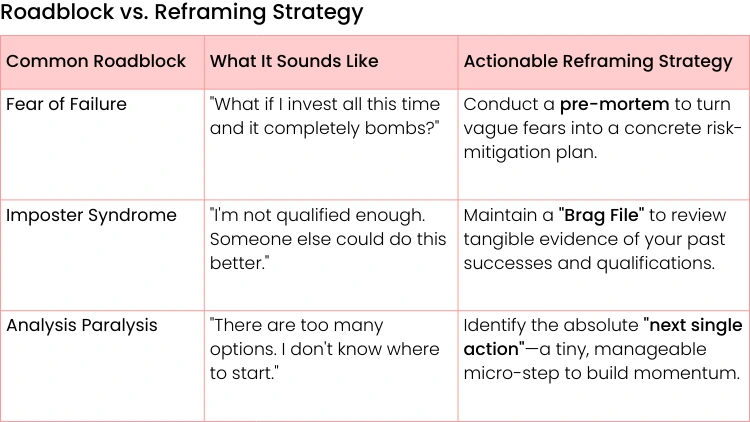
We're going to tackle three of the most common culprits we see time and time again: the paralyzing fear of failure, the nagging voice of imposter syndrome, and the endless loop of analysis paralysis. For each one, we’ll share some concrete strategies that have worked for us and countless others to push through with confidence.
Confronting the Fear of Failure
Fear of failure isn't just a mild concern; it's a powerful demotivator. It’s that voice in your head screaming, “What if this doesn’t work?” so loudly that you never even take the first step.
This isn’t just anecdotal. The GEM Global Report on entrepreneurship found that a staggering 49% of potential entrepreneurs hold back from starting a business specifically because they’re afraid it might fail.
Instead of letting that fear call the shots, you can flip the script with a powerful exercise called a "pre-mortem". It’s a game-changer.
Actionable Insight: A pre-mortem is the exact opposite of a traditional post-mortem. Instead of analyzing what went wrong after the fact, you intentionally imagine your project has already failed—before you even start.
Here’s a practical example of how you run one:
- Jump to the future: Get your team together (or just yourself) and imagine it’s six months from now. The project has been a total disaster.
- Figure out why: Spend 15-20 minutes brainstorming every possible reason for this imaginary failure. Get specific. “We burned through our cash because we totally underestimated marketing costs.” or “Our main competitor beat us to market with a similar feature.”
- Spot the real threats: Look at your list and circle the top 3-5 risks that feel most plausible and would be the most damaging.
- Build your defense: For each of those top risks, brainstorm specific actions you can take right now to prevent them from ever happening.
This simple exercise transforms that vague, overwhelming anxiety into a checklist of manageable risks. You’re not just hoping for the best; you’re actively de-risking your idea from day one.
Silencing Imposter Syndrome
That persistent, nagging feeling that you're a fraud, that you’ve just been lucky, and that you're about to be found out. It’s especially common among high-achievers.
The best way we’ve found to fight back against this feeling is with cold, hard evidence.
Actionable Insight: This is where a "Brag File" comes in handy. It’s exactly what it sounds like: a dedicated folder where you collect every piece of positive feedback and every win, no matter how small.
- Practical Example: Create a folder in your email titled "Wins" or on your computer desktop. Every time you get a glowing client email, a congratulatory Slack message, or see a metric that proves your project was a success, screenshot it and save it there.
When imposter syndrome creeps in, your feelings will try to erase the facts. Your Brag File is your personal archive of proof. A quick scroll through it is a tangible reminder of your skills and accomplishments, grounding you in reality when your confidence starts to dip.
Breaking Through Analysis Paralysis
Analysis paralysis is what happens when you overthink a decision so much that you end up doing nothing at all. The sheer volume of options becomes overwhelming, and you get stuck.
Actionable Insight: The trick is to break intimidating goals into ridiculously small micro-steps.
When you feel stuck, forget the big picture for a moment and just focus on the "next single action". Don't think about building the whole staircase; just look at the very first step. If your goal is "launch a new website", that's way too big and will keep you stuck.
Here's a practical example of how to break it down:
- Huge Goal: Launch a new website.
- First Step: Research website builders. (Still too big).
- Micro-Step: Watch one 10-minute YouTube review of Squarespace vs. Webflow.
See how much more manageable that feels? That tiny action is easy to complete, and it builds momentum. Once that’s done, the next micro-step (like "sign up for a free trial") feels much less daunting. It's a powerful technique against procrastination.
If you find yourself constantly getting stuck in this loop, this guide on how to overcome procrastination has even more strategies to help you get moving.
To make this even clearer, here's a quick guide to recognizing these roadblocks and the specific strategies to reframe your thinking.
By actively using these frameworks, you can start systematically dismantling the mental roadblocks that are holding you back and clear the path for progress.
Have Questions? Let's Talk.
Putting these ideas into motion always brings up good questions. Here are some of the most common ones we hear from people just starting to build their entrepreneurial mindset, along with some straight-up advice to keep you moving.
Can I Develop an Entrepreneurial Mindset If I Don't Want to Start My Own Business?
Absolutely. In fact, it might be one of the most valuable things you can do for your career, no matter where you work. Thinking like an entrepreneur isn't just for founders—it's about how you approach problems and create value, which can make you indispensable inside a bigger company.
This is what people call "intrapreneurship". The intrapreneur is the one who sees a clunky internal process and prototypes a better way, not the one who just gripes about it by the water cooler. They're the ones who raise their hand for new projects, bounce back from setbacks, and are always looking for ways to help the company win.
- Here's a practical example: Imagine an account manager at a software company. She keeps hearing that new clients are confused by one specific feature. Instead of just forwarding complaints to the support queue, she takes it upon herself to create a simple, two-minute tutorial video. She gets the green light to add it to the standard onboarding email. Boom. She didn't just pass the buck—she owned the problem and shipped a solution.
What's the Single Most Important Habit to Start With?
If you can only pick one thing, make it the Problem-Spotting Journal. This one habit is the bedrock of all entrepreneurial thinking. It trains your brain to stop passively accepting the world as it is and start actively seeing how it could be better.
Actionable Insight: The goal is simple: every day, write down one thing that frustrated you, seemed inefficient, or just felt broken. You don't have to solve it yet. The real magic is in the act of identifying and articulating the problem.
- Practical Example: This simple practice forces you to document everyday friction points, building a personal database of opportunities. Over time, as you review this log, solutions will start to jump off the page.
It's a small routine that completely rewires your perspective, turning fixed circumstances into a world of puzzles waiting to be solved.
How Do I Practice Risk-Taking Without Quitting My Job?
You don't have to bet the farm to build your risk-taking muscle. The key is to start with "micro-risks"—small, calculated moves in low-stakes environments. The point isn't to gamble your savings; it's to get comfortable with the feeling of stepping into uncertainty.
Actionable Insight: This approach keeps the potential downside tiny while giving you huge upside in learning and confidence.
Here are a few practical examples of micro-risks you can take this week:
- Speak up in a meeting with a new idea, even if it’s not fully baked. The risk is almost zero, but the practice of voicing your thoughts is priceless.
- Volunteer to lead a small, non-critical project that's a little outside your wheelhouse. This could be anything from organizing a team lunch to researching a new software tool.
- Launch a micro-venture with a hard budget cap of $100. The financial risk is contained, but you'll get a crash course in marketing, sales, and customer feedback.
How Long Does It Take to Really Develop This Mindset?
Think of it like getting in shape. It's not a destination you arrive at and then you're "done". Developing an entrepreneurial mindset is an ongoing practice, a new operating system for your brain.
That said, you can expect to feel a real shift in your thinking patterns and daily actions within 3 to 6 months of consistent effort. The key word there is consistency. A small action repeated daily—like logging a problem or challenging an assumption—compounds over time to fundamentally change how you see the world.
Ready to turn these mindset principles into real-world skills? At Uplyrn, we provide the practical courses and expert mentorship you need to not just think like an entrepreneur, but to act like one. Explore our programs and start building your future today.


Leave your thoughts here...
All Comments
Reply