









How to Improve Cognitive Abilities: Boost Memory and Focus

If you're serious about sharpening your mind, you need to move beyond just reading a few tips online. Real cognitive improvement isn't about finding a magic pill; it’s about following a systematic framework of targeted habits and exercises.
Let's walk through a practical, evidence-backed plan to actually enhance your memory, focus, and problem-solving skills. This is your roadmap for getting tangible results.
Jump To Section

Earn As You Learn
Earn 25% commission when your network purchase Uplyrn courses or subscribe to our annual membership. It’s the best thing ever. Next to learning,
of course.
Your Framework for Better Cognitive Function
Embarking on a journey to sharpen your mind is a lot like training for a marathon. You wouldn't just show up on race day without a plan, right? The same goes for your brain. You need a structured approach to boost your mental horsepower.
This isn't about randomly playing a few brain games and hoping for the best. It’s about systematically figuring out where you are now, training specific cognitive skills, and building a lifestyle that supports peak mental performance.
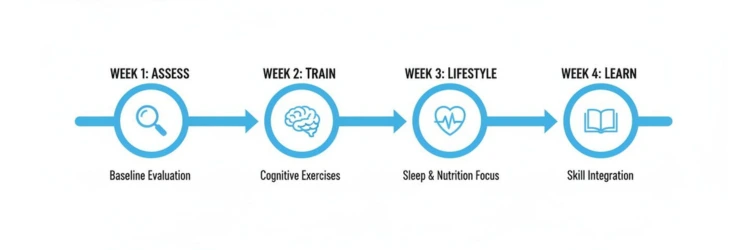
When you break this down over several weeks, you create a sustainable path to real improvement. For instance, a student might dedicate the first week to pinpointing exactly when and why their focus breaks during study sessions. A professional, on the other hand, could start by assessing their ability to recall key client details from the last few meetings.
This timeline gives you a bird's-eye view of how you can structure your own journey over four weeks, moving from initial assessment to active, hands-on learning.
The real secret here is that each phase builds on the last. It's a compounding effect—small, consistent efforts lead to big gains in your mental acuity over time.
Your 4-Week Cognitive Enhancement Kickstart Plan
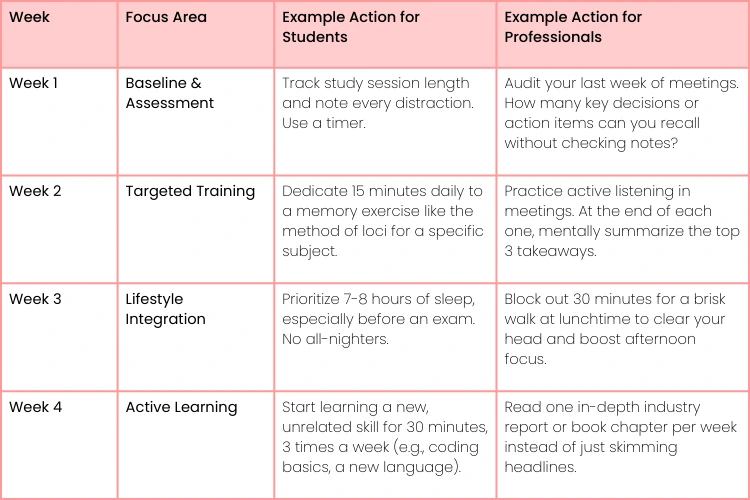
To help you get started, here's a simple, actionable plan you can adapt.
The Power of Continuous Learning
One of the cornerstones of any solid cognitive improvement plan is a genuine commitment to being a lifelong learner. Think about it: challenging your brain with new, complex information is one of the most powerful ways to keep it sharp.
This process directly fuels neuroplasticity—your brain's incredible ability to rewire itself by forging new connections between neurons. It's like paving new roads in your mind, making it faster and more efficient. If you want to get into the nitty-gritty of this, you can explore this guide on how the brain learns.
The link between education and cognitive function is incredibly strong. A fascinating study across more than 20 countries found that women aged 50 with a university education had immediate recall scores that were 0.594 standard deviations higher than those with only a primary education. That's a massive difference, and it really highlights how pushing your education can pay off for your brain health.
By intentionally adopting new skills—whether it’s learning a new software for work or mastering a musical instrument—you are actively creating a more resilient and efficient brain. This is the foundation for lasting cognitive improvement.
This table breaks down the key focus areas to jumpstart your cognitive improvement journey. Think of it as a cheat sheet to guide your first month.
This is just a starting point, of course. The key is to be intentional and consistent. Pick your actions, stick with them, and you'll begin to notice a real difference.
Establishing Your Cognitive Baseline and Goals
Before you can sharpen your mind, you have to know what you’re working with. You wouldn't start a road trip without knowing where you are on the map, right? The same logic applies here. This first step isn't about judging yourself; it’s about gathering some honest data to make sure your efforts actually pay off.
Think of yourself as a detective for a moment, investigating your own mental habits. A surprisingly effective way to start is by keeping a simple 'distraction journal' for a few days. Every time you're working and feel your focus drift, just jot down what pulled you away. Was it a notification? A random thought? The dog barking? This simple habit reveals powerful clues about your attention patterns.
Identify Your Cognitive Landscape
Once you have a few days of observations, you can get a little more specific. The idea is to get a practical feel for your personal strengths and where you could use a boost. No need for a formal lab test—simple, real-world checks work perfectly.
- Working Memory: Grab a friend and try this. Have them read you a list of 10 random words. As soon as they finish, write down as many as you can remember. Do it a few times to find your average. This gives you a quick and dirty benchmark for your short-term recall.
- Attention Span: Next time you sit down to work or study, set a timer. See how long you can truly maintain deep focus on one thing before your mind starts to wander off. Is it 15 minutes? 40? No judgment, just honest data.
- Processing Speed: Time yourself reading a single page from a book or a report. Immediately after, write a one-sentence summary of what you just read. This isn't just a test of reading speed; it measures how quickly you can absorb and synthesize information.
From Vague Wishes to Specific Missions
Armed with a clearer picture of your starting point, you can finally move from fuzzy goals like "I want to be smarter" to concrete, actionable targets. This is where the magic happens, turning a loose intention into an actual plan.
For a deeper dive, this guide on how to set personal goals is a great resource for making sure they stick.
A goal you can't measure is just a dream. The difference between a vague wish and an actionable goal is defining what success actually looks like. It gives you a clear finish line to run toward.
Instead of generic aims, you need to craft precise targets that are actually relevant to your life. That specificity is what makes your progress easy to track and keeps you motivated.
Here’s what that looks like in the real world:
- For a Student: "I need to get better at studying" is a wish. "Recall 20 key historical dates with 95% accuracy using active recall techniques within two weeks" is a mission.
- For a Professional: "I want to be more efficient" is vague. "Reduce the time it takes me to draft a project proposal by 20% by improving my planning and organization skills over the next month" is a measurable goal.
Getting this foundation right ensures that every exercise you do and every habit you build is aimed squarely at a target that truly matters to you.
Putting Targeted Brain Training Exercises into Practice
Think of your brain like a muscle. Just as lifting weights builds physical strength, specific mental exercises can sharpen your cognitive abilities. This isn't about mindlessly playing games on your phone; it's about intentional, focused training designed to give you real-world results in memory, attention, and problem-solving.
The key here is consistency and choosing exercises that truly challenge you.
It all comes down to the old "use it or lose it" principle, which has some serious science behind it. One major longitudinal study found that people who actively used their skills showed no cognitive decline up to age 65. In fact, their literacy and numeracy skills actually got better into their fifties. This just goes to show that keeping your mind engaged is one of the best things you can do to stay sharp.
By deliberately practicing these mental techniques, you're not just fighting against decline—you're actively upgrading your brain's performance.
Bolstering Memory and Deep Learning
One of the most powerful and time-tested techniques for a better memory is the Method of Loci, also known as a "memory palace". The idea is simple: you visualize a place you know intimately, like your house, and mentally "place" the things you want to remember in specific spots.
- Practical Example: Imagine you need to memorize the first five U.S. presidents for a history quiz. You could visualize George Washington greeting you at your front door, John Adams sitting on your hallway chair, Thomas Jefferson cooking in the kitchen, James Madison reading in the living room, and James Monroe sleeping in your bedroom. To recall them, you just take a mental walk through your house. It’s surprisingly effective.
But what about understanding things on a deeper level? For that, the Feynman Technique is brilliant. You take a complex topic and try to explain it in the simplest terms you can, as if you were teaching it to a kid. This simple act immediately reveals where the gaps in your own knowledge are, forcing you to learn the material inside and out.
Sharpening Attention and Executive Function
In a world full of distractions, the ability to focus is a superpower. Training your brain to resist those distractions and stay on task is crucial, and mindfulness meditation is one of the best-researched ways to do it.
Just 10-15 minutes of daily mindfulness practice can make a huge difference in your attention control and stop your mind from wandering. You're essentially training your brain to notice when it gets off track and gently bring it back, which strengthens the neural circuits responsible for concentration.
For professionals, visualization is an incredible tool for honing executive functions like planning and strategizing. Let's say you have a high-stakes negotiation coming up. Spend some time mentally rehearsing the whole thing. Picture the room, the people, what you'll say to open, their likely objections, and how you’ll respond. This mental dry-run builds confidence and primes your brain to perform at its peak when the pressure is on.
If you're looking for more ways to clear the mental fog, check out this guide on 7 ways to kickstart your mind. For more practical strategies to improve focus and concentration, there are some great techniques you can start using today. By adding these targeted exercises to your routine, you’re actively building a sharper, more resilient mind.

Building a Lifestyle That Supports Brain Health
Targeted brain exercises are a fantastic way to sharpen your mind, but they're only one piece of the puzzle. To see real, lasting gains, you have to back up that work with a lifestyle that nurtures your brain around the clock. Think of it as creating the perfect soil for your cognitive seeds to grow.
The whole foundation rests on three pillars: sleep, nutrition, and physical exercise. If you let one of them crumble, it can seriously undermine all the hard work you’re putting into your mental training.
Prioritize Restorative Sleep
Sleep isn't just downtime for your body; it's prime working time for your brain. This is when it gets busy consolidating memories from the day and clearing out metabolic gunk that builds up. Skimp on sleep, and you’ll feel it everywhere—from your attention span and working memory to your ability to manage emotions. We've all felt that brain fog after a rough night; research confirms that even one night of bad sleep can tank your cognitive performance.
The goal isn't complicated: aim for a solid 7-9 hours of quality sleep each night. The key is building a routine that makes it happen.
- Actionable Tip: Try setting a "wind-down" alarm for 30 minutes before you want to be asleep. When it goes off, it's a hard stop. All screens—phone, tablet, TV—get put away. Pick up a physical book, listen to some calm music, or do some light stretching. This simple cue tells your brain it's time to power down.
- Real-World Example: Let's say your target bedtime is 11 PM. Your wind-down alarm rings at 10:30 PM. You plug your phone in to charge across the room (not on your nightstand!) and grab a novel. This small shift in your evening habit can make a world of difference in your sleep quality.
Fuel Your Brain with Smart Nutrition
What you eat has a direct line to your brain's structure and function. A diet packed with the right nutrients can support memory, fight off mental fatigue, and even help protect against age-related cognitive decline.
You don't need to throw out everything in your pantry. Just start with a few small, high-impact additions.
Incorporating specific brain-healthy foods is a simple yet effective strategy. A daily handful of walnuts provides essential omega-3 fatty acids, while adding blueberries to your morning oatmeal delivers a powerful dose of antioxidants.
Here are a few easy swaps to get you started:
- Instead of a sugary afternoon snack, grab a small bowl of mixed nuts and seeds.
- Toss a side of leafy greens like spinach or kale onto your lunch or dinner plate.
- Try to have fatty fish like salmon once or twice a week to get a rich source of DHA.
If you're looking to build a solid nutritional foundation, this guide on the everyday basics for optimal health is a great place to start.
Move Your Body to Boost Your Mind
Physical exercise is one of the most powerful tools we have for enhancing cognitive function. Getting your heart rate up increases blood flow to the brain, delivering a fresh supply of oxygen and nutrients. It also triggers the release of growth factors that encourage the birth of new neurons, especially in the hippocampus—the brain's learning and memory hub.
And no, you don't need to start training for a marathon. When it comes to brain benefits, consistency beats intensity every time.
- Practical Example: Picture a professional who's completely stuck on a complex problem at work. Instead of staring at the screen, they go for a brisk 20-minute walk. That short burst of activity can spark new creative connections and improve their problem-solving ability when they get back to their desk. On a similar note, students can use a short yoga session to clear their head and improve focus before a long study block.

Weave Powerful Learning and Thinking Models into Your Routine
Okay, so you've started tuning up your lifestyle and doing the targeted brain exercises. That's like upgrading your computer's hardware. Now it's time to install better software—the mental models and learning strategies that truly change how you process information and crack complex problems.
This is where you shift from being a passive learner to an active, high-performing thinker. It’s not about grinding harder; it's about learning smarter. By adopting a few key frameworks, you’ll see a dramatic difference in how you absorb, retain, and apply new knowledge.
Upgrade Your Learning OS with Active Recall and Spaced Repetition
Let’s be honest: passively reading a textbook or highlighting notes feels productive, but it’s one of the least effective ways to learn. It creates an illusion of knowing without actually cementing information into your long-term memory.
The fix is to flip your entire approach on its head with two powerful, science-backed methods.
First up is active recall. This simply means forcing your brain to retrieve information without looking at the source. Instead of just re-reading a chapter, close the book and try to summarize the main points out loud. Or scribble them on a piece of paper. This simple act of retrieval is what builds and strengthens the neural pathways for that memory.
- Actionable Insight: After a client meeting, don't just scan your notes. Spend five minutes actively recalling the client’s biggest frustrations and questions. Write them down from memory first, then check your notes to see what you missed. It's a small habit, but the boost in retention is huge.
Next, you layer in spaced repetition. This technique interrupts the brain's natural forgetting curve by having you review information at increasing intervals. It’s a signal to your brain that says, "Hey, this is important—keep it."
The real magic happens when you combine them. Use active recall to create digital flashcards in a tool like Anki, and let its algorithm handle the spaced repetition schedule. It’s a ridiculously effective system for mastering anything from a new language to technical concepts for your job.
Deconstruct Problems with First Principles Thinking
Beyond just learning facts, you need better models for thinking. One of the most potent is First Principles Thinking, a method famously championed by innovators like Elon Musk.
It’s all about breaking a complex problem down to its most basic, fundamental truths and building your solution up from there. You throw out assumptions and stop copying what everyone else is doing. Instead, you ask: "What are the absolute, undeniable truths of this situation?"
Let's see it in action: A marketing manager wants to launch a new campaign. The typical approach is to see what competitors are doing and copy it (reasoning by analogy).
Using first principles, they break it down instead:
- Fundamental Truth: We need to reach potential customers who have X problem.
- Fundamental Truth: These customers spend most of their online time on platforms A and B.
- Fundamental Truth: They respond to authentic, helpful content, not aggressive sales pitches.
When you build a strategy from these core truths, you open the door to genuine innovation instead of just creating a slightly different version of what’s already out there. If you want to explore more frameworks like this, this guide on creative problem-solving methods is a great next step.
Consistently applying models like these is a powerful form of continuous education. And the long-term benefits are profound. Longitudinal studies show that extended access to education is a critical factor in boosting cognitive performance later in life. Turning these learning habits into a lifelong practice yields measurable, lasting improvements.
Common Questions About Improving Cognitive Abilities
Whenever you start a journey to sharpen your mind, a bunch of practical questions are bound to pop up. Knowing what to expect can make all the difference, helping you stick with the habits that actually move the needle. Let's dive into some of the questions we hear most often.
How Long Does It Take to See Results?
This is the big one, and the honest answer is: it depends on your consistency. Most people start to feel sharper and more focused within just 2 to 4 weeks of consistently applying new lifestyle habits and cognitive exercises.
But if you're aiming for deeper, more permanent upgrades in things like problem-solving or long-term memory, you need to think in months, not weeks. A realistic timeframe for seeing substantial, lasting gains is around 3 to 6 months of dedicated effort.
It's a lot like getting in shape. You won't look like a bodybuilder after one gym session, but after a few weeks, you definitely feel stronger. The real transformation takes months of showing up, and the exact same principle applies to your brain.
Are Brain-Training Apps Worth the Hype?
The research on brain-training apps is pretty clear on one thing: they make you very, very good at playing the games in the app. This is called "near transfer". So if you practice a working memory game, your score in that game will skyrocket.
The real debate is about "far transfer"—whether getting good at that game helps you remember someone's name at a party or recall key facts during a presentation. Here, the evidence gets a lot murkier and is far from conclusive.
Use them as a light supplement if you enjoy them, but don't make them the core of your cognitive training plan. The most powerful brain-building comes from tackling complex, novel activities in the real world. Think about things like:
- Learning a musical instrument: This is a full-brain workout, hitting your auditory processing, fine motor skills, and memory all at once.
- Mastering a new language: You’re literally forcing your brain to build new pathways for vocabulary, grammar, and recall.
- Taking up a strategy game like chess: This is pure training for planning, foresight, and adapting on the fly.
Activities like these give your brain a far richer, more integrated workout than any single app ever could.
Which Habit Delivers the Biggest Impact?
If you could only pick one habit to improve your cognitive function, the science is overwhelmingly clear: regular physical exercise. It’s the closest thing we have to a magic pill for brain health.
Aerobic exercise—like a brisk walk, a run, or swimming—is especially potent. It ramps up blood flow to the brain, tamps down inflammation, and triggers the release of growth factors that encourage new neuron growth, particularly in the hippocampus. That's the part of your brain that’s absolutely critical for learning and memory.
Of course, focusing on just one thing is never the full picture. The best results always come from a combination of forces working together. When you pair consistent physical activity with 7-9 hours of quality sleep, a diet rich in brain-healthy nutrients, and a real commitment to lifelong learning, you build an unshakeable foundation for how to improve cognitive abilities for good.
At Uplyrn, we believe that continuous learning is a cornerstone of peak cognitive performance. Our platform is designed to provide you with the tools and expert-led courses you need to challenge your mind, master new skills, and stay mentally sharp. Explore our courses today.


Leave your thoughts here...
All Comments
Reply