









How to Market Online Courses: A Proven Framework for Growth

Great course marketing isn't about flashy ads or complicated funnels. It’s about a strategic blend of understanding your ideal student, creating content they can't ignore, and building systems that sell for you. The whole process kicks off not with a big ad spend, but with a deep, honest look at who you're actually trying to help and the specific transformation your course delivers.
Jump To Section

Earn As You Learn
Earn 25% commission when your network purchase Uplyrn courses or subscribe to our annual membership. It’s the best thing ever. Next to learning,
of course.
Build Your Foundation: Know Your Audience and Your Market
Before you even think about writing a sales page or running an ad, the smartest course creators are digging into market research. Seriously. This is the part everyone wants to skip, and it's the number one reason courses flop.
The goal isn't to convince strangers they need what you have. It’s about finding the right people and showing them you’ve built the exact solution for a problem that’s already keeping them up at night.
This means going way beyond basic demographics like age and location. You need to get into their heads and understand their psychographics—their goals, their biggest frustrations, what makes them tick, and what finally pushes them to pull out their credit card.
- Practical Example: It’s the difference between saying your student is a "35-year-old manager" and truly knowing your student is "Alex, a 35-year-old new manager who feels completely overwhelmed, is terrified of looking incompetent to their team, and secretly Googles 'how to run a team meeting' on a Saturday morning."
See the difference?

Pinpoint Your Ideal Student Persona
A student persona isn't just a silly marketing exercise; it's a detailed, semi-fictional profile of your perfect customer. When you have this, every decision—from the copy on your landing page to the content of your emails—becomes ten times easier and more effective.
- Actionable Insight: Don't just invent your persona. Go find real data. Spend 30 minutes reading reviews (both good and bad) for a competitor's course on any online learning platform. The exact words people use to describe their frustrations are pure gold for your marketing copy.
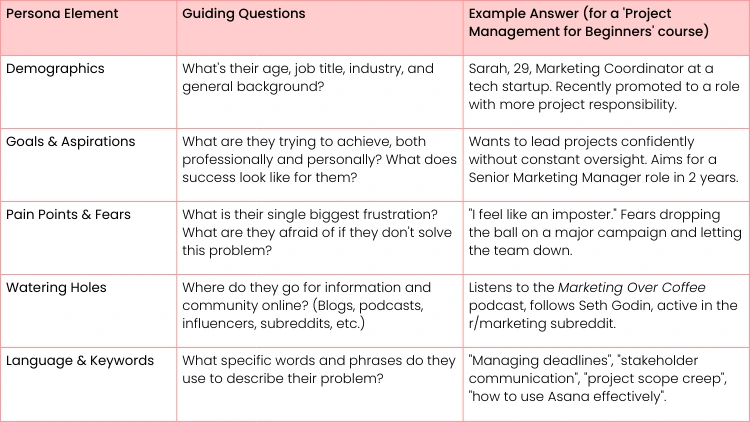
Audience Persona Development Template
This template helps you move beyond assumptions and build a data-driven picture of your ideal student, ensuring your marketing messages land perfectly every time.
Building this out gives you the exact language you need for your marketing materials. You're no longer guessing; you're reflecting their own thoughts back to them.
The goal isn't just to sell a course; it's to become the undeniable solution to a specific, urgent problem. When a potential student reads your sales page, they should feel like you've read their mind.
Find Your Unique Space in the Market
Once you know exactly who you're talking to, it's time to see who else is talking to them. This isn't about copying your competitors; it's about finding the gaps they've left open so you can create a truly unique and compelling offer. It's easy to fall into the trap of thinking your problem is everyone's problem, but diligent market research of your idea helps you find an authentic, profitable angle.
Actionable Insight: Create a simple spreadsheet to track your top 3-5 competitors. For each one, list their course name, price, core promise, and what their negative reviews complain about. This will instantly reveal market gaps you can fill.
- What's their core promise? What transformation are they selling?
- What are their students saying in reviews—both the good and the bad? (The bad reviews are pure gold!)
- How much do they charge, and what's included in their offer?
- What crucial topics are they not covering? Where's the gap?
Practical Example: Maybe every competitor offers a massive "Learn Python" course. After digging into reviews, you find students are overwhelmed. This is your gap. You can create a focused course on "Python for Data Analysis in Finance". That specific positioning makes your marketing infinitely more powerful. For more on building a solid online presence, check out this social media marketing guide for small businesses.
The global online learning market is absolutely massive, projected to grow from around $165 billion in 2014 to over $300 billion by 2025. A huge piece of that pie is corporate e-learning, with 83% of companies now using a Learning Management System (LMS). This points to a massive, often overlooked opportunity: selling bulk seats or B2B contracts to companies can be far more lucrative than just chasing individual sales. While North America is the biggest market, it’s also the most competitive, which is why your unique positioning is so critical.
Craft a Course Sales Page That Sells While You Sleep
Once you’ve nailed down who your ideal student is, your next mission is to build your course sales page. Think of this page as your best salesperson—it works around the clock, convincing visitors that your course is the one thing they’ve been missing.
This isn’t just some landing page with a “buy” button slapped on it. Every single element, from the headline down to the footer, has one job: to guide your reader one step closer to enrolling. It needs to hit on the exact pain points and desires you uncovered during your research, building trust and excitement along the way.
Headlines Have to Stop the Scroll
Let's be blunt: your headline is everything. If it doesn’t immediately grab your ideal student and promise a real solution, they’re gone. A weak headline will absolutely kill a brilliant course.
The secret is focusing on benefits, not features. People don't buy a "10-hour video course". They buy "the skill to finally get that promotion".
Here’s a practical example:
- Bad (Feature-Focused): "Learn Photoshop Skills"
- Good (Benefit-Driven): "Go from Photoshop Zero to Your First Paid Design Client in 30 Days"
See the difference? The second one paints a vivid picture of a life-changing result. It immediately answers the visitor’s silent question: “What’s in it for me?”
How to Structure Your Page for Maximum Impact
A great sales page tells a story. It meets the visitor where they are—stuck and frustrated—and shows them the path to where they want to be, with your course as the bridge.
- Actionable Insight: Structure your page to follow the "Problem-Agitate-Solve" (PAS) formula. First, state the problem clearly (e.g., "Tired of your resume getting ignored?"). Next, agitate the pain (e.g., "Every rejection stings, making you doubt your skills."). Finally, present your course as the clear solution (e.g., "The Resume Makeover course is designed to get you noticed.").
Think about the questions swirling in their mind as they land on your page:
- Is this for me? Your headline and opening sentence should scream "YES!"
- How will this actually help me? This is where you list the transformations, not just the features.
- What am I going to learn? Break down your curriculum, but frame each module as a stepping stone toward their big goal.
- Why should I trust you? Your "About the Instructor" section is crucial for building a human connection.
- Does this thing really work? This is where social proof comes in. It’s non-negotiable.
Your sales page has to be an empathy machine. It needs to look the visitor in the eye and say, "I get it. I know where you are, and I know exactly how to get you to where you want to go."
Use Social Proof to Build Instant Trust
People are skeptical online, and for good reason. Before they hand over their hard-earned money, they need proof that you can deliver on your promises.
Don't settle for generic testimonials. A "Great course!" quote does nothing. You need specifics.
- Weak Testimonial: "Great course, I learned a lot!"
- Strong Testimonial: "Before this course, I was struggling to land any freelance clients. Two weeks after finishing Module 4, I landed a $2,500 project using the exact proposal template inside!"
Actionable Insight: Don't just ask for testimonials. Ask specific questions like, "What was the single biggest result you got from this course?" or "What specific feature did you find most helpful?" This prompts your students to give you the detailed, result-oriented quotes you need.
Pricing is another huge trust factor. Be upfront about the cost, what’s included, and any payment plans you offer. If you're stuck on what to charge, this comprehensive guide on how to price your online course walks you through all the different strategies to find that sweet spot.
Don't Forget About SEO
Finally, your sales page isn't just for people you send to it; it's a magnet for organic traffic. A little on-page SEO goes a long way in helping people find you when they're actively searching for a solution.
- Find Your Keywords: Use a tool like Google Keyword Planner to discover the exact phrases your audience is searching for, like "how to start a podcast for beginners".
- Optimize Your Page: Weave your main keyword into your page title, your main headline (the H1), a few subheadings, and naturally throughout the text.
- Write a Killer Meta Description: This is the little snippet of text that shows up in Google search results. Think of it as a tiny ad for your page—make it compelling enough to earn the click.
By blending persuasive, benefit-focused copywriting with smart SEO, your sales page will become a true powerhouse for attracting and enrolling the right students.
Drive Organic Traffic with Content and Community
Paid ads can get you off the starting blocks, but a truly sustainable course business is built on an engine that brings in students for free. This is where strategic content and genuine community come into play. The goal is to stop chasing sales and start being the go-to expert people actively seek out.
When you consistently put value out into the world, you build trust and authority. People stop seeing you as just another person selling something and start viewing you as a trusted guide. This organic approach doesn't just pull in traffic; it attracts the right traffic—people who are already hunting for the solutions your course delivers.
Establish Your Expertise with Value-First Content
Your content marketing should never feel like an ad. Its real job is to solve the smaller, specific problems your ideal students are wrestling with right now. This move demonstrates your expertise and gives them a taste of the value you bring to the table, making your course the clear, logical next step.
Just think about the questions your audience is typing into Google or asking in Reddit forums. Your content needs to be the answer they find.
- Blog Posts: Write an in-depth article like "5 Common Mistakes New Freelance Writers Make (and How to Fix Them)". Each point tackles a real pain point and naturally tees up your comprehensive "Freelance Writing Business" course. To go even deeper, see how effective content marketing strategies can become the foundation of your brand.
- YouTube Tutorials: Create a 10-minute video showing "How to Set Up a Basic Photography Lighting Kit for Under $100". This kind of practical, get-it-done content builds a loyal audience of aspiring photographers who will trust you when you launch your advanced "Studio Lighting Mastery" course.
- Podcast Episodes: Host an interview with a successful graphic designer who shares their messy, real-world journey. A podcast can forge an intimate connection with listeners, making them much more receptive when you mention your "Graphic Design Portfolio" course.
The secret to marketing online courses organically is to teach for free what others are charging for. When you’re generous with your knowledge, your audience trusts that your paid stuff must be truly exceptional.
Actionable Insight: Create content "clusters". Write one major "pillar" blog post (e.g., "The Ultimate Guide to Starting a Podcast"). Then, create 5-7 smaller pieces of content (YouTube shorts, Instagram posts, tweets) that each cover one small point from that guide, all linking back to the main article. This maximizes your effort and builds SEO authority.
Build a Thriving Community Around Your Niche
Content brings in an audience, but community is what turns that audience into passionate advocates for your brand. A community is your dedicated space where potential and current students can connect with each other, ask you questions, and share their wins. This fosters a sense of belonging that is incredibly magnetic.
Let's face it: people are far more likely to buy from someone they feel a real connection to. A community creates that connection at scale.
Platforms like a private Facebook Group, a Discord server, or a Circle community can become buzzing hubs for your niche. For instance, a creator teaching Spanish could start a Facebook Group called "Daily Spanish Practice".
A practical example of community in action:
- Post daily conversation prompts like "¿Qué hiciste este fin de semana?" (What did you do this weekend?) to get people talking and practicing.
- Host weekly live Q&A sessions to tackle tricky grammar questions and build that crucial personal connection with members.
- Encourage members to share their progress, creating a super supportive environment and generating powerful social proof without even trying.
This active, engaged community becomes the absolute best audience for your course. When you launch, you aren't pitching to a cold list of strangers; you're offering the next logical step to people who already know, like, and trust you. This simple shift can turn passive followers into an enthusiastic sales force, often leading to your most successful launches without spending a single dime on ads.
Engineer Your Sales with Funnels and Paid Ads
While organic marketing builds a solid foundation, paid ads and automated funnels are your ticket to creating a predictable, scalable sales machine for your course. This is the point where you stop manually chasing down every student and start building a system that turns interested prospects into enrolled learners, 24/7.
The concept is pretty straightforward: you use paid ads to send highly targeted traffic to a valuable freebie (your lead magnet). From there, an automated email sequence takes over to build a genuine relationship and, eventually, introduce your course. It's a powerful engine built on trust, value, and smart automation.
The Power of The Lead Magnet and Email Funnel
Think of your lead magnet as the perfect conversation starter. It's a piece of high-value, free content designed to solve one specific, nagging problem for your ideal student. And we don't mean some throwaway PDF—this needs to be so good that people would have gladly paid for it.
Here are a few practical examples of lead magnets that work:
- For a coding course: A "Top 10 JavaScript Snippets" cheat sheet.
- For a marketing course: A "5-Day Podcast Launch Checklist" template.
- For a fitness course: A free 3-day video mini-course on "Fixing Your Posture".
- A live workshop or webinar where you teach a killer concept and then position your full course as the logical next step.
The moment someone downloads your lead magnet, they drop into your email funnel. This is simply a pre-written series of emails that automatically nurtures that new lead. The whole point is to build rapport and prove your expertise before you ever ask for a dime. If you need a starting point, exploring some proven Funnels Templates can help you map out that customer journey effectively.
Building Your Automated Nurture Sequence
A solid email nurture sequence typically runs for about 5-7 days. It’s designed to guide a new subscriber from a simple introduction to a compelling invitation.
Here's a common, practical email flow:
- Email 1 (Immediate): Welcome & Delivery. "Here's the checklist you asked for! In the next few days, I'll share some more tips on [topic]."
- Email 2 (Day 2): Problem & Agitation. "Are you struggling with [common pain point]? Most people do. It often leads to [negative outcome]."
- Email 3 (Day 3): Authority & Solution. Share a mini case study or your personal story. "I used to struggle with that too, until I discovered [the core concept of your course]."
- Email 4 (Day 5): The Offer. "If you're ready to solve this for good, I've built the exact roadmap inside my course, [Course Name]." Link to your sales page.
- Email 5 (Day 6): Urgency & Social Proof. "Just wanted to share what Jane said: '[Powerful testimonial]'. P.S. The launch bonus disappears in 24 hours!"
Running Strategic Paid Ad Campaigns
Once your funnel is built and tested, you can pour gasoline on the fire with paid advertising. Platforms like Facebook, Instagram, and YouTube are absolute goldmines for reaching your ideal students at scale. But here's the key: your first goal with paid ads isn't to sell your course directly. It’s to get people to download your lead magnet.
- Actionable Insight: Paid ads are an amplifier, not a magic wand. They only work if you have a killer offer and a funnel that converts. We always recommend starting small—even $10-$20 a day—to test your ads and targeting before you even think about scaling up.
It’s also important to have realistic expectations. For most online course funnels, click-through rates from ads hover between 0.5% and 3%. Landing page conversions for a lead magnet might be anywhere from 2% to 10%. Trying to sell a course directly from a cold ad usually results in a conversion rate of less than 1%, which is precisely why the funnel is so critical. By first turning that cold traffic into warm email leads, you can often push your landing page conversion into the 5-10% range and let your email sequence do the heavy lifting to close the sale.
A smart ad strategy really has two parts:
- Targeting Cold Audiences: Use the platform's tools to target people based on their interests, online behaviors, and demographics. For instance, on Instagram, you could target users who follow specific thought leaders in your niche.
- Retargeting Warm Audiences: This is where you make your money. You can run highly specific ads to people who visited your sales page but didn’t buy, or even to those who watched 75% of your last video ad. These are incredibly effective, low-cost ads that bring interested leads back into your orbit.
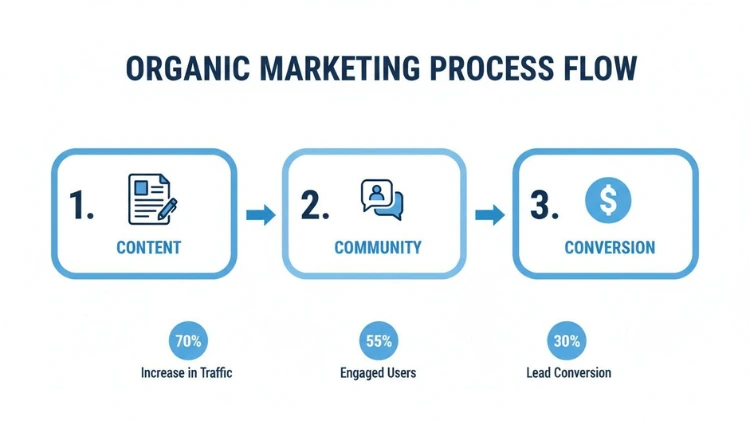
This process highlights how great content and a strong sense of community work hand-in-hand to drive sign-ups.
As you can see, quality content is what initially draws people in, but it's the community and trust you build that ultimately convinces them to become students.
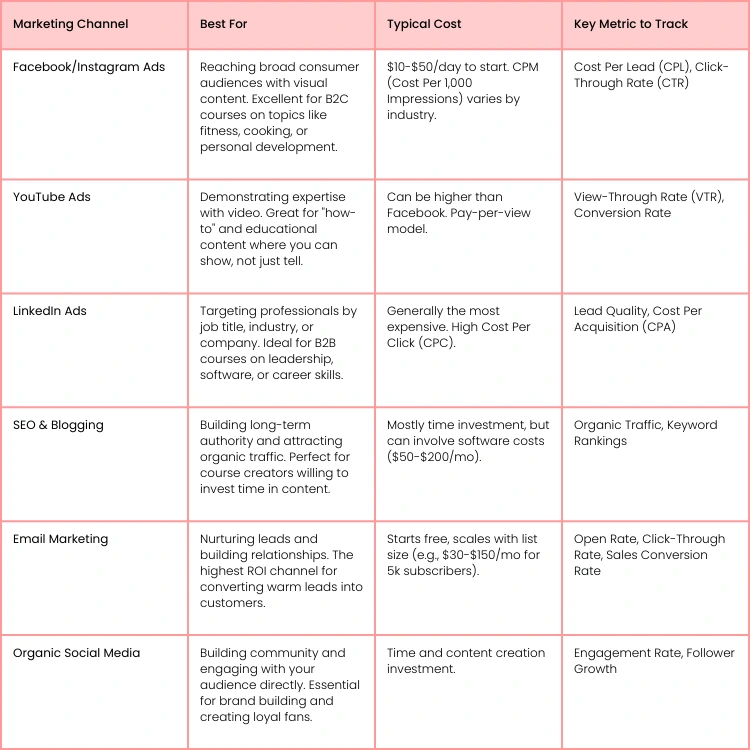
Marketing Channel Comparison For Online Courses
Choosing the right marketing channels can feel overwhelming. Not every platform is a good fit for every course. This table breaks down the most common paid and organic channels to help you decide where to focus your energy and budget.
Remember, the goal isn't to be everywhere at once. It's about mastering one or two channels that align perfectly with your audience and your course topic. Start focused, get results, and then expand.
For those interested in digging deeper into more advanced advertising tactics, this guide on programmatic advertising offers some valuable context. By combining a value-first email funnel with strategic, data-driven paid campaigns, you can create a powerful and predictable system for filling your online course.
Amplify Your Reach with Strategic Partnerships
Trying to build an audience from absolute zero can feel like pushing a boulder uphill. It's a slow, grinding process. But what if you didn't have to do it alone? The smartest course creators we know have figured out a powerful shortcut: tapping into other people's audiences.
Strategic partnerships put your course in front of thousands of potential students who already know, like, and trust the person recommending it. It's all about finding creators, brands, or influencers who serve the same type of person you do, just in a different way. This is the classic win-win—you get exposure to a warm, relevant audience, and your partner offers their community a valuable resource that makes them look good.
Finding and Pitching the Right Partners
The magic word here is alignment. You’re not looking for direct competitors; you need complementary experts.
- Practical Example: Let’s say you teach a course on "Keto for Beginners". Partnering with another keto coach is a bad idea. But teaming up with a fitness influencer, a meal-prep blogger, or even a kitchen gadget company? That’s a perfect match.
Once you have a shortlist of potential partners, your outreach has to be personal. A generic, copy-paste email is a one-way ticket to the trash folder.
Here’s a simple game plan that actually works:
- Engage First, Pitch Later: Before you even think about asking for something, become a real member of their community. Follow them on social media, leave thoughtful comments on their posts, and reply to their newsletters. Be a human.
- Personalize Your Pitch: Your email needs to scream, "I've done my homework". Mention a specific blog post or video you loved and explain exactly why your course would be a fantastic resource for their specific audience.
- Make It Insanely Easy for Them: Propose a clear, low-effort idea. Don’t say, "Let's work together sometime." Instead, suggest something concrete like, "Would you be open to a 20-minute joint Instagram Live next month to discuss X?" or "I've written a guest post for your audience about Y." For more tips, this guide on how to find brand collaborations as an influencer and content creator breaks this down perfectly.
Partnerships land best when they feel like a natural extension of both brands. The goal is to make your introduction feel like a trusted friend making a recommendation, not a blatant sales pitch.
Building an Affiliate Program That Sells For You
One-off collaborations are fantastic for a quick awareness boost, but an affiliate program builds you a scalable, performance-based sales army. You formally invite partners to promote your course, and in return, you give them a commission for every sale they send your way. It’s one of the most cost-effective ways to market a course because you only pay for results.
Setting up a program that's both attractive to affiliates and profitable for you comes down to a few key decisions.
Key Affiliate Program Components
- Commission Structure: For digital products like courses, the industry standard is anywhere from 30% to 50%. Don't cheap out here. A generous commission is a powerful motivator for affiliates to push your course hard.
- Cookie Duration: This determines how long the tracking link stays active after someone clicks it. A 60-90 day cookie window is fair. It gives potential students plenty of time to think it over while still making sure your affiliate gets credit for the sale.
- Promotional Assets: Don't make your partners do all the heavy lifting. Create a "swipe file" for them with pre-written email copy, social media graphics, and ad templates. The easier you make it for them to promote, the more they will.
Actionable Insight: Don't just open your affiliate program to everyone. Hand-pick your first 5-10 affiliates. The best candidates are often your most successful former students. They genuinely love the course and can speak about its benefits from personal experience, which is incredibly persuasive.
Thankfully, the tech side is surprisingly simple. Platforms like ThriveCart have built-in affiliate systems that handle all the tracking and payouts automatically. By empowering others to sell for you, you turn your marketing from a solo grind into a powerful, collaborative growth engine.

Common Questions from Course Creators
As you dive into marketing your online course, a few questions always seem to pop up. Whether you’re figuring out your budget or deciding where to even start, getting these fundamentals right is crucial. Let's tackle some of the most common hurdles creators face.
How Much Should I Spend on Marketing My Online Course?
While there's no single magic number, a great rule of thumb for a first-time launch is to set aside 10-20% of whatever you hope to make. So, if your goal is a $10,000 launch, you should be prepared to invest between $1,000 and $2,000 into marketing.
Things change a bit once your course is evergreen and always available. At that point, your focus shifts to Customer Acquisition Cost (CAC). First, you need to know your student's Lifetime Value (LTV). If your course costs $500 but you have an upsell that many students buy for $100, your LTV is actually $600.
A healthy CAC is usually around 1/3 or less of your LTV. In our example, that means you could comfortably spend up to $200 in ads or other efforts to get a new student and still be very profitable.
- Actionable Insight: Don't go all-in at once. Start with a small, manageable test budget—something like $10-$20 per day on Facebook ads—just to see if people are clicking and converting. Once you find an ad that works and your CAC is safely below your LTV, that's your green light to scale up your spending. The key is to track everything and only double down on what’s proven to work.
What Is the Most Effective Marketing Strategy for a New Creator?
If you're just starting out with a tiny audience (or no audience at all), our best advice is to embrace things that don't scale. Seriously. Forget about complex, automated funnels for now and get your hands dirty with direct outreach and building real relationships.
The absolute best way to do this? Host a free, live workshop or webinar that solves a small, specific problem related to your main course topic.
- Practical Example: If you're selling a course called "Accounting for Freelancers", you could host a free live workshop on "The 5 Biggest Tax Mistakes Freelancers Make".
- Promote this live event everywhere you can—to your tiny email list, your few social followers, and in relevant online communities (just be sure to follow their rules!).
- Going live creates incredible trust. People get to see you, hear you, and ask you questions in real-time. It’s the perfect opportunity to pitch your course to a super-engaged audience at the very end.
This high-touch, manual approach is often what lands you those first crucial sales and testimonials that create all your future momentum.
Should I Use a Course Marketplace or My Own Website?
This is a huge decision, and it really comes down to your long-term goals. There are pretty clear pros and cons to each path.
Choosing your platform is a trade-off between immediate discoverability and long-term business ownership. Marketplaces rent you an audience; your own site helps you build an asset.
Let's break it down simply:
- Course Marketplaces: The big advantage here is the massive, built-in audience. They bring the traffic, which can be a lifesaver when you have no following. The downside? You lose control over pricing, branding, and student data.
- Your Own Website: This route gives you total control. It's your brand, your prices, and most importantly, you own your email list. That said, you're responsible for generating 100% of your own traffic.
How Do I Market My Course with No Social Media Following?
No following? No problem. It just means you have to go where your audience already is. This strategy is often called "audience borrowing" and it’s one of the most powerful ways to get early traction.
Your mission is to find the podcasts, blogs, and YouTube channels that your ideal student already loves and trusts. Then, you find a way to provide massive value to that audience for free.
- Guest Posting: Write a killer, in-depth article for a popular blog in your niche.
- Podcast Interviews: Get yourself booked as a guest on a podcast where you can share your expertise and story.
- Collaborations: Team up with a YouTuber for a joint video or do a collaborative Instagram Live session.
Actionable Insight: When you do a guest post or podcast, don't just link to your homepage. Create a specific, customized landing page and freebie just for that audience. For example: "yourwebsite.com/podcastname". This makes the audience feel special and dramatically increases your email sign-up rate from that appearance.
Each appearance will drive interested people back to your website and your lead magnet, building your email list. At the same time, pick just one social media platform where you know your people hang out and start showing up there consistently. The audience borrowing will give you the initial boost while your own platform grows steadily in the background.
At Uplyrn, we believe that sharing knowledge should be empowering, not overwhelming. Our platform provides all the tools you need to create, market, and sell your online courses, helping you build a thriving business around your expertise. Discover how Uplyrn can help you grow your course business today.


Leave your thoughts here...
All Comments
Reply