









How to Reduce Employee Turnover in Your Organization

Before you can even think about fixing high employee turnover, you have to play detective. Guesswork won’t cut it. The only way to create retention strategies that actually work is by digging into the real reasons people are leaving, blending cold, hard data with candid employee feedback.
Jump To Section

Earn As You Learn
Earn 25% commission when your network purchase Uplyrn courses or subscribe to our annual membership. It’s the best thing ever. Next to learning,
of course.
Why You Are Losing Good People and What It Really Costs
It’s tempting to view employee turnover as a simple line item on the HR budget—the cost of a job ad, a few hours spent interviewing, and some onboarding paperwork. But that view misses the forest for the trees. When a great employee walks out the door, the impact goes far beyond the balance sheet.
Losing someone valuable sends ripples through the entire team, stalling projects, tanking morale, and letting priceless institutional knowledge vanish forever. The real cost isn't just what you can measure in dollars; it's the hidden, operational drag that follows them out.
This isn't just about people quitting. We're seeing a rise in what some call "The Great Detachment"—employees who have mentally checked out long before they hand in their notice. This quiet disengagement is a silent killer of productivity and innovation.
The True Financial and Cultural Impact
Let's be clear: high turnover is a business problem, not just an HR headache. It’s a bright, flashing warning light signaling deeper issues within the organization. In fact, 66% of HR executives name employee retention as their number one concern for a reason.
The cost of ignoring it is staggering. Replacing a single employee can cost anywhere from 20% of their annual salary for mid-level roles to a whopping 210% for highly specialized or senior positions.
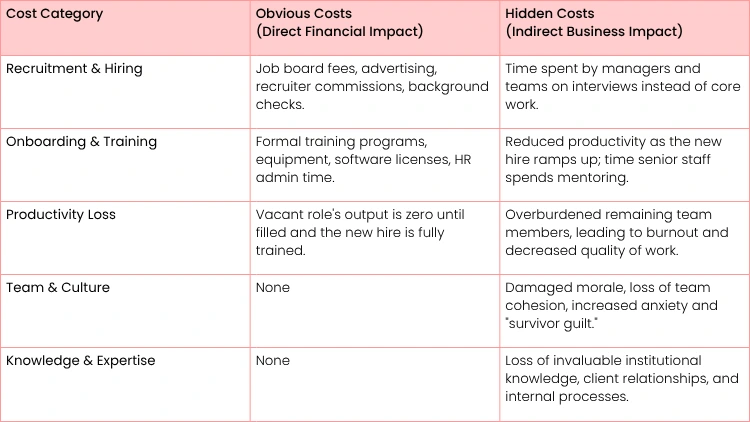
To understand the full picture, you have to look beyond the obvious expenses. We're talking about the tangible costs you see on paper versus the subtle, yet devastating, costs that erode your business from the inside.

The Hidden vs. Obvious Costs of Employee Turnover
This table breaks down where the real pain of turnover comes from.
As you can see, the indirect costs are where the true damage lies. These are the factors that can cripple a team's momentum and poison a healthy company culture.
Think about it in real-world terms:
- Lost Productivity: It takes months, not weeks, for a new hire to get up to speed. During that time, the whole team’s output can dip as others pick up the slack. For example, a new sales rep might take 6 months to match the revenue of the person they replaced.
- Diminished Morale: When a respected colleague leaves, the people left behind often feel overworked and start questioning their own futures at the company. This can easily trigger a domino effect of more resignations.
- Knowledge Drain: Seasoned employees are walking encyclopedias of undocumented knowledge—they know the clients, the history of past projects, and how to navigate internal politics. That kind of wisdom is nearly impossible to replace overnight.
Practical Example: A senior software engineer at a fintech startup resigns. The obvious cost is the recruiter’s fee. The hidden cost is the product launch delay because she was the only one who understood a critical piece of the legacy code, forcing the remaining team to spend weeks deciphering it.
Ultimately, getting a grip on the full scope of turnover is the first critical step toward building a workplace that people genuinely don't want to leave.
Uncovering the Real Reasons Employees Leave
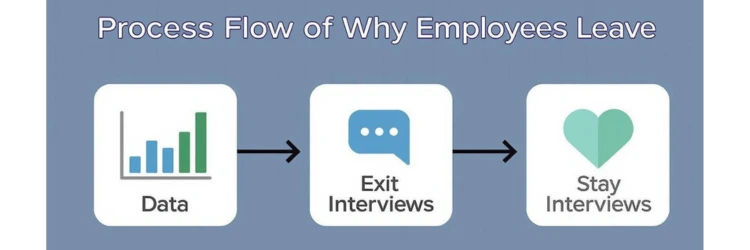
Before you can fix your turnover problem, you have to stop guessing and start diagnosing. Too many leaders jump to conclusions—blaming pay, a few unhappy campers, or some other easy target. But the real story is almost always buried deeper, hidden in patterns you just can't see on the surface.
Getting to the truth means combining hard data with real, human conversations. It’s a two-pronged approach: first, you dig into the analytics to spot the trends, and second, you talk to people to understand the stories behind those numbers. Only then can you build a retention strategy that actually solves your company's specific problems.
Start with the Data Detective Work
Your HR systems are a goldmine, but only if you know where to dig. The first step is to pull your turnover data from the last 12-24 months. You're not looking for a single, scary number; you're hunting for patterns that tell you who is leaving, when, and from where.
Break down the data to find the hotspots:
- By Department: Is the sales team a revolving door while engineering is rock-solid? A high turnover rate in one specific area often points to localized issues—a bad manager, an impossible workload, or a toxic team culture.
- By Manager: This one is classic. If one manager’s team has a significantly higher attrition rate than their peers, you’re seeing the old "people leave managers, not companies" adage play out in real-time.
- By Tenure: Are new hires bolting after just 6-12 months, or are you losing seasoned vets after 5-7 years? Early exits often signal a broken onboarding process or a serious disconnect between the job description and reality. Later departures might mean you have a career growth problem.
- By Performance Level: Are you losing your top performers or your low performers? If your A-players are heading for the exits, that’s a five-alarm fire demanding immediate attention.
Practical Example: A retail company noticed turnover on its sales floor always spiked right around the 18-month mark. A quick look at the data showed their commission structure was heavily front-loaded. Once the big, early payouts were earned, top performers had little financial incentive to stick around.
Actionable Insight: They redesigned the commission plan to include long-term incentives and tenure-based bonuses, which immediately improved retention beyond the two-year mark.
Master the Art of the Exit Interview
Data gives you the "what" but exit interviews give you the "why". A generic, check-the-box interview, however, is a complete waste of time. To get honest feedback, you have to create a safe space where people feel they can speak freely without burning a bridge.
Here's how to make them count:
- Timing is Everything: Hold the interview during the employee's last week, but never on their very last day. This gives them a moment to reflect without being distracted by final handoffs and goodbyes.
- Choose the Right Interviewer: The direct manager is almost always the worst person for the job. You need a neutral third party, like a seasoned HR business partner, who can create a sense of psychological safety.
- Ask Open-Ended Questions: Ditch the simple yes/no stuff. Instead of, "Were you satisfied with your manager?" try asking, "What could your manager have done differently to better support you and your career goals?"
Sample Actionable Exit Interview Questions:
- "What was the specific 'tipping point' that made you decide to start looking for a new role?"
- "Can you describe a time you felt really energized and engaged here? What made that experience stand out?"
- "What's one piece of advice you'd give to the next person taking on your role?"
- "If you had a magic wand and could change one thing about our culture, what would it be?"
Shift from Exit Interviews to Stay Interviews
Exit interviews are reactive; they tell you why people left. Stay interviews are proactive; they tell you why your best people stay—and what might tempt them to leave. Frankly, this is one of the most powerful retention tools out there because you get to fix problems before they lead to a resignation letter.
A stay interview is just a structured, informal chat between a manager and a high-performing employee. It's not a performance review. It's a conversation focused entirely on what keeps them motivated and what the company can do to keep them on board. It's also a fantastic way to understand and improve job satisfaction across your entire team.
Actionable Insight: Schedule 30-minute stay interviews with your key team members quarterly. Ask questions like, "What do you look forward to when you come to work each day?" and "What would make your job more satisfying?" This simple act demonstrates you value their presence and are invested in their future.
Building Your Proactive Retention Strategy
Once you've dug into the data and figured out why people are leaving, it's time to get ahead of the problem. A truly solid retention strategy isn't about plugging leaks as they appear; it's about building a ship that people don't want to jump from in the first place.
This means shifting from reactive fixes to proactively investing in the core pillars of a great employee experience. We're talking about a multi-pronged approach that addresses your team's financial security, professional ambitions, and day-to-day well-being. Let’s break down four of the most critical areas you need to focus on.
Getting Compensation And Benefits Right
Let's be honest: while money isn't everything, it’s a huge piece of the puzzle. If your pay isn't competitive, you’re already fighting a losing battle. But just throwing money at retention is a band-aid solution that won't fix deeper issues with culture or management.
The goal here is to be fair, transparent, and strategic. That process starts with knowing where you stand in the market.
- Benchmark Annually: At the very least, you should be reviewing your salary bands against industry and local data every single year. Use trusted data sources to make sure you're comparing apples to apples for the roles you have.
- Define Clear Salary Bands: Create and communicate specific pay ranges for every role or level in your company. This eliminates guesswork, promotes internal fairness, and cuts down on the feeling that compensation is arbitrary.
- Look at the Whole Package: Total compensation is more than just a base salary. It’s the bonuses, the quality of your health insurance, your 401(k) match, and any equity you offer. A slightly lower base might be perfectly acceptable if it's balanced by stellar benefits.
Creating Clear Pathways For Career Growth
One of the fastest ways to lose your best people is to make them feel like they've hit a ceiling. If your top performers can't see a clear future with you, they'll go find one with someone else. A well-defined career development program is absolutely essential.
This is way more than just offering access to a few online courses. It’s about building a visible, achievable framework for growth that people can actually see themselves in.
A Practical Example: A Marketing Coordinator's Path
Think about Sarah, a Marketing Coordinator. Without a clear path, she might assume the only way to become a Marketing Manager is to leave. A structured career ladder changes that narrative entirely:
- Her Current Role: Marketing Coordinator
- Next Obvious Step: Marketing Specialist (Requires mastering SEO and email marketing, which she can do with internal training and projects).
- Future Goal: Senior Marketing Specialist or Team Lead (Requires leading a few key projects and mentoring junior colleagues).
Actionable Insight: Create a simple one-page document for each core role in your company outlining the skills needed to get to the next level and the potential roles that follow. Share this during performance reviews to make career conversations tangible and proactive.
Of course, you have to back this up with real resources. This could be a learning stipend, mentorship programs, or platforms like Uplyrn that provide targeted upskilling and career support. You're turning career progression from a mystery into a collaborative journey.
Empowering Managers To Be Retention Champions
You've heard it a million times because it's true: people don't leave companies, they leave managers. A manager has a direct, daily impact on an employee's workload, stress levels, and overall job satisfaction. You can have the best pay and perks in the world, but a bad manager will drive people away every time.
This makes management training one of the highest-impact investments you can make. Your managers need to be coaches, not just taskmasters.
Here’s what to focus on in their training:
- Giving Feedback That Actually Helps: Teach them how to give constructive feedback that is specific and behavioral, not personal. Instead of, "This report is a mess", they should be saying, "I noticed a few data points in the client report that didn't line up. Can we review your process to make sure the next one is spot-on?"
- Running Meaningful 1-on-1s: These meetings are for the employee, not just a status update for the manager. Train your leaders to ask questions like, "What's getting in your way that I can help remove?" or "Which part of your work felt most energizing this week?"
- Spotting and Addressing Burnout: Give managers the tools to see the early signs of burnout—like slipping engagement or working late consistently—and empower them to step in by re-prioritizing tasks or shifting workloads.
Investing in your managers is one of the most effective strategies for reducing employee turnover because it turns a potential liability into your biggest retention asset.
Building A Culture Of Recognition And Flexibility
Finally, your strategy needs to address the cultural fabric of your company—the stuff that makes people genuinely want to work there. Two of the biggest levers you can pull are recognition and flexibility. These are the cornerstones of any good employee engagement program.
Real recognition isn't a once-a-year award. It needs to be frequent, specific, and authentic to mean anything.
Simple Recognition Ideas That Work (Actionable Insights)
- Peer-to-Peer Shout-Outs: Create a simple Slack channel (#kudos or #props) where anyone can publicly thank a colleague for their help. It builds camaraderie and ensures good work doesn't go unnoticed.
- "Values in Action" Spotlights: At your next all-hands meeting, highlight an employee who perfectly demonstrated a company value. For example, "I want to recognize Jane for her incredible customer focus when she stayed late to solve a client's urgent issue."
- Manager-Led Thank Yous: Give managers a small discretionary budget ($50 per employee per quarter) for things like a coffee gift card or a team lunch after a tough project is completed.
Flexibility has also shifted from a "nice-to-have" to a "must-have". This isn't about a free-for-all; it's about trusting your team to get their work done in a way that fits their life. Whether it's a hybrid model, flexible start times, or a compressed workweek, offering autonomy shows respect.
When you focus on these four pillars—compensation, career paths, management, and culture—you create an environment where top talent doesn't just stay, they thrive. Find more ways to keep your team engaged by reading about the top employee engagement strategies to implement.
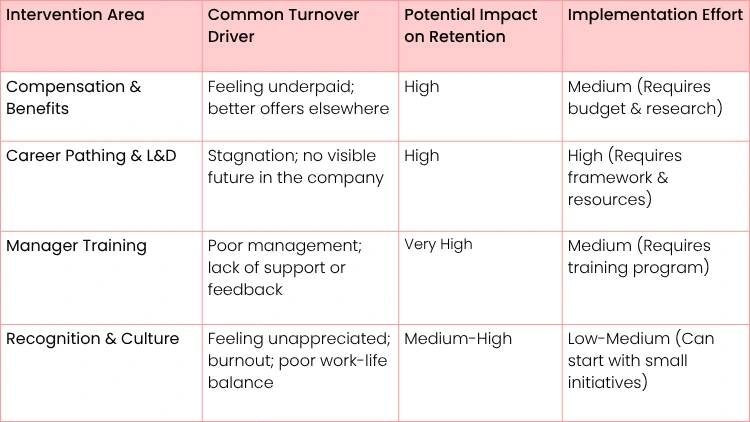
Prioritizing Your Retention Interventions
Not all turnover drivers are created equal, and you can't fix everything at once. This table helps you think through where to focus your energy for the biggest impact based on common issues.
Actionable Insight: If your exit interviews repeatedly mention "lack of growth", a high-effort initiative like building a career pathing framework will have a much greater ROI on retention than a medium-effort tweak to your benefits package. Use your diagnosis to guide your priorities.
Using Career Growth to Boost Employee Loyalty
When employees feel like they’re running in place, they start looking for a new track. One of the single most powerful ways to reduce employee turnover is to show your team you’re genuinely invested in their future. It's a simple truth: a lack of growth opportunities is a top reason high-performers walk out the door. But you can change that.
This isn't about just offering a random library of online courses. It’s about building a clear, visible framework that shows employees their next great role can be right where they are. When you directly connect learning to advancement, you transform training from a simple perk into a powerful retention engine.
From Generic Training to Personalized Career Paths
First things first: ditch the one-size-fits-all training model. It just doesn't work. Instead, you need to map out personalized learning paths that align directly with your company's actual career ladders. This is where platforms like Uplyrn come in, allowing you to create custom skill-building programs for specific roles and departments.
Let's take a junior software developer who wants to become a senior engineer. Instead of leaving them to figure it out alone, you can build a dedicated learning path within Uplyrn that includes:
- Technical Upskilling: Courses on advanced programming languages or cloud architecture.
- Soft Skill Development: Modules on project management and effective team communication.
- Leadership Prep: Training on how to mentor junior devs and lead code reviews.
This kind of structured approach removes all the guesswork. The employee sees a clear, step-by-step plan for reaching their goal, and the company builds a solid pipeline of internal talent ready for promotion. For anyone looking to take that next step, checking out the complete guide to moving up can offer some fantastic insights that pair well with company-led programs.
Fostering Growth Through Mentorship
Skills and knowledge are crucial, but real career growth thrives on human connection. Mentorship programs are an absolute game-changer for retention, bridging the gap between junior staff and seasoned leaders. These relationships create powerful bonds that tie employees more deeply to the organization.
A well-run mentorship program provides immense value all around:
- For Mentees: They get priceless institutional knowledge, honest career advice, and a trusted advocate inside the company.
- For Mentors: Senior leaders get a chance to hone their own coaching skills and stay plugged into the challenges and fresh ideas of the next generation.
- For the Company: It builds a stronger, more collaborative culture and helps you spot high-potential employees early on.
Practical Example: A marketing agency pairs new hires with senior strategists for a formal 6-month mentorship. They meet bi-weekly to discuss career goals and challenges. After implementing the program, the agency saw a 30% reduction in turnover among employees in their first two years. This is a powerful antidote to turnover.
Building a Culture of Continuous Learning
To truly make career growth a cornerstone of your retention strategy, it needs to become part of your everyday culture. This means moving beyond formal programs and encouraging a mindset where everyone is always improving.
You can also empower your team by pointing them toward resources with actionable tips for career growth, which helps them take ownership of their own development.
Here are a few practical ways to embed learning into your daily operations:
- "Lunch and Learn" Sessions: Host informal weekly sessions where team members can share a new skill or a cool project insight over lunch.
- Skill-Based Project Assignments: Intentionally assign people to projects that will stretch their abilities and expose them to new parts of the business.
- Leadership Buy-In: When senior leaders openly talk about their own learning journeys and actually participate in training, it sends a powerful message that development is a priority for everyone.
By proving to your team that you are committed to their upskilling and reskilling, you make one thing crystal clear: their best next opportunity is right here with you. This proactive investment in their potential is one of the most effective ways to build a loyal, engaged, and stable workforce.

Measuring Retention Success and Driving Improvement
You can't fix what you can't see. Kicking off a bunch of new retention initiatives without a way to track their impact is like flying blind. You’re putting in all this effort, but you have no real clue if you're actually moving in the right direction. To get a real sense of what's working, you have to move from an occasional, backward-looking review to a continuous feedback loop powered by a few clear, simple metrics.
This means looking past the overall turnover rate. That number is just the beginning; it doesn't come close to telling the whole story. The real gold is found when you dig a layer deeper.
Identifying the Key Metrics That Matter
To get a clear picture of your company's retention health, you need a small, potent set of key performance indicators (KPIs). Don't drown yourself in dozens of data points. Instead, lock in on a handful that give you a balanced view of both the hard numbers and how your people are actually feeling.
Here are three essentials to get you started:
- Overall Turnover Rate: The classic, of course. This is your baseline, giving you the big-picture view of employee exits over a given period.
- Regrettable Turnover Rate: This might just be the most important metric on the list. It hones in on the percentage of high-performing employees who choose to leave. Losing a top performer costs a fortune in lost productivity and institutional knowledge compared to losing a low performer.
- Employee Net Promoter Score (eNPS): A brilliantly simple survey that asks one question: "On a scale of 0-10, how likely are you to recommend our company as a great place to work?" It’s a powerful, real-time pulse check on employee sentiment and loyalty. A rising eNPS is often a leading indicator of a future drop in turnover.
Practical Example: A mid-sized tech company saw their overall turnover holding steady at 15%, which they thought was manageable. But when we calculated their regrettable turnover, we found it made up 70% of that total—they were hemorrhaging their best engineers. This single insight completely shifted their retention strategy from generic perks to hyper-focused career development for their A-players.
Building a Simple Retention Dashboard
Once you’ve picked your KPIs, you need an easy way to keep an eye on them. You don’t need sophisticated software right out of the gate; a straightforward spreadsheet or a basic dashboard in your existing HRIS can do the job just fine. The real goal is to visualize the trends over time.
Actionable Insight: Create a Google Sheet with four columns: Quarter, Overall Turnover %, Regrettable Turnover %, and eNPS Score. Update it at the end of each quarter and turn the data into a simple line graph. This visual makes it incredibly easy to spot trends and share progress with your leadership team.
Your dashboard should track these key metrics quarterly. For each one, make sure to include:
- The current quarter's number.
- The number from the previous quarter.
- The number from the same quarter last year.
This setup helps you spot patterns immediately. Is regrettable turnover spiking in Q3 every single year? Maybe it’s tied to your annual review cycle. Is the eNPS for one specific department in a nosedive? Time to have a chat with that team's manager. This kind of continuous monitoring transforms raw data into actionable intelligence, allowing you to fine-tune your strategy on the fly. And for a deeper dive into measuring the results of your training efforts, check out the best way to use the Kirkpatrick model for evaluating L&D impact.
Driving Improvement Through Communication and Accountability
Just tracking the numbers is only half the battle. The other half is actually using that information to spark change. This means making retention a shared responsibility, not just another task on HR's plate.
Set up quarterly retention check-ins with your entire leadership team. In these meetings, walk them through your dashboard and talk about the trends you're seeing. But don't just read off the numbers—tell the story behind them.
Practical Example: During a quarterly check-in, the Head of HR presents the dashboard, showing that the Customer Support team's eNPS score dropped by 20 points. Instead of blaming the manager, the leadership team brainstorms solutions. They discover the support team is burned out from a recent product issue and decide to approve two temporary hires to relieve the pressure. This is data driving action.
Celebrate the wins, like a manager whose team eNPS score jumped after they went through new leadership training. Even more importantly, be transparent about the challenges and brainstorm solutions as a group. When you communicate this progress to the whole company, it builds incredible momentum.
Got Questions About Reducing Turnover? We've Got Answers.
When leaders decide to get serious about employee retention, a few key questions always bubble to the surface. Getting straight, practical answers helps you cut through the noise and focus on what really moves the needle.
Where’s the Best Place to Start?
It’s tempting to jump straight into solutions. You hear about a competitor’s cool new perk or read an article about onboarding and think, "We should do that!" That's the most common mistake we see.
Before you spend a dime or an hour on a new initiative, you have to play detective. Your first job is diagnosis. Stop guessing why people are walking out the door.
Actionable Insight: Block out four hours on your calendar this week. Use two hours to pull turnover data from your HR system and sort it by department, manager, and tenure. Use the other two hours to schedule your first three stay interviews with high-performers. By Friday, you will have more clarity than you did on Monday. This is your starting point.
How Can a Small Business Improve Retention on a Tight Budget?
You don't need a Silicon Valley budget to make people want to stay. For smaller businesses, the biggest retention wins often have little to do with expensive perks and everything to do with culture and management.
If your budget is tight, pour your energy into these three high-impact, low-cost areas:
- World-Class Feedback: This costs nothing but time and intention. Train your managers to give feedback that is regular, specific, and genuinely helpful. When people feel seen and know how they're doing, they feel more connected.
- Radical Flexibility: Where the work allows for it, offering flexibility in hours or location is one of the most powerful retention tools available. It's a zero-cost benefit that screams "we trust you".
- Authentic Recognition: Forget the gift cards for a moment. Build a simple way for people to celebrate each other's work. A specific, public "thank you" from a manager or a peer can often mean more than a token bonus.
Practical Example: A 15-person design studio implemented "Focus Fridays", a no-meetings day where employees could work from anywhere. This no-cost policy dramatically improved morale and was cited in stay interviews as a primary reason people loved their jobs.
How Long Does This Actually Take? When Will I See Results?
This is a marathon, not a sprint. While some of your efforts can create "quick wins"—you might see a boost in morale within 3 to 6 months after launching a new recognition program or manager training—the big, systemic changes take time to root.
To see a real, measurable drop in your annual turnover rate, you need to be patient. It typically takes 12 to 18 months of consistent, focused effort. That’s the time it takes for new habits to form, for trust to be rebuilt, and for your retention strategies to become just "the way we do things here".
Ready to build a culture where your best people see a future for themselves? Uplyrn gives you the platform to create personalized learning paths, spark powerful mentorships, and prove you're invested in their growth. See how we can power your retention strategy here.


Leave your thoughts here...
All Comments
Reply