









How to Sell Courses Online: A Playbook for 2026

So, you've got an idea for an online course. That's a fantastic start. But turning that spark of expertise into a real, thriving business? That’s a whole different ball game. It's about more than just hitting record on your camera; it's a deliberate process of building a product that people genuinely want and need.
Jump To Section

Earn As You Learn
Earn 25% commission when your network purchase Uplyrn courses or subscribe to our annual membership. It’s the best thing ever. Next to learning,
of course.
Your Framework for Selling Courses Online
The world of online learning isn't some niche corner of the internet anymore. It's a global powerhouse. This shift is a massive opportunity for experts like you to package your knowledge into something that not only helps people but also builds a sustainable business.
Think about it this way: a marketing pro might notice that financial advisors are great with numbers but totally lost on LinkedIn. The old way was to just post free tips. The new way—the business-minded way—is to see that pain point and create a specific, step-by-step course that solves it. That’s the mindset shift we’re talking about.
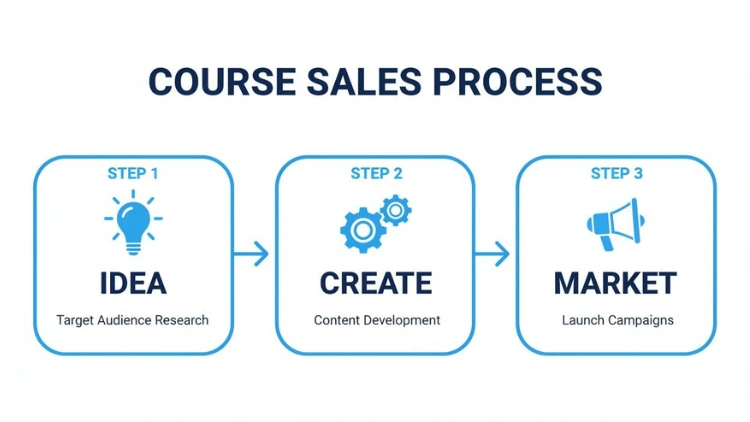
This simple flow chart breaks down the journey from idea to income.
As you can see, the real work starts long before you ever create a single video. It begins with a rock-solid idea, moves into thoughtful creation, and is ultimately fueled by smart marketing.
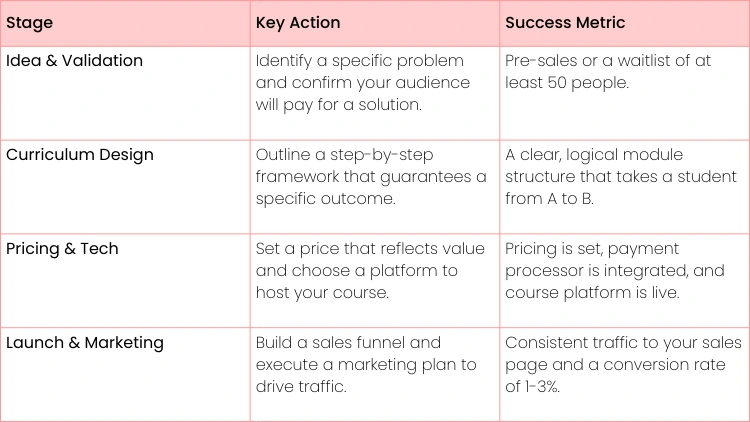
The Opportunity in Online Education
The growth we're seeing in online learning is absolutely staggering. The market for massive open online courses (MOOCs) went from practically zero in 2012 to an incredible 220 million students by 2021. And it hasn't slowed down.
The market hit USD 26 billion in 2024, and it's still climbing, all thanks to learners who want convenient, flexible ways to gain new skills.
This isn't just a trend; it's proof that people are actively looking for—and paying for—quality online education. Your expertise, whether it’s in coding, cake decorating, or financial planning, has an audience waiting for you to guide them.
The Big Idea: Selling a course isn't about dumping information into videos. It’s about spotting a real-world pain point, crafting a step-by-step solution, and building a system to attract the students who need that transformation.
Before you get lost in creating content, you absolutely must make sure people want what you're building. To learn how to create products that sell from day one, check out this guide on the front-loading strategy. This approach is all about making sure you’re building something people will actually line up to buy.
How to Find and Validate a Profitable Course Idea
So you want to sell a course online? Great. But let's get one thing straight: the most successful courses aren't just about your passion. They're born from solving a specific, painful problem for a specific group of people.
Your journey doesn't start with recording videos or designing fancy workbooks. It starts with finding an idea that already has a line of people waiting for a solution. Forget the guesswork—we're going to use real-world data.
You need to become a bit of a digital detective. The good news is, you can use free tools to listen in on what your potential audience is actively searching for. Think of it as eavesdropping on your market's biggest questions.
- Google Trends: This is your first stop. You can see how interest in a topic changes over time. Is the trend for "remote team management" going up? That's a strong signal of a growing market need.
- Actionable Insight: Compare "Python course" vs. "R course" to see which programming language is gaining more search interest right now.
- AnswerThePublic: This tool is gold. It literally visualizes the questions people are typing into Google. A search for "beginner sourdough" might spit out hundreds of gems like "why is my starter not rising?" or "how to get a good sourdough crust". Each one of these is a potential micro-lesson for your course.
- Practical Example: Use the questions you find here to create the titles for your course modules and lessons, ensuring they match what your audience is actively searching for.
Find the Gaps in the Market
Once you have a handful of potential topics, it's time to do some good old-fashioned competitor analysis. Head over to platforms like Uplyrn to see what’s already out there.
Now, don't get discouraged if you see other courses on your topic. In fact, that's a good sign. It proves there's a market for it. Your job is to find the gaps.
Is every photography course aimed at total beginners? Maybe you could create a highly specialized course on "Advanced Real Estate Drone Photography". Are the existing courses all theory and no action? Your angle could be a hands-on, project-based course where students walk away with a complete portfolio. This is how you stand out from the noise.
Key Insight: A crowded market is your friend. Your goal isn't to find a topic no one is teaching; it's to find a topic you can teach better or to a more specific, underserved audience. It’s a classic mistake to think your personal problem is everyone's problem. You have to let the market be your guide. You can read more about why market research is so important to avoid this common trap.
Test Your Idea Before You Build a Single Thing
The single biggest mistake new creators make: they spend hundreds of hours building a beautiful, comprehensive course that nobody wants. Please don't do this.
Instead, test your idea with what we call a Minimum Viable Product (MVP). This is just a small, low-effort version of your course that proves people are willing to pull out their credit cards for your solution.
Here are a few practical MVP ideas you can try this month:
- The Paid Webinar: Host a live, two-hour workshop on a core component of your course idea. If you can get people to pay $49 to attend, you've just validated your demand. It's that simple.
- The Pre-Sale Pilot: This is a classic. Outline your full course curriculum, create a simple sales page, and pre-sell it at a steep discount. For example, a marketing expert could pre-sell a "LinkedIn Content Mini-Course for Financial Advisors" to confirm there's real interest before building out the full program.
- The Short eBook: Write a small, focused eBook that solves one specific problem from your course idea. If it sells, you not only have validation, but you also have content you can expand into a full-blown video course.
This approach completely de-risks your project. Getting those first few sales isn't just about the money—it's the ultimate green light. It’s the market telling you, "Yes, we want this. Build it." That’s when you know you've found a profitable idea worth pursuing.
Designing a Course That Delivers Real Results
So, you’ve got a killer course idea and you know people want it. Fantastic. Now comes the fun part: building an experience that actually delivers on your promise.
This is where so many creators trip up. The goal isn’t to create a massive library of videos that your students collect like digital dust bunnies. The real mission is to build a clear, direct path to a specific outcome. That’s what turns a satisfied student into your most powerful marketing asset.
It’s time to shift your mindset from "content dump" to "learning journey". The courses that truly change lives—and build thriving businesses—are all about action.
Adopt an Action-Oriented Learning Model
This model is as simple as it is powerful: every single piece of content you create must lead to a practical, real-world task. This keeps your students locked in and helps them build momentum. They see themselves making tangible progress, which is the best motivation there is.
Let’s take a course on Facebook Ads as an example. Instead of a rambling 45-minute lecture, you’d break it down into bite-sized, actionable chunks:
- Module 1 Video: A crisp, 7-minute video explaining ad objectives.
- Task 1: A downloadable worksheet that walks students through defining their own campaign objective.
- Module 2 Video: A 10-minute screen-share tutorial on audience targeting.
- Task 2: Students use a provided template to build their first three target audiences directly in their own ad account.
See the difference? They aren’t just passively watching; they are actively doing. This immediate application is what makes the knowledge stick. For more on this, check out this guide on how to create an online course with tips and tricks for success.
Beyond Videos: Building a Complete Experience
Getting high completion rates—and the glowing testimonials that come with them—is about more than just great videos. While short, focused videos are the backbone of your course, a truly premium experience needs more layers.
The demand for quality online education is exploding. The online degree market alone is projected to hit $74 billion by 2025, a staggering jump from $36 billion in 2019. To carve out your slice of this pie, your course must deliver undeniable, real-world value.
Pro Tip: Always structure a course around a final "capstone" project. For a graphic design course, maybe it’s creating a complete brand guide. For a coding bootcamp, it could be building a simple web application. This gives students something tangible to show off at the end.
This is also where you can add premium features that justify a higher price tag. On a platform like Uplyrn, you can weave community and support right into the fabric of your course:
- Community Forums: Build a space where students can ask questions, celebrate their wins, and network. It turns a solo journey into a shared one.
- Expert Coaching: Offer group coaching calls or one-on-one feedback sessions as part of a higher-tier package.
When you design for transformation, not just information, you create a course that practically sells itself through the success of your students. And that, right there, is the ultimate engine for sustainable growth.

Choosing Your Tech and Pricing for Profit
Alright, you've got a killer course idea. Now for the nuts and bolts. The tech you choose and how you price your course are the twin engines that will power your business. Get these right, and you'll save yourself a world of pain down the road and build a solid foundation for growth.
First up, you need to decide where your course is going to go live. There are two main routes you can take, and the best one for you depends on your budget, how comfortable you are with tech, and just how much control you want to have over everything.
Selecting Your Course Platform
Let’s unpack the most common options for hosting and selling your course.
- Dedicated Course Platforms (e.g., Uplyrn): Think of these as bustling online marketplaces built from the ground up for courses. They handle the messy stuff—tech, payments, even some marketing—so you can pour all your energy into creating amazing content. The trade-off? You give up some branding control and typically share a slice of the revenue.
- WordPress with Plugins (e.g., LearnDash): This is the ultimate DIY path. It gives you 100% control over every pixel and process, but you're also the captain, crew, and mechanic. You’re responsible for everything: security, updates, plugin conflicts, and payment gateways. It's the most flexible option by far, but also the most technically demanding.
Key Takeaway: If you’re just starting out and want to test your idea without a massive upfront investment of time and money, a dedicated platform like Uplyrn is often the path of least resistance. If you’re a tech-savvy creator who craves total control, WordPress is your playground.
Pricing Your Course for Transformation
Once you’ve got your tech stack sorted, it’s time to talk money. Honestly, the biggest mistake creators make is pricing their course based on the number of videos or PDFs inside. That's the wrong way to look at it.
Your price should reflect the value of the transformation you deliver.
A course that teaches a high-income skill, like B2B sales negotiation or Python for data science, can easily command $500 to $2,000. Why? Because the return on investment for the student is huge. On the flip side, a hobby-focused course like "Introduction to Watercolor Painting" will likely find its sweet spot between $20 and $50. The outcome is what dictates the price, not the length.
Here are three battle-tested pricing models you can consider:
- Premium One-Time Fee: This is the simplest model out there. Students pay a single price for lifetime access. It’s clean, straightforward, and works perfectly for foundational courses that don't require constant updates.
- Practical Example: A $97 course on "Fundamentals of Graphic Design" that grants access forever.
- Tiered Packages: Offer a few different levels of access. For instance, a "Standard" package might just include the video lessons. A "VIP" package could add weekly group coaching calls, a private community, and direct feedback from you. This is a brilliant way to serve different budgets and levels of commitment.
- Practical Example: A "Standard" package at $199 and a "VIP" package with coaching at $499.
- Recurring Subscriptions: This model is a total game-changer, especially if your content is updated regularly or you're building an active community. It gives you predictable, recurring revenue, which is the holy grail for building a truly sustainable business.
- Practical Example: A $29/month membership for a "Stock Trading Club" with weekly market analysis videos.
Nailing your pricing is both an art and a science. For a much deeper dive, check out this guide on how to price your online course. It gives you a complete framework for putting the right price tag on your expertise.
Building a Sales Funnel That Converts
An amazing course is one thing, but it won't sell itself. Too many creators pour their hearts into building a fantastic program, only to be met with crickets at launch. You can't just hope for the best; you need an automated system that turns curious visitors into enrolled students, working for you around the clock.
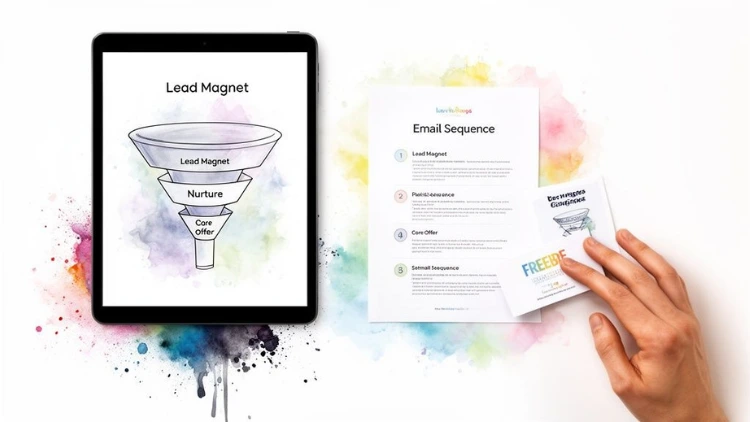
This is where a sales funnel comes in. The most reliable model which works time and again is beautifully simple: Lead Magnet -> Nurture Sequence -> Core Offer. You start by giving away something genuinely valuable for free (your lead magnet) in exchange for an email. From there, you build trust with an automated email series before you even think about asking for the sale.
Crafting a High-Value Lead Magnet
Your lead magnet isn't just a random freebie. It needs to solve a small, specific problem for your ideal student. Think of it as a quick win—a taste of the incredible results your full course delivers. A generic "subscribe to my newsletter" won't cut it. You need to offer a powerful tool.
Here are a couple of real-world examples:
- For a Career Coach: A specialized 'Resume Template for Tech Roles' is the perfect entry point for a comprehensive 'Land Your Dream Tech Job' course. It tackles an immediate, painful problem head-on.
- For a Fitness Instructor: A '7-Day Meal Prep Guide for Busy Professionals' speaks directly to their ideal client for a '12-Week Transformation' program.
To get the most out of your lead magnet, your landing page has to be on point. A solid landing page design can dramatically increase how many people sign up.
The Automated Nurture Sequence
Once someone's on your email list, the real relationship-building begins. This is where your pre-written nurture sequence takes over. It’s a series of emails designed to build trust, establish you as the go-to expert, and naturally introduce your course. It's more about connection than conversion at this stage. We dive deep into this in this guide to build your audience for a successful launch.
And the timing couldn't be better. The e-learning market is absolutely exploding, with projections showing it will skyrocket from $325 billion in 2025 to $1 trillion by 2028. The potential for creators is massive, especially for tech-focused courses which already make up 40% of the top performers. The opportunity is right there for the taking.
A Simple 5-Day Nurture Sequence You Can Steal
- Email 1 (Immediately): Deliver the lead magnet and give them a warm welcome.
- Email 2 (Day 2): Share a powerful case study or a personal story about the problem your course solves.
- Email 3 (Day 4): Bust a common myth or address a mistake your audience makes. This positions you as the expert with the real answers.
- Email 4 (Day 5): Introduce your course as the ultimate solution, focusing on the transformation they'll experience.
- Email 5 (Day 6): Tackle common questions (FAQs) and drop in a great testimonial to build social proof and a bit of urgency.
Scaling Your Course Sales with Smart Marketing
Okay, so your sales funnel is built. Now it's time for the fun part: opening the floodgates and driving consistent traffic. This is where you graduate from simply having an online course to truly scaling a business.
The most effective way to do this is by combining two powerful approaches: organic content that builds your authority and paid advertising that gives you immediate, targeted reach.
Think of organic marketing as your long-term asset. It's all about creating genuinely helpful content that answers the exact questions your ideal students are typing into Google or YouTube. This means SEO-optimized blog posts, in-depth tutorials, or insightful social media threads.
- For example, if you sell a course on public speaking, you could create a YouTube video titled, "How to Stop Saying 'Um' in Your Presentations". It directly solves a common problem, positions you as the go-to expert, and naturally guides viewers toward your paid course.
Getting Started with Paid Ads
If organic marketing is the slow-burning fire, paid advertising on platforms like Facebook and Instagram is the gasoline. It lets you put your course directly in front of the people who need it, right when they need it. Forget casting a wide net; smart targeting is what wins the game.
Here are a couple of powerful strategies:
- Lookalike Audiences: Once you have a handful of sales, you can upload your customer list to Facebook's ad platform. It will then analyze their characteristics and build a brand-new "lookalike" audience of people who are statistically very similar. You get to market to a cold audience that's already primed to be interested in your offer. It's incredibly effective.
- Retargeting: This is a must. You can create campaigns that show specific ads only to people who have visited your sales page but didn't buy. A simple, low-pressure ad that says, "Still thinking about becoming a better public speaker? Your journey starts here." can work wonders to bring warm leads back to finish their purchase.
Pro Tip: Don't feel like you need to break the bank. Start with a small, manageable daily budget—even $10-$20 per day is enough to gather data. Keep a close eye on two key metrics: your Cost Per Lead (CPL) for your lead magnet and, most importantly, your Return On Ad Spend (ROAS). As long as your ROAS is positive, your ads are a profitable investment.
Sustaining Your Growth
Scaling isn't just about getting new students through the door. It's also about keeping the ones you have, especially if you run a subscription or membership model.
Sustainable growth comes from keeping your churn rate low. After all, it's far easier to keep a happy customer than to constantly find new ones. Explore effective methods to reduce subscription churn to maintain a stable student base and predictable revenue.
When you combine smart customer acquisition with strong retention, you’ve found the real recipe for scaling your course business long-term.
Still Have Questions About Selling Your Online Course?
Jumping into the world of course creation always sparks a few questions. It's totally normal. Let's walk through the most common ones so you can get the clarity you need to start building.
How Much Money Can I Realistically Make?
Honestly, the income potential is all over the map. Some creators are happy to bring in a few hundred dollars a month as a side hustle, while others scale their courses into seven-figure businesses. It really hinges on your niche, the size of your audience, how well you market, and of course, your price.
Think about it this way: a well-marketed course on a hot topic like coding or digital marketing, priced at $499, could pull in $25,000 with just 50 students. The real secret is to price based on the transformation you deliver, not just the number of videos.
Do I Need to Be a Video Pro to Make a Course?
Absolutely not. Let's be clear: your students are paying for your brain, not your fancy camera work. In fact, most learners today prefer authenticity over a polished, Hollywood-style production.
Just focus on the basics: clear audio and decent lighting. Your smartphone, a simple lapel mic you can get for cheap, and a window for some natural light are more than enough to create videos that are high-quality and, most importantly, engaging. The content itself is what makes or breaks a course.
What If Someone Else Is Already Teaching My Topic?
That's actually a great thing! Competition is validation. It proves people are willing to open their wallets for what you know. Instead of letting it scare you off, you should see it as a green light.
Your goal isn't to be the only one, but to be a different one. Find a unique spin, focus on a more specific audience, or simply offer a better, more hands-on learning experience. That's how you carve out your space and succeed, even in a field that seems crowded.
How Long Should My Course Be?
There’s no magic number here. The real focus should be on efficiency and results. A short, powerful course that solves a specific problem in two hours is infinitely more valuable than a 20-hour behemoth filled with fluff.
Your job is to break down your topic into the absolute essential steps someone needs to take to get the result you're promising. Your course should be as long as it needs to be to achieve that—and not a minute longer.
Ready to stop wondering and start building? It's time to turn what you know into a business you love. Start building your legacy today at Uplyrn.


Leave your thoughts here...
All Comments
Reply