









Mastering Passive Aggressive and Assertive Communication

At its heart, the difference between passive aggressive and assertive communication comes down to one thing: clarity versus confusion.
Assertiveness is all about expressing what you need, think, and feel directly and honestly, but with respect for the other person. Passive-aggressive behavior, on the other hand, is hostility in disguise. It uses indirect tactics—think sarcasm, the silent treatment, or "forgetting" to do something—to show you're upset without ever having to say it out loud.
Jump To Section

Earn As You Learn
Earn 25% commission when your network purchase Uplyrn courses or subscribe to our annual membership. It’s the best thing ever. Next to learning,
of course.
Defining Communication Styles
Getting a handle on these two approaches is the first real step toward improving how you interact with people. One style builds trust and solves problems, while the other just creates resentment and confusion. The good news is that communication is a skill you can learn, and picking the right style is a game-changer for your relationships and your career.
At a Glance: Passive-Aggressive vs. Assertive Communication
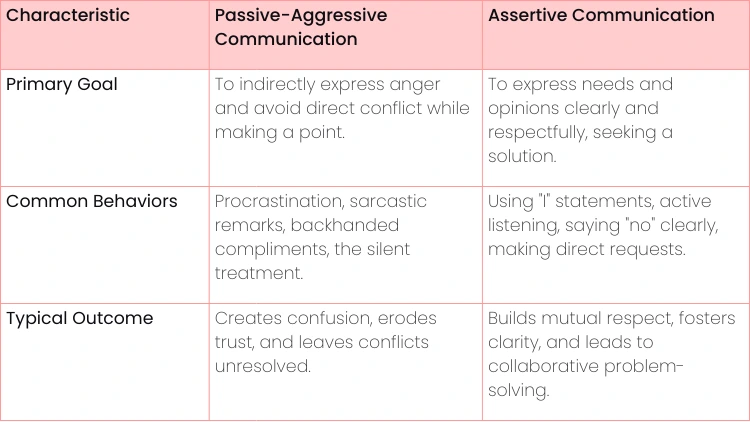
To really see how these styles stack up, let's put them side-by-side. The following table breaks down the fundamental differences in their goals, typical behaviors, and the results they usually produce.
Looking at the table, the contrast is stark. Assertive communication aims for a win-win, where everyone feels heard and respected. Passive aggression, however, operates from a place of hidden anger, which almost always creates lose-lose situations where nobody's real needs are met.
Even though passive aggression feels common, the data shows it’s far from the most effective strategy. A study from the Niagara Institute found that a massive 75.3% of workplace respondents see themselves as primarily assertive, while only 9.6% identify as passive-aggressive. This really cements assertiveness as the standard for professional, effective interactions.
Understanding these distinctions is crucial for improving how you communicate. If you want to dive deeper, you might find this guide on what interpersonal communication is and why it matters helpful.
How to Spot Passive Aggressive Behavior
Trying to pin down passive-aggressive behavior can feel like trying to catch smoke. The hostility is so indirect and cleverly disguised that it often leaves you questioning yourself, wondering if you're just being overly sensitive. Getting good at recognizing these subtle signals is the first real step toward shifting from an emotional reaction to an effective, assertive response.
This communication style is especially common in professional settings, where direct confrontation is often discouraged. According to a survey by Preply, a staggering 83% of Americans have received passive-aggressive emails at work. That statistic really drives home how frequently this kind of indirect hostility can poison team dynamics, all while hiding under a thin veil of professionalism.
Common Verbal and Non-Verbal Cues
Passive aggression shows up in both what people say and what they do—or don't do. The real giveaway is the mismatch between their words and their actions. It’s this disconnect that creates an atmosphere of uncertainty and slowly erodes trust.
Here are some of the most common signs to watch out for:
- Sarcasm as a Weapon: These are the remarks with a biting, critical undertone that get passed off as a "joke". Think of a colleague who says, "Oh, another brilliant plan. What would we do without you?" right after you present a new idea.
- The Silent Treatment: This is when someone deliberately ignores you to express their displeasure without saying a word. It’s a power move designed to punish, and it makes the environment tense and awkward for everyone.
- Practical Example: A teammate is upset you got a lead role on a project, so they stop acknowledging you in meetings and "forget" to reply to your emails.
- Backhanded Compliments: You know these—the praise that comes with a hidden insult attached. A classic example is, "I'm so impressed you finished that project on time; I never thought you would."
- Intentional Inefficiency: This is the person who purposely procrastinates, "forgets" key tasks, or just does a sloppy job. It’s their way of showing resentment for being asked to do something in the first place.
- Practical Example: Your roommate agrees to clean the kitchen but only wipes the counter, leaving dirty dishes in the sink as a way to silently protest.
To really get to the bottom of these behaviors, it's useful to look at the deeper relational patterns that might be at play. For instance, someone with an anxious-avoidant attachment style might be more prone to this kind of indirect communication.
Decoding Common Phrases
Some phrases are just classic passive-aggressive calling cards. While the context always matters, hearing these should definitely make your ears perk up. They're often red flags that someone is avoiding a direct conversation.
A passive-aggressive person often says one thing but means another, leaving you to decipher the real message. Their goal is to express discontent without taking responsibility for it.
Here are a few common phrases and what they really mean:
- "Fine, whatever." This is almost never a sign of agreement. It’s a verbal door-slam, a way to shut down the conversation while signaling that they are definitely not fine.
- "Per my last email..." In a corporate setting, this is the polite-but-pointed way of saying, "You clearly didn't read what I already told you, and I'm annoyed that I have to repeat myself."
- "I was just joking!" This is the go-to defense after landing a sarcastic or critical jab. It's a tactic to deflect accountability and make you feel like you’re the one who’s overreacting.
Learning to recognize these patterns is your best defense. For more strategies, you might find this guide on dealing with difficult personalities helpful.

The True Cost of Passive Aggression at Work
Passive aggression in the workplace isn’t just a minor annoyance—it’s a quiet poison that slowly dismantles team cohesion and drains productivity. Think of it this way: while assertive communication builds bridges, this indirect style of hostility digs trenches, creating an environment where the real issues never see the light of day. Instead of open dialogue, you're left with simmering resentment and unresolved conflicts that fester just beneath the surface.
This constant undercurrent of unspoken negativity is a direct threat to creativity and collaboration. When your team members start fearing sarcastic replies or backhanded compliments, they’ll naturally become hesitant to share new ideas or offer honest feedback. Innovation needs psychological safety to thrive—a space where people feel secure enough to be vulnerable—and passive aggression completely obliterates that foundation. The result? A stagnant team where playing it safe and delivering mediocrity feels like the only winning move.
Eroding Trust and Fueling Turnover
The consequences of this behavior are tangible, and they're costly. When every communication is laced with ambiguity and hidden meanings, trust evaporates. Projects start suffering from missed deadlines due to intentional procrastination cleverly disguised as forgetfulness. Team morale plummets as people grow weary of trying to decode veiled insults. The financial and cultural impact can be severe, leading to widespread disengagement and a constant, expensive cycle of replacing valuable team members.
The data paints a pretty stark picture. A recent study found that 23% of employees admitted passive-aggressive behavior from their colleagues was a real factor in their decision to quit. What's more, a massive 94% believe that stress and anxiety are the primary drivers behind this communication style, highlighting a direct link to workplace burnout.
When passive aggression becomes the norm, the workplace culture shifts from collaborative to combative. The focus moves from achieving shared goals to navigating interpersonal minefields, damaging both individual reputations and the organization's bottom line.
- Actionable Insight: As a manager, you can combat this by modeling assertive communication yourself. Address issues directly but respectfully in team meetings and one-on-ones. Create a clear policy for feedback that encourages constructive, open dialogue and discourages indirect jabs. This sets a standard for the entire team to follow. This toxic atmosphere doesn't just hurt the team; it puts immense pressure on leadership. For more on this, check out this guide on a manager's role in a toxic workplace.
Comparing Communication Styles in Real Scenarios
It’s one thing to understand the textbook definitions of passive-aggressive and assertive communication, but it’s another thing entirely to see how they play out under pressure. Theory is great, but it’s in the messy reality of the workplace—where one conversation can shift a project, a relationship, or even your career—that these concepts truly matter. This is where we close the gap between knowing and doing.
The real test of any communication style is how it holds up when things get stressful. Let's break down some common professional hurdles, looking at side-by-side scripts to show just how different the approaches and outcomes can be. Think of this as a practical model for upgrading your own communication habits when the stakes are high.
Scenario 1: Disagreeing with a Manager
Let's say your manager rolls out a new strategy, but you can see some major flaws in it from your perspective. How you respond is critical.
- Passive-Aggressive Script: You stay quiet during the team meeting. Later, you mutter to a coworker, "Well, I guess this is the new plan. Good luck to us." You might also conveniently "forget" to prioritize tasks for the new strategy, dragging your feet without ever saying why.
- Assertive Script: You pick the right moment—either in the meeting or by asking for a quick chat later—and say, "I appreciate the vision behind this new strategy. I have a couple of concerns about potential roadblocks in area X, and I've got some ideas that might help us get ahead of them. Do you have 15 minutes to talk it over this week?"
The assertive path frames your feedback as a constructive effort to help the plan succeed, not as a challenge to their authority. It’s solution-focused and shows you're engaged.
Scenario 2: Addressing an Unbalanced Workload
Imagine a teammate consistently misses their deadlines, leaving you to scramble and pick up the slack to keep a project from derailing.
- Passive-Aggressive Script: You fire off a "friendly reminder" email and make sure to CC their manager. Maybe you drop sarcastic comments in the office kitchen like, "Must be nice to have so much free time" or just give them the cold shoulder.
- Assertive Script: You pull them aside for a private conversation and say, "Hey, I've noticed I've had to take on the final reporting for the last three project stages to make sure we hit the deadline. I want to make sure we're on the same page. How’s your workload? Let's quickly clarify our roles so we can both stay on track without getting burned out."
The assertive response avoids blame and opens a dialogue. It starts from a place of teamwork, using "I" statements to describe the situation's impact on you and seeking a collaborative solution. This directness is far more likely to resolve the issue than indirect jabs.
Response Showdown: Passive-Aggressive vs. Assertive
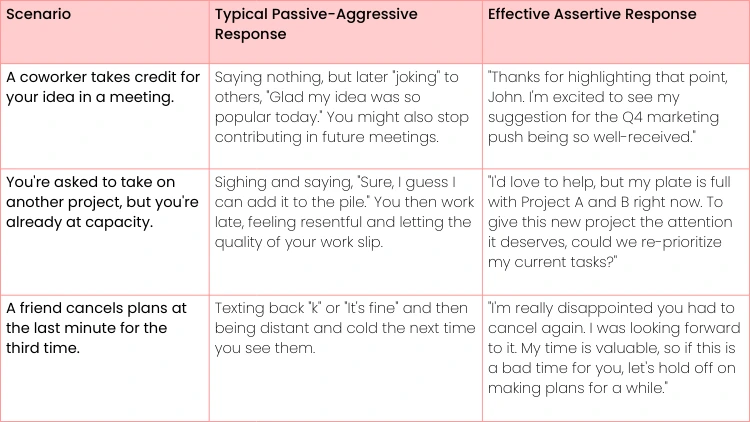
To really see the difference in action, let's put these styles head-to-head in a few more everyday situations. Notice how one approach creates tension and confusion, while the other builds clarity and respect.
The table makes it crystal clear: assertiveness isn't about being aggressive or confrontational. It's about being direct, honest, and respectful—of both yourself and the other person. It’s the fastest path to a genuine resolution.
Actionable Steps to Develop Assertive Communication
Making the switch from passive-aggressive habits to clear, assertive communication isn't something that happens overnight. It's a skill, and like any skill, you can build it with conscious practice. The goal is to learn how to express your thoughts, needs, and feelings directly while still respecting others. Get this right, and you’ll not only resolve conflicts more effectively but also build stronger, more honest relationships in every part of your life.
Master the "I" Statement
If there's one foundational tool for assertive communication, it's the "I" statement. This technique is all about owning your feelings and experiences without pointing fingers. When you stop casting blame, you immediately lower the other person's defenses.
Think about it. Instead of leading with an accusatory "You always...," try framing the issue from your own perspective.
Practical Example:
- Instead of: "You never listen to my ideas in meetings."
- Try: "I feel unheard when I share my ideas and get interrupted. I would appreciate the chance to finish my thoughts."
This simple shift can turn a brewing confrontation into a productive conversation. The impact is huge; techniques like 'I' statements can cut misunderstandings by up to 50% in team settings. And when this becomes the norm? Assertive teams can resolve conflicts 40% faster, a massive boost to performance.
Learn to Set Clear Boundaries
One of the most powerful things you can do for yourself is learn to say "no"—politely but firmly. A lot of passive aggression comes from agreeing to things you secretly resent. Setting boundaries is about protecting your time and energy, which is non-negotiable for preventing burnout and keeping your relationships healthy.
You don't owe anyone a long-winded excuse. A simple, direct refusal is usually the best way to go.
"Clear is kind. Unclear is unkind." This saying gets to the heart of assertiveness. Being direct prevents confusion and respects both your time and the other person's.
- Actionable Insight: Before your next work week, write down one thing you will say "no" to. It could be an extra task, an optional meeting, or working late. Then, practice your response. For instance, if you're asked to take on a task you just don't have the bandwidth for, a strong response would be: "Thank you for thinking of me for this, but I'm unable to take on any new projects right now." It's respectful, honest, and leaves zero room for misinterpretation. To get more comfortable with this, check out this guide on saying no at work without guilt and fear.
Practice Active Listening
Assertiveness isn't a one-way street. It’s not just about talking; it’s about listening to actually understand, not just waiting for your turn to speak. When you show someone you're genuinely hearing their side, it validates their feelings and encourages them to offer you the same courtesy. That's how you build a cycle of mutual respect.
Here's a simple three-step exercise you can start today:
- Listen Fully: The next time someone is talking, give them your complete focus. Fight the urge to plan your rebuttal while they're still speaking.
- Paraphrase and Clarify: When they finish, summarize what you heard. Say something like, "So if I'm understanding correctly, you're feeling frustrated because..."
- Share Your View: Once they confirm you've got it right, you can then share your perspective using an "I" statement.
This process ensures both of you feel heard and respected, turning potential arguments into dialogues where you can actually solve problems together.
Common Questions About Assertiveness
Dipping your toes into a more direct communication style can feel a little intimidating. It's totally natural to have questions, and getting a handle on the common misconceptions about the line between passive-aggressive and assertive communication is a huge first step toward building confidence. Let's clear up some of those nuances right now.
A lot of us hold back from being assertive because we're terrified of coming across as rude or pushy. This is a massive hurdle, but it’s rooted in a fundamental misunderstanding of what assertiveness really means. Once you get the core differences, you can start practicing this skill effectively and, just as importantly, ethically.
Assertive vs. Aggressive: What Is the Difference?
The most critical distinction between being assertive and being aggressive boils down to one simple word: respect.
Assertive communication is all about honoring your own needs, feelings, and boundaries while—and this is the key part—also respecting the needs, feelings, and boundaries of the other person. It’s a balanced approach that shoots for a win-win outcome where everyone feels heard. On the flip side, aggressive communication steamrolls right over the other person’s rights, zeroing in on a win-lose result where your needs are met at their expense.
Assertiveness says, "My feelings matter, and so do yours." Aggression screams, "Only my feelings matter." That fundamental difference in intent is what separates a constructive conversation from a destructive conflict.
Practical Example:
- Aggressive: "That's a terrible idea. We're doing it my way."
- Assertive: "I see the point you're making, but I have a different perspective. Can we explore a third option that incorporates both our ideas?"
How to Handle a Passive-Aggressive Person
When you're faced with passive-aggressive behavior, the single most effective strategy is to meet it with calm, direct assertiveness. Instead of getting sucked into an emotional reaction to their subtle jabs, stay focused on the real issue and gently steer the conversation toward clarity.
- Actionable Insight: Try using clarifying questions to nudge them toward being more direct. For example, if a colleague says, "Must be nice having an easy project", you could respond calmly with, "It sounds like you have a concern about the workload distribution. Can you tell me more about what you mean?" This puts the ball back in their court to be clear. You can also use "I" statements to explain the behavior's impact without pointing fingers: "When the deadline gets missed, I have to rush my part of the project. Can we figure out a solution together?" For a deeper dive, check out this guide on how to improve your communication skills in tough situations.
How Long Does It Take to Become More Assertive?
Becoming more assertive is a journey, not an overnight switch. It's a skill, and like any skill, it takes consistent, conscious practice. You can start using simple techniques like "I" statements today and see small but meaningful wins in your daily interactions.
But for assertiveness to become your go-to, automatic communication style? That could take several months of dedicated effort. The trick is to be patient with yourself. Start by practicing in low-stakes situations, give yourself a high-five for the small victories, and remember to focus on progress, not perfection.


Leave your thoughts here...
All Comments
Reply