









The 4 Stages of the Product Life Cycle: A Practical Guide

Every product, just like every person, has a life cycle. It’s born, it grows up, it matures, and eventually, it declines. This journey is what we call the product life cycle, and it’s typically broken down into four distinct stages: Introduction, Growth, Maturity, and Decline.
Think of it like the four seasons. Each phase has its own unique climate and requires a different strategy to navigate successfully. You wouldn't wear a parka in July, and you wouldn't try to scale your marketing budget before anyone knows your product exists.
Understanding this cycle isn't just a neat business school theory; it's a powerful strategic tool. It gives you a roadmap to anticipate what’s coming next, helping you make proactive decisions about marketing, pricing, and product development instead of just reacting when your sales numbers suddenly change.
Jump To Section

Earn As You Learn
Earn 25% commission when your network purchase Uplyrn courses or subscribe to our annual membership. It’s the best thing ever. Next to learning,
of course.
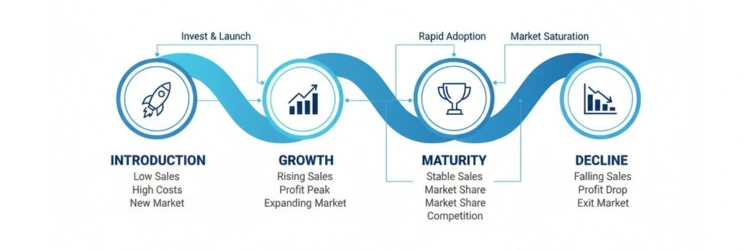
The 4 Stages of the Product Life Cycle at a Glance
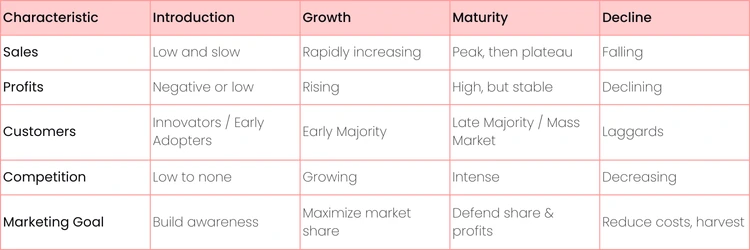
The table below offers a side-by-side comparison of the key characteristics defining each stage of a product's journey, from sales trends to the competitive landscape.
Understanding these differences is the first step to mastering your product strategy and ensuring you're doing the right things at the right time.
A Quick Look at Each Stage
Let’s take a bird's-eye view of what happens in each phase. Every stage brings its own set of challenges and opportunities, demanding a specific game plan. Before a product can even enter this cycle, it has to solve a real problem for a real audience. If you're starting out, it's critical to begin by identifying the problem-solution fit for your startup.
- Introduction: This is the big launch. Sales are sluggish as you work to build awareness. Profits are usually in the red because of heavy spending on R&D and marketing. The main goal here is just to get a foothold.
- Growth: Things are taking off! Sales start climbing fast as your product gains traction with a wider audience. Profits grow as your production costs decrease with scale. But be warned—this is when competitors start to notice you and jump in. Your focus shifts to grabbing as much market share as you can, as quickly as possible.
- Maturity: The party starts to wind down. Sales growth flattens out and hits a ceiling. The market is now saturated, and competition is fierce, which often leads to price wars and a battle for customer loyalty. The key objective is to defend your turf and squeeze out as much profit as you can.
- Decline: The inevitable final chapter. Both sales and profits begin to drop. This could be due to new technologies, changing consumer tastes, or simply everyone who wanted your product already has it. Now you face a tough choice: try to reinvent the product, milk it for any remaining profit (harvest), or phase it out completely.
Stage 1: Introduction – Igniting Your Market Entry
This is the launch pad. The Introduction stage is a high-stakes, high-investment period where sales start slow, competition is minimal, and you’re spending a lot of money just to get noticed. Think of it like planting a seed; you put a ton of resources into the soil upfront with no immediate harvest, focusing instead on creating the perfect conditions for future growth.
The primary goal here isn't profit. It's about carving out a space in the market and teaching potential customers that your product even exists and why they should care.
During this phase, you’re almost certainly losing money. The cash poured into research, development, and marketing campaigns will far outweigh any initial revenue trickling in. A rock-solid product launch strategy is non-negotiable here. Your focus is simply on survival and building awareness.
Key Characteristics And Strategies
In the Introduction stage, your marketing is laser-focused on creating brand awareness and attracting those first adventurous customers—the early adopters willing to try something new. You're not just selling a product; you're selling a new idea, a new way of doing things.
A few key strategies come into play:
- Pricing Strategy: You have two main options. You could go with price skimming (starting with a high price to capture eager early adopters) or penetration pricing (launching with a low price to grab market share fast).
- Marketing Focus: Campaigns are heavily educational. They need to clearly explain what the product does and why it matters. Expect to spend big here.
- Distribution Channels: Distribution is usually very selective at first. You're still figuring out the most effective channels to reach your target audience without wasting money.
Actionable Insight: The Introduction stage is a game of patience and precision. Focus all your energy on one or two key buyer personas. Trying to be everything to everyone at launch is a recipe for burning through your budget with little to show for it.
Practical Example And KPIs
Practical Example: When Tesla first launched the original Roadster in 2008, they didn't try to sell it to everyone. They targeted wealthy, tech-savvy early adopters who were passionate about innovation and less sensitive to the high price tag. Their marketing wasn’t about being a practical family car; it was an educational campaign about the future of electric vehicles, building a brand image long before they aimed for the mass market.
To get through this period, you have to track the right Key Performance Indicators (KPIs) to make sure your launch is on solid ground. The data you gather now is what you'll use to build momentum in the next stage. Learning about the essential research techniques to develop a successful B2B go-to-market strategy is critical to getting this right from day one.
Here are the vital signs to watch:
- Customer Acquisition Cost (CAC): How much are you paying, on average, to get one new customer?
- Brand Awareness Metrics: Keep an eye on social media mentions, direct website traffic, and how many people are searching for your brand name.
- Trial or Demo Sign-ups: This is a direct measure of interest. Are people curious enough to give it a try?
- Conversion Rate: What percentage of those trial users are becoming paying customers?
Stage 2: Growth – Scaling And Capturing The Market
Alright, you’ve survived the launch. Now the real fun begins. Welcome to the Growth stage, the acceleration phase where all your hard work starts to pay off.
This is when sales begin to climb, profits finally show up, and the market really starts to notice what you’ve built. Your focus has to pivot—hard. It's no longer just about creating awareness; it’s about aggressively grabbing as much market share as you can before the competition shows up to the party.
Your goal is to build brand preference and persuade the "early majority" that your product is the best choice among the growing number of alternatives. That’s the Growth stage in a nutshell.
This kind of rapid expansion is a double-edged sword. On one hand, you start benefiting from economies of scale, which means better profitability. On the other hand, your success is like a giant flashing sign for competitors. They see a proven market and start scrambling to launch their own versions.
Key Characteristics And Strategies
During the Growth phase, you need a new playbook to keep the momentum going. The goal is to cement your brand as the go-to choice and build a fiercely loyal customer base that won't jump ship. Your marketing has to evolve from just explaining what your product is to persuading people why it's better than the new alternatives popping up.
Here’s how your strategy needs to shift:
- Product Strategy: It’s time to level up. Add new features, improve the quality, and expand your service options. This keeps your product fresh and makes it appeal to an even wider audience.
- Marketing Strategy: Move away from broad awareness campaigns and get more targeted. Focus on building brand preference and creating a real community around your product.
- Distribution Strategy: Make it easier for people to buy from you. Open up new distribution channels, whether that’s new retail partners, online marketplaces, or expanding into different countries.
Actionable Insight: Your job now is to build a "moat" around your product. This could be a killer feature set, an unbelievably good customer experience, or a strong brand community. You want to create switching costs that make leaving you for a competitor feel like a major downgrade.
Practical Example And KPIs
Practical Example: Think back to the early days of streaming services. Once a company like Netflix proved the concept and hooked its first wave of users, it hit a period of absolutely explosive growth. As it grew, it didn't just sit on its existing library. It poured money into original content (a brilliant product enhancement), expanded into dozens of new countries (a massive distribution expansion), and launched huge ad campaigns to become a global name (a powerful marketing push). This strategy helped it build a massive lead before competitors like Disney+ and HBO Max entered the fray.
Scaling this fast means you have to be obsessed with your numbers to make sure the growth is sustainable. As you expand, you also need a steady stream of new customers. You can learn more about effective lead generation strategies tips and tricks for startups to keep that pipeline full.
Keep a close eye on these key metrics:
- Market Share Growth: Are you still gaining ground, or are new competitors starting to eat into your lead?
- Customer Lifetime Value (CLV): As you get bigger, is the long-term value of each new customer going up? It should be.
- Customer Satisfaction (CSAT): Is your quality holding up under the pressure of growth? Happy customers stick around and bring their friends.
- Repeat Purchase Rate: Are people coming back for more? This is the ultimate sign of a product that’s truly solved a problem.

Stage 3: Maturity — Defending Your Position and Maximizing Profit
After that whirlwind of rapid expansion in the Growth stage, your product finally hits the summit. This is the Maturity stage, the point where sales growth flattens out and reaches its peak.
Think of it this way: the market is now saturated. Pretty much everyone who was ever going to buy your product has already done so. Because of this, competition becomes more intense than you've ever seen. But there's a huge upside—this is often the most profitable of the 4 stages of the product life cycle.
The game changes completely. Your challenge is no longer about grabbing new market share; it's about defending what you have. The primary goals now are to squeeze out as much profit as possible, fend off competitors, and keep this lucrative phase going for as long as you can.
Key Characteristics and Strategies
By the time you reach the Maturity stage, your brand is well-established. But don't get comfortable. Rivals are constantly looking for cracks in your armor, trying to steal your hard-won customers.
Your marketing messages have to pivot. Instead of trying to attract brand-new buyers, the focus shifts to reinforcing brand loyalty. You need to remind your existing customers why they chose you in the first place. For a deeper dive, this guide on building brand identity is a great resource.
Strategies become much more defensive and laser-focused on efficiency:
- Product Strategy: Differentiation is everything now. You'll want to introduce minor improvements, add new features, or roll out different models to keep things fresh and stand out.
- Pricing Strategy: A saturated market almost always leads to price wars. You might need to lower your prices to stay competitive, or you could offer bundles and special promotions to create more perceived value.
- Marketing Strategy: It’s time to double down on what makes your brand unique. Emphasize superior quality, unbeatable customer service, or your brand's heritage to justify your spot at the top.
Actionable Insight: Shift your focus from acquisition to retention. It's often five times more expensive to attract a new customer than to keep an existing one. During the maturity phase, maintaining customer relationships is crucial; understanding how to build customer loyalty can help defend your market position.
Practical Example and KPIs
Practical Example: The modern smartphone market is the perfect poster child for the Maturity stage. The big players like Apple and Samsung aren't seeing the explosive growth they once did. Instead, they're locked in a fierce battle over existing customers. You can see their strategies in action with every new release. It’s all about subtle product tweaks (a slightly faster chip, a trendy new color) and clever promotional pricing (trade-in deals, carrier discounts) designed to encourage upgrades and stop customers from jumping ship to a competitor.
To survive in this competitive arena, you have to track the right KPIs to protect your profit margins and market share.
- Customer Retention Rate: What percentage of your customers are sticking with you over time? This is your single most important health metric in the Maturity stage.
- Market Share: While you might not be growing it, are you successfully defending your slice of the pie against competitors?
- Average Revenue Per User (ARPU): Are you finding creative ways to get each customer to spend more, maybe through services or accessories?
- Profit Margins: As you fight off rivals and potentially lower prices, are you optimizing your operations to keep profits healthy?
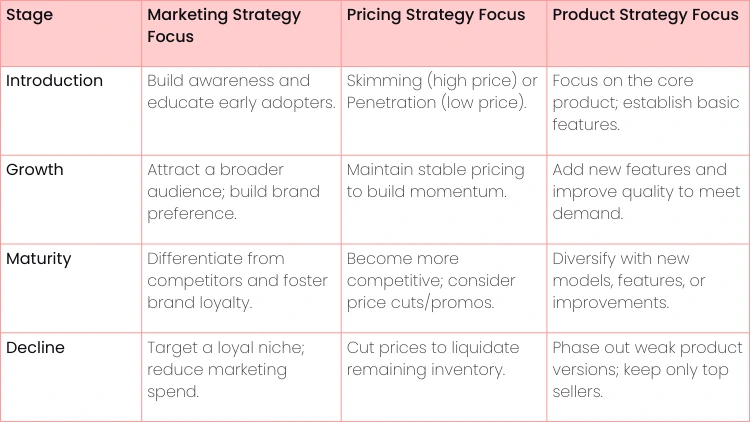
To give you a clearer picture, let's break down how these strategies evolve across the entire product life cycle.
Strategic Focus Across the Product Life Cycle
This table shows how your priorities must shift as your product moves from one stage to the next. The strategies that worked in the Growth phase will fall flat in Maturity, which is why adapting is so critical to long-term success.
Stage 4: Decline — Making Smart Endgame Decisions
Sooner or later, every product’s journey winds down. The Decline stage isn’t about admitting failure; it’s about making smart, strategic choices when sales and profits take a permanent dip. This isn't a fluke. It's usually kicked off by a major shift, like changing consumer tastes, a disruptive new technology hitting the scene, or the market simply becoming oversaturated.
When your product hits this final phase, you’re at a crossroads. The trick is to take emotion out of the equation and focus on a clear-eyed endgame strategy.
Identifying the Endgame and Core Strategies
The dead giveaway of the Decline stage is a steady, persistent drop in sales that can't be fixed with a new marketing campaign or a price cut. Your market share starts to shrink, profits all but disappear, and a product that was once a star player is now just eating up resources that could be put to better use.
Getting through this phase without getting burned comes down to picking one of three core strategies. Each has its own set of pros and cons, so the right call really depends on how much brand loyalty your product still has and where your company is headed.
- Harvesting: This is all about maximizing whatever short-term cash you can squeeze out. You go into full cost-cutting mode—slashing the marketing budget, winding down product support, and streamlining operations—to milk every last drop of profit from the loyal customers who are still hanging on.
- Divesting: Maybe the product or brand still has some value, but it just doesn't fit into your company's future plans. In that case, you can sell it off. Divesting lets you pass the product line to another business that might see a better strategic opportunity for it.
- Discontinuing: This is the "pull the plug" option, plain and simple. You completely phase out the product, liquidate whatever inventory is left, and officially retire it from your portfolio. This frees up cash, people, and focus to pour into new, more promising ventures.
Actionable Insight: The biggest mistake leaders make in the Decline stage is doing nothing. It's easy to hold on to a failing product because of emotional attachment, hoping against hope for a turnaround that's never going to happen. A proactive decision, even a really tough one, is always better than letting it slowly bleed you dry.
Practical Example and Strategic Decision Making
Practical Example: Just look at the story of BlackBerry phones. They were once the undisputed kings of the mobile market, but the rise of the iPhone and Android devices sent them into a steep decline. For years, they tried to fight back, but sales just kept dropping. Finally, they made a smart strategic move: they harvested profits from their loyal enterprise customers while simultaneously divesting by licensing the brand name to other hardware makers. This allowed them to exit the phone business and pivot to software and security services, ultimately saving the company.
This strategic move allowed them to survive and completely reinvent themselves. If your product is facing a similar uphill battle, it's time to dig into the root causes. Check out this guide on why your business might be struggling and what to do about it for more ideas. The final chapter of the 4 stages of the product life cycle demands tough but absolutely necessary choices.
How to Extend Your Product's Life Cycle
Just because a product hits the Maturity stage doesn't mean the end is near. Think of it less as a cliff and more as a high plateau with multiple paths forward. Reaching the Decline stage isn't a foregone conclusion.
With the right moves, you can keep the profitable Maturity stage going for a long, long time, giving a product a second wind and pushing its final chapter far into the future. This isn't about small, insignificant updates; it’s about making smart, calculated plays to kickstart growth all over again.
Finding New Customers Through Market Development
One of the most powerful ways to breathe new life into a product is to find a whole new group of people who need it. This strategy is called market development. You take the exact same product you’ve been selling and introduce it to a completely new audience.
This could mean targeting a different demographic, expanding to a new city or country, or finding a new segment of customers you’d never considered before.
- Practical Example: For decades, Johnson & Johnson's baby shampoo was just for babies. To extend its lifecycle, they started marketing it to adults as a super-gentle, mild shampoo for daily use. The product didn't change, but the customer base exploded.
- Actionable Insight: To find new markets, analyze your existing customer data for unexpected user segments. Are there industries or demographics using your product in ways you never intended? This can be a goldmine for identifying your next target audience.
Revitalizing Your Offering with Product Modification
Sometimes, it’s the product itself that needs a refresh. Product modification is all about changing one or more of its features—maybe its quality, its capabilities, or even just its design—to win over new users or get your current ones to use it more often.
This might be as simple as adding a new feature that your competitors don't have or making a significant improvement to the product's performance and durability.
- Practical Example: Car manufacturers are masters of this. A model like the Honda Civic remains in the maturity stage for years by releasing updated versions annually with better tech, improved fuel efficiency, and sleeker designs, encouraging repeat purchases.
- Actionable Insight: Your customers are your best source of ideas. The most successful product modifications often come straight from their feedback and complaints. They will flat-out tell you what they wish your product could do.
Repositioning Your Brand for a New Perception
Finally, you can completely change how people see your product through repositioning. This is a strategic marketing shift that alters the product's entire image in the public's mind. The goal is often to appeal to a totally different market or to make it stand out in a crowded space.
It’s about changing the story, not necessarily the product.
- Practical Example: Old Spice used to be your grandpa’s aftershave. It was seen as dated and out of touch. Then came the wildly clever and funny "The Man Your Man Could Smell Like" campaign. Overnight, they repositioned the brand as cool, modern, and desirable for a much younger audience, dramatically extending its life.
- Actionable Insight: Repositioning works best when it's grounded in an authentic product truth. Old Spice didn’t claim to be a luxury brand; it leaned into its masculine heritage with humor. Find a core attribute of your product and present it to a new audience in a fresh, compelling way.
Got Questions?
Once you start thinking about the 4 stages of the product life cycle, a few questions always seem to pop up. Let's tackle some of the most common ones so you can start putting this framework to work.
How Does the Product Life Cycle Apply to Digital Products and Services?
The model works perfectly for digital stuff, but the timeline is often hyper-compressed. A SaaS product, for instance, might blow through its entire cycle in just a few years, not the decades it might take for something like a car model.
- Practical Example: A social media app like Clubhouse had an explosive introduction and growth period in 2020-2021, hit maturity very quickly as competitors like Twitter Spaces emerged, and entered a decline as the initial hype wore off—all within about two years. The decline stage meant pivoting its feature set rather than having unsold inventory.
Can a Product Re-Enter a Previous Stage?
Yes, and this is where things get really interesting. A product that's settled into the Maturity stage can absolutely be kicked back into Growth with the right moves. In fact, this is the entire goal of life cycle extension strategies.
- Practical Example: When iPod sales started to flatten out, Apple didn't just let it fade. They launched the iPod Nano and Shuffle, which were smaller, more colorful, and targeted new segments. Bam—they essentially relaunched the growth phase for the entire product line by reigniting interest and capturing new customers.
How Do I Know Which Stage My Product Is In?
You have to look at the vital signs—your key metrics. Is your sales growth going vertical while new competitors seem to pop up every other day? You're almost certainly in the Growth stage. Or have sales leveled off, and now you're in a dogfight over pricing just to hold onto your market share? That's a textbook sign of Maturity.
- Actionable Insight: To get a clear diagnosis, create a dashboard tracking your sales growth rate (month-over-month and year-over-year), market share percentage, and profit margins. Reviewing these three metrics together will give you a clear, data-driven picture of which stage your product is in.
Ready to become the expert who can guide products through every stage with confidence? Uplyrn offers practical, expert-led courses on product management, marketing strategy, and business development. Start building your skills today.


Leave your thoughts here...
All Comments
Reply