









10 Succession Planning Best Practices for 2026

A leadership gap isn't just an inconvenience; it's a critical business risk that can halt momentum, erode investor confidence, and disrupt your entire organization. Yet, many companies treat succession planning as a reactive, 'check-the-box' exercise, only scrambling when a key executive announces their departure. This approach is no longer sustainable in a competitive business environment. True organizational resilience comes from a proactive, strategic, and deeply integrated talent development culture that anticipates needs before they become emergencies.
This article moves beyond generic advice to provide a detailed roundup of 10 essential succession planning best practices. We will explore actionable strategies, practical examples, and step-by-step insights that HR leaders and managers can implement immediately to build a robust leadership pipeline. To truly build a resilient leadership pipeline, it's essential to understand the critical distinction between employee training and development as a foundational concept. Training addresses immediate skill gaps, while development prepares individuals for future roles and unknown challenges.
From early talent identification and documented strategic plans to implementing robust mentoring programs and capturing institutional knowledge, each practice detailed here is a vital component of a comprehensive succession framework. You will learn not just what to do, but how to do it effectively, ensuring your organization is prepared for any leadership transition. We'll cover everything from defining critical competencies to preparing for unexpected vacancies, providing a complete playbook for cultivating leaders who can not only fill vacancies but actively drive future business success.
Jump To Section

Earn As You Learn
Earn 25% commission when your network purchase Uplyrn courses or subscribe to our annual membership. It’s the best thing ever. Next to learning,
of course.
1. Early Identification and Assessment of High-Potential Talent
Proactive succession planning begins long before a key role becomes vacant. The foundational step is to systematically identify and assess high-potential (HiPo) employees early in their careers. This practice shifts the organization from a reactive hiring scramble to a strategic, forward-thinking approach, ensuring a ready pipeline of internal leaders. By recognizing talent ahead of immediate need, you create the runway necessary for meaningful leadership development.
This approach goes beyond simply rewarding top performers. It involves a multi-faceted evaluation to distinguish employees who excel in their current roles from those who possess the agility, aspiration, and engagement to succeed in more complex, senior positions. This is a core component of effective succession planning best practices, as it directly addresses the long-term leadership needs of the business.
How to Implement Early Identification
To build a robust identification process, organizations must move beyond subjective manager nominations. A balanced scorecard approach provides a more objective and holistic view of an employee's potential.
- Performance Metrics: Analyze historical performance data, focusing on consistency and the ability to exceed expectations in varied contexts.
- Behavioral Assessments: Use tools like 360-degree feedback, situational judgment tests, and behavioral interviews to evaluate leadership competencies such as strategic thinking, emotional intelligence, and resilience.
- Potential vs. Performance Grid: Plot employees on a nine-box grid that maps their current performance against their future potential. This visual tool helps distinguish between solid contributors and true high-potentials who need accelerated development.
Practical Example: A project manager who consistently delivers projects on time (high performance) also demonstrates an exceptional ability to motivate cross-functional teams, resolve conflicts without escalation, and proactively identify future project risks (high potential). This combination makes them a prime candidate for a future program director role.
Actionable Insights for Success
- Establish Clear Criteria: Define and communicate what "potential" means in your organization. Is it learning agility, strategic mindset, or motivational capability?
- Actionable Insight: Create a one-page guide for managers defining these traits with behavioral examples to ensure everyone uses the same objective framework.
- Leverage Multiple Data Points: Avoid relying solely on a manager's opinion. Incorporate peer feedback, project outcomes, and psychometric assessments to create a well-rounded profile.
- Actionable Insight: Implement a "talent calibration" meeting where managers discuss and defend their HiPo nominations with their peers to challenge bias and ensure consistency.
- Review and Calibrate Regularly: Talent is not static. Conduct annual or semi-annual talent reviews to reassess your HiPo pool, allowing for new additions and recognizing that some individuals' career goals may change over time.
2. Documented Succession Plans Aligned with Business Strategy and Clear Timelines
Effective succession planning moves beyond informal conversations and into a structured, documented process. Creating formal, written succession plans for critical roles provides a clear roadmap for leadership continuity. This practice transforms succession planning from a hypothetical exercise into an actionable strategy, complete with specific timelines, successor candidates, identified development gaps, and contingency plans.
The true power of this approach lies in its direct link to the organization's strategic objectives. A documented plan ensures that future leaders are being developed not just for the roles of today, but for the business challenges of tomorrow. This is a cornerstone of succession planning best practices because it guarantees that leadership development efforts are directly contributing to long-term business viability and growth.
How to Implement Documented and Aligned Plans
To create a meaningful plan, it must be a living document that is integrated with the company's strategic vision. This requires a collaborative effort that looks beyond just replacing a single individual. For a deeper understanding of how to connect your talent strategy to overarching business goals, you can explore the strategic planning process in more detail.
- Define Critical Roles: Identify positions that, if vacant, would pose a significant risk to operations or strategic execution. This goes beyond the C-suite to include key technical experts and operational leaders.
- Create Role Profiles for the Future: Document the capabilities required for critical roles not just today, but 3-5 years from now. Consider skills needed for digital transformation, market expansion, or new product lines.
- Develop Individual Succession Blueprints: For each critical role, create a document that names 1-3 potential internal successors, outlines their readiness timeline (e.g., "Ready Now", "Ready in 1-2 Years"), and details specific developmental actions needed to close skill gaps.
Practical Example: Microsoft's succession planning focuses heavily on its AI and cloud-first strategy. Their plans don't just identify a successor for a senior VP; they document the specific cloud computing and AI leadership skills that person must develop over the next 24 months to steer the company's future strategic direction, including leading a cross-functional AI initiative as a key development milestone.
Actionable Insights for Success
- Integrate with Strategic Reviews: Review and update succession plans quarterly or semi-annually, in conjunction with business strategy reviews.
- Actionable Insight: Make "Talent Implications" a mandatory agenda item in every quarterly business review to ensure the discussion remains current.
- Conduct Scenario Planning: Develop plans for different scenarios, such as an unexpected departure, a sudden market shift, or a corporate merger.
- Actionable Insight: Run a tabletop exercise where leaders must respond to a surprise "resignation" of a key executive, forcing them to activate the contingency plan in a simulated environment.
- Link Plans to Business Needs: Explicitly map emerging skills required by your 3-5 year strategic plan to the development goals within your succession documents. If global expansion is a goal, ensure potential successors are gaining international experience.
3. Mentoring and Coaching Programs for Leadership Development
Once high-potential talent is identified, the next crucial step is to actively cultivate their leadership capabilities. Structured mentoring and coaching programs are a highly effective method for this, creating direct channels for knowledge transfer, skill development, and cultural assimilation. This personalized approach accelerates leadership readiness far more effectively than generic training by pairing emerging leaders with seasoned executives.
These programs go beyond informal advice, providing a dedicated framework for successors to learn the nuanced, unwritten rules of leadership within the organization. Mentors offer strategic guidance based on years of experience, while coaches help individuals unlock their own potential and overcome specific challenges. For succession planning best practices, this dual approach builds both competence and confidence in future leaders.
How to Implement Mentoring and Coaching
A successful program requires more than just making introductions. It demands a thoughtful structure that aligns with both individual development needs and broader organizational goals.
- Formalize Program Structure: Establish clear guidelines, goals, and timelines for each mentoring relationship. Use a formal agreement to outline expectations regarding confidentiality, frequency of meetings, and desired outcomes.
- Strategic Matching: Pair mentors and mentees based on complementary skills, career aspirations, and personality traits.
- Provide Training and Resources: Equip mentors with coaching skills and a toolkit of resources. Many great leaders are not automatically great mentors; they need training on how to guide, listen, and provide constructive feedback effectively.
Practical Example: Johnson & Johnson’s renowned executive mentoring program strategically pairs a senior leader in operations with a high-potential manager from marketing. This gives the marketing manager a broader business perspective on supply chain and finance, preparing them for a future general management role.
Actionable Insights for Success
- Set Clear, Measurable Goals: Begin each mentorship with a development plan that outlines specific competencies the mentee will focus on, such as strategic decision-making or team leadership.
- Actionable Insight: Have the mentee draft 3-5 specific goals for the first 90 days, such as "Present a business case to the leadership team" and review progress with their mentor.
- Use External Coaches for Senior Roles: For C-suite successors, an external executive coach can provide an objective, confidential sounding board to navigate complex political landscapes and refine executive presence.
- Recognize and Reward Mentors: Acknowledge the time and effort mentors contribute.
- Actionable Insight: Feature a "Mentor of the Quarter" in company-wide communications and include mentorship contributions as a key factor in leadership performance reviews. The importance of having a mentor cannot be overstated, and recognizing those who fill this role reinforces a positive development culture.

4. Cross-Functional Development and Rotational Assignments
Effective succession planning develops leaders with a holistic understanding of the business, not just deep expertise in a single silo. Strategically rotating high-potential employees through different departments, divisions, or geographies is a powerful method to achieve this. This practice broadens their perspective, builds diverse skill sets, and prepares them to navigate organizational complexity with a big-picture view.
This approach transforms development from a theoretical exercise into a hands-on, immersive experience. It breaks down departmental barriers and cultivates leaders who can foster collaboration and drive integration across the entire organization. For any list of succession planning best practices, this method is crucial for building versatile, adaptable leaders ready to steer the company through future challenges.
How to Implement Rotational Assignments
A successful rotational program is more than just moving people around; it's a structured development journey with clear goals and support systems. The aim is to provide a breadth of experience that deepens an employee's understanding of the business ecosystem.
- Structured Rotations: Design programs with predetermined placements in key business units like finance, operations, marketing, and R&D.
- Stretch Assignments: Place high-potentials into challenging roles that push them beyond their existing expertise. This could involve leading a product launch in a new market or managing a critical supply chain project.
- International Mobility: For global organizations, international assignments are invaluable. A program like Shell’s, which often requires leaders to have significant international experience, ensures they can operate effectively in diverse cultural and market contexts.
Practical Example: A high-potential manager from sales might rotate into a product development role for 18 months. This experience provides them with direct insight into the innovation pipeline, customer feedback integration, and technical constraints, making them a more strategic and empathetic future business leader upon their return. Unilever's Future Leaders Programme is a prime example of this model in action.
Actionable Insights for Success
- Set Clear Learning Objectives: Before a rotation begins, define specific competencies and business knowledge the employee is expected to gain.
- Actionable Insight: Create a "Rotation Charter" signed by the employee, their home manager, and their host manager that outlines the key projects and learning goals for the assignment.
- Ensure Proper Onboarding and Support: Provide each rotator with a dedicated sponsor or mentor in the new department to help them acclimate, navigate political landscapes, and accelerate their learning curve.
- Balance Rotation Length: Make assignments long enough for meaningful impact, typically 18-24 months. This allows the employee to move beyond the initial learning phase and contribute to the team’s goals.
5. Knowledge Transfer and Institutional Memory Capture
Effective succession planning is not just about finding a replacement; it's about ensuring a seamless transition of critical knowledge. When a seasoned leader departs, they take with them years of institutional memory, nuanced insights, and key relationships that are not captured in any formal document. Systematically capturing this vital information is a cornerstone of robust succession planning best practices, preventing knowledge gaps that can disrupt operations and stall momentum.
This process involves a deliberate strategy to document and transfer both explicit knowledge (processes, data) and tacit knowledge (intuition, political savvy, decision-making frameworks). By making knowledge capture a formal part of the offboarding process, organizations can de-risk leadership transitions, safeguard their intellectual capital, and empower incoming leaders to be effective from day one.
How to Implement Knowledge Capture
A structured knowledge transfer plan should begin well before an employee's final day. It requires a multi-pronged approach that goes beyond a simple handover document to truly embed institutional memory within the organization and with the successor.
- Structured Exit Interviews: Conduct a series of deep-dive interviews focused on specific areas like decision-making rationale on key projects, critical stakeholder relationships, and undocumented operational nuances.
- Process and Relationship Mapping: Ask the departing leader to visually map out critical workflows, internal and external relationship networks, and informal communication channels that are essential for success in the role.
- Shadowing and Mentorship: Implement a formal overlapping transition period (4-6 weeks minimum) where the successor actively shadows the incumbent, participating in meetings and key decisions to gain contextual understanding.
Practical Example: A law firm might implement a client transition protocol where a retiring partner spends six months introducing their successor to key clients, documenting case histories in a shared repository, and co-chairing meetings to transfer relational capital smoothly and ensure client retention.
Actionable Insights for Success
- Start Early: Begin the knowledge capture process at least 6-12 months before a planned departure to avoid a last-minute rush.
- Actionable Insight: Schedule a recurring monthly "legacy meeting" between the incumbent and successor to ensure a steady, unhurried transfer of knowledge.
- Use Multiple Methods: Combine interviews, written documentation, video recordings of key processes, and direct observation. This creates redundancy and caters to different learning styles. The process often highlights key areas for a deeper training needs analysis for the incoming leader.
- Involve the Successor Directly: The incoming leader should drive much of the knowledge capture process.
- Actionable Insight: Task the successor with creating a 100-day plan based on their interviews with the incumbent, forcing them to actively pull the information they need to succeed.
- Centralize and Organize Information: Store all captured knowledge in an accessible, searchable, and centralized repository like a company wiki or shared drive to ensure it becomes a lasting organizational asset.
6. Board Engagement and Oversight of Succession Planning
Effective succession planning is not just an HR function; it is a core governance responsibility. Elevating the process to the board level ensures it receives the strategic attention, resources, and accountability it requires. Board engagement transforms succession planning from a periodic administrative task into a continuous, high-stakes dialogue about the organization's future leadership and long-term viability. This practice aligns talent strategy directly with corporate strategy at the highest level of oversight.
By formalizing board involvement, organizations mitigate the significant risks associated with sudden leadership vacancies, particularly at the CEO and C-suite levels. This top-down approach is a cornerstone of modern succession planning best practices, as it embeds a culture of leadership continuity and accountability throughout the enterprise. It signals to investors, employees, and stakeholders that the organization is prepared for the future.
How to Implement Board Oversight
Establishing formal board oversight requires a structured approach with clearly defined roles and responsibilities, often housed within a specific committee like the Nominating and Governance Committee. This creates a dedicated forum for strategic talent discussions, free from the immediate pressures of quarterly performance.
- Formalize a Committee Charter: The board committee's charter should explicitly state its responsibility for overseeing CEO and executive succession planning, outlining the frequency of reviews and required reporting from management.
- Schedule Regular Succession Reviews: The board should review the succession plan at least annually, with a deeper dive dedicated to CEO succession. This includes evaluating the readiness of internal candidates and discussing emergency succession protocols.
- Integrate with Strategic Planning: Frame succession discussions around the company's long-term strategic goals.
Practical Example: If a company's five-year strategic plan involves a major digital transformation, the board's governance committee must ensure the CEO succession pipeline includes leaders with proven experience in technology and large-scale change management, not just operational excellence.
Actionable Insights for Success
- Define Clear Timelines and Deliverables: Set a formal calendar for succession planning activities, including talent reviews, development plan updates, and board presentations.
- Actionable Insight: Create a "Board Talent Dashboard" with key metrics like bench strength for critical roles, HiPo retention rates, and successor readiness timelines, updated quarterly.
- Provide Data-Driven Insights: Equip the board with more than just names on a chart. Present comprehensive candidate profiles that include performance data, 360-degree feedback results, readiness assessments, and development progress.
- Educate the Board: Regularly update board members on key leadership competencies required for future success and trends in the external talent market. By fostering this environment, you can learn more about how to enhance leadership accountability at every level.
- Benchmark Against Peers: Present data on how peer organizations are handling succession to provide context and highlight best practices.
7. Development of Critical Competency Frameworks
Effective succession planning requires a clear, shared understanding of what "good" leadership looks like within your organization. A critical competency framework provides this blueprint, defining the specific skills, behaviors, and knowledge required for success in key roles. This moves talent assessment beyond gut feelings and subjective evaluations, creating an objective standard for identifying and developing future leaders.
These frameworks act as the connective tissue between individual development and broader business strategy. By outlining the exact capabilities needed to execute strategic goals, you ensure that your leadership pipeline is being cultivated to meet future challenges, not just fill past roles. This is one of the most foundational succession planning best practices, as it provides the language and criteria for every other talent management activity.
How to Implement Competency Frameworks
Building a meaningful framework involves a blend of internal insight and external research. The goal is to create a model that is both aspirational and deeply relevant to your company’s unique culture and strategic objectives.
- Define Core and Role-Specific Competencies: Start by identifying universal leadership competencies (e.g., strategic thinking, emotional intelligence) that apply to all leaders. Then, layer on role-specific competencies that are critical for particular functions.
- Establish Proficiency Levels: For each competency, define what it looks like at different levels of proficiency (e.g., from foundational to expert).
- Integrate into Talent Processes: Weave the framework into every stage of the employee lifecycle, from hiring and onboarding to performance reviews, development planning, and promotion decisions.
Practical Example: A global tech firm might define "Adaptability" as a core competency. For a mid-level manager, demonstrating this could mean successfully leading a team through a software platform change. For a Vice President, it could mean pivoting an entire product line in response to a new competitor, including reallocating budget and redeploying talent.
Actionable Insights for Success
- Involve Current Leaders: Engage your current high-performing leaders in the definition process.
- Actionable Insight: Conduct "future-focused" workshops where leaders brainstorm the skills and behaviors that will be most critical in 3-5 years, ensuring the framework is forward-looking.
- Balance Technical and Behavioral Skills: A robust framework includes both "what" a leader achieves (technical skills) and "how" they achieve it (behavioral skills).
- Communicate and Train: Don't just publish the framework; actively train managers and employees on how to use it.
- Actionable Insight: Create a "Competency in Action" video series where leaders share stories of how they applied a specific competency to solve a real business problem.
- Review and Refresh: Business strategy evolves, and so should your leadership requirements. Review and update your competency frameworks every two to three years to ensure they remain aligned with future needs.
8. Emergency Succession and Contingency Planning
While strategic succession planning focuses on long-term leadership pipelines, it is equally critical to prepare for the unexpected. Emergency succession planning addresses the sudden, unplanned departure of a key leader due to illness, resignation, or crisis. This practice ensures business continuity by creating a pre-defined "break-glass" plan that can be activated instantly, minimizing disruption and stabilizing the organization during a critical period.
This approach is not about long-term development; it is about immediate operational stability. It involves pre-identifying interim leaders, clarifying the transfer of decision-making authority, and outlining communication protocols. Having a robust contingency plan is a cornerstone of effective succession planning best practices because it protects the organization from the volatility of sudden leadership vacuums.
How to Implement Emergency Succession Planning
Building an effective contingency plan requires thinking through worst-case scenarios and establishing clear, pre-approved protocols to guide the organization’s immediate response.
- Scenario-Based Playbooks: Develop detailed action plans for different scenarios, such as the sudden resignation of a CEO versus the temporary incapacitation of a department head.
- Interim Role Identification: For each critical leadership position, identify at least one "ready now" internal candidate who can step in as an interim leader. This person may not be the long-term successor but has the competence to maintain stability.
- Delegation of Authority Matrix: Create a clear document that outlines who assumes specific decision-making powers if a leader becomes unavailable. This prevents confusion and ensures critical business functions continue without delay.
Practical Example: Following the 2008 financial crisis, many financial institutions implemented rigorous emergency protocols. A playbook might specify that in the event of the CEO's incapacitation, the CFO is the interim leader, the Head of Communications leads investor relations, and a pre-selected board member acts as the external spokesperson.
Actionable Insights for Success
- Pre-Identify and Brief Interim Leaders: Confidentially inform potential interim leaders of their role in a contingency scenario.
- Actionable Insight: Give them "read-only" access to critical documents and high-level strategy materials so they are prepared to act decisively without being involved in daily operations.
- Create Communication Templates: Prepare draft communications for internal and external stakeholders (employees, investors, media) for various scenarios.
- Actionable Insight: Have your legal and communications teams pre-approve these templates so they can be deployed within minutes of a crisis.
- Conduct Annual "Fire Drills": Test your emergency plans annually through tabletop exercises or simulations. This helps identify gaps, clarify roles, and ensures the response team is ready to execute the plan effectively.
9. Regular Talent Reviews and Successor Progress Monitoring
Succession planning is not a one-time event; it is a dynamic, continuous process. Establishing a regular cadence for talent reviews and monitoring successor progress ensures that your plans remain relevant, agile, and aligned with both business strategy and individual development. This practice transforms a static document into a living talent strategy, allowing for real-time adjustments based on performance, potential, and changing organizational needs.
This systematic evaluation prevents succession plans from becoming outdated. By regularly assessing successor readiness and tracking development milestones, organizations can identify and address gaps before they become critical. This commitment to ongoing oversight is a cornerstone of effective succession planning best practices, guaranteeing that the leadership pipeline is not just identified but actively managed and prepared for future challenges.
How to Implement Regular Talent Reviews
To make talent reviews truly effective, they must be structured, consistent, and integrated into the organization's operational rhythm. The goal is to create a formal forum for leadership to discuss talent, assess readiness, and make data-informed decisions about development priorities.
- Formalize the Process: Schedule dedicated talent review sessions, such as quarterly assessments or annual deep-dives. GE’s famous "Session C" reviews are a classic example where senior leadership dedicates significant time to meticulously review the leadership pipeline.
- Use a Consistent Framework: Employ standardized tools like the nine-box grid or a successor readiness scorecard across all departments to ensure evaluations are equitable and comparable.
- Integrate with Performance Data: Tie discussions to objective performance data. Accurately assessing potential successors requires insights from robust performance evaluations. To learn more about how to implement effective modern performance review management, you can explore strategies that connect performance directly to development planning.
Practical Example: A quarterly review might reveal that a high-potential candidate for a Director role is excelling in operational tasks but still needs to develop their strategic financial acumen. This insight allows HR to pivot their development plan immediately, assigning them to a cross-functional project with the finance team to build that specific skill.
Actionable Insights for Success
- Align with Business Cycles: Schedule talent reviews to coincide with strategic planning or annual budgeting cycles.
- Actionable Insight: Use the outputs of the talent review (e.g., identified skill gaps) to directly inform the following year's training budget and development program priorities.
- Document Specific Observations: Train managers to provide concrete, behavior-based feedback.
- Actionable Insight: Instead of saying a candidate "lacks presence", document it as "During the project update, they read from their slides and did not effectively answer questions from the leadership team." This makes feedback actionable.
- Ensure Transparency with Successors: After reviews, hold transparent development conversations with potential successors. Discuss their strengths, identified gaps, and the action plan to support their growth, which fosters engagement and ownership.
10. External Search and Hybrid Succession Models
While developing internal talent is the cornerstone of succession planning, a purely internal approach can lead to organizational insularity and skill gaps. Integrating external searches creates a hybrid model that balances internal development with strategic external recruitment. This practice ensures the organization can access specialized expertise, diverse perspectives, and market-tested talent when internal candidates are not ready or available.
This balanced strategy is one of the most pragmatic succession planning best practices, acknowledging that the best leader for a role may sometimes exist outside the company walls. It infuses the organization with fresh ideas and external benchmarks, preventing stagnation and ensuring competitiveness. A hybrid model allows for a direct comparison of internal high-potentials against top external talent, validating the strength of the internal pipeline.
How to Implement a Hybrid Model
Successfully blending internal and external candidates requires a structured and transparent process that maintains morale among internal employees while attracting top external talent. The goal is to make the most informed decision, not simply fill a vacancy.
- Benchmark Internal Candidates: Before launching an external search, conduct a thorough assessment of internal successors against the defined role competencies. This creates a clear benchmark to measure external candidates against.
- Define Search Parameters: Clearly identify the specific skills, experiences, or perspectives that are missing internally.
- Concurrent and Fair Evaluation: Run the internal and external search processes concurrently. Use the same interview panels, assessment tools, and evaluation criteria for all candidates to ensure a fair and objective comparison.
Practical Example: A technology company might have a strong internal candidate for a CTO role who excels in team leadership but lacks experience in AI and machine learning. A hybrid search would specifically target external candidates with that niche expertise, allowing the company to weigh the value of internal cultural knowledge against critical future-facing skills in a direct comparison.
Actionable Insights for Success
- Communicate with Transparency: Be open with internal candidates about the decision to explore the external market.
- Actionable Insight: Frame it as a "best-practice validation step" to ensure the organization secures the best possible leader, and assure them they will be evaluated by the same rigorous standards as external candidates.
- Use Search Firms Strategically: Engage executive search firms to access a wider talent pool, but provide them with a clear brief that includes the strengths of internal candidates. Learn more about avoiding common mistakes in the hiring process.
- Plan for Integration: External hires require a robust onboarding process.
- Actionable Insight: Create a 90-day onboarding plan for an external hire that includes dedicated meetings with key influencers, a "culture buddy" and a project that requires cross-functional collaboration to accelerate their integration.
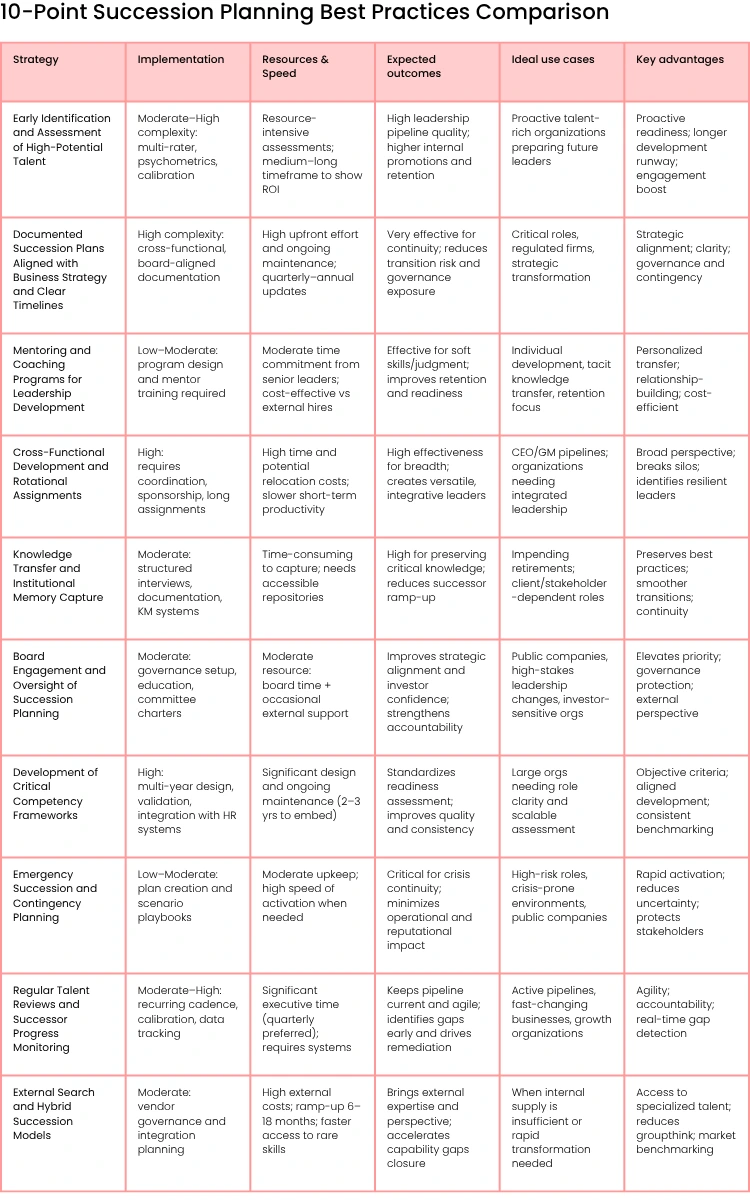
From Plan to Performance: Activating Your Succession Strategy
Navigating the landscape of succession planning can seem daunting, but as we've explored, it’s not an insurmountable challenge. It is a strategic imperative that transforms a theoretical exercise into a dynamic engine for organizational resilience and growth. The journey from a static document to a living, breathing talent development culture is built on the consistent application of the best practices we've discussed.
Moving beyond simple replacement charts requires a fundamental shift in perspective. It means viewing succession planning not as a crisis management tool but as an ongoing commitment to nurturing talent from within. From the early identification and assessment of high-potential individuals to creating robust mentoring programs and cross-functional development opportunities, each practice is a vital thread in a larger tapestry of leadership continuity. This approach ensures your organization is never caught off guard, whether facing a planned retirement or an unexpected departure.
Recapping the Pillars of Effective Succession Planning
The most effective strategies are comprehensive and integrated. We've seen how aligning your succession plan with overarching business goals provides direction, while documenting timelines and roles creates clarity and accountability. The development of critical competency frameworks ensures you are building the exact skills needed for future success, not just replicating the capabilities you have today.
Furthermore, proactive measures like knowledge transfer protocols and capturing institutional memory are crucial for preserving your organization's competitive edge. Engaging the board and conducting regular talent reviews transforms the process from a periodic HR task into a core strategic function. By embracing these succession planning best practices, you are actively future-proofing your leadership pipeline and fostering a culture where every employee sees a clear path for growth and contribution.
Your Actionable Path Forward
The goal now is to translate insight into action. A powerful succession plan is not built overnight; it is cultivated through deliberate, incremental steps. Avoid the common pitfall of analysis paralysis. Instead of trying to implement all ten practices at once, select two or three that address your organization's most pressing needs.
Consider these practical starting points:
- Pilot a Mentoring Program: Pair two high-potential employees with seasoned leaders. Document the goals, track the progress, and gather feedback after three months to refine the process before a wider rollout.
- Conduct a "Talent Deep Dive": Focus on one critical department. Work with its manager to identify key roles, assess the current talent pool using a 9-box grid, and outline development plans for at least one potential successor.
- Launch a Knowledge Transfer Initiative: Identify one senior employee nearing retirement. Task them with creating a "playbook" for their role, documenting critical processes, key contacts, and unspoken knowledge over their final six months.
By starting small, you create manageable wins that build momentum and demonstrate the value of a proactive approach. Each small success makes the case for deeper investment and broader implementation across the organization. The ultimate value of mastering these concepts lies in creating an agile, resilient organization where leadership transitions are seamless, talent is continuously developed, and performance is sustained through any change. This isn't just about filling boxes on an org chart; it's about securing your organization's legacy and empowering its future.
Ready to equip your future leaders with the skills they need to excel? Uplyrn offers a comprehensive library of courses and expert-led mentoring designed to close critical competency gaps identified in your succession plan. Bridge the divide between potential and performance by visiting Uplyrn and discover how our targeted development solutions can accelerate your talent readiness today.


Leave your thoughts here...
All Comments
Reply