









What is Content Marketing Strategy: A Complete Guide

A content marketing strategy is your master plan for creating and sharing valuable content to attract and keep a clearly defined audience. It's the documented "why" behind every blog post, video, and social update, making sure every effort is tied directly to your business goals.
Jump To Section

Earn As You Learn
Earn 25% commission when your network purchase Uplyrn courses or subscribe to our annual membership. It’s the best thing ever. Next to learning,
of course.
What Is a Content Marketing Strategy Anyway
Let’s get right to it. Think about building a house. You wouldn't just show up with a pile of bricks and hope for the best, right? You’d start with a detailed blueprint that lays out exactly who the house is for, its purpose, and how all the rooms connect to create a functional home.
Your content marketing strategy is that exact blueprint for your business. It’s what stops you from just creating random content and praying it works—a common mistake that burns through time and money. Instead, every single piece of content has a specific job.
A documented strategy is the crucial difference between creating random content and building a reliable engine for business growth.
This structured approach is what turns your content from a simple business expense into a hard-working asset that delivers results 24/7.
Content Without a Strategy vs With a Strategy
So, what does this actually look like day-to-day? The difference is night and day.
Let’s say you run an online store that sells high-quality coffee beans.
- Without a Strategy: You post a random picture of a latte on Instagram one day. The next, you write a blog post about your company’s founding story. You're definitely creating stuff, but it's all disconnected. The result? A few likes, maybe a comment, but no real impact on sales.
- With a Strategy: Your goal is clear: increase online sales by 20% in the next six months. You know your target audience is home-brewing fanatics who care about quality and where their beans come from. Your strategy guides you to create a "How-To" video series on YouTube for different brewing methods, publish blog posts comparing bean origins, and run an Instagram campaign featuring your customers’ own morning coffee setups.
See the difference? This approach ensures every piece of content educates your audience, builds trust, and gently nudges them toward making a purchase. If you want to learn more about the foundations of smart marketing, you can check out this simplified guide right here.
The Core Purpose of a Strategy
Ultimately, a content marketing strategy is about being intentional. It's the formal plan that forces you to answer the tough questions before you write a single word or hit record.
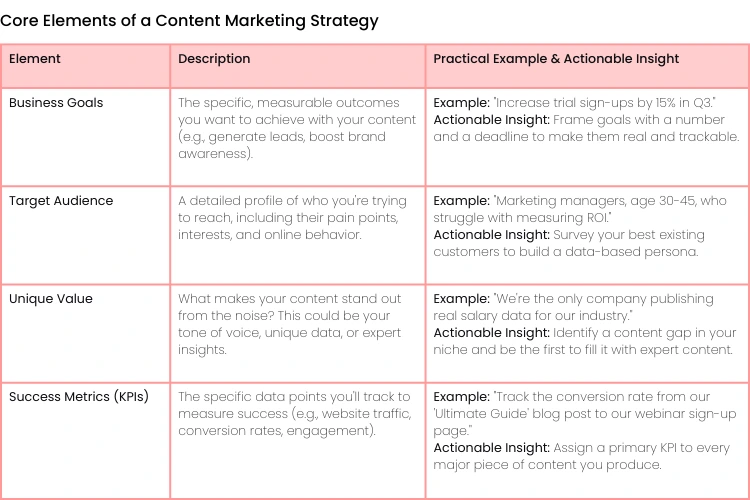
To help you get started, we've broken down the key components every solid strategy needs.
Without these pillars in place, you’re basically flying blind. A well-defined strategy gives your team direction, keeps everyone aligned, and makes it possible to measure your return on investment. It’s what turns your content efforts into a predictable and powerful source of business growth.
The Building Blocks of a Powerful Content Strategy
A solid content strategy isn't just one single document you create and forget about. Think of it as a living system where several key pieces have to work together perfectly. If you get these parts right, every single piece of content you publish will have a clear purpose and push you closer to your business goals.
Let's break down the four pillars that form the foundation of any truly effective content strategy.
Business Goals as Your North Star
Before you write a single word, you have to know exactly what you’re trying to accomplish. Vague ideas like “getting more traffic” aren’t real goals—they’re wishes. Your objectives need to be specific, measurable, and tied directly to what makes your business grow.
Your goal is the destination, and your content is the map that gets you there. Without a destination, you're just wandering.
- Actionable Insight: Always frame your content goals around real business outcomes. Instead of saying you want to "increase brand awareness", make it "Increase organic search impressions by 30% in six months." Don't just aim to "get more leads"; set a target like "Generate 50 qualified marketing leads per month from our blog."
This simple change in thinking forces you to justify every piece of content you create. Does this new blog post help you hit that lead generation target? If the answer is no, it’s probably not the right thing to work on right now.
Audience Personas That Go Beyond Demographics
You can't create content that people love if you don't have a crystal-clear picture of who you're talking to. This is where creating detailed audience personas becomes essential. These are realistic, semi-fictional profiles of your ideal customer, built from real data and market research.
Strong personas dig much deeper than basic details like age or location. They uncover the real motivations, daily challenges, and a-ha moments of your audience.
- Pain Points: What problems are they struggling with right now? (e.g., "I can't find the time to learn new skills for a promotion.")
- Motivations: What are their biggest career or personal goals? (e.g., "I want to finally transition into a project management role.")
- Information Sources: Where do they already go for advice and information? (e.g., Specific industry blogs, certain YouTube channels, or key influencers on LinkedIn.)
Practical Example: Imagine you run an online learning platform. A persona could be "Career-Climbing Chloe", a 32-year-old marketing manager. Her pain point isn't just "needing more skills". It's the feeling of being overwhelmed by how fast digital marketing is changing and the fear of being left behind. That specific insight helps you create content that speaks directly to her anxiety and offers a clear path forward.
Topic Pillars and Keyword Research
Once you know your goals and your audience, you can start figuring out what you should actually talk about. The best way to organize this is by establishing topic pillars—these are the handful of core subjects your brand is going to be known for. These broad themes should connect directly to your audience’s problems and your company's expertise.
- Practical Example: For a fitness app, your topic pillars might be "At-Home Workouts", "Healthy Nutrition" and "Mindfulness". If you're a B2B software company, they might be "Project Management", "Team Productivity" and "Leadership".
Every one of these topic pillars has to be backed up by smart keyword research. This isn't about stuffing words into an article. It’s about understanding the exact phrases and questions your audience uses when they search online for solutions.
As you map out your topics, it’s a great time to incorporate proven content creation best practices to ensure everything you produce is high-quality and built for long-term success.
Content Formats and Distribution Channels
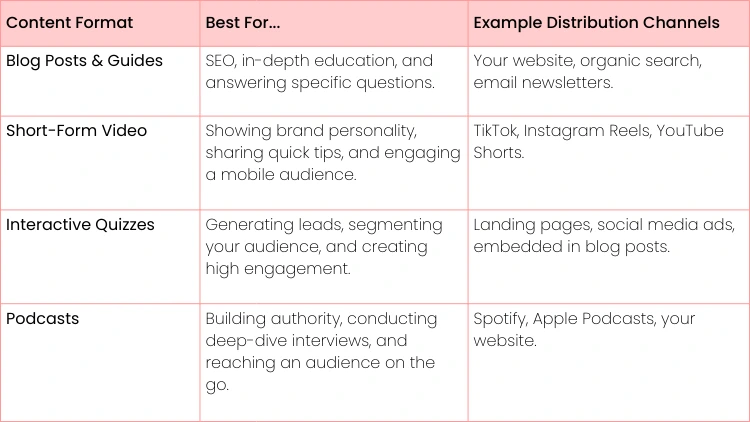
Finally, how are you going to package and deliver your message? The format of your content and the channels you use to share it are just as critical as the message itself. The right mix always depends on who your audience is and what you're trying to achieve.
- For example, studies consistently show that video is fantastic for engagement and telling a memorable story. For a deeper dive, you can check out this guide on how to use video to boost your business to get some fresh ideas.
Here’s a quick breakdown of how to match formats and channels to your audience.
- Actionable Insight: Don't just guess where your audience is. Use a tool like SparkToro or simply survey your customers and ask, "What social media platforms do you use daily?" or "Which podcasts do you listen to?" Use their answers to pick your distribution channels.
Why Documenting Your Strategy Is Non-Negotiable
So you’ve got a brilliant content strategy rattling around in your head. That’s a great start, but it’s not enough. An idea only becomes powerful when you write it down. A formally documented plan is what turns those abstract thoughts into a real, functioning asset for your business. It's the key difference between a team running on guesswork and one that’s executing a unified mission.
Think of it like a playbook for a pro sports team. Without one, you’ve just got a bunch of talented players running around on instinct, hoping for the best. With a documented playbook, everyone knows their role, the plays to run, and exactly how they’re going to win together.
From Chaos to Cohesion
That's precisely what a documented content strategy does—it gets your entire organization on the same page. When the plan is written down, it’s no longer just a vague concept. It becomes a real reference point for everyone involved, from your writers and designers all the way to the sales team and the C-suite.
This single act of documentation helps prevent one of the biggest marketing budget killers: "random acts of content". You know what I'm talking about—those blog posts, videos, or social updates created on a whim that aren't tied to any real business goal. They might make you feel productive, but they rarely move the needle.
A proper strategy connects your big-picture goals to the people you’re trying to reach and the topics they care about. Every piece of content should have a clear purpose, tracing back to a specific goal and a defined audience. A written strategy makes this connection impossible to ignore.
The Real-World Benefits of Writing It Down
Putting your strategy on paper isn't just busywork. It delivers tangible advantages that make your team more effective, day in and day out. It becomes the single source of truth for everything you do.
- Practical Example: A SaaS company's documented strategy includes a "Voice & Tone" section. It specifies: "We are helpful experts, not arrogant professors. Use simple language. Avoid jargon like 'synergistic paradigms'." When a new freelance writer is hired, they get this guide and can start creating on-brand content from day one, saving hours of edits.
Here are a few of the biggest wins:
- Secures Budget and Buy-In: It’s much easier to get your boss to sign off on a budget when you can hand them a formal document. It clearly shows them the goals, the plan, and the expected ROI, making that "yes" a whole lot easier to get.
- Ensures Brand Consistency: A documented strategy defines your brand’s voice, tone, and key messages. This guarantees that whether a customer is reading a blog post or watching a video, they’re getting the same consistent experience every time.
- Streamlines Onboarding: Handing a new writer or marketer a documented strategy is a game-changer. It gets them up to speed in record time on your goals, audience, and voice, saving you from countless introductory meetings.
The data is clear: marketers who formally document their strategy are significantly more likely to say their efforts are successful compared to those with just a verbal plan.
That's no coincidence. The act of writing it all down forces you to be clear and accountable.
If you want to get a better handle on this foundational step, you might find this guide on the strategic planning process helpful, as it provides a wider lens on effective planning. At the end of the day, a written plan is what separates professional content marketing from a simple hobby.
Real-World Content Marketing Strategy Examples
It's one thing to talk about strategy, but it’s another thing entirely to see it work in the wild. A plan on paper is just theory. A living, breathing content engine that drives real business results? That’s where the magic happens. Let's move past the abstract and see how different companies put these ideas into practice to win over their audiences.
We're going to break down two mini case studies below. Each one has a totally different business model and unique goals, but they all have one thing in common: a documented, audience-first strategy that turns content into a serious growth asset.
B2C E-commerce Brand Building Community
First up, let’s look at a fictional B2C brand called "Summit Gear" which sells high-quality outdoor equipment. Their big business goal is to increase online sales by 25% and build a tribe of loyal brand advocates who keep coming back.
Their ideal customer is "Adventure Alex", a 28-year-old weekend hiker who cares more about quality, sustainability, and real experiences than flashy ads. Alex’s biggest headache is information overload. He has a hard time picking the right gear and gets turned off by overly technical jargon.
The Strategy in Action:
Summit Gear's strategy isn't about running more ads; it's about education and community. They create content that solves Alex's problems and taps into his passion for the outdoors.
- Educational Blog Content: They publish in-depth guides like "How to Choose the Right Hiking Boot for Your Foot Type" and "A Beginner’s Guide to Backpacking". This move positions them as a trusted expert, not just another online store.
- User-Generated Social Campaigns: They launch a #SummitStories campaign on Instagram, getting customers to share photos from their adventures using Summit Gear. This is brilliant for authentic social proof and helps build a real community.
- Practical Video Tutorials: Their YouTube channel is full of short, helpful videos on topics like "How to Pack Your Backpack for a Day Hike" and "5 Knots Every Hiker Should Know". This provides genuine value.
The Actionable Insight: Summit Gear wins because their strategy is all about empowering the customer, not just pushing a product. By giving away valuable information, they build trust that naturally leads to sales and incredible long-term loyalty.
B2B SaaS Company Generating Qualified Leads
Now for a B2B SaaS company, "ProjectFlow" which has its own project management tool. Their main business goal is to generate 500 new marketing qualified leads (MQLs) per month.
Their target is "Manager Maria", a 40-year-old department head at a tech company. Maria’s biggest pain point is inefficiency. Her team is plagued by missed deadlines and messy communication, and she absolutely has to justify any new software purchase with a clear return on investment (ROI).
The Strategy in Action:
ProjectFlow’s content is built to attract, educate, and convert professionals like Maria by proving their expertise and the tool's bottom-line value.
A B2B strategy must address both the user's practical needs and the buyer's financial justification. The content must speak to productivity and profitability.
Their whole approach centers on creating a resource hub that acts like a magnet for their target audience.
- Expert Comparison Guides: They write articles like "ProjectFlow vs. Asana vs. Trello", offering an honest, deep-dive comparison. This helps Maria make a smart decision and builds major credibility.
- Free ROI Calculators: One of their most powerful content pieces is an interactive ROI calculator. Maria can plug in her team's size and project data to get a real estimate of the time and money ProjectFlow could save. It's a lead-gen goldmine.
- Targeted Case Studies: They showcase detailed case studies from similar companies that transformed their workflow with ProjectFlow. This gives Maria the social proof and business case she needs to get buy-in from her boss.
The Actionable Insight: ProjectFlow gets that B2B buyers are risk-averse. Their strategy gives Maria a simple, low-pressure way to educate herself, calculate the value, and see proof that it works. By the time she's done, requesting a demo feels like the only logical next step.

How to Measure Content Marketing Success
Look, creating fantastic content is only half the job. If you’re not measuring how it performs, you're just throwing stuff at the wall and hoping it sticks. You have no real way of knowing what’s a hit, what’s a miss, or where to put your time and money next. Measuring success is what turns content from a creative hobby into a reliable growth machine for your business.
The trick is to look past "vanity metrics" like raw page views or a bunch of likes on a social post. Sure, those numbers feel good, but they don't tell you if your content is actually moving the needle on your business goals. Real measurement connects every single data point back to the objectives you laid out from the very start.
Measuring content success isn't just about collecting data; it's about connecting that data to outcomes. It’s how you translate clicks, shares, and downloads into cold, hard proof of business impact.
To pull this off, you need to track metrics across the entire customer journey—from the very first time someone hears about your brand to the moment they become a loyal fan.
Awareness Metrics: Discovering Your Brand
At the top of the funnel, the goal is simple: get on your audience's radar. You're trying to answer the question, "Are the right people finding us?" These metrics tell you how visible your content really is.
- Organic Traffic: This is the number of people who find you through a search engine like Google. A steady climb in organic traffic is a great sign your SEO work is paying off.
- Keyword Rankings: Keeping an eye on your search engine position for important topics shows if you're winning the visibility battle. For example, are you on page one for a term like "best project management software for small teams"?
- Social Media Reach: This number tells you how many unique people saw your content on social media. It’s a direct indicator of how far your message is traveling.
Engagement Metrics: Building a Connection
Once someone finds your content, the next big question is: do they care? Engagement metrics tell you if your content is actually interesting enough to hold your audience's attention.
A great way to boost your marketing performance is by staying on top of what's working now. High engagement is a powerful signal that you're delivering genuine value.
- Time on Page: How long are people actually sticking around to read your article or watch your video? A longer time on page means your content is compelling and hitting the mark.
- Social Shares: When someone shares your content, they’re basically vouching for you. It's a huge sign of quality and trust.
- Comments and Mentions: Lively discussions in the comments or people talking about your content on social media mean you're sparking conversations and making a real impact.
Conversion and Loyalty Metrics: Driving Business Action
This is where the rubber meets the road—where your content marketing proves its financial worth. Conversion metrics track how well your content convinces people to take a valuable action that brings them closer to becoming a customer.
- Actionable Insight: The most important part of measurement is tying your content to a specific action. For instance, if a blog post's goal is to generate leads for your CRM software, the main KPI isn’t traffic; it’s the "demo request" conversion rate from that specific page. You can track this in Google Analytics by setting up a destination goal for your demo confirmation page.
Here are the bottom-line metrics you need to watch:
- Lead Generation: This includes things like form submissions for ebooks, webinar sign-ups, or demo requests. It’s a direct count of the potential customers your content is bringing in.
- Conversion Rate: What percentage of people who see a piece of content actually take that desired next step? This number reveals how persuasive your content truly is.
- Customer Retention: For your existing customers, you can track things like repeat purchases or even a drop in support tickets. This shows how your content is building loyalty and creating long-term value.
Common Content Strategy Mistakes to Avoid
Putting together a solid content plan is a huge step, but knowing the common traps is just as vital. Even the most well-thought-out strategy can get completely derailed by a few classic, yet costly, mistakes. Avoiding these pitfalls is often what separates content that gets real results from content that just becomes more internet noise.
Let’s walk through the most common errors that trip up marketers and, more importantly, how you can steer clear of them.
Focusing On Quantity Over Quality
It’s one of the oldest temptations in the book: the idea that more is always better. This thinking puts you on a content treadmill, where the only goal is to push something out every single day. The end result? A mountain of thin, forgettable articles that don't rank, don't engage, and definitely don't convert.
- Actionable Insight: Instead of churning out five short, generic posts a week, shift your focus. Publish one truly comprehensive, well-researched guide that solves a reader’s problem from start to finish. A single piece of high-quality "pillar" content can pull in more traffic, shares, and leads than a dozen weak ones put together.
Creating Content Without A Promotion Plan
This is a massive mistake. Too many teams treat hitting "publish" as the finish line. They’ll spend weeks perfecting a piece of content, only to let it sit on their blog and hope people stumble upon it. That’s like throwing a huge party but forgetting to send out a single invitation.
Great content doesn't promote itself. Promotion isn't something you do after you create content; it's an integral part of the content's lifecycle from the very beginning.
- Actionable Insight: Use the 80/20 rule for content: spend 20% of your time creating the content and 80% promoting it. Before you write a word, list 5 specific ways you will promote the piece. For example: 1) Email newsletter, 2) Post on LinkedIn, 3) Share in 3 relevant online communities, 4) Send to 5 industry influencers, 5) Run a small targeted ad.
Writing For Search Engines Instead Of People
In the race for better rankings, it’s easy to start writing for algorithms instead of human beings. This is how you end up with robotic, keyword-stuffed text that might tick an SEO box but makes for a terrible reading experience. Always remember, search engines don't have credit cards—people do.
- Practical Example: A bad, keyword-stuffed sentence: "Our best dog walking service is the best dog walking service in Brooklyn because we offer premier dog walking." A good, human-first sentence: "Looking for a trusted dog walker in Brooklyn? We help your furry friend get the exercise and care they need while you're at work."
The fix is simple: write for your audience first, then optimize for search. Concentrate on answering your reader's question completely and giving them real value. When you create genuinely helpful content that people actually enjoy reading and sharing, all the right SEO signals—like backlinks and high on-page time—will follow naturally.
Failing To Connect Content To Business Objectives
This might be the most fundamental error of all: creating content with no clear link to a real business goal. If you can’t explain how that new blog post or video is going to help generate leads, drive sales, or improve customer loyalty, then you’re just practicing "random acts of content".
To dig deeper into why this gap exists in so many marketing efforts, you might find this article on what most marketing misses insightful. It's a critical piece of the puzzle for any effective strategy.
- Actionable Insight: Before starting any new piece of content, fill in this blank: "This content will help us achieve our goal of [Business Goal] by [Action the Reader Will Take]." For example: "This blog post will help us achieve our goal of generating 50 MQLs/month by getting readers to download our free project management template."

Frequently Asked Questions
Even with the best roadmap, a few questions always come up. Let's tackle some of the most common ones head-on so you can move forward with confidence.
How Long Until I See Results From Content Marketing?
Let’s get the big question out of the way. The honest answer is that content marketing is a long-term play, not an overnight fix.
You might notice some early signs of life, like small upticks in traffic, within the first 3-6 months. But for the real, business-changing results—like a reliable flow of leads—you need to plan for 6-12 months of dedicated, consistent work.
- Practical Example: A new law firm starts a blog. Months 1-3 see minimal traffic. By month 6, a few posts answering specific local legal questions start ranking on page 2 of Google, and organic traffic grows. By month 12, they have multiple page-one rankings, generating a predictable number of "contact us" form submissions each week.
What Is the Difference Between Content Strategy and Content Marketing Strategy?
This is a subtle but crucial distinction. Picture your entire company as a library full of information.
- Content Strategy is the master blueprint for that entire library. It’s the high-level plan that governs every single piece of content you create—from the microcopy on a button to your internal training manuals and customer support articles.
- Content Marketing Strategy is one specific, very important wing of that library. It’s the collection designed to attract new people, draw them in, and show them why they should care about what you do. It’s a focused part of the larger strategy, aimed squarely at hitting marketing and sales goals.
Can a Small Business Realistically Implement This?
Absolutely. In fact, a smart, focused strategy is a small business’s greatest advantage. You can't outspend the big players, but you can out-think and out-focus them.
The secret is to start small and be ruthlessly consistent.
- Actionable Insight: Don't try to launch a blog, a podcast, and a YouTube channel all at once. Pick one format and one channel and master them. A local bakery, for example, could have a winning strategy by just mastering Instagram Reels. They can post one daily video showing their creations or offering quick baking tips. Quality and focus will always beat spreading yourself too thin.
Ready to build the skills for your own winning strategy? At Uplyrn, we provide expert-led courses to help you master digital marketing, from SEO to social media. Start your learning journey and advance your career by exploring our courses.


Leave your thoughts here...
All Comments
Reply