









What is Digital Transformation Strategy: A Practical Guide

A digital transformation strategy is the roadmap for how your business will use technology to completely rethink its operations, culture, and what it offers customers. It’s not just about buying the latest software—it’s a complete business metamorphosis, much like a caterpillar reorganizing itself to become a butterfly.
Jump To Section

Earn As You Learn
Earn 25% commission when your network purchase Uplyrn courses or subscribe to our annual membership. It’s the best thing ever. Next to learning,
of course.
Defining Digital Transformation Without the Jargon
It’s easy to get this mixed up with just digitizing old paper records or bolting an e-commerce feature onto your website. While those are small steps in the right direction, a real strategy goes much, much deeper. Think of it as a continuous journey that weaves together technology, people, and processes to discover new, smarter ways of working and delivering value.
Having a formal plan isn't a "nice-to-have" anymore; it's a must for survival and growth. It gets everyone in your organization on the same page, pointing toward a shared vision for the future. This ensures that every tech investment and process tweak actually moves you closer to your most important business goals.
Beyond Basic Tech Upgrades
One of the biggest mistakes is treating digital transformation like a one-and-done IT project. In reality, it's a core business initiative that reimagines how you operate from the ground up.
Take the education sector, for example. It's projected to be a $7.3 trillion industry by 2025, yet on average, less than 4% of that spending goes toward technology. A solid strategy for a university wouldn't just be about putting courses online. It would mean using AI to create personalized learning paths for students or data analytics to spot at-risk students and improve retention rates.
While global education digital spending is expected to hit $404 billion by 2025, this figure shows there's still a massive opportunity for strategic thinking to make a real impact. You can explore more data on global education tech spending to see the full picture.
To really get a grip on this, it’s helpful to understand the different stages of digital maturity. Many people use terms like "digitization" and "digital transformation" interchangeably, but they mean very different things.
A digital transformation strategy isn’t a checklist—it’s a dynamic approach that connects where your business is today with where it needs to go. And like any good strategy, it should evolve as fast as your market does.
Digitization vs Digitalization vs Digital Transformation
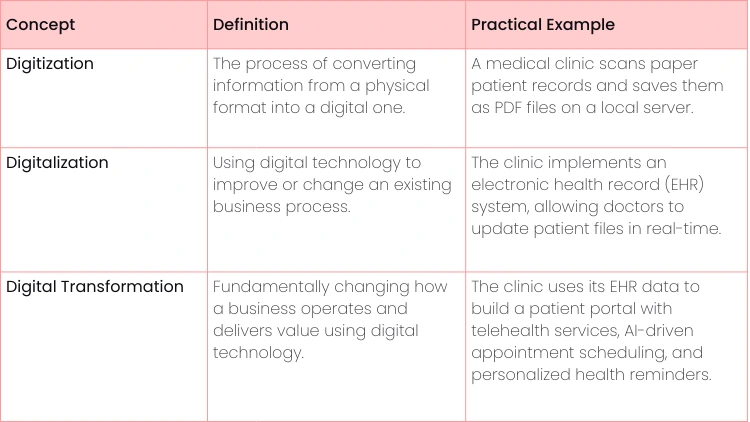
Let's break down these concepts. Each one builds on the last, moving a business from simple updates to a complete reinvention. This table will help you identify where your own organization stands.
As you can see, the journey starts with converting information, moves to improving processes, and finally culminates in reinventing the entire business model. True transformation touches every part of the organization.
The Pillars of a Modern Transformation Strategy
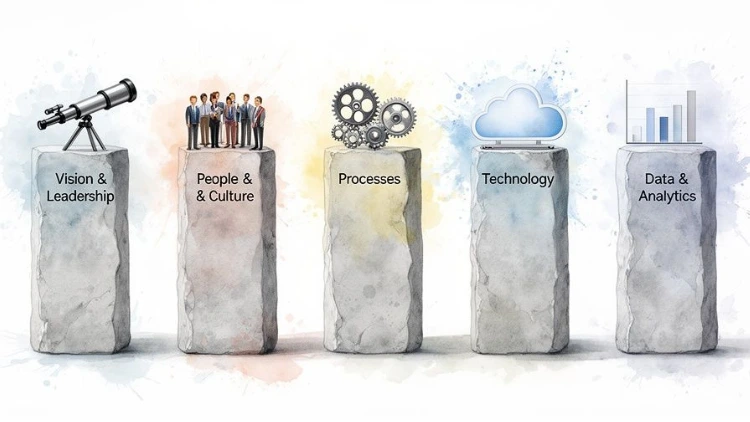
A solid digital transformation strategy is never a happy accident. It’s built on a set of core pillars, each one holding up the entire structure. If you neglect even one, the whole thing can get wobbly and might even come crashing down. Think of it like the blueprint for building a business that’s fit for the future.
To build something that lasts, you have to nail five critical areas. Each one demands real thought and deliberate action to make sure your efforts pay off in a tangible way. Let's dig into what they are.
Vision and Leadership
Every great transformation starts with a clear, compelling answer to a simple question: "Why are we even doing this?" That answer is your vision, and it has to be driven from the very top. Without real commitment from leadership, the best-laid plans will starve for resources and never gain the momentum they need.
- Practical Example: A retail chain’s leadership doesn't just say, "We need a better website". A true vision sounds more like this: "We will create the most personalized, seamless shopping experience in our industry, whether you're online or in our store". This bigger "why" becomes the north star for every single decision that follows.
- Actionable Insight: The best way to get executives on board is to speak their language. Frame the transformation around business outcomes. Don’t just talk about new software; show them a data-backed case for how the plan will grow revenue, cut operational costs by 15%, or boost customer retention.
People and Culture
Let’s be honest: technology is just a tool. It's your people who actually use it to create value. If your company culture resists change, punishes failure, or is stuck in departmental silos, you've found the number one reason transformations fail. The goal is to build an environment where people feel safe to experiment, learn, and adapt.
- Practical Example: A company introduces a new data analytics tool. Instead of just rolling it out, they create "data champion" roles—employees from different departments who are trained first and then act as go-to experts for their peers. This builds internal support and accelerates adoption.
- Actionable Insight: Foster psychological safety. Create forums where employees can voice concerns about new technologies without fear of being judged. When people feel heard, they are more likely to buy into the change.
Your digital transformation strategy is ultimately a human one. It succeeds or fails based on your ability to bring your people along on the journey, inspiring them to embrace new ways of working.
Processes and Operations
You wouldn't put a high-performance engine in a car with a rusted-out frame. In the same way, layering new technology over broken, inefficient processes only makes the existing problems bigger and faster. A real transformation means rethinking your core workflows for a digital-first world, embedding things like automation and data-driven alerts right into the process itself.
- Practical Example: A manufacturing company decides to digitize its supply chain. Instead of tracking inventory on clunky spreadsheets, they install an automated system. Now, sensors monitor stock in real-time, AI helps predict demand, and the system automatically reorders supplies before they run low. This cuts waste to the bone and prevents costly production delays.
- Actionable Insight: Don't try to boil the ocean. Start by mapping out one high-impact journey—maybe a frustrating customer onboarding process or a clunky internal approval workflow. Pinpoint the biggest bottlenecks and figure out how digital tools could completely eliminate them.
Technology and Infrastructure
While it’s definitely not the only piece of the puzzle, technology is the engine that makes everything else possible. Picking the right tech stack is critical, whether that means moving to the cloud, experimenting with artificial intelligence (AI), or using Internet of Things (IoT) sensors. But the secret isn't chasing shiny objects. It's about choosing tools that directly serve the business vision you established in step one.
- Practical Example: Instead of buying a massive, expensive, all-in-one software suite, a growing business adopts a flexible, "best-of-breed" approach. They use a cloud-based CRM for sales, a separate tool for marketing automation, and integrate them via APIs. This is more cost-effective and allows them to swap out tools as their needs change.
- Actionable Insight: Before investing in any new tech, create a simple "decision scorecard". Rate potential tools based on criteria like cost, ease of use, scalability, and—most importantly—direct alignment with your core business goals. This prevents "shiny object syndrome".
Data and Analytics
Finally, data is the fuel for any modern business. In the past, too many decisions were made based on gut instinct or habit. Today, the companies that win are the ones that can collect, analyze, and, most importantly, act on data. The mission is to turn raw information into strategic intelligence that guides every single decision, from what products to build next to how to handle a customer service call.
- Practical Example: An e-commerce site uses analytics to see that customers who watch product videos are 50% more likely to buy. This insight leads to a strategic decision: invest in creating a short video for every top-selling product, directly boosting sales.
- Actionable Insight: Make data visible. Create simple, automated dashboards for key teams showing the metrics that matter most to them. When people can see the real-time impact of their work, they are more motivated to improve.
How Technology Fuels Transformation
If your digital transformation strategy is the blueprint, then technology is the engine that actually makes it go. We’re talking about tools like Artificial Intelligence (AI), Cloud Computing, and the Internet of Things (IoT). It’s easy to dismiss these as buzzwords, but they are the real enablers of change, giving you the power to completely rethink how your business runs and what you offer customers.
The golden rule here is simple: technology must serve the business goal, never the other way around. Chasing a new piece of tech just because it's popular is a fast track to a failed project. But, using AI to solve a genuine problem—like personalizing a customer’s shopping experience or automating mind-numbing manual data entry—that’s where the magic happens.
The Strategic Role of Core Technologies
A handful of technologies have become the bedrock of nearly every successful transformation today. Getting a practical grip on what they do is essential. Think of cloud computing as the flexible foundation you build everything on. It lets you scale up or down without buying massive servers, test new ideas on the fly, and give your teams access to powerful tools from anywhere.
- Practical Example (IoT): A logistics company puts IoT sensors on its shipping containers. Suddenly, they have real-time data on location, temperature, and even if a container has been opened. With this, they can reroute shipments to avoid delays, ensure sensitive cargo isn't spoiling, and give customers pinpoint-accurate delivery times. A standard shipping service just became a premium, high-value experience.
- Actionable Insight: Start by identifying one key business question you can't currently answer. For example, "Where are our biggest operational delays happening in real-time?" Then, explore if a technology like IoT could provide the data needed to find the answer. This problem-first approach ensures you invest in tech with a clear purpose.
AI: The Accelerator of Change
Among all these tools, AI is a standout. It's more than just simple automation; it injects real intelligence into your business processes. This could be an AI that analyzes customer behavior to predict their next purchase or a chatbot that offers instant, 24/7 support so your human agents can handle the complex issues. By taking over the repetitive work, AI frees up your people to be more creative and strategic.
We're already seeing this play out everywhere. In education, AI is quickly becoming essential. By 2025, over 47% of leaders in the field expect to use AI every single day. The reason is clear: 66% of schools say it helps reduce staff burnout, and AI tools for grading can cut marking time by up to 80%. That’s a direct and massive impact on efficiency.
Technology is the vehicle, but your business strategy must be the driver. The most successful transformations happen when technology choices are made to directly serve a clear, customer-focused vision.
Building Your Digital Transformation Roadmap
An idea without a plan is just a wish. This is especially true for digital transformation. You need a practical, step-by-step roadmap to guide your organization from where you are today to where you want to be tomorrow. Think of it as your North Star, keeping everyone aligned on the destination, the milestones, and how you'll track success. It’s what turns big ideas into a series of concrete, achievable actions.
Without this plan, it’s easy to get lost chasing every shiny new tech trend. A roadmap ensures every project, every investment, is a deliberate step toward your core business goals. It’s the difference between randomly buying spare parts and methodically building a high-performance engine.
Phase 1: Assessment and Vision Setting
The journey starts with an honest self-assessment. You need to get a clear picture of your current digital maturity—your strengths, weaknesses, and where the real opportunities lie. This means looking at everything: your current tech stack, the digital skills of your team, and how efficient your processes really are.
- Practical Example: A local bakery realizes its phone-and-paper ordering system is slow and full of errors, causing customer frustration. Their vision isn't just "get new software". It's: "Create the easiest and most reliable online ordering experience for fresh bread in our city, increasing repeat customers by 30%."
- Actionable Insight: Don't do this in a silo. Involve people from every corner of the business. The perspective of a sales rep or a warehouse manager is just as crucial as the view from the IT department. Use a simple survey to ask, "What is the single biggest technology-related frustration in your workday?" The patterns in their answers will point you to the most painful problems.
Phase 2: Prioritization and Planning
You can't boil the ocean. This next phase is all about picking your battles wisely. Look for high-impact, low-risk pilot projects that can deliver some quick wins. These early successes are your secret weapon for building momentum and getting everyone else on board.
Think big, but start small. A successful pilot project is the best proof of concept you can offer. It demonstrates real value, lowers perceived risk, and builds the confidence needed for bigger, bolder moves down the line.
The technology available to us is always evolving, opening up new strategic doors.
This progression from Cloud to IoT and now AI shows how data and intelligence have become central to any modern strategy.
Phase 3: Execution and Iteration
With your first project chosen, it's time to get to work. The best way to manage this is with an agile approach, which values flexibility over rigid, long-term plans. Launch your initiative, get it into the hands of real users and customers, and listen closely to their feedback. Be ready to pivot.
- Practical Example: A team launches a new internal dashboard. Instead of waiting months for a "perfect" version, they release a basic version in two weeks. They hold weekly 15-minute feedback sessions with users, making small, continuous improvements based on what they hear. This ensures the final product is genuinely useful.
- Actionable Insight: Adopt the "build, measure, learn" loop. For every new feature, define one key metric to track (e.g., user adoption rate). If that metric doesn't improve after a short period, it's a signal to rethink your approach.
Phase 4: Scaling and Optimization
Once your pilot proves its worth, it's time to scale it across the organization. This isn't just about flipping a switch. It means creating a clear playbook based on what worked (and what didn't), providing solid training, and rolling out the new process or tool to other teams.
- Practical Example: After a successful CRM pilot in one sales division, the company creates a "Scaling Toolkit". It includes video tutorials, a one-page best practices guide, and the contact info for the "data champions" from the pilot team. This makes it easier for other divisions to get up and running quickly.
- Actionable Insight: Don't stop at launch. Schedule quarterly check-ins to review how the new tools are being used. Are people using all the features? Have new workarounds emerged? Continuous optimization ensures you keep getting value from your investment.
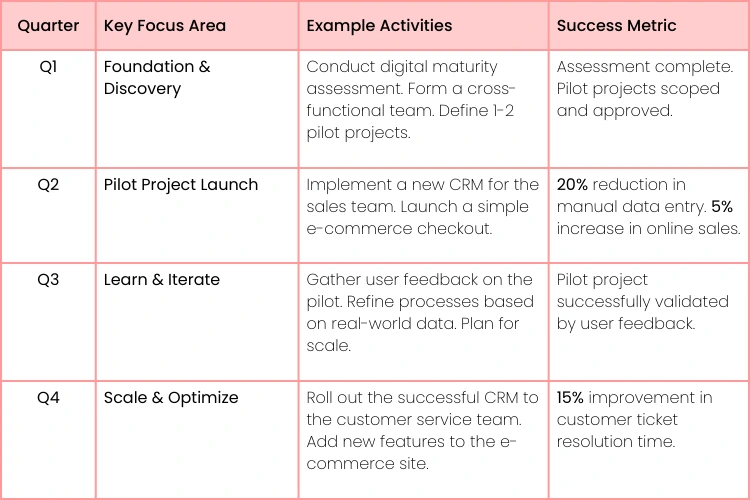
To make this tangible, here's a simplified look at what the first year might look like for a small business just starting out.
Sample 12-Month Digital Transformation Roadmap
A simplified timeline illustrating key milestones and activities for a small business embarking on its digital transformation journey.
This table is just an example, but it shows how a big goal can be broken down into manageable, quarterly chunks with clear measures of success.
Digital Transformation Examples in the Real World
It’s one thing to talk about frameworks and theories, but seeing a digital transformation strategy come to life is where the real learning happens. Let's look at a few companies that completely reinvented themselves by weaving technology into the very fabric of their business. These examples offer both inspiration and a practical roadmap.
Take Nike, for example. For decades, they were a wholesale giant. But they made a deliberate pivot to become a direct-to-consumer powerhouse. This wasn't just about launching a website; they built an entire digital ecosystem. With apps like the Nike Training Club and SNKRS, they stopped just selling shoes and started building a community. This move gave them a direct line to their customers, providing a goldmine of data for creating personalized experiences and products people actually wanted.
Starbucks: Brewing a New Kind of Customer Loyalty
Starbucks is another classic case study. With competition heating up, they realized their advantage wasn't just in the coffee but in the entire customer experience. Their mobile app became the heart of their digital strategy, and it was a game-changer.
The app lets you order ahead, pay with a tap, and rack up loyalty rewards. It’s deceptively simple, but it brilliantly solved several key problems:
- It killed the queue. By streamlining the in-store process, it slashed wait times and removed a major point of friction for busy customers.
- It fostered loyalty. The rewards program turned casual coffee drinkers into daily regulars, driving incredible repeat business.
- It turned transactions into insights. Every order provides valuable data, helping Starbucks personalize offers and fine-tune its operations based on real customer behavior.
Starbucks didn't just build an app; they built a competitive moat. It's proof that a smart digital strategy can completely revitalize even the most traditional brick-and-mortar business.
Transformation Is Happening Everywhere
This kind of fundamental shift isn't just for retail. Look at the manufacturing sector, where a company like Siemens uses "digital twins". They create incredibly detailed virtual models of physical products and systems. This lets them simulate, test, and optimize everything before a single piece of metal is cut, radically reducing development costs and boosting quality.
Even a field as established as education is being completely reshaped. Many institutions are now creating immersive learning environments with VR and AR. In fact, research from Stanford shows these methods can be 76% more effective than traditional lectures. While 44% of institutions admit they face challenges with implementation, 49% are pushing ahead with tech investments to improve student outcomes. It’s a strategy that’s paying off, with 84% of education leaders now using data to make better decisions and AI freeing up 80% of grading time for more valuable student mentoring. You can discover more insights about digital transformation in education.
The common thread here is that these companies didn't just buy new software. They completely rethought their value proposition and put the customer at the center. Their stories prove that a clear strategy, focused on solving real problems with technology, is the ultimate engine for growth.
Sidestepping the Common Traps on Your Transformation Journey
Even the most well-thought-out digital transformation strategy can hit a snag. The data doesn't lie: a startling number of these projects don't deliver on their initial promise. More often than not, it's because they fall into a few predictable, and entirely avoidable, traps.
Knowing what these pitfalls look like is the first step to steering clear of them.
One of the biggest blunders is leading with technology. It's easy to get caught up in the buzz around AI, machine learning, or the latest automation platform. But when you buy the shiny new tool without first defining the problem it's supposed to solve, you end up with a very expensive solution in search of a problem.
- Practical Example: A company invests in a sophisticated project management tool, but adoption is low. Why? Because they never asked their teams what the biggest challenges were with the current process. The new tool didn't solve their actual problems (like too many meetings or unclear priorities), so it was ignored.
- Actionable Insight: Always start with the problem, not the product. Write a "problem statement" before you even look at vendors. For example: "Our sales team spends 10 hours per week manually updating spreadsheets, which leads to outdated data and lost opportunities." This frames the search around a specific, measurable issue.
Don't Forget the People
Here’s a hard truth: your transformation is more about people than it is about platforms. Overlooking the human element is a guaranteed way to stall your progress.
If your team feels like this change is something being done to them, not with them, you're going to face a wall of resistance. When you don't communicate the "why" behind it all, you create a vacuum that quickly fills with fear and uncertainty.
- Bring people in early: Involve your teams in the planning stages. When they help build it, they'll feel a sense of ownership.
- Invest in real training: Don't just throw a new system at them. Give them the skills and support they need to feel confident and capable.
- Be radically transparent: Explain how these changes will improve their work, help the company, and ultimately benefit everyone.
Finally, a surprisingly common mistake is flying blind without clear metrics. If you don't define what success looks like—in real numbers—from day one, how can you ever know if you've achieved it? You'll have no way to track progress, justify the investment, or celebrate the wins. It's a critical oversight that can sap all your momentum.
Answering Your Key Questions
Even the best-laid plans run into real-world questions. When you're in the trenches of planning a digital transformation, some practical concerns always surface. Let's tackle some of the most common ones head-on.
How Do I Start With a Small Budget?
Don't let a tight budget stop you. In fact, starting small is often the smartest way to begin.
Forget trying to boil the ocean. Instead, look for a high-impact, low-cost win. Find a single, universally frustrating process—like manually entering invoice data—and fix it with a simple digital tool. This proves the concept without a massive upfront investment.
- Practical Example: A small business automates its appointment scheduling using a low-cost tool like Calendly. This saves hours of back-and-forth emails each week and reduces no-shows with automated reminders. The cost is minimal, but the impact on efficiency and customer experience is immediate.
- Actionable Insight: Focus on "painkiller" projects. Ask your team: "If you could wave a magic wand and eliminate one repetitive, manual task from your day, what would it be?" Start there.
What Are the Most Important KPIs to Measure Success?
Your metrics need to be tied directly to what the business actually cares about. If a KPI doesn't tell you a meaningful story about your progress, it's just noise.
Good Key Performance Indicators (KPIs) usually fit into one of four buckets:
- Customer Experience: Are customers happier? Track things like your Net Promoter Score (NPS) or customer satisfaction ratings.
- Operational Efficiency: Are we working smarter? Measure cost savings from automation or how much faster you can complete key processes.
- Employee Engagement: Is the team adopting the new way of working? Monitor how many people are using the new tools and check in on their satisfaction.
- Financial Impact: Is this helping the bottom line? Watch for direct revenue growth or improvements in your profit margins.
Actionable Insight: Always, always establish a clear baseline before you start. You can't know how far you've come if you don't know where you began.
How Do I Get My Team on Board?
This is non-negotiable. Without your team’s buy-in, even the most brilliant strategy is doomed to fail.
Start by communicating clearly and often. Explain the "why" behind the change, not just the "what". Show them how this new approach will make their jobs better and help the company succeed.
- Practical Example: When introducing a new communication platform like Slack or Microsoft Teams, leadership doesn't just send a memo. They host a "kick-off" session demonstrating how it will reduce internal email by 30% and make finding information easier. They also highlight a specific team that piloted it successfully.
- Actionable Insight: Identify and empower your champions. In every team, there are people who are naturally more excited about new technology. Bring them into the process early, make them super-users, and let them evangelize the benefits to their peers. Peer-to-peer influence is far more powerful than a top-down mandate.
Ready to build the skills for your own transformation journey? Uplyrn offers expert-led courses and mentorship to guide you every step of the way. Start learning with Uplyrn today.


Leave your thoughts here...
All Comments
Reply