









What is Skills Based Hiring: A Practical Guide

Skills-based hiring isn't just a new buzzword; it's a fundamental shift in how we think about talent. It’s a strategy that puts a candidate's actual abilities and competencies front and center, moving past the traditional reliance on formal education, job history, or other credentials.
Put simply, it’s about what a person can do, not just what their resume says they've done.
Jump To Section

Earn As You Learn
Earn 25% commission when your network purchase Uplyrn courses or subscribe to our annual membership. It’s the best thing ever. Next to learning,
of course.
Moving Beyond Resumes: What Is Skills Based Hiring?
Think about hiring a chef for a new restaurant. Would you hire them based on their collection of cookbooks or by actually tasting their food? Of course, you'd taste the food. Yet, traditional hiring often focuses on the "cookbooks"—the degrees, past job titles, and years of experience—and just assumes they translate into real capability.
That old-school approach is becoming less and less effective in a world where practical skills are what truly drive success.
Skills-based hiring flips that script. It’s the practice of “tasting the food” first. Instead of using a college degree as a gatekeeper, this method evaluates candidates on their provable skills and their potential to nail the job. It’s a powerful recognition that valuable expertise comes from all kinds of places, not just a four-year university program.
The Core Idea Behind the Shift
The thinking here is pretty straightforward: a person’s past isn't a perfect crystal ball for their future performance. Consider that only 36% of the U.S. workforce holds a college degree. If you make a degree a hard requirement, you're automatically shutting the door on more than half of the country's potential talent.
This modern approach throws those doors wide open by focusing on concrete abilities.
Actionable Insight: Change the interview question from "What credentials do you have?" to "What can you accomplish?" It’s a move from pedigree to proficiency, creating a much fairer and more effective way to build a team.
This strategic pivot means assessing both the hard and soft skills that are absolutely critical for the job. These usually fall into two buckets:
- Hard Skills: These are the teachable, technical abilities you can measure.
- For example, proficiency in Python, running Google Ads campaigns, or using accounting software like QuickBooks.
- Soft Skills: These are the interpersonal traits that determine how someone works with others.
- Practical examples include clear communication in team meetings, adaptability when a project's scope changes, or collaborative problem-solving.
By homing in on these competencies, companies start making hiring decisions based on solid evidence, not just a few keywords on a resume. This also opens the door to new ways of validating a candidate's claims. For a look at what's next in this space, you can explore how blockchain is transforming recruitment by creating instantly verifiable credentials.

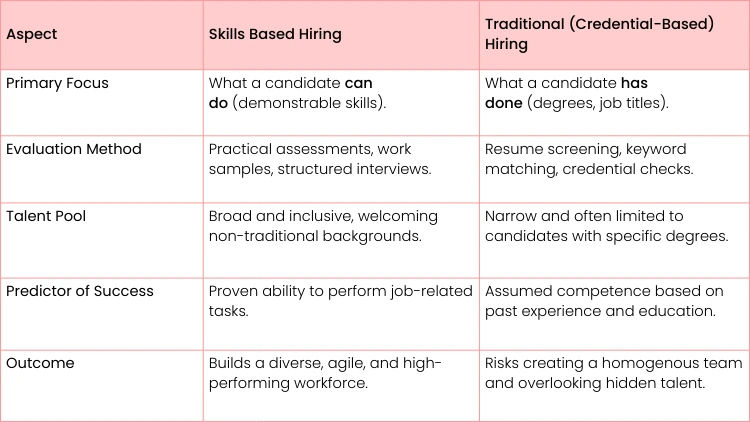
Skills Based vs Traditional Hiring At a Glance
The value of skills-based hiring really clicks when you see it next to the old model. This whole shift is gaining momentum because of a massive skills gap that companies are struggling to fill—you can actually learn more about that in this guide on why nearly half of all workers need upgrading.
To make it crystal clear, this table breaks down the key differences between the two hiring philosophies.
Looking at it this way, it’s easy to see why so many companies are making the switch. One approach looks for proven ability, while the other relies on proxies for ability. In today's competitive landscape, betting on proven skills is the smarter move.
Why Top Companies are Making the Switch
Let's be honest: the shift to skills-based hiring isn't just some feel-good HR trend. It's a hardcore business strategy with tangible, bottom-line benefits. The smartest companies are ditching old-school credential-based models for a simple reason: what someone can do is a far better predictor of success than where they went to college.
This isn't just a minor tweak; it's about fundamentally widening the net. By dropping arbitrary barriers like a mandatory four-year degree, companies instantly unlock a massive pool of qualified people who were previously invisible. In a tight labor market, that’s not just an advantage—it's a survival tactic.
When you focus on skills, you start discovering incredible talent in unexpected places. You begin to value the expertise gained from apprenticeships, military service, certifications, or just years of getting the job done, treating it with the same respect as a formal degree.
Expanding the Talent Pool Dramatically
The most immediate payoff of a skills-first mindset is the sheer explosion in the number of potential candidates. The moment a degree is no longer a hard-and-fast requirement, the doors swing open to millions of skilled people who were automatically filtered out before.
And we're not talking about a small increase. One analysis showed that dropping degree requirements can blow up your candidate pool by up to 19 times. Suddenly, you have access to a market of over 70 million American adults who built their skills through hands-on experience and other non-traditional paths. You can dig deeper into how skills-based hiring is reshaping the workforce.
By tapping into this bigger talent market, companies don't just fill roles faster. They end up building more diverse, innovative teams that actually look like the customers they serve.
Improving Hiring Efficiency and Retention
A skills-based approach doesn't just find more candidates; it finds the right candidates, and it does it more efficiently. This creates a powerful ripple effect across all your key hiring metrics.
When your process is built around practical assessments and real-world problem-solving, you get a much clearer picture of who can actually hit the ground running.
Actionable Insight: By focusing on what people can prove they can do, you take a lot of the guesswork out of hiring. The result is a faster, more accurate process that dramatically lowers the odds of a costly bad hire.
The data backs this up with some pretty impressive numbers:
- Faster Hiring: Companies using skills-based practices have been able to slash their time-to-hire by around 50%.
- Better Retention: Employee retention jumps by a staggering 89% because people are a much better fit for their roles right from the start.
- Fewer Mistakes: This intense focus on capability cuts down on costly mis-hires by an estimated 88%, saving a ton of time and money.
Making the right hire the first time is one of the most powerful things a business can do. Avoiding the usual stumbles is crucial, which is why we break down the top 3 mistakes entrepreneurs make in hiring in this guide.
Building a More Agile and Future-Ready Workforce
At the end of the day, hiring for skills is about building a team that can roll with the punches. When you hire based on a credential someone earned years ago, you're betting on the past. When you hire for skills, you're investing in a person's ability to learn, adapt, and solve problems you haven't even thought of yet.
This mindset fosters a culture of continuous learning, where people are valued for what they can do now and their potential to pick up new skills tomorrow. An organization full of adaptable problem-solvers is simply better prepared for whatever the future throws at it, whether it's a market shift or a new technology.
- A practical example: instead of asking for a "Project Manager with a PMP certification", a skills-based job post might look for someone with "proven experience leading cross-functional teams to deliver complex projects on time and on budget." It’s a subtle change, but it focuses on the result, not the piece of paper, attracting a much broader range of effective leaders. That's how you build a company that's not just successful today but resilient for years to come.
How to Build Your Skills Based Hiring Framework
Switching to skills-based hiring isn’t something you do overnight by flipping a switch. It's a deliberate process of building a solid framework, one that moves you from a cool idea to a practical system that finds the right talent for the right reasons. The very first step is a big one: a mental shift away from pedigree and toward genuine proficiency.
This means you have to deconstruct your job roles and get down to the essentials. Instead of starting with a list of degrees and certifications, you begin by asking a simple, but powerful, question: "What does someone in this role actually need to do to be successful?" Answering that question honestly is the bedrock of your entire framework.
Redefine Roles Around Core Competencies
Before you can hire for skills, you have to know which skills truly matter. This involves doing a skills audit for each position, ditching the generic job templates, and identifying the specific abilities that actually drive results in your company.
Think of it like writing a recipe. A lazy recipe might just say "flour" and "sugar". But a great recipe gets specific, calling for "bread flour" because of its high gluten content or "brown sugar" for the moisture it adds. In the same way, your job analysis needs to pinpoint the exact technical and interpersonal skills that make someone great at their job.
Actionable Insight: Create a crystal-clear profile of what works in a role. This profile should be based on performance data and team needs, not just on what previous employees happened to have on their resumes. This objective, data-driven approach is what makes skills-based hiring so powerful.
Take a "Project Manager" for instance. The role is so much more than just having a PMP certification. The real core competencies might be things like:
- Stakeholder Communication: The ability to clearly explain project status to both the tech team and the non-technical execs.
- Risk Mitigation: The foresight to spot potential problems and come up with a backup plan before they blow up the project.
- Budget Management: The knack for tracking every dollar and allocating resources efficiently to keep things on track financially.
When you focus on these practical abilities, you start building job profiles that reflect reality, not just tradition. This detailed work is a lot like a training needs analysis, which companies use to find and fix skill gaps. If you want to dive deeper into that, check out this guide on conducting a training need analysis for your own teams.
Write Inclusive and Action-Oriented Job Descriptions
Once you've nailed down the core skills, your next mission is to translate them into job descriptions that speak to the right people. This is where your new framework becomes public. The language you choose is absolutely critical—it signals to the world that you care more about ability than arbitrary qualifications.
Your goal should be to write a job description that a skilled person can read and immediately think, "Hey, I can do that" no matter what their background looks like. This means swapping out old-school credential requirements for performance-based ones.
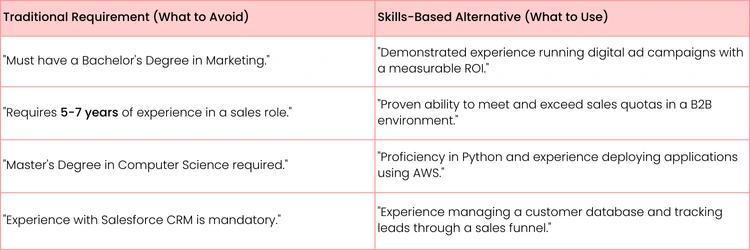
Practical Examples of Skills-First Language
Let's get practical. Here’s how you can transform traditional, exclusionary job requirements into skills-focused language that invites a much wider range of talented people to apply.
The new phrasing is all about the outcome and the action. It asks candidates to show what they can do, which throws the door wide open for someone who is self-taught, graduated from an online bootcamp, or learned everything on the job. This simple change in language is a concrete, actionable first step in building your skills-based hiring framework. It helps you attract a more diverse and capable pool of candidates, ensuring you're evaluating real potential right from the very beginning.
Choosing the Right Tools to Assess Candidate Skills
So, you’ve redefined your job roles around the skills that actually matter. Great. Now comes the real test: figuring out how to measure those skills accurately. Once you stop relying on resume keywords, you need solid, reliable ways to see a candidate’s abilities in action. This is where skill assessments come in—they provide the tangible proof skills-based hiring is built on.
The right tool for the job depends entirely on the role and the specific skills you need to see. A one-size-fits-all test just won’t cut it. You need a thoughtful mix of methods designed to show you what a candidate can really do in a context that actually feels like the job they’re applying for.
Matching Assessments to Job Roles
To get a true sense of a candidate's potential, your assessment has to mirror the day-to-day demands of the position. You wouldn't test a fish on its ability to climb a tree, right? In the same way, you shouldn't give a software developer a public speaking challenge if their job is writing clean code. The key here is relevance and practicality.
This means building scenarios and tasks that give people a chance to show you what they know in a meaningful way.
Actionable Insight: Make the hiring process feel less like a test and more like a preview of the job. It gives candidates a chance to shine by doing what they do best, providing you with a clear, unbiased picture of their on-the-job potential.
Here are a few practical examples of how this looks in the real world:
- For a Software Developer: Give them a technical coding challenge. Ask them to solve a specific problem or hunt down a bug in a snippet of code. This directly tests their logic and fluency in a programming language.
- For a Marketing Manager: Assign a work sample project where they outline a three-month social media strategy for a hypothetical product launch. This quickly reveals their strategic thinking and content creation chops.
- For a Customer Support Specialist: Use a situational judgment test. Present them with three tricky customer complaint emails and ask for their written responses. This evaluates their empathy, problem-solving, and communication style all at once.
These methods go so much deeper than typical interview questions, giving you direct evidence of competence. Of course, asking the right questions is still a huge piece of the puzzle. To round out your practical tests, think about including some crucial interview questions for marketers that dig into specific, experience-based situations.
Selecting the Best Assessment Method
With so many different types of assessments out there, picking the right one can feel a little overwhelming. The goal is to choose the method that gives you the clearest picture of the skills that are most critical for success in the role.
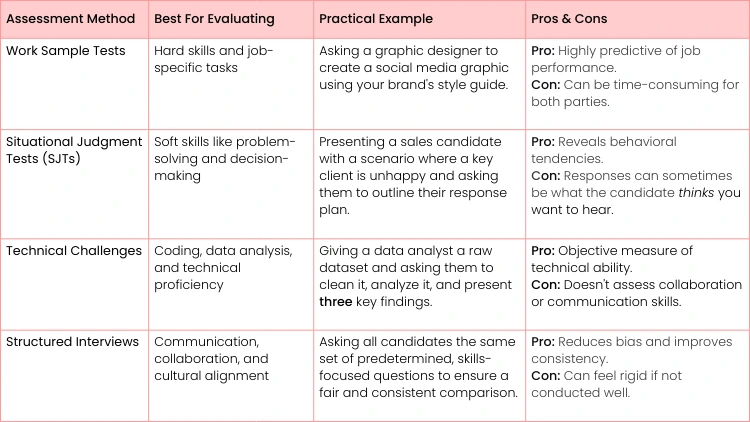
To make it easier, here's a breakdown of the most common methods, what they're best for, and a real-world example to help guide you. Understanding the pros and cons of each will help you build a much stronger and more predictive evaluation process.
Choosing the Right Skill Assessment Method
Remember, there's no single "perfect" method. The smartest approach is often to combine two or more of these assessments to get a well-rounded view of each candidate. You might start with a technical challenge to confirm hard skills, then follow up with a structured interview to see how they communicate and work with others. This multi-layered strategy minimizes bias and gives you much richer information to base your hiring decision on.
Building your team's ability to run these discussions well is a skill in itself. Investing in better interviewing skills ensures your assessments are as effective as they can be.
The Bigger Picture Driving This Global Shift
The shift to skills-based hiring isn't just some new corporate trend—it's a direct answer to massive economic tremors changing how the world works. Technology, especially automation and AI, is moving at a breakneck pace, and it’s causing a seismic shift in the job market.
The skills that landed someone a great job a decade ago are quickly becoming outdated. At the same time, completely new skill sets are suddenly in high demand.
This isn’t a problem for the distant future. It's happening right now. Traditional markers of talent, like a specific degree or a fancy job title, are losing their punch. They just can't keep up. A degree from 2010 doesn't say much about a candidate's ability to navigate the complex tools, platforms, and data-driven strategies that define today's roles.
This new reality has kicked off an urgent, worldwide scramble for upskilling and reskilling. Companies—and even entire economies—that can't adapt are going to find themselves facing crippling talent shortages and left behind.
Automation and the Great Skill Reset
Let’s be clear: automation is no longer just about robots on a factory floor. Modern AI and sophisticated software can now tackle complex analytical and even creative work, completely flipping the script on what makes an employee valuable.
This technological wave is making some job functions obsolete while simultaneously creating brand-new roles that didn't even exist a few years ago.
This phenomenon is what many experts call the "great skill reset". You can no longer assume that the team you hired for yesterday's needs is ready for tomorrow's challenges. The only path forward is to build a resilient, agile team by focusing on the adaptable skills that allow people to learn and evolve right alongside the technology.
Actionable Insight: The real challenge for the global economy isn’t just about finding people with the right degrees anymore. It's about building a system that can quickly spot, develop, and deploy the skills needed to handle constant change. Skills-based hiring is uniquely positioned to solve that exact problem.
The numbers really tell the story here. By 2030, it's projected that 39% of a worker's core skills will need a major update. Employers are already feeling the heat, with 63% pointing to skill gaps as a major roadblock to growth. The challenge is staggering, with over 120 million workers around the world potentially lacking access to the training they need. For more on this, check out the latest global hiring trends.
Building a More Dynamic and Equitable Economy
By putting someone's proven abilities front and center, skills-based hiring gets right to the heart of these massive economic challenges. It helps create a much more fluid and efficient labor market, where talent can flow to where it's needed most—regardless of a person's educational background.
This has a profound impact on economic mobility and fairness. It opens doors for millions of skilled people who were previously overlooked simply because they didn't have a specific piece of paper. Think about veterans, workers from rural areas, or people who learned their craft through apprenticeships and self-study instead of a four-year university.
This isn't just a theory, either. Industry leaders and governments are adopting this as a core strategy to future-proof their workforces.
- Practical Example (Tech Industry): Companies are leading the way. They know that rapid innovation means they have to hire for current coding, data science, and cybersecurity skills—not a degree earned years ago.
- Practical Example (Government): Public sector agencies are ditching degree requirements for many jobs to attract a broader pool of talent. The goal is to build a civil service that can actually solve modern, complex problems.
This strategic pivot is crucial for bridging skill development in education and business. At its core, skills-based hiring is the foundation for a more dynamic, resilient, and inclusive global economy that's actually ready for the future of work.
Measuring Success and the Future of Recruitment
So, you’ve made the switch to skills-based hiring. That’s a huge step, but just changing your job descriptions isn't enough. You need a new way to measure what "good" looks like. To really get everyone on board, from the C-suite down, you need to show them the proof in the numbers—the tangible ways that focusing on abilities delivers better results for the business.
The good news? The data is on your side, and it's compelling. When you can draw a straight line from your skills-first practices to real-world metrics, the conversation changes. It’s no longer just an HR initiative that feels right; it becomes a core business strategy that performs better.
Key Metrics to Track Your Progress
To really see the impact of your new skills framework, you'll want to track a few key metrics that tell the story of your hiring quality and efficiency. Think of it as a clear before-and-after snapshot that demonstrates the real return on your investment.
Here are the KPIs that truly matter:
- Quality of Hire: This is the big one. How are your new people actually performing?
- Actionable Insight: Survey hiring managers and team members 90 days in to get a read on performance, how quickly they got up to speed, and how well they fit into the team culture. A higher score here is direct proof you're finding better talent.
- Employee Retention Rate: Are your new hires sticking around?
- Actionable Insight: Calculate the percentage of people who stay with the company beyond their first year. Better retention is a massive sign that you’re putting the right people in the right seats—roles where they can actually thrive.
- Time to Fill: How long does it take to get someone in the door, from posting the job to getting an offer signed?
- Actionable Insight: Track this metric for roles where you've switched to skills-based descriptions versus those with traditional requirements to see a direct comparison. A shorter time often proves the wider talent pool is paying off.
The most powerful argument for skills-based hiring is its proven ability to build stronger, more effective teams. The data shows it’s not just about fairness—it’s about finding people who perform better and stay longer, creating a direct competitive advantage.
The Future is Skills-First
Looking ahead, it's clear that skills-based hiring isn't just a trend; it's quickly becoming the new standard for modern recruiting. The evidence is just too overwhelming to ignore. Projections show that by 2025, it will be the dominant approach, with a whopping 85% of companies adopting these practices.
The results speak for themselves. Employers who've made the switch are far happier with their hires—34% report being 'very satisfied' compared to just 18% of traditional recruiters. This isn't just a feeling; it translates to a 60% rate of improved performance and 50% better retention. You can dig into more of these stats in this great report on the state of skills-based hiring.
This isn't a temporary shift. It’s a permanent change in how the best companies think about talent. The future of recruitment is agile, data-driven, and focused on what people can do, not just what’s on their resume. Companies that lean into this will not only win the war for talent but will also build the resilient, adaptable teams they need to thrive for years to come.
Frequently Asked Questions
Switching up your hiring playbook is a big move, and it's natural to have questions. Let's tackle some of the most common ones that come up when companies start exploring skills-based hiring.
We'll clear up the confusion and give you some practical advice on what this all looks like on the ground.
Does Skills-Based Hiring Mean Degrees Are Now Worthless?
Not at all. Think of it less as devaluing degrees and more as rebalancing the scales. A degree is a fantastic way to build a foundation of skills, but it’s not the only way.
This approach simply acknowledges that real, valuable expertise comes from all sorts of places: certifications, online courses, apprenticeships, military service, and good old-fashioned on-the-job experience.
Instead of a degree being a hard-and-fast gatekeeper, it becomes one data point among many. The focus shifts from, "Where did you learn this?" to the far more important question: "What can you actually do?" This opens the door for incredible talent from non-traditional paths while still recognizing the value of formal education.
How Can a Small Business Start Without Expensive Tools?
You don't need a massive budget or fancy software to get started. Small businesses can jump into skills-based hiring by keeping it simple and focusing on what truly matters for the job.
Actionable Insight: Pinpoint the top 3-5 make-or-break skills for the position you're filling. Then, design a quick, practical test for them.
- Practical Example (Social Media Manager): Ask candidates to draft three sample posts for your company's Instagram, complete with captions and hashtags.
- Practical Example (Customer Service Pro): Give them two real (but anonymized) tough customer emails and ask how they'd respond.
Structured interviews are another powerful, free tool. Ask every single candidate the same skill-focused questions, like, "Walk me through a time you used data to make a decision." These simple methods are incredibly effective at showing you who can actually do the work.
Is This Approach More Time-Consuming Than Traditional Hiring?
It might feel like more work upfront—and in some ways, it is. You're investing time in redesigning job descriptions and creating thoughtful assessments. But that initial effort pays off big time down the road.
By zeroing in on practical skills early on, you stop wasting time interviewing people who look perfect on paper but can't deliver.
Actionable Insight: That front-loaded work leads to a much more efficient interview process and drastically lowers the risk of a bad hire—a mistake that's incredibly expensive and time-consuming to fix.
Ultimately, companies often find this approach shrinks their overall time-to-hire. You're investing your energy in what predicts success, getting the right person in the door, faster.
Ready to build the skills that employers are looking for? Uplyrn provides a complete ecosystem for learning, mentorship, and career growth. Explore our courses today and start your journey toward mastering in-demand abilities.


Leave your thoughts here...
All Comments
Reply