









What is Transformational Leadership for High-Achievers

When you hear the term “leadership”, what comes to mind? For many, it’s a manager giving out orders or a boss overseeing day-to-day tasks. But what if leadership was less about managing and more about inspiring?
That’s the core idea behind transformational leadership. It’s a style where leaders don’t just direct; they ignite passion, motivate innovation, and encourage their teams to create meaningful change that shapes the future. They act as role models, pushing their followers to step up and become leaders themselves.
This approach moves far beyond a simple exchange of work for pay. It's about building a deep, shared commitment to a vision. A practical example is a marketing lead who doesn't just assign tasks for a campaign, but rallies the team around a mission to "become the number one voice in our industry", turning everyday work into a shared cause.
Jump To Section

Earn As You Learn
Earn 25% commission when your network purchase Uplyrn courses or subscribe to our annual membership. It’s the best thing ever. Next to learning,
of course.
What is Transformational Leadership Really?
Think of a leader not as a manager who just delegates tasks, but as an architect who inspires a team to build something truly magnificent, like a grand cathedral. They don't just hand out blueprints; they share the vision, making everyone feel part of a monumental effort. That’s the essence of transformational leadership.
It shifts the entire focus from daily management to unlocking the potential and drive within every single person on the team.
The whole style is built on a simple human truth: people will follow someone who genuinely inspires them. A leader armed with a clear vision and authentic passion can achieve incredible things by injecting that same energy into their team.
The Four Pillars of This Approach
The real power of transformational leadership is anchored by four core components, often called the "4 I's". Think of them as the foundational pillars holding up the entire structure. Each one plays a unique role in turning a group of individuals into a focused, high-performing team.
And this isn't just theory—the impact is backed by some pretty compelling data. Research has shown that teams guided by transformational leaders see a 30% surge in engagement. It also makes people 50% more accountable and motivated. These aren't small numbers; they show just how effective this style is at driving real-world results.
The key takeaway here is that transformational leadership isn't about command and control. It’s about inspiring and developing people to achieve more than they ever thought possible, which in turn lifts the entire organization.
To truly understand how this works, we need to break down those four pillars. If you're looking to build a solid foundation on leadership concepts, you might also find this guide on what leadership truly is helpful.
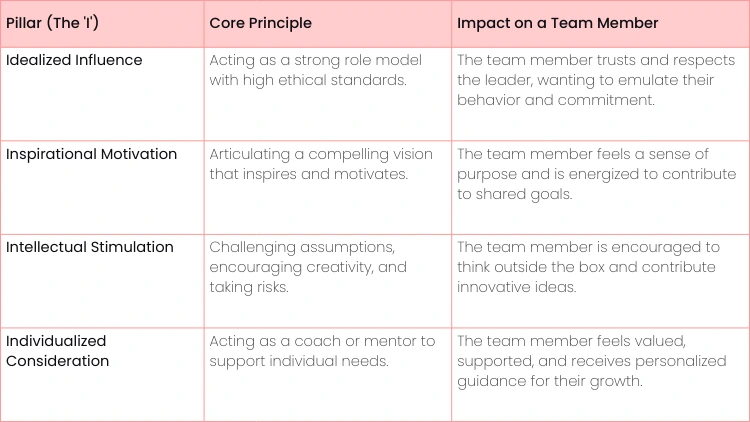
The table below unpacks each of the "4 I's", explaining its core principle and how it directly affects a team member's experience and performance.
The Four Pillars of Transformational Leadership
Together, these four pillars create an environment where people don't just work—they thrive, grow, and contribute their absolute best.
The Four Pillars of Transformational Leadership Explained
Transformational leadership isn't just one thing you do; it's a way of being that’s built on four interconnected ideas. Think of them as the legs of a very sturdy table. These components, which experts often call the "4 I's", all work in concert to build a team environment where trust, motivation, and real growth can flourish.
Getting a handle on these pillars is the first real step toward understanding what makes this leadership style so powerful.
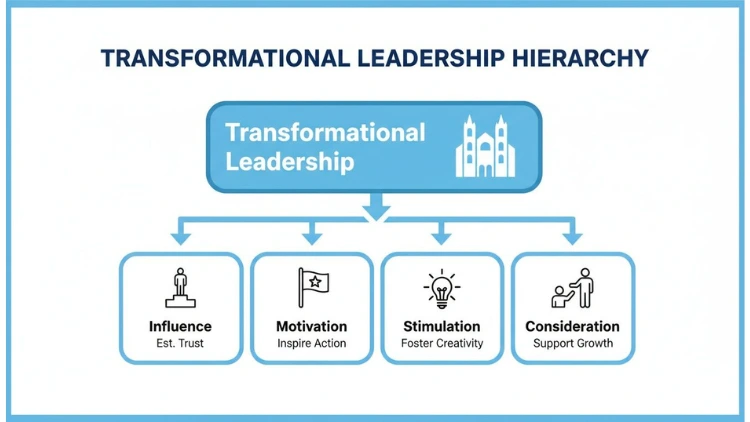
The diagram below shows you how it all fits together, with each pillar holding up the central concept of being a transformational leader.
As you can see, Influence, Motivation, Stimulation, and Consideration are the bedrock. Let's dig into what each of these looks like in the real world.
Idealized Influence
This is all about walking the walk. Leaders who nail idealized influence don't just preach about high standards—they live by them. They become the kind of person others want to follow, not because they have to, but because they’ve earned genuine respect and admiration through their own actions.
- A practical example is the project manager who, facing a brutal deadline, rolls up her sleeves and stays late with the team instead of just delegating from afar. She’s in the trenches with them, sharing the load and showing she’s part of the team. That act alone transforms her from a boss into a trusted leader.
- Actionable Insight: Pick one core value you want your team to embody—maybe it’s accountability or transparency. For the next week, make it your mission to demonstrate that value with a specific action each day. Own a mistake openly. Go out of your way to credit someone for their great idea. People notice.
Inspirational Motivation
This pillar is about painting a picture of the future that’s so compelling, people can't help but feel energized. A transformational leader connects the dots between everyday tasks and a bigger, more exciting mission. It’s about giving people a 'why'.
- A practical example is a startup CEO who could frame a tough software update as just more work. But instead, she presents it as a chance to "completely change how small businesses handle their money". Suddenly, the team isn't just coding; they're on a mission. Their mindset shifts from "we have to do this" to "we get to be part of this".
The magic of this pillar is turning a to-do list into a shared vision. It’s the difference between telling people to lay bricks and inspiring them to build a cathedral.
- Actionable Insight: Start your next project kickoff by dedicating the first 10 minutes to explaining the "why". Connect the project's goals to the company's overall mission and, more importantly, to the team's professional growth. Use phrases like, "This project will help us become experts in..."
Intellectual Stimulation
Transformational leaders love to poke the bear—in a good way. They challenge the "we've always done it this way" mentality and foster a culture where curiosity reigns supreme. Intellectual stimulation means creating a space where people feel safe to ask tough questions, experiment, and even fail.
- A practical example is a marketing director who, instead of rubber-stamping the usual campaign ideas, calls a brainstorm with one rule: no idea is off-limits. By asking questions like, "What's something our biggest competitor would be too scared to try?" he unlocks a flood of fresh, innovative thinking.
If you're serious about growing your own leadership skills, take a look at the 7 attributes of great leaders for some more valuable perspectives on what it takes.
- Actionable Insight: In your next team meeting, when a problem arises, resist giving the answer. Instead, ask, "What are three different ways we could approach this?" or "What assumptions are we making that might be wrong?" This shifts the dynamic from you solving the problem to the team owning the solution.
Individualized Consideration
Last but not least, this pillar is about seeing and leading the whole person. A transformational leader acts as a mentor and a coach, taking the time to understand the unique strengths, weaknesses, and goals of each individual on their team. It's the opposite of a one-size-fits-all approach.
- A practical example is a manager who notices one of her team members is brilliant in writing but quiet during meetings. Instead of forcing him to speak up, she starts using a shared document for brainstorming before meetings. This lets him contribute in a way that plays to his strengths, showing she's paying attention not just to the work, but to the person doing it.
- Actionable Insight: Schedule a 15-minute "career chat" with each team member this month. Don't talk about current projects. Instead, ask questions like, "What part of your job are you most excited about right now?" and "What skill would you love to learn in the next six months?" Then, look for a small, tangible way to help them with that goal.
Proven Benefits of Transformational Leadership
So, why should any organization bother with developing transformational leaders? The short answer: it delivers clear, tangible results that go way beyond just warm, fuzzy feelings. This approach creates a powerful ripple effect, boosting everything from team morale right down to the bottom line. It’s not just a feel-good theory; it’s a proven strategy for building a more resilient, motivated, and successful organization.
The benefits always start with the people. When leaders genuinely inspire and support their teams, employee engagement just naturally goes up. This isn’t some minor perk—it’s a direct line to major organizational advantages you simply can't ignore.
Higher Employee Engagement and Retention
Highly engaged employees are the real engine of any successful company. They’re more committed, more creative, and more willing to put in that extra effort. Transformational leaders are masters at building this kind of engagement because they connect the daily grind to a bigger purpose and show they actually care about individual growth.
The real kicker is that when people feel valued and inspired, they’re far less likely to jump ship. This drastically cuts down on employee turnover, saving companies a fortune in recruiting, hiring, and training costs over the long haul.
This powerful link between transformational leadership and employee dedication is well-established. Seminal research showed that followers of these leaders report much higher job satisfaction and motivation. Later studies backed this up, connecting the style to deeper organizational commitment and a greater willingness to embrace change, which you can explore in this study on the impact of transformational leadership.
Increased Innovation and Adaptability
Transformational leaders cultivate a culture where challenging the status quo isn't just allowed—it's encouraged. By fostering intellectual stimulation, they create a safe space for teams to question old assumptions and experiment with new ideas. This is absolutely critical for any business that wants to stay ahead of the curve.
- Practical Example: A software manager encourages her team to use Friday afternoons for "blue-sky projects" that have no immediate deliverables. That freedom to explore led to a new feature that became a massive selling point for their product.
- Actionable Insight: Try starting a "what if" segment in your weekly team meetings. Just dedicate ten minutes to questioning a current process and brainstorming unconventional solutions without any fear of judgment.
By empowering employees to think critically and creatively, the entire organization becomes more agile and better equipped to pivot when the market shifts. That kind of adaptability is a huge competitive advantage. For more ideas, take a look at this guide on how to increase employee productivity through smarter leadership.
Enhanced Performance and Productivity
At the end of the day, the purpose of any leadership style is to drive results. Transformational leadership consistently delivers by unlocking the full potential tucked away inside every team member. When people are fired up by a shared vision and backed by a leader who invests in them, their performance naturally skyrockets. They don't just clock in to meet expectations; they're driven to blow them out of the water.
- A practical example is an underperforming sales team whose new leader stops focusing on daily call quotas (transactional) and instead starts coaching each member on consultative selling techniques and celebrating team wins publicly. Within a quarter, the team’s morale and sales numbers see a dramatic increase. This collective drive leads to higher quality work, more effective problem-solving, and a direct, positive impact on overall business outcomes.
Transformational Leadership vs Other Common Styles
To really grasp what makes transformational leadership special, it helps to see how it stacks up against other, more common approaches. While plenty of styles can get the job done in specific scenarios, their core philosophy and long-term results are worlds apart.
Once you can spot these differences, you’ll not only recognize the type of leadership you’re currently under—you’ll be able to choose the kind you want to practice.
The most frequent comparison is with transactional leadership. This style isn't about grand visions or personal growth; it's about a straightforward exchange. It all boils down to a clear system of rewards and consequences.
Think of a transactional leader as a referee. Their job is to enforce the rules, call penalties, and make sure the game runs according to the book. They are absolutely essential for maintaining order and structure.
This style shines when tasks are clear-cut and rules are non-negotiable. Think of a factory floor with strict safety protocols or a sales team with a simple commission structure—both benefit from this direct, "if you do this, you get that" approach.
The Coach vs. The Referee
On the flip side, a transformational leader is the "coach". The coach does more than just watch the game; they are actively developing their players. Their focus is on unlocking each person's unique potential, building unstoppable team chemistry, and inspiring everyone to aim for a championship-level vision.
While the referee ensures the rules are followed today, the coach builds a team that can keep winning for years to come.
This gets to the heart of the matter: transactional leadership manages people, but transformational leadership develops them.
To see how these styles play out in the real world, let's break down their core philosophies. If you're interested in exploring other models, this guide on the 6 most common leadership styles offers a fantastic overview.
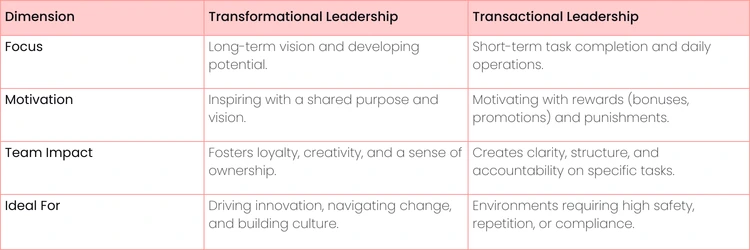
Leadership Style Comparison: Transformational vs. Transactional
This table cuts through the noise and shows a direct, side-by-side look at how these two leadership styles operate in practice. One is focused on managing the now, the other on building the future.
As you can see, the "best" style really depends on the goal. A transactional approach keeps the assembly line moving, while a transformational one invents the next product line entirely.
Then there’s laissez-faire leadership, which sits at the complete opposite end of the spectrum. This is a hands-off style where the leader provides tools and resources but then steps away, trusting the team to manage itself. While this can work with a group of highly experienced, self-starting experts, it often dissolves into chaos, leaving teams without clear direction or accountability.
- Actionable Insight: The next time you're in a team meeting, pay attention to how a new project is introduced. Is the leader talking about the rules of engagement and the rewards for hitting targets (transactional)? Are they painting a picture of the future and explaining how your contribution is critical to that vision (transformational)? Or are they just handing it off and leaving the team to sort it out (laissez-faire)? Recognizing the style in play is the first step toward understanding its impact on you and your team.
How to Become a Transformational Leader
Becoming a transformational leader isn't like flipping a switch. It’s a journey, not a destination. Think of it as a gradual process of building specific skills and, more importantly, a new mindset. You're moving from just managing tasks to actively developing people, and that's a big shift.
This entire process really boils down to four key actions: building a clear vision, acting with integrity, encouraging new ideas, and coaching your team members.
Craft and Communicate a Compelling Vision
Your first job is to become a storyteller. A transformational leader doesn't just present a plan; they paint a picture of the future so vividly that the team feels personally invested in bringing it to life. This vision has to connect the day-to-day grind to a bigger purpose, answering the "why" behind the "what".
When done right, a clear vision acts like a North Star, guiding every decision and keeping everyone pulling in the same direction. The results are real. Gallup data shows that companies with highly engaged leadership can see 21% higher profitability. In one case study, a sales team saw an 18% jump in productivity and a 12% drop in turnover after their leaders adopted these principles.
- Actionable Insight: In your next team meeting, don't just dive into a task list for a new project. Start by explaining why it matters. Try framing it with phrases like, "This project gives us the chance to..." or "Imagine if we could solve..." to turn the work into a shared mission.
Act with Integrity to Become a Role Model
A powerful vision is worthless if your actions don't back up your words. This is where you have to walk the talk. You must live and breathe the values you expect from your team—accountability, respect, and high ethical standards.
People follow the person before they follow the plan. Your credibility is your most valuable leadership asset.
- A practical example is when a leader makes a mistake, they don't hide it or blame someone else. They own it publicly, apologize, and explain what they'll do differently. This builds immense trust and shows the team that it's okay to be human and accountable.
To do this effectively, you have to start with self-awareness. Understanding yourself is the foundation of modern leadership; knowing your own strengths and weaknesses is the first, non-negotiable step toward leading with authenticity.
Encourage Creativity and New Ideas
A huge part of being a transformational leader is creating a space where curiosity can flourish. Your role is to challenge the status quo and make it safe for your team to question old ways of doing things, suggest new solutions, and even fail without fearing blame.
This means you have to actively invite different perspectives and reward innovative thinking, even when an idea doesn’t quite work out. It's all about building psychological safety so people feel comfortable experimenting.
- Actionable Insight: Try starting a "process-kill" session once a quarter. Ask the team, "If you could get rid of one process that slows us down, what would it be and why?" This empowers them to take ownership and improve their own workflows.
Coach and Mentor Your Team
Finally, a transformational leader is a dedicated coach. This means taking a genuine interest in each team member's growth, both professionally and personally. You need to understand their career goals, spot their unique talents, and give them chances to shine and develop.
- Listen Actively: Set up regular one-on-one meetings with no agenda other than to listen. Ask open-ended questions like, "What part of your work energizes you the most?" or "What new skills are you interested in developing?"
- Provide Personalized Support: If someone on your team wants to grow in a specific area, go out of your way to find projects, training, or mentorship opportunities for them. This shows you're truly invested in their future, not just what they can do for you today.
A practical example is a manager who learns that a junior analyst wants to improve their public speaking. The manager then gives them low-stakes opportunities to present small sections of team updates, providing constructive feedback afterward to build their confidence.

Frequently Asked Questions About Transformational Leadership
As you start to really dig into what transformational leadership is all about, a few practical questions always seem to pop up. It’s one thing to talk about inspiring people and driving big change, but what does that actually look like day-to-day? Let's tackle some of the most common ones.
One of the first questions people ask is: "Can anyone actually become a transformational leader, or is it something you're born with?" The great news is that these are learnable skills, not some innate personality trait you either have or don't. Leadership is a practice, not a title, and anyone can learn to inspire by building a clear vision, acting with integrity, and genuinely mentoring those around them.
Are There Any Downsides to This Style?
While this leadership approach can be incredibly effective, it isn't a magic bullet and does come with potential risks. The biggest one? Team burnout. Transformational leaders are known for setting high expectations and inspiring a deep sense of commitment. But if that passion isn't matched with enough support and resources, people can push themselves too hard for too long.
The key is for leaders to pair high expectations with high support. Inspiring a team to climb a mountain is great, but a true leader also ensures everyone has the right gear, training, and rest breaks to make the journey sustainable.
- A practical example of mitigating this is a leader who, after a period of intense effort to meet a deadline, explicitly schedules "cooldown" days with lighter workloads and actively encourages the team to use their vacation time to recharge, demonstrating that rest is as important as work.
Without that crucial balance, a highly motivated team can quickly turn into an exhausted one. This is where creating a culture of psychological safety becomes non-negotiable. If you'd like to dive deeper, we have an article on fostering the prominence of psychological safety.
How Can I Use This If I Am Not a Manager?
This is such an important point. Transformational leadership is all about influence, not authority. You don’t need a fancy title or a corner office to be a leader. Anyone, in any role, can practice these principles to positively impact their peers and help build a better team culture.
Here’s how you can start doing it today:
- Share a vision for a project: Instead of just getting bogged down in tasks, talk about the "why" behind the work. Help your colleagues connect to the bigger picture to energize them.
- Encourage new ideas: Be that person who doesn't just hear a teammate's suggestion but actively helps them explore it further. Create a space where creativity is welcomed.
- Act as a peer mentor: See a colleague struggling? Offer your support. Notice someone wants to learn a new skill you have? Share your knowledge.
Actionable Insight: Next time a new project starts, volunteer to create a one-page summary that outlines not just the tasks, but the overall goal and the "win" for the team and the company. Share it with your colleagues to create a shared sense of purpose from the very beginning.
Ultimately, leadership is an action you take, not a role you're given. When you start demonstrating these behaviors, you can lead from anywhere in the organization and become a real catalyst for positive change.
At Uplyrn, we believe in empowering everyone to become a leader. Our platform offers a wide range of expert-led courses and mentoring to help you develop the skills needed to inspire teams, drive innovation, and advance your career. Discover how Uplyrn can help you on your leadership journey.


Leave your thoughts here...
All Comments
Reply