









A Winning 30 60 90 Day Plan for Managers

Stepping into a new manager role isn't about having all the answers on day one. It's about having the right questions—and a plan to find those answers. This is where a 30/60/90 day plan becomes your most valuable tool. Think of it as your strategic compass, guiding you from just learning the ropes to leading with real confidence.
Jump To Section

Earn As You Learn
Earn 25% commission when your network purchase Uplyrn courses or subscribe to our annual membership. It’s the best thing ever. Next to learning,
of course.
Charting Your First 90 Days for Lasting Impact
At its core, a 30/60/90 day plan is a communication tool. It’s how you set clear expectations with both your new team and your own leadership, making sure your efforts are focused, visible, and actually making a difference right from the get-go. The magic is in how it breaks down your first quarter into three distinct phases.
The first 30 days are all about deep listening and learning. You’re a sponge, soaking up everything you can about your team, the key stakeholders, and the true pulse of the business. The next 30 days are for action—translating those initial insights into tangible contributions and some quick wins. Finally, the last 30 days are about looking ahead and driving strategic initiatives that really cement your leadership.
This structured approach isn't just a to-do list; it’s a commitment to thoughtful, intentional leadership. It stops you from falling into the trap of making reactive, gut-instinct decisions in a high-pressure new role.
Of course, a plan is only as good as the leader executing it. It's always a good idea to explore different ways to become a better people manager as you grow. This framework lines up perfectly with the core ideas of the strategic planning process, helping you map out a clear path forward.
This visual lays out that natural progression from observation to impactful action. Each stage builds on the one before it, methodically transforming you from a newcomer into a leader your team trusts.
Now, let’s get into how to set meaningful goals for each phase, with practical examples you can borrow for your own journey.

Your First 30 Days Are All About Listening
Let's get one thing straight: your first month as a new manager is a fact-finding mission. It's not a sprint to see how quickly you can start changing things. The single most important goal is total immersion. You have to fight that powerful urge to jump in and "fix" everything you see. Instead, channel that energy into building trust and truly understanding the landscape from your team and peers.
This initial phase is where you gather all the crucial context—the qualitative data—that will empower you to make smart, respected decisions down the road. This means your plan should be heavy on one-on-one meetings with each person on your team. You need to learn their strengths, their challenges, and their career goals, not just what's written in their job descriptions.
Setting Your Immersion Goals
A good way to approach this is to frame your goals around discovery and connection. This pushes you past being a passive observer and into the role of an active learner. But to make these goals really work, they have to be specific and measurable.
For instance, a solid, tangible goal for this phase looks something like this: "Meet with all 8 direct reports and 5 key cross-functional partners to map current workflows and identify the top three unspoken challenges."
See how that works? It sets clear targets and defines the desired outcome, which is insight, not just a checked box for having conversations. This structured approach isn't just theory; it gets results. Organizations that implement plans like this see a 25% reduction in the time it takes for new managers to become fully productive. By focusing on deep immersion, new leaders uncover 15% more operational gaps than those who take a more casual approach.
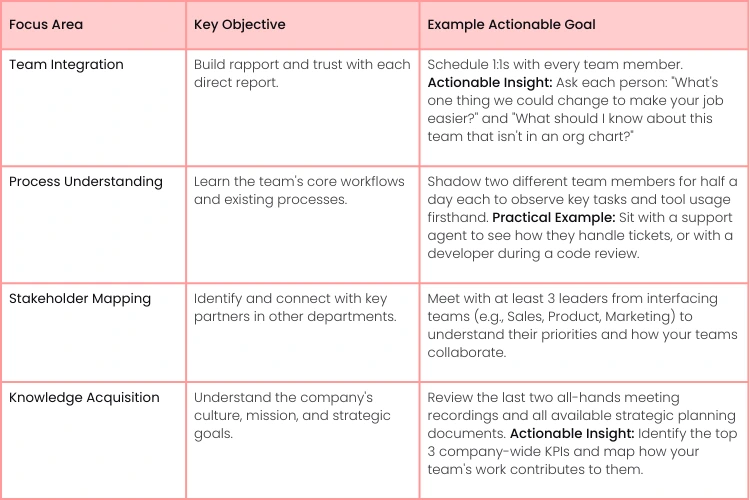
To help you structure this critical first month, here's a look at the key areas you should be focusing on, along with some concrete goals you can adapt.
Manager's 30-Day Plan Focus Areas & Actionable Goals
This table is a starting point. Your real mission is to listen, learn, and absorb as much as you can.
Your success in the first 30 days is measured by the quality of questions you ask, not the number of problems you solve. Your primary output should be a well-documented understanding of the people, processes, and politics at play.
To make these conversations as productive as possible, you have to become a master of active listening. If you want to sharpen this skill, this guide on how to be a better listener can help you get the most out of every interaction. The understanding you build now will be the bedrock of your success in the months ahead.
Making Your Mark From Day 31 to 60
Alright, you've survived the first month. You've listened, you've learned, and you've probably had about a thousand coffees with your new team members. Now it's time to shift gears. The second month isn't about sitting back anymore—it’s about stepping up and starting to contribute in a tangible way.
This is where you move from being the new manager to being their manager. It's time to translate all those insights you gathered into some early wins that show your team you're here to make their lives easier.
Think back to those initial one-on-ones. What were the common frustrations? The "if only we could fix..." conversations? Those are your gold mines. Tackling these immediate pain points shows you weren't just nodding along; you were actually listening and are ready to roll up your sleeves.
From Insights to Action
Now, this isn't about you coming down from the mountain with a list of decrees. Real change happens with your team, not to them. Pull them into the process. Partner with them to pilot a few small changes, which gives them a sense of ownership from the get-go. This is a massive step in building trust and is fundamental to creating a truly high-performing team. For more on that, this guide on how to build high-performing teams is a great place to start.
So, what does this look like in the real world?
- Practical Example (Marketing Manager): You heard everyone complain about the clunky weekly reporting dashboard. Your quick win is to create a simplified template in Google Data Studio that auto-populates, saving the team a few hours of manual data entry each week.
- Practical Example (Engineering Lead): Developers are getting stuck in the code review process. You could introduce a small tweak, like a dedicated Slack channel for urgent review requests or implementing a "two-person rule" to unblock tickets faster.
A solid, actionable goal for this phase sounds something like this: "I will partner with two senior team members to pilot a new weekly status update format in Asana, with the goal of reducing meeting time by 20% by day 60."
The point of this phase isn't to overhaul the entire department. It's about showing you can deliver real value by knocking down the small, annoying obstacles. That's how you build the credibility needed for the bigger stuff down the road.
These early successes are proof that you're not just an observer—you're an active participant in improving the team's day-to-day. By day 60, getting these small wins on the board can have a real impact, like boosting stakeholder satisfaction by 15% just by closing a few nagging feedback loops. This is the crucial stage where you go from being the new hire to being a leader they trust.

Driving Strategic Change in Your Final 30 Days
The first 60 days were about listening, learning, and fixing what's broken. Now, the final 30 days are where you pivot from being a reactive problem-solver to a proactive, forward-thinking leader. You've built trust and scored some early wins; it's time to cash in that political capital and focus on bigger, strategic initiatives that connect your team to the company's future.
Your focus completely shifts from putting out today's fires to building a fire-proof future.
This is the time for mentoring your people, laying out a clear, long-term vision, and introducing strategic improvements that will pay dividends for months to come. By now, you should have a solid grasp of your role and the authority to drive meaningful change. To make room for this high-impact work, mastering effective delegation strategies is non-negotiable.
Executing Your Long-Term Vision
Everything you do now needs to tie directly back to the bigger picture—the company's main objectives. This isn't just about making plans; it's about proving your leadership's impact with cold, hard data and setting your team up for success long after these 90 days are over.
Here are a few concrete examples of what your goals could look like in this final stretch:
- Present a six-month roadmap that outlines two new projects designed to boost customer retention by 10%.
- Actionable Insight: Back this roadmap with data from your first 60 days, such as customer feedback trends or support ticket analysis.
- Roll out a new professional development framework, with the goal of getting 75% of your team to complete at least one new certification by the end of next quarter.
- Practical Example: Identify specific, company-paid courses on platforms like Uplyrn that align with individual career goals discussed in your 1:1s.
- Finalize and present the budget proposal for a new software tool (e.g., a project management system like Jira) that automates a painful team process, with a projection to increase efficiency by 15%.
Notice how these goals are strategic, measurable, and forward-looking. They show you're thinking beyond the immediate chaos.
By day 90, you are no longer just managing tasks; you are shaping the future direction of your team. Your plan should reflect this shift from operational management to strategic leadership.
And this isn't just theory. An analysis of over 500 global firms found that new leaders using 30-60-90 day plans saw a 30% improvement in key results, especially in project-heavy fields. Rolling out these bigger ideas means guiding your team through change, which requires a good handle on what the change management process entails.
Common Mistakes New Managers Make (And How to Avoid Them)
Even a perfectly crafted 30-60-90 day plan for managers can hit a wall if you fall into a few common traps. We’ve seen it happen time and again.
A classic mistake is trying to boil the ocean in your first month. You’re eager to make an impact and prove you were the right hire—we get it. But storming in with a grand plan to overhaul major processes on day one is a recipe for disaster. It almost always sparks resistance and puts your new team on the defensive.
- Practical Example of what not to do: Announcing in your first week that the team is migrating from Slack to Microsoft Teams without consulting anyone. This creates immediate friction.
- Actionable Insight: Instead, add "Evaluate internal communication tools" to your 30-day plan and gather team feedback first.
Another pitfall is clinging to your plan like it's gospel. Business doesn’t stand still. A key person might hand in their notice, a top-priority project could get shelved, or a new company-wide directive lands on your desk. Your plan has to be a living, breathing document, not something you laminate and hang on the wall.
A rigid plan is a fragile plan. Your ability to pivot based on new information is a sign of strong leadership, not a failure to stick to the original script.
Keeping Your Plan a Secret
This one is probably the most damaging mistake of all: keeping your plan to yourself. This isn’t your private journal; it's a powerful tool for building alignment and trust.
When you keep your intentions under wraps, you create a vacuum that people will fill with suspicion and anxiety. Your team starts to feel like they’re just pieces on a chessboard, and you’re the only one who knows the rules of the game.
To sidestep this, you have to be radically transparent about your plan:
- Share it with your own boss. This is non-negotiable. You need to make sure your goals line up with their expectations and the bigger picture. It’s your best chance to get their feedback and crucial buy-in before you start making moves.
- Share it with your team. Walking your team through your plan—or at least a version of it—builds incredible trust right out of the gate. It shows them your priorities, gives them a glimpse of the future, and makes them feel like they're part of the journey with you.
- Actionable Insight: Create a simplified, one-page version of your plan focusing on team-level goals and share it in a dedicated team meeting. This makes it digestible and encourages discussion.
By steering clear of these traps—being overeager, inflexible, or secretive—you give your 30-60-90 day plan a real chance to succeed. It stops being just a personal checklist and transforms into a shared roadmap for getting things done together.
Answering Your 30 60 90 Day Plan Questions
As you start piecing your plan together, a few questions always seem to come up. Let's walk through some of the most common ones we hear from new managers so you can move forward with confidence.
Can I Share My Plan With My New Team?
Absolutely. In fact, you really should.
You’ll obviously share a detailed version with your own boss for alignment, but giving a high-level overview to your team is a massive trust-builder. It pulls back the curtain on your priorities and shows them you value transparency. This simple act makes them feel like partners in the journey, not just subjects of a new regime.
A great way to do this is in a team meeting sometime during your second week. Frame it simply: "My main goal for the first month is to listen and learn from all of you. Here’s what I'm focused on, and I'd love your input." It sets a collaborative tone right from the start.
What If My Priorities Change Unexpectedly?
Let's be real—they probably will. A 30-60-90 day plan is a guide, not a contract set in stone. The business might pivot, a key team member could resign, or a new company-wide initiative might drop out of nowhere. The best leaders know how to adapt.
When things change, just update your plan and, most importantly, communicate the why to your manager and your team.
- Practical Example: If a project suddenly gets fast-tracked, you could say in your weekly team sync, "Given the new deadline for Project X, I'm shifting some of my 60-day goals to focus on supporting the team through this crunch. We'll revisit those process improvement ideas in month three." This transparency prevents confusion.
How Detailed Should My Plan Be?
Your plan needs to be specific enough to be actionable but flexible enough to evolve. Vague goals like "learn the business" won't get you very far. You need concrete, measurable targets.
Think of it this way: your 30-day goals should be highly detailed with specific meetings and deliverables. Your 60-day goals can be a bit less granular, focusing on key initiatives. Your 90-day goals should be more about strategic outcomes.
Practical Example:
- 30-Day Goal: "Schedule and complete 1:1s with all 8 team members by week 2." (Highly specific)
- 60-Day Goal: "Identify and implement one process improvement to reduce redundant work." (Specific outcome, flexible method)
- 90-Day Goal: "Develop Q3 team roadmap aligned with company objectives." (Strategic outcome)
This tiered approach gives you a solid framework without boxing you in. This kind of structure is precisely why these plans are so effective. In fact, data shows that a well-crafted 30 60 90 day plan for managers can lead to a 40% faster ramp-up time, with 75% of managers reporting higher confidence and alignment by day 90.
If you're wondering what this looks like in practice, this guide on what to do in the first 30 days of a new job can give you more specific, real-world examples.
At Uplyrn, we believe great leadership starts with a great plan. Our platform provides the tools and expert-led courses you need to master management skills and accelerate your career from day one. Start your learning journey with Uplyrn today!


Leave your thoughts here...
All Comments
Reply