









Mastering the Business English Course: Your Career Guide

A business English course is a specialized program that teaches professionals the exact language and communication skills they need to thrive in a global workplace. It goes way beyond just learning conversational English, focusing instead on practical, career-specific communication like writing emails that get results, confidently leading meetings, and nailing negotiations.
Jump To Section

Earn As You Learn
Earn 25% commission when your network purchase Uplyrn courses or subscribe to our annual membership. It’s the best thing ever. Next to learning,
of course.
What is a Business English Course and Why Does It Matter?
Think of it like this: general English is your all-purpose toolkit, great for everyday life. A business English course, however, hands you the specialized instruments—the high-precision tools you need for complex professional tasks. You're not just memorizing vocabulary; you're mastering how to apply language in the real world of business.
This isn't just about sounding more "professional". It's about communicating with clarity and purpose to get things done. Knowing how to politely interject in a heated video call ("If I could just add one thought here...") or structure a report that actually persuades your boss are the kinds of skills that directly fuel your performance and open up new career doors.
Who Benefits Most From This Training?
A huge range of professionals find this kind of targeted training incredibly valuable. You’re probably the perfect fit if you are:
- An ambitious professional eyeing an international role or a big promotion inside a multinational company.
- A team leader trying to improve collaboration and eliminate confusion within a culturally diverse team.
- A job seeker looking to stand out from the crowd by showcasing top-tier communication skills in interviews.
- An entrepreneur who needs to negotiate with global partners, pitch to foreign investors, or connect with an international customer base.
The demand for these skills is exploding. The Business English Language Training market was valued at USD 19,518.72 million in 2024 and is on track to hit USD 45,680.75 million by 2033. This massive growth is happening for a simple reason: a staggering 98.5% of employers actively screen for professional communication skills when hiring.
The Practical Focus of Modern Courses
Today’s courses are all about immediate, real-world application. The whole point is to give you communication strategies you can put into practice at work the very next day. This hands-on approach ensures you’re not just learning abstract grammar rules, but actually mastering the skills that build real confidence and competence.
Actionable Insight: The next time you have to decline a request, instead of a blunt "No, I can't", try a more professional phrase like, "Unfortunately, my schedule is fully committed this week. Could we perhaps revisit this next Monday?" This small shift maintains a positive relationship while still being clear.
If you want to dive deeper into what makes communication truly effective, check out this guide on the principles of business communication.
Decoding the Curriculum: What You Will Actually Learn
So, what's really inside a business English course? If you're picturing endless vocabulary lists and dry grammar exercises, you'll be pleasantly surprised. A great curriculum is a practical journey, designed to take you from foundational skills to specific, real-world situations you’ll face at work.
It's all about mastering the language of getting things done. The goal isn’t to sound like a textbook, but to communicate with confidence and clarity. You'll learn how to turn a vague, passive request ("The presentation needs to be reviewed") into a clear, action-oriented message that actually gets a response ("Could you please review the attached presentation and provide feedback by 3 PM today?").
Core Modules and Practical Skills
While every course is a bit different, any solid program will be built around practical, skill-based modules. Think of them as toolkits for different professional scenarios. You can expect to dive deep into topics like:
- Professional Email Etiquette: Writing subject lines that get opened, striking the right tone, and structuring messages so they’re easy to scan and act on.
- The Language of Meetings: This is everything from how to politely jump in with an idea ("May I offer a suggestion?") to presenting your points clearly and summarizing the key takeaways for your team.
- Negotiation and Persuasion: You'll get hands-on practice with the exact phrases that build agreement ("I see your point, and I think we can build on that..."), handle pushback gracefully, and help you advocate for your position.
- Cross-Cultural Communication: This is a big one. You’ll learn the subtle nuances of working with international colleagues and clients, especially over video calls.
Of course, mastering any skill requires more than just good materials.
- Practical Example: Instead of sending a flat, one-line email like, "The report is attached", you'll learn to write something far more effective: "Hi Team, please find the Q3 sales report attached. I'd appreciate your feedback on the regional performance section (pages 8-10) by EOD Friday so we can finalize it for Monday's executive review."
See the difference? It's clearer, more professional, and sets a specific expectation. That’s the kind of practical upgrade you can expect.
Making It Relevant to Your Industry
The very best business English programs don't stop at general skills. They offer specialized vocabulary and scenarios tailored to your actual field, whether you're in tech, finance, marketing, or healthcare. When you're looking at a syllabus, keep an eye out for modules that speak directly to your industry—that's how you know the language you're learning will be immediately useful.
The demand for this kind of focused training is absolutely massive. The global English Language Training market is set to hit an incredible $129.3 billion by 2030, driven in large part by the more than 1.1 billion non-native speakers using English to advance their careers.
If your focus is on breaking into or succeeding within the U.S. market, you'll find even more specific nuances to master. For a deeper dive, check out this guide on mastering American business English for more targeted advice.
Finding the Right Course Format for Your Lifestyle
Picking the right format for your business English course is just as crucial as picking the right content. Let's be honest, the best program in the world is useless if you can't fit it into your life. The goal is to find something that feels natural, not like another chore, so you actually stick with it.
It really comes down to your personality and your calendar.
Live Online Classes
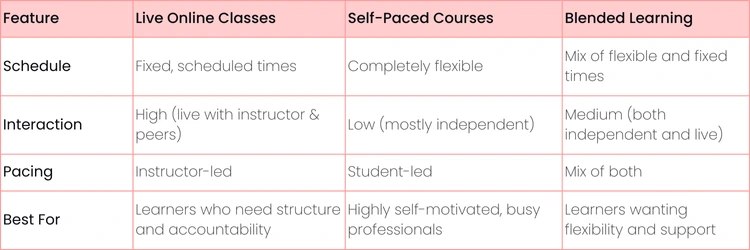
Live online classes are fantastic if you crave real-time interaction. Think of them as a traditional classroom, just virtual. You get to talk with instructors and other students, practice speaking on the fly, and get feedback right then and there. This setup is perfect for anyone who needs that external push—a fixed schedule and the accountability of a group to keep you on track. The downside? That fixed schedule can be a deal-breaker if your professional life is unpredictable.
Self-Paced Courses for Maximum Flexibility
On the other end of the spectrum, you have self-paced courses. These put you completely in the driver's seat. Feel like studying at midnight or squeezing in a lesson on your lunch break? Go for it. This approach is a dream for highly disciplined people or those juggling chaotic work hours. The trade-off, however, is a big one: you miss out on spontaneous speaking practice, which is absolutely essential for building true fluency.
If you're leaning this way, it's worth checking out some proven strategies to stay on track. You can learn more about the best practices for distance education to make sure you get the most out of the experience.
Actionable Insight: If you choose a self-paced course, schedule one 30-minute "study session" in your calendar each day. Treat it like a real meeting. This simple act of time-blocking creates the structure you need to stay consistent without a live instructor.
Blended Learning: A Balanced Approach
For many, blended learning hits the sweet spot. It's a hybrid model that mixes the freedom of self-paced learning with the structure and interaction of live classes. You might watch pre-recorded lectures on your own time, then join a scheduled group session to practice what you’ve learned. It's a fantastic compromise for people who want both independence and support.
Comparison of Business English Course Formats
To make the decision a little easier, here’s a quick breakdown of how the three main formats stack up against each other.
Ultimately, choosing a format is a personal decision based on how you learn best and what your daily life looks like. By weighing these options, you can find a path that not only teaches you business English but also fits seamlessly into your world.
How to Evaluate and Select the Best Course
With so many business English courses out there, picking the right one can feel like a shot in the dark. But it doesn't have to be. A few key things separate the truly great programs from the just-okay ones. Think of it like buying any important tool for your career—you want to make sure it's the right fit for the job and built to last.
First thing's first: look past the glossy brochures and focus on who's actually teaching. The best instructors aren't just academics; they have real-world miles on their resumes. Someone who has actually navigated tricky international negotiations or managed a global team brings a level of insight and practical wisdom that you just can't get from a textbook.
Next, take a hard look at the curriculum. Does it feel like a series of abstract grammar lessons, or is it grounded in what you’ll actually do at work? A top-tier course will be built around project-based assignments that mirror real-life business scenarios. Look for things like drafting persuasive emails to a client, role-playing a salary negotiation, or building a presentation for stakeholders. That’s the stuff that really moves the needle.
Key Evaluation Checklist
As you start comparing different courses, keep this simple checklist handy to stay focused on what matters:
- Instructor Qualifications: Do they have hands-on business experience in a field that's relevant to you?
- Curriculum Relevance: Is the syllabus packed with industry-specific language and tasks you can immediately apply on the job?
- Student Testimonials: Go beyond the generic praise. Look for detailed, authentic reviews that talk about specific skills people gained and how they used them.
- Practical Assignments: Does the course make you produce actual work, like reports or presentations, or is it just a series of multiple-choice quizzes?
Actionable Insight: Before enrolling, ask the provider for a sample lesson or a detailed syllabus. A quality course will be transparent. If their materials focus on abstract grammar rules instead of practical scenarios like "Crafting a Follow-Up Email After a Sales Call", it might not deliver the real-world skills you need.
Investing in your communication skills isn't just a nice-to-have anymore; it's a strategic career move. At the end of the day, a great business English course should offer a clear return on your investment. And that ROI isn’t just a piece of paper. It’s the confidence to speak up in meetings, the clarity to write compelling emails, and the skills to perform better in your role.
Putting Your New Skills into Practice at Work
Let's be honest—the real measure of a great business English course isn't the certificate you get at the end. It's that feeling of confidence when you speak up in a meeting or send a perfectly worded email. The trick is to start using what you’ve learned right away, turning theory into real-world skill.
Don’t wait for a huge, high-stakes presentation to try out your new phrases. The key is to start small and build momentum. This makes the whole process feel less intimidating and helps lock in your knowledge through day-to-day practice.
Small Steps Lead to Big Wins
The fastest way to make new language skills feel natural is to weave them into your daily work. Here are a few simple ways to get started:
- Take on a small role. Offer to kick off the next team meeting with a quick five-minute update on your project.
- Practical Example: Use the phrase, "To bring everyone up to speed, I'll quickly summarize our progress on Project Alpha..."
- Upgrade a standard email. Grab a template you use all the time—like a meeting invitation—and see if you can polish it with the new vocabulary and sentence structures you’ve learned. The goal is to make it sharper and more professional.
- Become an active listener. In your next video call, pay close attention to the professional phrases your colleagues use. Jot them down, and then look for a natural opportunity to use one yourself later.
For more specific advice, check out this guide on how to write effective emails for practical tips you can apply immediately.
Seek Feedback to Accelerate Growth
Asking for honest feedback is one of the most powerful things you can do to improve. You don't have to wait for your annual performance review to get valuable input.
Actionable Insight: Find a manager or a senior colleague you trust and send them a quick message: "Hi [Name], I'm actively working on my presentation skills. Could you give me one piece of feedback on how I communicated my key points in today's meeting?" This simple, direct request makes it easy for them to help you.
This simple move shows you’re proactive about your growth and gives you targeted advice you can use to fine-tune your skills right away.
As your communication gets stronger, so will your professional image. Once you feel confident in your business English, you can really shine in job interviews. For more on that, take a look at these essential resume and interview tips to help you make a fantastic impression.

Got Questions About Business English Courses?
Jumping into any kind of professional development program can feel like a big step, and you probably have a few questions. Let’s clear up some of the most common ones people ask about business English courses.
How Long Does It All Take?
This is a classic "it depends" situation. The time it takes to complete a business English course really comes down to the program's intensity and where your skills are to begin with. An immersive, bootcamp-style course with daily classes might get you results in 4 to 8 weeks. On the other hand, a more relaxed, part-time schedule could stretch out over 12 weeks to six months.
But here's what really matters: good courses aren't just about clocking hours. The best ones are built around competency. They have clear milestones that track your progress toward tangible professional goals, so you know you're not just spinning your wheels.
Will I Get a Certificate at the End?
Yes, any reputable course will provide a certificate of completion. It’s a great piece of validation to add to your LinkedIn profile or resume, showing potential employers that you’re serious about your professional growth.
However, the real prize isn't the piece of paper. The most valuable outcome is a real, noticeable improvement in how you communicate at work. That's the skill you'll carry into every meeting, presentation, and email long after the course is over.
The bottom line: Think of the certificate as proof you did the work. Your newfound confidence and communication skills are the actual career-changing results.
Is This a Good Place to Start for Beginners?
Most business English courses are geared toward people who already have a solid grasp of the language—at least an intermediate (B1) level. The idea is to take the English you already know and sharpen it for a professional environment, not to teach you basic grammar from the ground up.
If you're just starting your English journey, you'll get much more value from a general English course first. That will give you the foundation you need to really crush a specialized business course later on.
Ready to build the kind of communication skills that open up global career opportunities? Uplyrn offers expert-led courses designed for real-world business challenges and success. Explore our Business English programs today and start your journey to professional fluency.


Leave your thoughts here...
All Comments
Reply