









How to Become a Subject Matter Expert: An Action Plan

So, what does it really mean to be a subject matter expert?
It’s not about memorizing every last detail in your field. It's about earning the trust of your peers by developing deep, practical knowledge in one specific area. This is the kind of expertise that gets you pulled into important meetings and makes your opinion the one that matters.
You're no longer just the person with the facts; you're the one people count on to solve the tough problems. For example, instead of just knowing the features of a new software, you understand its limitations and can advise on the best way to integrate it into the company's existing workflow to avoid common pitfalls.
Jump To Section

Earn As You Learn
Earn 25% commission when your network purchase Uplyrn courses or subscribe to our annual membership. It’s the best thing ever. Next to learning,
of course.
The Makings of a True Expert
Think about that one person at your company, the one everyone goes to when they're truly stuck. How did they get there? It wasn't by accident. They didn't just hoard information; they built a solid reputation for delivering clear, reliable, and actionable guidance, time and time again.
A genuine Subject Matter Expert (SME) is much more than a walking encyclopedia. They're the person who sees the connections others miss, anticipates what's coming next, and can break down ridiculously complex ideas into simple, strategic advice.
This isn't some exclusive club reserved for a chosen few. It’s a completely achievable goal for anyone who’s willing to put in the work—focusing their learning, applying it consistently, and building their credibility piece by piece. You have to move past a surface-level grasp and get to a point where you can genuinely innovate and drive the conversation forward.
More Than Just a Title
Becoming the go-to expert in your niche is a massive career accelerant. It’s about building a personal brand that screams competence and reliability. The payoff is real and tangible.
- Your Voice Gets Heard: Suddenly, your opinions carry more weight. People listen when you talk in meetings, on projects, and during strategic planning. For example, when the team is debating two different marketing strategies, your data-backed insight on customer acquisition cost for a similar past campaign becomes the deciding factor.
- Your Career Takes Off: True expertise makes you invaluable. This naturally leads to faster promotions, better projects, and, yes, more money. Recognized experts command higher salaries and consulting fees—it’s that simple.
- Opportunities Find You: You’ll start attracting the kind of work you actually want to do. Speaking gigs, interesting collaborations, and offers from other industry leaders will start coming your way.
The real secret to expertise isn't just knowing the answer. It's understanding the why behind it. It's having the context to see what's coming and the wisdom to guide people to the right solution.
Ultimately, this whole journey is about creating undeniable value. It's worth stopping every so often to ask yourself if what you're doing is actually making a difference. If you're looking for a good way to frame that question, thinking through whether are you actually delivering value is a great place to start.
This guide will give you a no-nonsense roadmap to build your skills and, just as importantly, make sure that expertise gets the recognition it deserves.
Find Your Niche and Lay the Groundwork
The first move toward becoming a subject-matter expert isn't trying to learn everything. It’s actually the opposite. It starts with a much smarter play: carving out a specific, focused niche where you can build deep, undeniable knowledge.
Forget about broad categories. Instead of aiming to be a "marketing expert", you need to zero in on becoming the go-to person for "customer lifecycle marketing for B2B tech startups". That kind of sharp focus is the foundation for everything else you'll do.
By narrowing your field, you seriously speed up your learning curve. You can rack up experience and insights much faster than someone trying to be a jack-of-all-trades. This focus is what lets you become the authority in that specific space in a fraction of the time.
Aligning Passion with Market Demand
The perfect niche exists at the intersection of three things: what genuinely fascinates you, what you're already good at, and what the market is willing to pay for. If you miss one of these, you’re setting yourself up for burnout or, worse, irrelevance.
Start with an honest self-assessment. Ask yourself:
- What topics do I get lost in? Think about the articles you read for fun or the work problems you actually enjoy tackling. For instance, do you find yourself voluntarily researching new cybersecurity threats on a Saturday morning? That's a strong signal.
- What are my proven strengths? Where have people consistently praised your work? What are your measurable wins? Can you point to a project where your input directly increased efficiency by 15%?
- Where is the actual demand? Jump on LinkedIn and look at job postings and industry trend reports. What specialized skills are companies throwing money at?
- Actionable Insight: Search for your potential niche keywords (e.g., "AI ethics consultant") and see how many high-quality job postings appear. This is a quick reality check on market demand.
Answering these questions helps you map out where your personal interests collide with real-world needs. This sweet spot ensures you're building expertise in a field that not only keeps you engaged but also has legs for long-term growth.
Your niche isn't just a topic; it's your professional battleground. Choose one where you have a natural advantage and a clear path to victory. It's about finding that sweet spot where your curiosity meets a clear market need.
A Practical Example of Niche Selection
Let’s look at Maya, a data analyst at a big retail company. She’s good at her job, but her skills feel too generic. She wants to be known for something specific.
First, Maya takes stock of her interests and strengths. She realizes she loves digging into customer data to find hidden patterns and is fascinated by the "why" behind what people buy. She’s way more excited by predictive modeling than by pulling standard financial reports.
Next, she checks out market trends. She sees a massive spike in demand for experts in "predictive analytics for e-commerce". Companies are desperate for people who can forecast customer behavior to dial in their inventory and marketing spend. This is a perfect match.
Maya has found her niche.
She immediately shifts her focus from general data analysis to mastering predictive analytics specifically for online retail. Now she has a clear direction. It makes it a thousand times easier to pick the right courses, find relevant projects, and connect with the right people to build her authority in this high-demand specialty.
To get going, she can find practical advice on how to gain expertise in your areas of interest and build a structured learning plan. This targeted approach is exactly how you lay the groundwork to become a true subject-matter expert.

Build Deep Knowledge with Deliberate Learning
Alright, you've carved out your niche. Now the real work begins.
Becoming a true expert isn't about casually reading a few articles or binge-watching tutorials. It demands a systematic, almost obsessive approach to gaining deep, specialized knowledge. This is where you graduate from being a simple consumer of information to a dedicated student of your craft.
The mission is to shift from passive learning to deliberate learning. Instead of just "reading more", you’re going to design a personal curriculum that weaves together foundational theories with the most current, real-world practices. This ensures you’re building a solid framework of understanding, not just collecting a pile of disconnected facts.
Adopt the T-Shaped Professional Model
A great way to map this out is the T-shaped professional model. Picture the letter "T". The vertical bar is your profound expertise in one core area. The horizontal bar is your working knowledge of related fields that give your core expertise context.
This model is your blueprint for being both a go-to specialist and a fantastic collaborator. You go incredibly deep in your niche while keeping a broad enough perspective to see how your work connects to the bigger picture.
Let's say you're gunning to be a subject matter expert in user experience (UX) research. Here’s what your "T" might look like:
- Deep Expertise (Vertical Bar): Total mastery of qualitative and quantitative research methods, usability testing, journey mapping, and persona development. This is your non-negotiable, core skill set.
- Broad Knowledge (Horizontal Bar): A solid understanding of front-end development principles, product management goals, data analytics, and marketing funnels. You don't need to code a website, but you absolutely need to speak the language.
This combination makes you infinitely more effective. A UX researcher who gets the technical constraints of development can pitch solutions that are actually buildable. An expert who grasps the business goals behind a project can deliver insights that truly move the needle.
Create Your Personal Learning Curriculum
Your next move is to build a structured learning plan. Forget about enrolling in a formal degree program (unless you want to). This is about curating the best resources to create your own focused educational journey. A killer curriculum should blend different types of content to cover theory, practical application, and what’s coming next.
Start by pinpointing the cornerstones of your field. What are the seminal books everyone quotes? Who are the top 5-10 thinkers publishing game-changing research? What are the industry-standard tools and methodologies you can't live without?
Make sure your curriculum includes a mix of these:
- Foundational Books and Texts: To get the core principles and history of your field down cold.
- Actionable Insight: Don't just read them. Take notes and create a one-page summary for each, explaining how the core concepts apply to a recent project you worked on.
- Advanced Online Courses: For structured learning on specific skills and tools. Platforms like Uplyrn are built for this.
- Peer-Reviewed Research and Journals: To stay on the absolute cutting edge of new developments.
- Industry Conferences and Webinars: For fresh insights from current practitioners and, of course, networking.
- Actionable Insight: After each webinar, write down three key takeaways and one action you will take at work based on what you learned.
This dedication to ongoing education is what separates the pros from the amateurs. If you’re looking to get into the right headspace for this, embracing the mindset of the eternal learner is a perfect place to start.
Becoming an expert is a marathon, not a sprint. The depth of your knowledge is directly proportional to the consistency and quality of your learning efforts over time.
This isn't just a nice thought; it's backed by a ton of research. Many studies echo the popular "10,000-Hour Rule" which suggests that achieving true mastery takes about 10,000 hours of focused practice. That’s roughly five years of dedicated, full-time work and learning. You can dig deeper into the time investment required through various industry analyses on becoming a subject matter expert. The key takeaway is simple: expertise is the result of sustained, deliberate effort—not an overnight miracle.

Turn Knowledge into Credibility and Experience
Having deep knowledge is great, but it's totally invisible to the outside world until you prove it. To be seen as a true subject matter expert, you have to turn what you know into tangible proof that people can see, trust, and ultimately, pay for. This is where you transform your theoretical smarts into real-world credibility.
The whole game really comes down to two things: practical experience and formal credentials. It’s one thing to know the theory, but you absolutely have to show you can apply it when things get messy—and have the qualifications to back it all up.
Get Your Hands Dirty with Real-World Experience
The fastest way to build credibility is by actually doing the work. Nothing tests your expertise like a real-world problem that doesn't follow the textbook. This is the difference between knowing a recipe and actually cooking a Michelin-star meal.
Don’t just sit around waiting for the "perfect" project. You need to be proactive and either find or create opportunities that put your skills on display. This is how you build a portfolio that proves you can deliver.
Here are a few actionable ways to get that critical, hands-on experience:
- Volunteer for the tough projects at work. Put your hand up for that gnarly assignment everyone else is avoiding.
- Practical Example: If your company is migrating its database, volunteer to lead the data validation work, even if it’s tedious. You’ll learn the system inside and out.
- Kick off a targeted side project. If you're an aspiring e-commerce guru, build a small online store to test conversion strategies. A future cybersecurity pro? Set up a home lab to practice penetration testing.
- Take on strategic freelance gigs. Platforms like Upwork or Toptal are full of small, well-defined projects. These are perfect for getting direct proof that you can deliver results for clients.
Every project you finish becomes another story in your arsenal—a case study showing how you tackled a problem, used your skills, and got a measurable result. This is the currency of credibility.
Expertise isn't just about what you know; it's about what you've done. A portfolio of successful projects speaks louder than any resume ever could.
Once you have a collection of these wins, you can even start a business book to monetize your expertise, turning your hard-won experience into a powerful asset.
Validate Your Skills with Formal Credentials
While nothing beats hands-on experience, formal credentials are a fantastic shortcut to building trust. An industry-recognized certification is a clear signal to employers, clients, and your peers that your skills have been tested and approved against a professional standard.
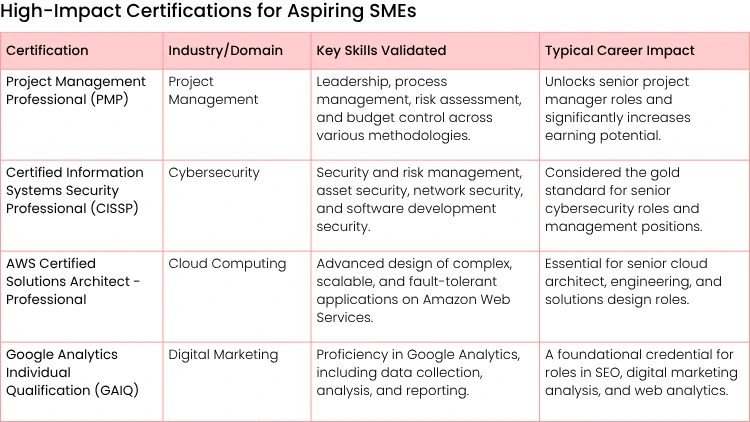
Getting the right certifications is a key step on the path to becoming an SME. Think about it: the Project Management Professional (PMP) is one of the most in-demand certifications on job boards right now for a reason. Data shows the average project manager earns around $85,365, but subject matter experts—often boosted by these very credentials—pull in an average of $103,749.
But you have to be strategic. Don’t just collect acronyms for your LinkedIn profile. Focus on credentials that are respected in your niche and will actually open doors.
- Actionable Insight: Look at the LinkedIn profiles of 5-10 people who have the job you want in 5 years. What certifications do they all have in common? That's your target. Not sure where to start? Check out this guide on how to ask someone to be your mentor to connect with pros who can point you toward the certifications that carry the most weight.
To give you an idea, let's look at some popular certifications that can really cement your expert status.
When you combine a solid portfolio of hands-on work with respected certifications, your expertise becomes undeniable. You're no longer just telling people you're an expert—you're showing them the receipts.
Establish Your Authority and Build Your Brand
Having deep knowledge and real-world experience is the price of entry. But on its own, it won't get you recognized as an expert. If you want people to see you as a subject-matter expert, you have to consciously build your professional presence and establish that authority.
This is where you shift from just being good at what you do to being known for it.
It’s all about making your expertise visible. You have to get the insights out of your head and away from just your immediate team. If you don't share what you know, your reputation has nowhere to go.
Start Sharing Your Expertise Consistently
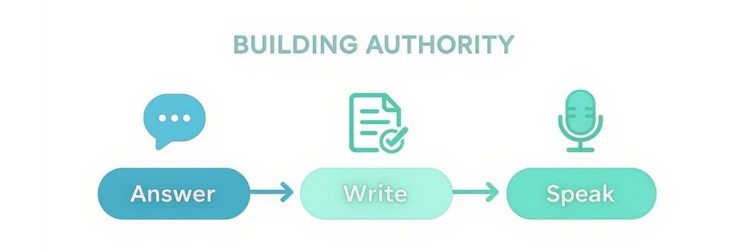
Building authority starts with small, consistent acts of sharing. You don't need to launch a world-famous blog overnight. The smarter move is to start creating value where your target audience already hangs out.
Think about a software developer who wants to be the go-to person for performance optimization. Their journey could start simply by answering questions on Stack Overflow or jumping into conversations on a niche subreddit. Done consistently, these small actions build a reputation for being knowledgeable and genuinely helpful.
Once you've got your feet wet, the next logical step is to start creating your own content. This is your chance to really dig in and show off your unique perspective.
- Write In-Depth Blog Posts: Don't just summarize a topic. Tackle a specific, thorny problem your peers are struggling with. A post like "Three Advanced Techniques for Slashing API Latency in Node.js" carries way more weight than "An Intro to Fast Code".
- Develop Detailed Case Studies: Turn your project wins into stories. Lay out the initial challenge, how you approached it, the specific actions you took, and—most importantly—the measurable results.
- Practical Example: Create a one-page PDF detailing how you helped your team reduce customer support tickets by 20% by rewriting the onboarding documentation.
- Create Practical Tutorials or Guides: Show, don't just tell. Walking people through a process step-by-step proves you not only know your stuff but can also teach it effectively.
- Actionable Insight: Record a 5-minute screencast showing how to use a little-known feature in a popular software tool in your field. Post it on LinkedIn.
Grow Your Influence from a Platform of Proof
As you create more and more high-value content, you're not just posting online—you're building a platform. This body of work acts as a living, breathing resume that proves your skills far more powerfully than a static CV ever could.
This is the tangible proof that you can apply theory to solve real-world problems.
And that visibility naturally opens doors to bigger opportunities. That same developer who started on Stack Overflow might leverage their blog to land a guest spot on a popular tech podcast. Their case studies could catch the eye of a conference organizer, leading to an invitation to speak.
Your personal brand is what people say about you when you're not in the room. By consistently sharing valuable insights, you actively shape that conversation and build a reputation for expertise.
This entire process is central to building a strong professional identity. If you want to go deeper, this guide on What is Personal Branding: The Golden Rules to Follow is a great next step for crafting your expert persona.
Validate Your Expertise Through Community Involvement
Getting involved with professional communities is another fantastic way to cement your authority. For instance, major players like Amazon Web Services (AWS) and CompTIA lean on SMEs to help create and validate their certification exams.
Getting involved in programs like these is a huge credibility booster. It signals a high level of mastery, especially since organizations like AWS often require contributors to have at least one to two years of direct, hands-on experience with the tech in question.
To truly stand out, you also need to understand the principles of how to become a thought leader. This isn't just about sharing what you know; it's about offering fresh perspectives that challenge old ways of thinking and predict what's coming next. When you do that, you become more than an expert—you become an indispensable resource.
Your SME Journey: A 24-Month Roadmap
Becoming a true subject-matter expert is a marathon, not a sprint. The idea can feel overwhelming, so the key is to break it down into a structured, actionable plan. Think of it less as a giant mountain to climb and more as a series of manageable base camps.
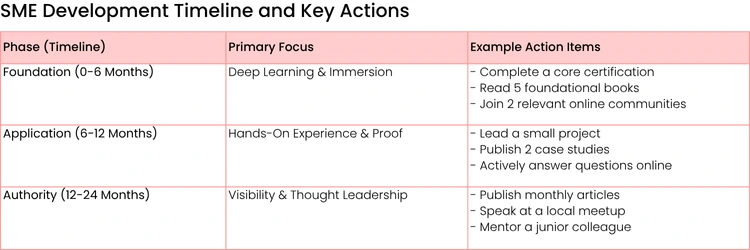
This roadmap lays out the core activities you’ll focus on, starting with absorbing information, then applying it, and finally, sharing your unique perspective with the world.
The progression is what matters here. You move from being a reactive participant to a proactive creator and, eventually, a recognized leader. Each stage builds on the last, solidifying your reputation and expanding your influence over time.
The Foundation Phase: Months 0-6
Your first six months are all about building a solid base of knowledge and getting the lay of the land. The primary focus is deep, intentional learning. You need to know who the key players are, what the foundational concepts are, and where the real conversations are happening in your chosen niche.
This isn't the time to broadcast your expertise. It's about making sure the ground beneath your feet is solid enough to build on.
Your checklist for this phase should be practical and targeted:
- Complete one core certification: Pick a well-respected credential that validates your foundational skills.
- Practical Example: For a cloud engineer, this could be the AWS Certified Cloud Practitioner.
- Read five foundational books: Go find the seminal texts that define your field and really absorb them.
- Identify three key mentors or influencers: Find experts whose work you admire. Start following their content, studying their career paths, and understanding how they think.
- Join two relevant online communities: Get into the forums, Slack channels, or LinkedIn groups where practitioners in your niche actually hang out. For now, just listen and learn.
The Application Phase: Months 6-12
Okay, time to get your hands dirty. This next phase is all about turning theory into practice. You'll be applying what you’ve learned in real-world scenarios and creating tangible proof that you know your stuff.
The goal is to shift from a learner to a doer. You're building a portfolio of work that speaks for itself.
During this period, your action items become much more hands-on:
- Lead one small-scale project: Volunteer to take the lead on a project that directly uses your niche skills, even if it's a small one.
- Practical Example: Offer to create and manage the A/B testing schedule for your team's next email campaign.
- Publish two detailed case studies: Document the projects you're working on. Focus on outlining the problem, detailing your solution, and—most importantly—showing the measurable results.
- Answer 10-15 questions weekly: Jump into those online communities you joined and start being helpful. Consistently providing valuable, well-thought-out answers is one of the fastest ways to build credibility.
A roadmap transforms ambition into action. By setting clear milestones for learning, application, and authority-building, you create a clear and measurable path from aspiring professional to recognized expert.
The Authority Phase: Months 12-24
You've built a solid foundation and have a portfolio of real-world experience. Now, the final year is about scaling your visibility and truly establishing yourself as an authority. The focus shifts from just doing the work to sharing your unique insights about the work.
This is how you go from being "good at your job" to becoming a recognized name in your field.
Your goals now are all about public contribution and influence:
- Write and publish one in-depth article per month. Share what you've learned.
- Deliver a presentation at an internal company meeting or a local meetup.
- Practical Example: Prepare a 15-minute "lunch and learn" for your colleagues on a new tool you've mastered.
- Mentor one junior professional in your field. Teaching is the ultimate test of knowledge.
- Develop a unique point of view on an emerging trend in your industry.
Following a plan like this gives you a clear path forward, with tangible milestones you can hit and celebrate along the way.
To make this even clearer, here's a table summarizing the entire journey.
This structure provides a repeatable process, ensuring you’re always moving forward and building on your previous efforts. It’s a deliberate climb, but one that leads to the summit of expertise.
Got Questions About Becoming an SME? Let's Clear Things Up.
Thinking about committing to the expert's path usually brings up a few nagging questions. It’s completely normal. Here are some straight answers to the most common ones I hear.
How Long Does It Really Take to Become an Expert?
Look, everyone loves to throw around the "10,000-hour rule" which can feel incredibly daunting. But that's not the whole story, especially in fast-moving industries.
In fields like tech, you can become the go-to person for specific problems with 18-24 months of dedicated, focused work. The game isn't just about logging hours; it's about the intensity and focus of your effort. This whole guide is designed around high-impact actions to get you there faster, without the fluff.
How Do I Overcome Imposter Syndrome?
Welcome to the club. If you feel like an imposter sometimes, it just means you care enough to question yourself. The best way I've found to shut down that nagging voice is with cold, hard facts.
Actionable Insight: Keep a 'brag file'. Seriously. It's not about ego. It's a running list of your wins, finished projects, and nice things clients or colleagues have said. When you feel that doubt creeping in, open the file. It’s hard to argue with your own track record.
Also, start small. You don't have to deliver a keynote tomorrow. Try mentoring a junior team member or writing up a short guide for your company's internal wiki. Every small win builds real, earned confidence.
Can I Become an SME While Working a Full-Time Job?
Absolutely. In fact, that's how most people pull it off. The trick is to stop seeing it as a second job and start weaving it into your current one.
- Raise your hand for projects that push you just outside your comfort zone.
- Block out 3-5 hours a week for pure, focused learning. No distractions.
- Actionable Insight: Use a calendar app to schedule these "deep learning" blocks like you would any other important meeting. Protect that time.
- Actively look for ways to apply what you're learning to your day-to-day tasks.
Think of it this way: your job is the perfect lab. It's where you get to test theories, practice new skills, and see what actually works. Slow, steady progress beats frantic, short-lived sprints every single time.
Ready to build your expertise with a clear plan? At Uplyrn, we provide the courses, mentorship, and support to help you transform your knowledge into recognized authority. Start your journey today and connect with experts who can guide you every step of the way.


Leave your thoughts here...
All Comments
Reply