









Learn How to Build Self Discipline for Lasting Success

Building self-discipline isn't about some mythical, iron-clad willpower. It's much more practical than that. It’s about building a bridge between where you are and where you want to be, using small, consistent habits as the planks.
Think of it as creating a system that makes the right choices almost automatic. You structure your life and your environment so that your goals aren't just abstract dreams—they become the natural outcome of your daily actions. For example, instead of just wanting to learn a new skill, you schedule a non-negotiable 30-minute practice session into your calendar every morning before checking emails. That's a system.
Jump To Section

Earn As You Learn
Earn 25% commission when your network purchase Uplyrn courses or subscribe to our annual membership. It’s the best thing ever. Next to learning,
of course.
Why Self-Discipline Is Your Most Valuable Skill
Let's get one thing straight: discipline isn't a rigid, joyless trait that some people are just born with. Forget that myth. It’s a skill, plain and simple—and it’s one you can learn. In fact, it's probably the single most important skill for achieving anything worthwhile.
Discipline is the engine that gets you through the tough, messy, and unglamorous work that real growth demands.
Picture a professional trying to learn a new programming language after a long day at work. The initial excitement is there, but after a week, the couch and a Netflix binge look way more appealing than staring at lines of code. This is where discipline kicks in. It’s not about forcing yourself through misery. It’s about honoring the commitment you made to your future self by completing just one 25-minute study block.
Self-discipline is the bridge between goals and accomplishment. It’s what transforms a vague desire—like “I want to get a better job”—into a concrete action, like completing a course module every Tuesday and Thursday, no excuses.
This skill isn't just about ticking boxes, either. It creates a powerful feedback loop. Every time you follow through on a small commitment, you build self-respect and confidence.
- Actionable insight: Sticking to that 30-minute study session when you're tired proves you can count on yourself. That makes the next challenge just a little bit easier to face.
This is all about playing the long game, which is absolutely essential for any kind of lasting success.
Don't just take my word for it. The research backs this up. The famous Dunedin Study, which followed people for decades, found that children with higher self-control ended up significantly better off as adults. They had lower poverty rates and reported higher life satisfaction.
When you build discipline, you're not just working on today's to-do list; you're making a direct investment in every part of your future.
Understanding the Science of Willpower
Before you can build rock-solid self-discipline, you need to get a handle on the engine that powers it: willpower.
Most of us think of willpower as some kind of moral superpower, an endless well of grit. But that’s not how it works. It’s much more like a mental battery that drains as you go about your day. This idea is what psychologists call ego depletion.
Every single decision you make—from hitting snooze, to picking an outfit, to resisting that extra slice of pizza—taps into this limited energy reserve. This is exactly why dragging yourself to the gym feels a thousand times harder after a long, stressful day at work. Your battery is already flashing red.
Conserving Your Mental Energy
So, what's the secret? It isn't about trying to magically get more willpower through sheer force. The smarter play is to be strategic with the willpower you already have. You do this by creating systems that cut down on the number of decisions you're forced to make.
- Practical Example: Lay out your gym clothes the night before. That simple action completely short-circuits the exhausting morning debate about whether or not to work out.
- Actionable Insight: If you want to clean up your diet, get the junk food out of your kitchen. You save a ton of willpower by not having to fight that same battle every time you open the pantry.
These small, clever moves prevent unnecessary drains on your mental fuel, saving it for the big tasks that actually move the needle. Getting this right is critical for overcoming the real challenges of decision fatigue and its quiet sabotage of your goals.
The most disciplined people aren't superhuman. They've just engineered their lives to require less willpower. They build routines and habits that make the right choices the easy choices.
The Willpower Muscle and Small Wins
Now for the good news. While your daily willpower is finite, your overall capacity for it isn't set in stone. Self-discipline is a skill, and you can get better at it.
Large-scale economic research has actually shown our self-control can increase throughout our lives. This proves it's a trainable muscle, not a fixed trait you either have or you don't. You can explore the full study on how self-control develops for a deeper dive.
Think of it this way: every time you follow through on a small, disciplined act—like studying for just 15 minutes when you’d rather be scrolling—you're doing a rep for your willpower muscle.
- Actionable Insight: Start by committing to meditating for just one minute each morning. The success of that small act builds the confidence needed to tackle a five-minute session next week.
Laying the Foundation for Discipline
Real self-discipline isn't about having superhuman willpower or forcing yourself through misery. It’s a lot more strategic than that. Think of it like building a house—you can't start putting up walls without a solid foundation.
Before you can consistently make the right choices, you need to build that foundation with absolute clarity and a solid structure. This means getting crystal clear on your motivation—the deep, personal reason behind your goal. When you inevitably hit a wall and your motivation tanks, this "why" is what will pull you through.
It’s the difference between a flimsy goal like "I should work out" and a powerful one like, "I'm getting stronger so I can keep up with my kids and be there for them long-term."
Craft a Clear Roadmap with SMART Goals
Once you've nailed down your 'why', you need a map. Vague goals are the enemy of discipline. Something like "get better at Python" sounds good, but it's a recipe for failure because you'll never know if you're actually making progress or when you've "arrived".
This is where the classic S.M.A.R.T. goals framework comes in. It turns a fuzzy wish into a concrete plan of attack.
- Specific: Instead of "study more", make it "complete one module of my data science course".
- Measurable: How will you track progress? "I will finish three coding exercises per session."
- Achievable: Be honest with yourself. Don't aim for five hours of study if you can realistically only manage 30 minutes.
- Relevant: Does this small goal connect directly to your powerful 'why'? It has to.
- Time-bound: Deadlines create urgency. "I will finish this introductory chapter by Friday."
Practical Example: A vague goal is "I want to be more productive." A SMART goal is "I will use the Pomodoro Technique to complete two 25-minute focused work blocks on my main project before lunch every weekday."
Your environment is more powerful than your willpower. Designing it to support your goals isn't a bonus—it's a non-negotiable part of building self-discipline.
Engineer Your Environment for Success
Here's a hard truth: willpower is a finite resource. Stop wasting it fighting battles you don't need to fight. Instead, become an architect of your surroundings. The goal is to make the right choices the easiest choices.
- Actionable Insight: If you’re a professional studying for a certification after a long workday, don't leave it to chance. The night before, leave your textbook open on your desk to the exact page you need. That simple visual cue removes the friction of getting started.
Is your phone the black hole where your focus goes to die? Before you start your work session, put it in another room. Turn off the notifications. By adding friction to your bad habits and removing it from your good ones, you save your precious mental energy for the actual work.
Use the Two-Minute Rule to Just Get Started
Let's be honest, the hardest part of any task is just starting. Procrastination loves to whisper in your ear that the project is too big, too complicated, too daunting. The Two-Minute Rule is your secret weapon to shut that voice down.
You simply shrink the task until it's ridiculously easy to begin.
- Practical Example: Instead of thinking, "I have to study for an hour", you tell yourself, "I'll just open my textbook and read one paragraph". That's it. Anyone can commit to two minutes. But a funny thing happens once you start—that initial momentum often carries you much further.
Stack New Habits Onto Existing Routines
You can make adopting new habits almost effortless by piggybacking them onto behaviors you already do on autopilot. This simple but powerful technique is called habit stacking.
The formula is straightforward: "After I [Current Habit], I will [New Habit]."
- Actionable Insight: "After I pour my morning coffee, I will spend 15 minutes on my online course."
- Practical Example: "After I brush my teeth at night, I will lay out my workout clothes for the morning."
By anchoring the new behavior to something you already do, you eliminate the need for reminders or a fresh burst of willpower. It becomes automatic. This is a core concept, and you can really dig into it by understanding the power of routine and how it essentially automates your success.
The most effective way to build self-discipline is to reduce the friction it takes to get started. Make the right choice the easiest choice, and you'll find yourself making it far more often.
This isn't just some productivity gimmick; it's a proven method for fighting procrastination. Psychological research backs this up, showing that practicing these kinds of small, disciplined actions directly chips away at procrastination tendencies. One study, for instance, found that when participants were coached on self-discipline initiation, their procrastination scores dropped significantly. You can read the full research about these findings and see the data for yourself.
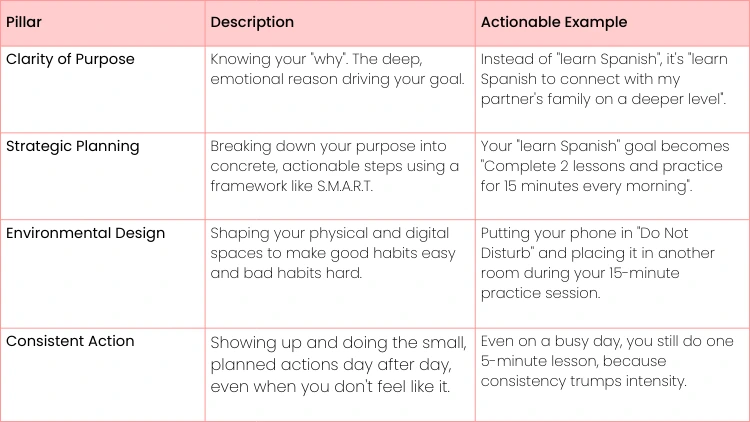
The Four Pillars of Self Discipline
To put this all together, think of self-discipline as having four core pillars. Each one supports the others, creating a structure that's much harder to knock down.
Mastering these four pillars moves discipline from a vague idea into a practical, repeatable system you can apply to any area of your life.
Forget about trying to overhaul your life overnight. That approach almost never works. The real secret to building rock-solid self-discipline is found in small, consistent daily actions that strengthen your resolve over time.
Think of these as daily reps for your discipline muscle. They turn vague, intimidating goals into concrete, manageable steps.
The foundation of this entire approach is learning the mechanics of forming habits that stick. The aim isn't to wait for motivation to strike—because it won't, at least not reliably. Instead, you build systems that carry you forward even on the days you feel completely uninspired.
Your 90-Day Self-Discipline Action Plan
Knowing the principles is one thing, but putting them into practice is where the real change happens. Think of this as a roadmap, breaking down the massive goal of "building discipline" into a manageable 90-day journey. We'll move from small, almost trivial wins to creating habits that stick for good.
Month 1: Focus on Awareness and One Keystone Habit
The first 30 days are all about building momentum, not chasing perfection. The only goal here is to prove to yourself that you can be consistent with one small, high-impact habit. That's it.
Let's make this real with a few practical examples:
- For a student: Your habit could be "review class notes for 15 minutes every night". No excuses.
- For a professional: It could be "dedicate the first 30 minutes of the workday to a high-priority task, no emails allowed".
- For anyone: A great one is "drink a full glass of water immediately after waking up".
Actionable Insight: Get a simple journal or an app and track everything. Just put a checkmark on the days you succeed. You’d be surprised how motivating the visual proof of a winning streak can be. This phase is less about the habit itself and more about training the muscle of consistency.
Month 2: Drive Consistency and Add a Second Habit
Alright, you've got a foundation. Now it's time to layer. In this second month, you'll keep that first habit going while strategically adding another one. You've proven you can do it once, so doing it twice isn't as daunting.
- Practical Example: If your first habit was the 15-minute note review, your second might be to spend 10 minutes planning your next day's schedule before you shut down your computer for the night.
This is also where you’ll inevitably face a setback. You’ll miss a day. It happens. The disciplined response isn’t to feel guilty or throw in the towel—it's to simply get back on track the very next day. Don't let one slip-up derail a month of progress.
If you find yourself struggling with this mindset, this guide on how to set personal goals can help you frame your progress in a much more constructive way.
Month 3: Solidify Routines and Tackle Bigger Goals
By the final 30 days, your habits should start feeling more automatic. You'll spend less mental energy forcing yourself to do them. This is the perfect time to start pointing your newfound discipline toward larger, more meaningful ambitions.
By this stage, discipline starts shifting from a conscious effort to a core part of your identity. You're no longer just doing disciplined things; you are becoming a disciplined person.
- Actionable Insight: Take the skills you've built and apply them to a bigger project. If you've mastered daily 30-minute study sessions, now is the time to block out a dedicated 90-minute "deep work" session once a week to tackle a major assignment or project.
This is how small daily actions transform into significant life changes. To keep the momentum going, it helps to connect these habits to a bigger picture by setting actionable goals for self-improvement that truly align with where you want to go.
Got Questions About Building Discipline?
As you start down the path of building real self-discipline, a few questions are bound to pop up. It happens to everyone. Let's tackle some of the most common ones we hear, so you can sidestep these hurdles and keep moving forward.
What’s the Fastest Way to Build Self-Discipline?
There's no magic pill, but the absolute quickest way to see real progress is to start ridiculously small. Seriously. Forget about some massive life overhaul.
- Practical Example: Pick one tiny, almost laughably easy habit you can do every single day without fail. Think studying for just 10 minutes. Or reading two pages of a book. The goal isn't the outcome; it's proving to yourself you can show up.
Consistency is the engine of discipline. By keeping these tiny promises, you build momentum and, more importantly, self-trust. That foundation is far more powerful than the all-or-nothing approach that almost always ends in burnout.
How Do I Stay Disciplined When I’m Not Motivated?
Here’s the thing: motivation is fickle. It comes and goes. Discipline is a system you build precisely for the days when you "don't feel like it". The secret is to stop waiting for inspiration to strike and just start. Action creates momentum, not the other way around.
The most disciplined people don't have more willpower—they just have better systems. They've engineered their environment to make the right choice the easiest choice, effectively taking emotion out of the equation.
- Actionable Insight: Get your study materials ready the night before. This tiny act removes the initial friction of starting. When your motivation is at zero, your pre-planned system kicks in. It makes it easier to begin than to keep putting it off, which is a key part of learning how to overcome procrastination.
Is It Too Late to Learn Self-Discipline?
Absolutely not. Self-discipline isn’t a fixed trait you're born with; it’s a skill. And like any skill, it can be strengthened at any point in your life.
While habits might form a bit easier when we're younger, adults have a huge advantage: we have a much clearer "why". We know what our long-term goals are and have the life experience to appreciate the payoff. By applying the right routines and exercises consistently, anyone can dramatically improve their self-discipline.
- A practical example is a 50-year-old learning a new instrument by committing to just 15 minutes of practice daily—their consistency, driven by a clear purpose, will outperform a less-focused teenager every time.
Ready to turn those goals into actual achievements? Uplyrn gives you the structured courses and expert guidance to build the discipline you need to nail your career ambitions. Start your learning journey with Uplyrn today!


Leave your thoughts here...
All Comments
Reply