









How to Build Talent Pipeline: Future-Proof Your Team

Building a talent pipeline is all about getting ahead of the game. It means you’re actively creating a pool of qualified, engaged people before you even have a job opening.
This isn't just a recruiting tactic; it's a fundamental shift that turns hiring from a reactive, fire-fighting exercise into a predictable, strategic part of your business. The goal is to always have the right people ready to step in when you need them.
Jump To Section

Earn As You Learn
Earn 25% commission when your network purchase Uplyrn courses or subscribe to our annual membership. It’s the best thing ever. Next to learning,
of course.
Why a Talent Pipeline is Your Strategic Advantage
Let's be real for a second. The old "post and pray" method of hiring is broken. When a key role suddenly opens up, that reactive scramble is costly, stressful, and almost always leads to rushed decisions and bad hires.
A talent pipeline completely flips this model on its head. Instead of starting from scratch every single time, you're building relationships with talented people over the long haul. This moves hiring from a purely transactional process to a relational one, giving your business the agility it needs to navigate a pretty volatile market.
Move from Reactive Scrambles to Proactive Wins
Imagine your best software engineer hands in their notice, effective immediately. If you're stuck in a reactive cycle, the panic button gets hit. Hard. You rush to write a job description, blast it out everywhere, and then drown in a sea of mostly irrelevant applications. The role sits empty for months, projects get delayed, and the rest of the team starts to burn out. Not great.
Now, let's replay that scenario, but with a solid talent pipeline. You pull up a curated list of ten fantastic engineers you’ve been in touch with for the last six months. You've already built some genuine rapport—maybe you shared company news with them or invited them to a tech webinar. Within days, you have several high-quality interviews lined up. Your time-to-hire plummets, and the business barely skips a beat.
This proactive approach isn't just a "nice-to-have" anymore; it's about survival. Consider this: automation is expected to displace 85 million jobs globally while creating 97 million new ones by 2025. That's a massive shift. It highlights just how urgent it is for companies to build their pipelines now, not when critical skill gaps are already hurting them.
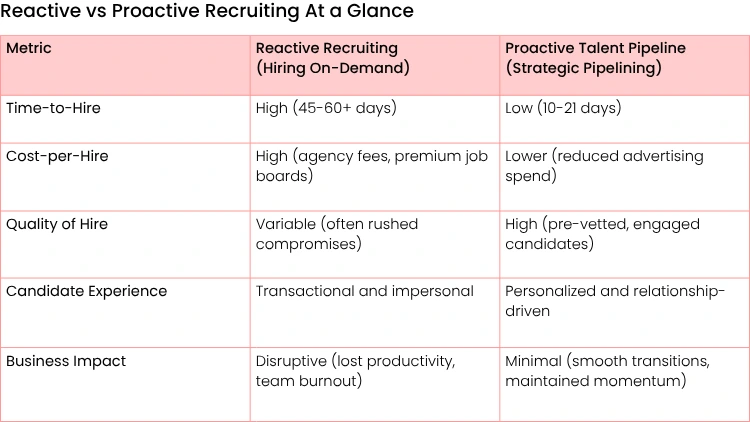
The difference between these two approaches is stark. Here's a quick breakdown of how they stack up across key business metrics.
As you can see, the proactive pipeline model consistently delivers better, more predictable results. It's an investment that pays dividends in efficiency, quality, and overall business health.
Future-Proof Your Team in a Changing World
A strong pipeline does more than just fill roles faster—it gets your organization ready for whatever comes next. Job requirements are constantly shifting as technology evolves. Staying on top of the evolving landscape of job applications and how new tech is shaping the candidate experience is no longer optional.
The real power of a talent pipeline is that it forces you to think like a strategist, not just a recruiter. You start anticipating future needs, identifying critical skill sets, and building relationships with the people who will drive your company's growth tomorrow.
This kind of foresight is what separates the leaders from the laggards, especially as entirely new roles emerge. The rise of AI, for example, is creating brand-new team dynamics. Figuring out how humans will work alongside AI is becoming a critical piece of workforce planning. For a deeper dive, check out these insights on how teams with AI agents and humans will perform.
When you build a pipeline, you're not just hiring for today's job description. You're securing the talent you'll need to innovate and win for years to come.

Define the Talent You Actually Need
A great talent pipeline is built on one simple idea: knowing exactly who you're looking for, both today and tomorrow. This is where most companies trip up. They recycle old job descriptions and react to openings instead of getting ahead of them.
To do this right, you need to shift from simply filling empty seats to proactively hunting for the specific skills and mindsets that will give your business a real edge. It’s about being deliberate.
Look Beyond the Job Description
First things first, ditch the boring list of responsibilities and start thinking about the person. This is where building out detailed candidate personas is a game-changer. Think of a persona as a semi-fictional profile of your ideal hire, pieced together from real data and honest chats with hiring managers.
It’s like creating a character for a movie. You go way deeper than just "5 years of experience". What kind of problems will this person tackle in their first year? What team environment makes them thrive?
The goal isn't just to define what the person will do, but who they need to be to succeed. This means capturing their motivations, their preferred work styles, and the soft skills that separate an average performer from a star.
Practical Example: The "Data Storyteller" Persona
Let's say a tech company needs a new content marketer. Instead of a generic job description, they build a persona for a "Data Storyteller".
Here’s what that looks like:
- Skills: A unique blend of SEO know-how, data analysis chops (Google Analytics, Tableau), and truly compelling writing.
- Motivations: They're driven by seeing their content actually influence business decisions and user behavior, not just vanity metrics like traffic.
- Work Style: Loves to experiment. They enjoy collaborating with the data science team and are quick to pivot strategy based on what the numbers are saying.
- Cultural Fit: Insatiably curious, values transparency, and sees feedback as a gift, not a critique.
See the difference? This detailed profile makes it so much easier to spot and connect with the right people because you know exactly what you’re looking for beyond the resume.
Forecast Your Future Needs
Building a truly strategic pipeline means looking over the horizon, not just at the immediate fire drill. The trick is to sit down with department leaders and map out the critical roles you'll need over the next 12-24 months. This turns you from a reactive recruiter into a proactive talent partner.
This isn't about gazing into a crystal ball. It's about tying talent directly to business goals. If the company is launching a new product line next year, what new roles will that demand? If you're expanding into a new market, what specific language skills or regional expertise will be non-negotiable?
A simple forecasting exercise can get the ball rolling. Just ask each department head these three questions:
- What are your top three strategic goals for the next 18 months?
- What skills or roles are missing from your team that could stop you from hitting those goals?
- Which roles on your team are absolutely critical, the ones that would be a huge risk if someone left?
This conversation translates abstract business plans into concrete hiring targets. It also shines a light on the organizational skills gap you need to address before it slows down growth.
By anticipating these future needs, you can start building relationships with amazing candidates for jobs that don't even exist yet. When the time comes to hire, you won't be starting from scratch—you'll have a warm pool of qualified people who are already interested. That kind of foresight is what makes a talent pipeline a massive strategic advantage.
Find and Attract Top Passive Candidates
Let’s be honest: the most impactful hires you'll ever make probably aren’t looking for a new job. They're busy crushing it in their current roles, completely invisible to traditional recruiting methods like job boards. This is the passive talent pool, and learning how to tap into it is the secret to building a truly powerful talent pipeline.
This isn’t about just broadcasting job ads and hoping for the best. It's a fundamental shift toward becoming a strategic presence where top talent already spends their time. The goal is to start conversations and build relationships, so when the right opportunity finally opens up, you’re the first person they think of.
Go Where the Talent Lives
To connect with passive candidates, you have to meet them on their own turf. A generic LinkedIn search is a decent start, but the real magic happens in the niche, industry-specific communities where people are actually sharing knowledge and building their professional credibility.
Think beyond the obvious. Where do the best of the best in your target roles gather online? Your sourcing strategy has to be tailored to the persona you're trying to attract.
- Hunting for Software Developers? Look past LinkedIn. Spend time on GitHub exploring repositories or jump into relevant conversations on Stack Overflow. These are the places that show you who is actively contributing and earning respect in their field.
- Need Top Sales Professionals? Get involved in industry-specific Slack or Discord communities focused on sales development or revenue operations. Pay attention to who is asking the smartest questions and sharing genuinely helpful advice.
- Sourcing World-Class Designers? Your best bet is to explore portfolios on platforms like Behance or Dribbble. This gives you a direct look at their work and creative style, which makes for a perfect, non-generic conversation starter.
By becoming a genuine member of these communities, you can spot high-potential people based on their actual contributions and expertise—not just what they claim on a resume.
Craft Outreach That Actually Starts a Conversation
Once you've found a promising passive candidate, that first message is everything. You know the ones—the generic, copy-paste templates that get deleted on sight. Your outreach has to be personalized, authentic, and focused entirely on them, not you.
The goal of your first message isn't to pitch a job; it’s to start a real dialogue. Show them you've done your homework and that you genuinely respect their work. A little bit of effort here will make you stand out from the avalanche of recruiter spam.
For example, instead of the classic "I have a great opportunity for you", try something that shows you're paying attention:
- The Generic (and bad) Way: "Hi Alex, I came across your profile and was impressed with your experience. We are hiring for a Senior Product Manager. Are you open to a chat?"
- The Personalized (and much better) Way: "Hi Alex, I saw your recent talk on scaling product features at the Tech Forward conference—your point about user feedback loops was brilliant. I lead the product team here at [Company Name], and we're exploring similar challenges. I'd love to connect and hear more about your work in that area, no strings attached."
This approach immediately signals that you value their expertise and are interested in them as a professional, making a reply feel natural instead of like a transaction.
Use Your Employer Brand as a Magnet
Your employer brand is your most powerful tool for attracting passive talent organically. When you get it right, you don't always have to do the hunting; your ideal candidates start coming to you, wanting to join your ecosystem. You get there by consistently sharing compelling, valuable content that shows people what it’s really like to work at your company.
To really find and attract the best passive candidates, it’s also important to understand how technology can expand your reach. Modern tools are changing the game, and keeping up with how AI transforming candidate sourcing methods can give you a serious competitive edge.
Create content that gives candidates an authentic peek behind the curtain. Here are a few ideas that work wonders:
- Project Deep Dives: Publish a blog post or short video where an engineer walks through the nitty-gritty technical challenges they solved on a recent project. This is like a magnet for other skilled engineers who are motivated by solving interesting problems.
- Employee-Led Webinars: Host a live session where your Head of Marketing discusses a successful campaign or a new industry trend. This positions your team as thought leaders and attracts other ambitious marketing pros.
- "Day in the Life" Content: Use social media to share short, unpolished videos of team members talking about their work, their colleagues, and your company culture. This builds a human connection and makes your company feel far more accessible.
When you consistently create and share this kind of content, you build an audience of engaged followers. Over time, these individuals become a warm pipeline of talent—people who already admire what you do and are just waiting for the right chance to join the team.
Keep Your Talent Community Engaged
Sourcing a list of promising names is the easy part. The real work—and where the real payoff is—comes from turning that list into a living, breathing community of professionals who actually trust your brand and want to hear from you.
This is the nurturing phase. It's where you build the relationships that transform a cold database into a warm, strategic talent pipeline.
Let's be honest: a disengaged pipeline is just a glorified spreadsheet. Candidates who haven't heard from you in six months won't feel any connection when a role finally opens up. The key is to create a simple, effective communication cadence that provides genuine value, not just another job alert clogging up their inbox.
Segment Your Pipeline for Personalized Communication
A one-size-fits-all approach is a recipe for disaster. Sending a generic company newsletter to everyone in your pipeline is the fastest way to get them to hit "unsubscribe". To make your outreach feel personal and meaningful, you have to segment your talent community into smaller, more relevant groups.
This lets you tailor your content to what each group actually cares about. You don't need to overcomplicate it. Start with a few simple but powerful criteria:
- By Role or Skill Set: Group your software engineers, product managers, and marketing specialists separately. This allows you to send highly relevant technical articles or marketing case studies that won't bore the other groups.
- By Seniority Level: The content that resonates with an entry-level candidate is worlds apart from what interests a senior leader looking for their next big challenge.
- By Engagement Level: Create a special segment for your "superfans"—the people who always open your emails or show up for your webinars. These are the folks who might be ready for more direct, personal engagement.
Practical Example: A tech company creates two email segments: "Senior Frontend Developers" and "Aspiring Product Managers". The developer segment receives an email with a link to their engineering team's latest blog post on migrating to a new JavaScript framework. The product manager segment gets an invite to a webinar hosted by their Head of Product on roadmap prioritization techniques. Each piece of content is highly relevant and valuable to its specific audience.
Create a Cadence That Provides Genuine Value
Once your segments are in place, it’s time to build a simple, sustainable communication plan. The goal here is consistency and value, not bombarding people with spam. You need to shift your mindset from selling jobs to sharing useful information that helps them grow in their own careers.
A great nurturing strategy makes candidates feel like insiders, not just prospects. It gives them a reason to stay connected with your company, even when they aren't actively looking for a new role.
Here are some practical, high-value touchpoints you can build into your cadence:
- Exclusive "Ask Me Anything" (AMA) Sessions: Invite a specific segment of your pipeline to a private 30-minute video call with a team lead or hiring manager. This offers incredible value and a rare peek behind the curtain.
- Curated Monthly Insights: Ditch the generic newsletter. Instead, send a short, sharp email with links to 3-5 of the most interesting industry articles your team has read that month, complete with a brief comment from an internal expert.
- Project Previews or Case Studies: Share a behind-the-scenes look at an exciting project your team is working on. This helps candidates visualize themselves tackling the interesting challenges at your company.
- Skills-Building Content: Offer access to a free webinar or a guide your company has produced. This positions you as an organization that genuinely invests in professional growth.
These nurturing activities are a core part of building an engaged workforce from the outside in. For more ideas on keeping both internal and external talent motivated, check out these top employee engagement strategies to implement and build a culture people want to be a part of.
As you can see, successful attraction is a process. It starts with deep community involvement and builds toward a strong employer brand that pulls talent in naturally. This is the groundwork for your entire nurturing strategy.
A Sample Nurturing Sequence
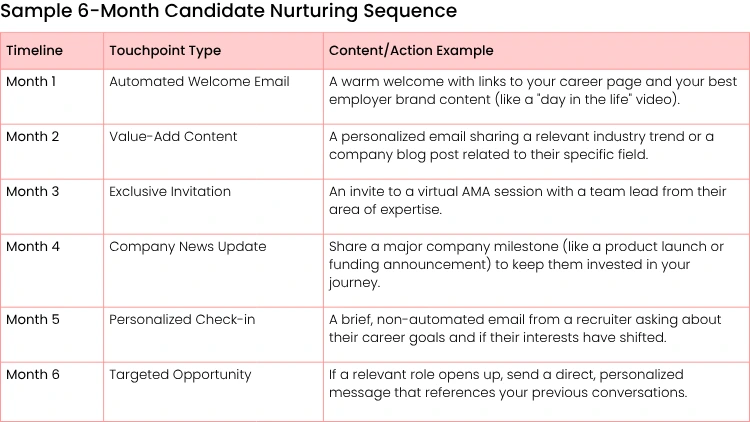
Putting a structured sequence in place makes sure no candidate falls through the cracks. It's the perfect blend of smart automation and the personalized touchpoints that make people feel seen and valued.
Here’s a look at what a simple but effective 6-month sequence could look like for a new candidate you’ve just added to your pipeline.
This deliberate, value-driven approach is how you build a talent pipeline that doesn't just exist—it thrives. It ensures you have a community of warm, engaged candidates who are ready when their next move aligns with your next opening.
Build Your Pipeline from Within
While it’s easy to get tunnel vision on external candidates, some of the most powerful pipeline sources are walking your own halls. The best person for your next big opening might already be on your payroll, just waiting for the chance to step up.
Pivoting your focus inward is a genuine game-changer. It doesn't just fill roles faster; it dramatically boosts morale and retention by showing your people they have a real future with you.
Create Transparent Career Paths
Let’s be honest: vague promises of "future opportunities" aren't cutting it anymore. People are far more likely to stick around and grow with you if they can see a clear road ahead.
You need to map out tangible career paths showing exactly how an employee can get from their current role to a more senior one. This means defining the specific skills, experiences, and competencies needed for each step up the ladder. When this is all laid out for everyone to see, it empowers your team to take ownership of their own development.
A well-defined career path turns a job into a journey. It stops talented people from looking elsewhere for growth by showing them the adventure they can have right where they are.
Practical Example: A B2B SaaS company creates a transparent career framework for its sales team. It clearly defines the jump from "Sales Development Rep (SDR)" to "Account Executive (AE)". The framework states an SDR needs to consistently hit 110% of their quota for two consecutive quarters, successfully complete an advanced negotiation skills course, and mentor a new hire for one month. This removes ambiguity and gives SDRs a clear, actionable goal to work toward.
Build an Internal Talent Marketplace
An internal talent marketplace is exactly what it sounds like: a system that connects your current employees with new opportunities inside the company. We're talking about everything from short-term projects and gigs to full-time role changes. Think of it as an internal job board, but much more dynamic and fluid.
This approach helps create a workforce where you can deploy skills precisely where they're needed most. It also gives employees a chance to "test drive" different roles or departments, which is an invaluable tool for professional development.
Here’s how a marketplace starts filling your pipeline from the inside out:
- It develops new skills. An engineer from one team might jump on a three-month project with another to learn a new coding language.
- It uncovers hidden talent. A project manager might discover they have a real knack for user experience design after collaborating on a short-term gig.
- It breaks down silos. Encouraging this kind of cross-functional collaboration spreads knowledge and creates a much more connected, agile organization.
By creating these internal gigs, you are actively building a more skilled and versatile talent pool that's ready to fill future openings.
Invest in Upskilling and Mentorship
Simply showing employees the path isn't enough; you have to give them the tools to walk it. This is where targeted upskilling and mentorship programs become your secret weapon. When you invest in your employees' growth, you are directly fueling your internal talent pipeline.
Take this real-world example: a mid-sized tech company was getting hammered by a 58% turnover rate for its mid-level managers. They decided to tackle it head-on by launching a "Future Leaders" program for their high-potential individual contributors.
The program was structured and intentional, including:
- Targeted Learning Paths: Each participant got a personalized development plan with specific courses and certifications to complete.
- Mentorship Pairing: They were paired with senior leaders outside of their direct chain of command for honest guidance and perspective.
- Stretch Assignments: Participants were given real leadership roles on critical, high-visibility projects.
The results were stunning. Within two years, the company filled 70% of its open management positions with graduates from this program, slashing its time-to-fill for senior roles. You can find more inspiration in this guide to designing effective employee training programs.
This kind of strategic investment is becoming a global priority. In response to skill shortages in fields like AI, governments worldwide are launching massive talent initiatives. The United States has committed $2.8 billion to its National AI Research Institutes, while China aims to train 500,000 new AI professionals by 2027. These huge efforts prove that building a talent pipeline for the future requires a coordinated investment in training and education. You can discover more insights about the global AI talent race on SecondTalent.
Measure What Matters and Optimize Your Pipeline
You can't improve what you don't measure. A talent pipeline, no matter how well-designed, is just a feel-good initiative without the data to back it up. If you want to get real buy-in and actually refine your strategy, you have to track metrics that prove you're adding value to the business.
This means getting past vanity metrics, like how many names you have in your database. Instead, let's focus on the key performance indicators (KPIs) that tie your pipelining efforts directly to what the company cares about. These are the numbers that tell the real story of your pipeline’s health and its return on investment (ROI).
KPIs That Reveal True Pipeline Health
The right metrics bring clarity. They cut through the noise and show you exactly what’s working, what isn’t, and where you should be putting your energy. You don't need a massive dashboard to start; just track a few high-impact numbers that paint a clear picture.
Here are the essentials we always recommend monitoring:
- Pipeline-Influenced Hires: This is your North Star. It’s the percentage of hires who came from your pre-existing, nurtured talent community. A high number here is the ultimate proof that your proactive work is paying off.
- Time-to-Fill for Pipelined Roles: Run a simple comparison. How long does it take to fill a role with a pipelined candidate versus one you had to source from scratch? A 30-50% reduction in time-to-fill is a massive win that any hiring manager or executive will immediately understand.
- Cost-per-Hire Reduction: Proactive recruiting means less money spent on last-minute job board blasts and expensive agency fees. Calculate those savings. It’s a direct financial benefit you can take straight to the C-suite.
- Quality of Hire: Look at new hire performance reviews at the 90 or 180-day mark. When your pipelined hires consistently meet or exceed expectations, it's solid proof that you're not just filling seats faster—you're filling them with better talent.
Keeping a close eye on these numbers is non-negotiable for making smart decisions. Select the right key performance indicators that align with your bigger business goals.
Demystifying the Talent Pipeline Tech Stack
While your strategy is what really matters, the right technology can make managing and measuring all this infinitely easier. You don't need to go out and buy a dozen new tools. Often, it's about using what you already have more effectively and maybe making one or two smart additions.
Your tech should support your process, not make it more complicated. The two core pieces you’ll lean on are an Applicant Tracking System (ATS) and a Candidate Relationship Management (CRM) system.
ATS vs. CRM: What's the Difference?
Here’s a simple way to think about it: An ATS is for managing active applicants who have applied to an open job. A CRM is for nurturing passive candidates and building long-term relationships for future roles.
Many modern platforms are starting to blend these functions, but it's important to know the distinction. Your ATS is great for keeping track of who’s in process right now. But your CRM is where the relationship-building magic really happens.
This is the tool that lets you segment your talent community, automate personalized outreach, and track every single interaction over months or even years. It’s what makes nurturing a large pool of passive candidates manageable instead of impossible. With these tools working together, you can turn raw data into real insights, making sure your pipeline is always getting better.
Got Questions? We’ve Got Answers
If you're diving into talent pipelining for the first time, you probably have a few questions. Let's tackle the most common ones we hear from recruiters and hiring managers.
How Long Does This Actually Take to Work?
Let's be real: building a solid talent pipeline is a long game, not a quick win. If you're consistent, you can start seeing some early traction—like a small, engaged pool of candidates for one or two key roles—within 3-6 months.
But if you're aiming for a deep, diverse, and self-sustaining pipeline that feeds multiple departments? You should be thinking more along a 12-18 month timeline. It's all about consistency. The sourcing, branding, and nurturing you do today compounds over time, just like a good investment.
What are the Biggest Mistakes People Make When Pipelining?
The single biggest mistake we see is treating your pipeline like a dusty old database. Just collecting resumes without ever building a real, human connection is a complete waste of everyone's time. It just doesn't work.
A few other common pitfalls to sidestep:
- Being a Robot: Sending those generic, copy-paste outreach messages that scream "spam". Nobody replies to those.
- Going Silent: You find a great person, have a good chat, and then... crickets. Letting promising relationships go cold is a huge missed opportunity.
- Forgetting Your Own People: Focusing all your energy on finding external talent while ignoring the high-potential folks already on your team.
- Flying Blind: If you aren't tracking your metrics, you have no way to prove your pipeline is working or figure out how to make it better.
Can a Small Business Really Do This with Limited Resources?
Absolutely. You just have to be scrappy and strategic. Instead of trying to build a pipeline for every role under the sun, laser-focus on the 1-3 most critical or hardest-to-fill positions that really move the needle for your business.
You don't need a massive budget. Lean on free or low-cost tools like LinkedIn or niche online communities to find great people. Your employer brand doesn't need a Hollywood production crew; it just needs to be authentic. Share genuine stories and photos of your team and culture on social media.
A simple spreadsheet can work perfectly fine as your first Candidate Relationship Management (CRM) system. Seriously. The goal is quality over quantity. Nurturing a handful of strong relationships with high-potential candidates is infinitely more valuable than having a giant, unengaged list of names.
Ready to build the skills that will define your career and strengthen your team's internal pipeline? Explore the courses and learning paths at Uplyrn and start your journey toward professional growth today. Find your next course at Uplyrn.


Leave your thoughts here...
All Comments
Reply