









Learn How to Develop Good Habits That Actually Stick

So, you want to build some good habits. The secret isn’t about gritting your teeth and forcing yourself through it with sheer willpower. It’s actually about designing a smarter system.
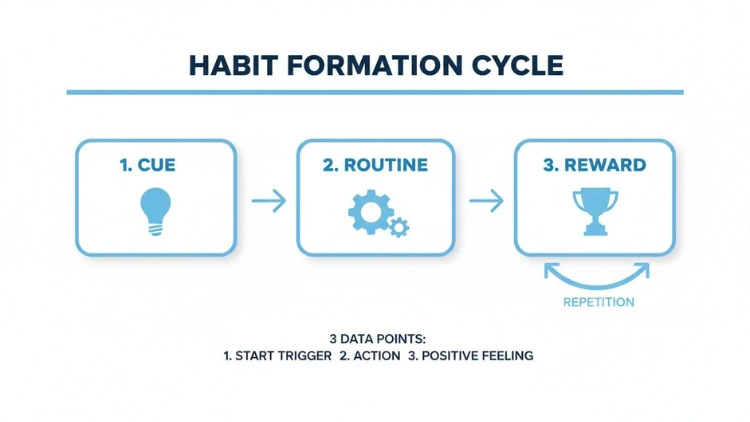
The most effective way to do this is to break down any habit you want to build into three simple parts: a clear cue (the trigger that kicks things off), a simple routine (the action you take), and a satisfying reward (the little prize at the end that makes your brain happy). This whole process works with your brain's natural wiring, not against it, which is the key to making new behaviors stick for good.
Jump To Section

Earn As You Learn
Earn 25% commission when your network purchase Uplyrn courses or subscribe to our annual membership. It’s the best thing ever. Next to learning,
of course.
The Real Reason Your New Habits Don't Stick
Ever find yourself mindlessly reaching for your phone at a red light? Or grabbing a snack the second you flop onto the couch after a long day? These aren't really conscious decisions. They're automated behaviors, driven by a powerful little script in your brain called the Cue-Routine-Reward loop. This loop is running in the background all day, every day, governing a huge chunk of what we do without us even realizing it.
Getting a handle on this framework is the first real step to building better habits. Trying to rely on willpower alone is a losing game because it’s a finite resource. The real trick is to work smarter, not harder, by setting up a system where the good habit becomes the path of least resistance.
Beyond the 21-Day Myth
For years, we’ve all heard the same thing: it takes 21 days to form a new habit. It’s a nice, simple idea, but it’s also one that has set countless people up for failure and frustration. The truth is a lot messier.
A fascinating 2023 study from the California Institute of Technology dug into the data from over 30,000 gym-goers. They found that, on average, it took about six months to form a consistent gym habit. On the flip side, simpler things like remembering to wash your hands took only a few weeks to become automatic.
What this tells us is that there’s no magic number. The context, the complexity of the habit, and you as an individual all play a much bigger role.
The real takeaway here is to stop worrying about a deadline and start focusing on your system. The environment and the structure you build around a habit are far more important than a ticking clock.
Why Willpower Isn't the Answer
Relying on willpower to force a new habit is like trying to hold your breath forever—sooner or later, you’re going to have to give in. Every single decision we make during the day, from what to eat for breakfast to which email to answer first, chips away at our mental energy. Constantly trying to strong-arm yourself into a new routine drains that battery fast. If you've ever felt that drain, you can learn more about it in this guide on decision fatigue.
Instead of fighting your brain’s natural tendency to take the easy way out, the goal is to make your new habit the easy way out. Acknowledging the inherent difficulty of change helps us understand why sticking to something new feels so tough. When you design habits that are obvious, easy, and satisfying, you don't need a ton of self-discipline. The behavior just starts to happen on its own.
How to Engineer a Habit from the Ground Up
Let's get one thing straight: building a habit that actually sticks isn't about some superhuman display of willpower. It's not about a dramatic, overnight transformation. It’s about smart design.
Forget relying on motivation—we all know how flaky that can be. Instead, you can engineer a system that makes your desired behavior feel less like a chore and more like an automatic reflex. The secret lies in making the habit obvious, easy, and satisfying.
This entire process hinges on the three simple parts of any habit: the cue, the routine, and the reward. When these three elements work together, they create a powerful, self-reinforcing loop.
Think of it this way: a trigger prompts an action, and that action delivers a payoff. Your brain recognizes that payoff and says, "Hey, that was good. Let's do it again." That’s the habit loop in action.
Make the Cue Unmistakable
First things first, you need a trigger so obvious you can't possibly ignore it. Your environment has a massive influence on your behavior, so it's time to put it to work for you. Stop tucking your new habit away in a closet or a drawer and put the cue directly in your line of sight.
Here are a few practical examples of how to make your cues impossible to miss:
- Want to read more? Every morning, place a book directly on your pillow. When you get into bed at night, you literally have to touch it to move it.
- Need to drink more water? Before you start work, fill up a large water bottle and set it right next to your keyboard. It'll be staring you in the face all day.
- Hoping to practice guitar? Get that instrument out of its case. Put it on a stand right in the middle of your living room where you’ll trip over it.
Actionable Insight: Walk through your home and office right now. Identify one new habit you want to build and change one thing in your environment to make its cue visible. Put your vitamins next to the coffee maker or your journal on your nightstand.
Make the Routine Ridiculously Easy
This is the step where so many good intentions fall apart. We try to go from zero to a hundred, aiming for a grueling 30-minute workout or an hour of intense study right out of the gate. That approach creates way too much friction and is a surefire recipe for burnout.
Your initial goal shouldn't be about achieving some massive result. It should be about one thing: showing up.
The most effective way to start is to scale your new habit down to something that takes two minutes or less. This strategy, known as the Two-Minute Rule, makes it almost impossible to say no.
Practical Example: Want to start running? Your new habit isn't "run three miles". It's "put on my running shoes and step out the front door". That’s it. Anything you do after that is just a bonus. Want to start journaling? Just write one sentence. The goal is to master the art of starting, because once you've overcome that initial inertia, continuing is so much easier.
For more on weaving these tiny actions into your day, take a look at this guide on the power of routine.
Make the Reward Immediately Satisfying
Finally, for the habit loop to close, your brain needs an immediate payoff. It needs to feel good right away to be motivated to do it again. The trouble with most good habits—like exercising or learning a language—is that their rewards are delayed. You don't get a six-pack after one workout, and you don't become fluent after one lesson.
You have to create your own immediate reward. This doesn't need to be anything grand.
Practical Example: It can be as simple as listening to your favorite podcast only when you jog, enjoying a delicious smoothie right after your workout, or the pure satisfaction of drawing a big, bold checkmark next to an item on your to-do list.
This little hit of immediate positive reinforcement sends a clear message to your brain: “That was good. Let’s do it again.”
Actionable Insight: Choose a habit you want to build and pair it with a reward you genuinely enjoy. For instance, if you want to get better at cleaning, allow yourself to watch an episode of your favorite show only after you've tidied the kitchen.
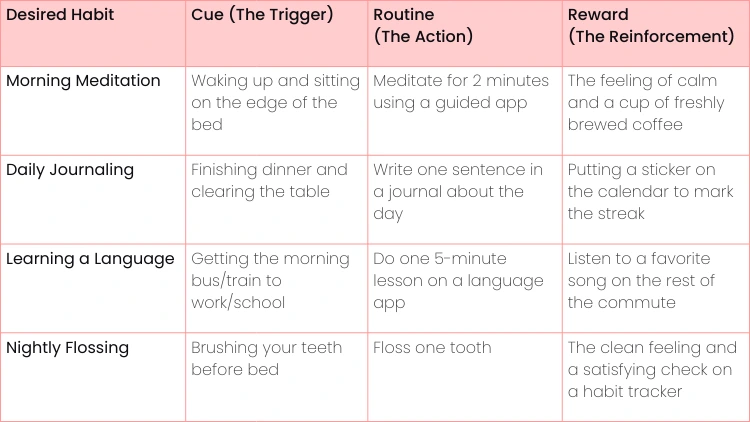
The Habit Loop Breakdown Practical Examples
This table illustrates the Cue-Routine-Reward loop with concrete examples for common habits, helping you design your own.
Use these examples as a starting point. Think about your own goals and what small, immediate rewards would feel genuinely satisfying to you. Getting this part right is the key to making a new habit stick for the long haul.
Using Habit Stacking to Build Momentum
Once you’ve successfully locked in a single new habit, you can start a powerful chain reaction. The secret is a technique called habit stacking. Instead of trying to force a new routine into your day from scratch, you simply tack it onto something you already do without thinking.
This brilliant little trick works by piggybacking a new, desired behavior onto a pre-existing one. It creates a smooth, logical flow of actions, which cuts out the decision fatigue that so often kills our best intentions.
The formula couldn't be simpler: After/Before [CURRENT HABIT], I will [NEW HABIT].
This structure turns your existing routines—like brushing your teeth or making coffee—into powerful triggers for your next move. It’s hands-down one of the most effective ways to build good habits because you’re working with the momentum you already have, not against it.
The Simple Formula for Habit Stacking
What I love about habit stacking is how flexible it is. You can apply it to pretty much any part of your life, whether it's getting healthier, learning a new skill, or boosting your productivity. The key is to pick an anchor habit that’s rock-solid—something you do every single day in the same place and at the same time.
Here are a few practical examples you can steal and use today:
- Health: After I finish my morning coffee, I will take my daily vitamin.
- Learning: Before I check social media in the evening, I will do one 5-minute language lesson on my phone.
- Mindfulness: After I shut my laptop for the day, I will meditate for one minute.
- Productivity: After I brush my teeth in the morning, I will identify my most important task for the day.
Actionable Insight: Take a piece of paper and write down a list of things you do every single day without fail (e.g., wake up, get out of bed, brush teeth, make coffee). Now, pick one new habit you want to start and use the formula to "stack" it onto one of your existing routines. Write it down and post it where you'll see it.
Why Visual Tracking Is a Game Changer
Habit stacking gets the routine started, but tracking is what keeps you going. There's something incredibly motivating about seeing your progress laid out visually. Every checkmark on a calendar or filled-in box on a chart gives your brain a tiny hit of dopamine, reinforcing the behavior and making you want to do it again tomorrow.
This visual proof of your own consistency builds self-belief. When you can look back at a chain of successful days, the thought of breaking that streak becomes painful. You're no longer just doing a habit; you're protecting your progress.
The act of tracking does more than just record your actions; it makes you more mindful of them. It forces a moment of accountability and transforms an abstract goal into a concrete, daily accomplishment.
There's a reason the global habit tracking apps market hit USD 1.7 billion in 2024 and is projected to explode to USD 5.5 billion by 2033. People are catching on to how effective this is. You can dig into the data by exploring the full habit tracking market research.
Simple Tracking Methods That Don't Feel Like a Chore
Let's be real: if tracking itself becomes a burden, you'll stop doing it. The best method is always the one that’s simple, visible, and satisfying to use.
Here are a few practical ways to track habits:
- The Calendar Method: Grab a physical wall calendar and a big red marker. Every day you nail your habit, draw a huge "X" over that date. Your only mission? Don’t break the chain.
- The Paperclip Strategy: Put two jars on your desk. Fill one with 100 paper clips. Each time you complete your habit (like making a sales call or doing 20 push-ups), move one paperclip to the empty jar. It’s a simple, tangible way to see your efforts add up.
- A Dedicated Notebook: A simple journal can be your best friend. At the end of each day, just jot down the habits you completed. This works especially well when paired with a planning routine, like the one we outline in this guide to writing your list of top 6 to-dos ready for tomorrow.
When you combine the automatic cues of habit stacking with the motivational boost of visual tracking, you create a system where your new routines feel less like a struggle and more like an inevitability.

How to Get Back on Track When You Slip Up
Let’s get one thing straight right away: when you're building new habits, you will slip up. It’s not a matter of if, but when. Life happens. A surprise project at work, a nasty cold, or even a well-deserved vacation can throw your perfectly crafted routine completely off-kilter.
The goal isn't to be perfect. Perfection is a myth. The real win is building the resilience to bounce back fast.
Missing a single day isn’t failure—it's just a data point. The real trouble starts when one missed day bleeds into two, then three, and suddenly your new habit is a distant memory. This is where a simple, yet incredibly powerful, rule can save you.
The Never Miss Twice Rule
This is probably the single most important strategy for habit recovery: the "never miss twice" rule. It’s a beautifully simple concept designed to stop a single slip-up from turning into a full-blown relapse.
The rule is exactly what it sounds like. You have permission to miss one day. Life gets in the way, and that's fine. But you are absolutely not allowed to miss two days in a row.
Practical Example: You skipped your morning run today because you overslept. Okay, it happens. But tomorrow, you get it done. No excuses. Even if you can only muster a five-minute jog around the block, you show up. This simple commitment shifts your mindset from an "all-or-nothing" trap to an "always something" approach, which is crucial for long-term success.
Redesign Your Environment for an Easy Return
When your routine has gone off the rails, don't rely on sheer willpower to get back on track. That's a losing battle when you're already feeling drained or unmotivated. Instead, make your good habit the easiest, most obvious choice available. Just tweak your surroundings.
Here are some practical examples:
- Heading out on vacation? Pack your workout clothes and running shoes right on top of everything else in your suitcase. They'll be the first thing you see when you unpack.
- Staring down a crazy work week? Spend an hour on Sunday prepping healthy lunches. When you're starving at noon on Wednesday, grabbing that nutritious meal is faster than scrolling through a delivery app.
- Feeling that motivation dip? In the morning, place the book you want to read directly on your pillow. It becomes a literal obstacle to flopping into bed without at least reading a page or two.
No habit journey is a straight line. For those times when life gets particularly messy, you might find some great strategies in articles that explore how to stick to a routine even when life gets messy.
The key is to reduce the friction. Make getting back on track so ridiculously easy that it feels harder to skip the habit than to just do it.
Finally, give yourself some grace. A systematic review found that the average time it takes to form a new habit is around 66 days. But here's the important part: the range for individuals was anywhere from 18 to 254 days.
What that tells us is that everyone's timeline is different. Consistency is what matters, not speed. Embrace the process, live by the "never miss twice" rule, and trust that you're building something that will stick.
Your Action Plan for Building Lifelong Habits
Theory is one thing, but real, lasting change? That comes from action. This is where we pull everything together and turn good intentions into the kind of automatic behaviors that stick. Think of this as your roadmap.
We'll kick things off with a simple 30-day plan designed to install one new habit. The goal here isn't perfection—far from it. It's about getting good at the simple act of showing up. Remember, the first month is all about laying the foundation, not building the skyscraper.
Your First 30 Days: The Kickstarter Plan
The first few weeks are critical, and the strategy is simple: make your new habit almost laughably easy to do. Your only job is to be consistent and let your brain enjoy the small wins. Forget about intensity or how long you do it for. Just get the reps in.
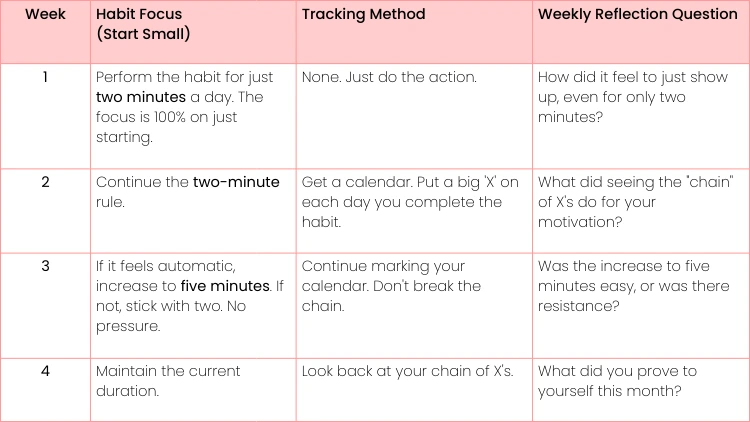
This template is a great way to map out your first month.
Sample 30-Day Habit Kickstarter Plan
This plan is all about starting small and building momentum. Each week introduces a new layer to strengthen the habit, from making it tiny to tracking it visually and then reflecting on your progress.
What's really happening here is you're proving to yourself that you are someone who follows through. Each little X on the calendar is a vote for your new identity.
The first 30 days are less about the habit itself and more about building self-trust. Every small win reinforces the belief that you can, in fact, stick to your commitments.
The 90-Day Habit Solidification Plan
After that first month, your habit has taken root, but it's still a fragile little sprout. The next 60 days are about making it strong enough to survive a crazy week at work, a vacation, or just a day when you don't feel like it. This is when the behavior starts shifting from conscious effort to an unconscious part of who you are.
- Days 31-60: Standardize and Test. Now you can settle into a more sustainable groove, like 15 minutes of reading or a 20-minute walk. The goal is to make this the new normal. During this time, you should also test the habit's strength. When a chaotic day inevitably hits, fall back on the "never miss twice" rule. One missed day is an accident; two is the start of a new (bad) habit.
- Days 61-90: Integrate and Expand. By now, the habit should feel pretty normal, like brushing your teeth. This is the perfect time to start habit stacking. For example, "Right after I finish my 20-minute walk, I will spend five minutes meditating." You're anchoring a new, tiny habit to the one you've just successfully built.
This structured timeline takes the guesswork out of the process. For a raw, honest look at what this kind of long-term commitment feels like in the real world, check out this story on the lessons learned from 100 consecutive days of learning. The journey from day one to day ninety is where the magic really happens.
Got Questions About Building Habits?
Even with a solid game plan, you're bound to run into a few hurdles on your habit-building journey. It's totally normal. Let's tackle some of the most common questions that pop up, so you can navigate the tricky parts and keep moving forward.
How Many Habits Should I Realistically Work On At Once?
It’s tempting to try and reinvent yourself overnight, isn't it? New gym routine, daily meditation, learning a language—let's do it all! But if you’ve tried this, you know how it ends.
Actionable Insight: The most effective (and sane) approach is to focus on one new habit at a time. Each new routine demands a surprising amount of mental real estate to get established. When you try to juggle multiple new behaviors, you dilute your focus and set yourself up for burnout.
- Practical Example: Instead of trying to start a new workout plan, a healthier eating habit, and a daily journaling practice all in the same week, just pick one. Pour all your energy into making daily journaling feel like second nature. Once it’s locked in—usually after a couple of months—you can ride that wave of success into building your next habit, like going for a daily walk.
How Do I Stay Motivated When I See Zero Results?
This is the big one. It's the silent killer of so many good intentions. You don't get a six-pack after a few trips to the gym. You don't get fluent after one language lesson. When the payoff is so far in the future, it's easy to throw in the towel.
Here's the secret: you have to fall in love with the process, not just the outcome.
You need to shift your focus from that distant goal to the immediate win of simply showing up.
- Track your effort, not just your results. Grab a calendar and put a big 'X' on every day you complete your habit. Jerry Seinfeld famously used this "don't break the chain" method. The goal isn’t to be perfect, but to build a visual record of your consistency. That chain becomes its own reward.
- Lean into identity-based goals. Forget "I want to lose 15 pounds". Instead, tell yourself, "I am the kind of person who moves their body every day". Every time you lace up your sneakers, you're casting a vote for that new identity.
This simple reframe makes the daily action the victory, giving you the small hits of reinforcement you need long before the big results show up.
What's The Best Way To Finally Break A Bad Habit?
Breaking a bad habit uses the same logic as building a good one, just in reverse. Instead of making a new habit obvious, attractive, and easy, you need to make the old, unwanted one invisible, unattractive, and difficult.
First, you have to play detective and identify the cue. What actually triggers the behavior? Do you find yourself reaching for a sugary snack right around 3 p.m. every day? That mid-afternoon energy slump is your cue.
Actionable Insight: Once you know the trigger, add friction. Make the bad habit harder to do. If your kryptonite is mindless doomscrolling on social media, delete the apps from your phone. Seriously. The extra effort of having to open a browser and log in is often just enough of a roadblock to kill the impulse. If the 3 p.m. snack is the problem, don't bring junk food into the house in the first place.
By disrupting the old pattern and making the better choice the path of least resistance, you can systematically dismantle the habits that are holding you back.
Ready to build the skills that power your new habits? At Uplyrn, we provide the expert-led courses you need to turn your personal and professional development goals into reality. Start your learning journey today.


Leave your thoughts here...
All Comments
Reply