









How to Develop Negotiation Skills to Win Any Deal

Learning to negotiate is one of the best investments you can make in yourself. It's a skill that pays dividends for a lifetime, changing how you handle everything from big career moves to small daily interactions.
At its core, it's a simple loop: understand the basics, do your homework, practice like crazy, and learn from every conversation. This isn't about being confrontational; it’s about becoming the architect of your own success.
Jump To Section

Earn As You Learn
Earn 25% commission when your network purchase Uplyrn courses or subscribe to our annual membership. It’s the best thing ever. Next to learning,
of course.
Why Negotiation Is Your Most Valuable Skill
Most people think "negotiation" and immediately picture a high-stakes salary review or a massive corporate merger. But the real magic happens in the small, everyday moments. Those little wins are what really stack up over time.
It’s the tool you pull out to get more resources for your project, set clear expectations with a teammate, or persuade your department to try a new process.
- Practical Example: As a student, it might mean landing a better internship offer by discussing your unique contribution. As a professional, it’s how you shape your role during a promotion, ensuring your new responsibilities align with your long-term career goals. For instance, instead of just accepting a title change, you might negotiate for a key project that gives you visibility with senior leadership.
The Real Return on Investment
Getting good at negotiation doesn't just get you better deals—it builds incredible confidence and smooths out your professional relationships. When you can articulate what you need while truly understanding where the other person is coming from, you start creating solutions instead of arguments.
This skill is so vital that companies are pouring money into training. The global negotiation training market was on track to hit USD 2 billion in 2025 and is projected to soar to USD 4.5 billion by 2033. For individuals, interactive training has shown a staggering 16x ROI in just three months. The link between practice and reward is undeniable.
Negotiation is the art of letting them have your way. The minute you shift your mindset from a battle to a collaborative puzzle, you start seeing opportunities everyone else misses. It's about making the pie bigger before you slice it up.
More Than Just a Boardroom Tactic
Think of negotiation as a fundamental life skill, like communication or problem-solving. It's woven into almost everything you do, and building that muscle gives you a serious edge.
Strong negotiators are able to:
- Solve Problems Creatively: They look past the initial demands to find the real interests at play, which naturally leads to more innovative and lasting agreements.
- Actionable Insight: The next time someone makes a rigid demand, ask, "What's the most important thing this helps you achieve?" This question can pivot the conversation from a standoff to a brainstorming session.
- Build Stronger Relationships: People see them as trustworthy partners because they’re always looking for a win-win, not just a personal victory.
- Advocate for Yourself: They have the confidence and the framework to ask for what they're worth, whether that's a raise, a promotion, or just a better project to work on.
Ultimately, figuring out how to be persuasive and get what you want easily is a cornerstone of personal and professional growth. It’s what separates those who simply accept their circumstances from those who actively shape them.

Getting to Grips with the Foundations of Negotiation
Before you can really start developing your negotiation skills, you have to get your head around the core concepts that all the pros rely on. These aren't just academic theories; they're practical, real-world tools that give you structure and confidence in any discussion. To really get good at this, you need to internalize the real principles of negotiating that everything else is built on.
Let's start with the big one: your BATNA, which stands for Best Alternative to a Negotiated Agreement.
Simply put, this is your walk-away plan. It’s what you’ll do if the current deal falls through. Knowing your BATNA inside and out is the ultimate source of power in any negotiation. It’s your safety net, the one thing that keeps you from accepting a lousy deal just because you feel desperate.
- Practical Example: Imagine you're a freelancer negotiating your rate for a big project. Your BATNA could be another potential client who’s already shown a lot of interest in hiring you.
- Actionable Insight: Before any negotiation, write down your BATNA on a piece of paper. This physical act solidifies it in your mind and makes you less likely to accept a deal that is worse than your best alternative.
Positions vs. Interests: The Real Game-Changer
Another absolute game-changer is understanding the difference between positions and interests. It sounds simple, but this is where amateurs get stuck and pros find breakthroughs.
A position is what someone says they want—a specific, concrete demand. An interest is the underlying why behind that demand. Truly skilled negotiators know that if you can get past the stated positions and uncover the hidden interests, you can unlock all sorts of creative, win-win solutions.
- Practical Example: Picture yourself negotiating a contract with a new vendor. Their position is rigid: "We need payment within 15 days of the invoice date."
- Their Position: Get paid in 15 days.
- Their Potential Interest: They might be struggling with short-term cash flow and need money in the bank to make payroll at the end of the month.
- Actionable Insight: Instead of just pushing back, you can ask a few smart questions to uncover that underlying interest. Try, "Can you walk me through why the 15-day term is a critical factor for you?" Once you know their real problem is cash flow, you can propose a solution that works for everyone. Maybe you offer to pay 50% upfront and the rest in 45 days. This solves their immediate cash problem (their interest) without destroying your own budget, sidestepping their initial demand (their position) entirely.
The Power of the First Number: Anchoring
Finally, you absolutely have to be aware of a powerful psychological trigger called Anchoring. The very first number dropped in a negotiation acts as a mental "anchor", heavily influencing every offer that follows. From that point on, the conversation tends to revolve around that initial figure.
- Practical Example: Think about a job interview. If the hiring manager asks for your salary expectations and you say, "$60,000", that number immediately anchors the whole discussion. Their counteroffer will almost certainly be an adjustment based on that figure, making it incredibly difficult for you to pivot and ask for $75,000 later on.
A well-prepared negotiator either sets a powerful, favorable anchor themselves or is ready to immediately and confidently challenge an anchor that doesn't work for them. Never let someone else's opening number define your worth.
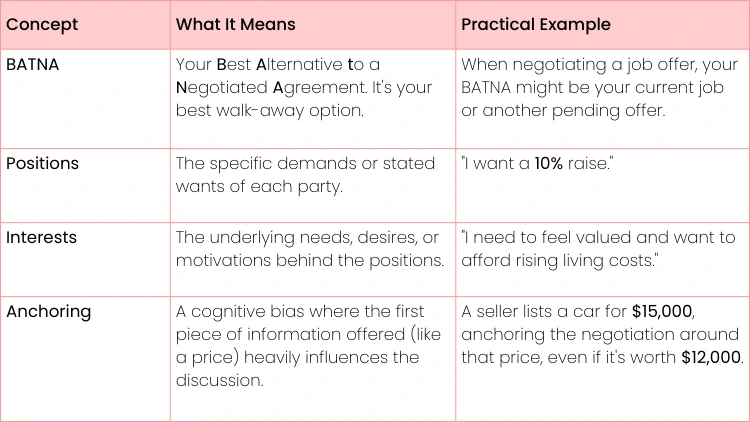
To help you keep these core ideas straight, here's a quick cheat sheet.
Key Negotiation Concepts at a Glance
This table breaks down the foundational terms every negotiator should know and shows how they apply in the real world.
Getting a handle on these psychological dynamics is non-negotiable (pun intended). This kind of awareness plugs directly into what is emotional intelligence and how you can use it to read the room, manage your reactions, and guide the conversation.
By mastering your BATNA, digging for interests, and understanding the power of anchoring, you’re not just learning tactics—you’re building the essential framework for success in any negotiation you walk into.
A Practical Framework for Skill Development
Knowing the core concepts is one thing, but actually putting them to work is what builds your negotiation muscle. A repeatable framework takes the guesswork out of the process. It gives you a roadmap for any conversation, whether you're just discussing a project deadline or making a major career move.
Think of it in three stages: smart preparation, skillful execution, and thoughtful analysis.
The Critical Preparation Stage
Honestly, this is where most negotiations are won or lost.
Rushing into a discussion unprepared is like trying to build a house without a blueprint—it’s going to get messy, and it probably won't stand for long. Proper prep is what separates the amateurs from the pros.
The data doesn't lie. Top performers who blow past their sales targets by 150% are almost always diligent preparers. A whopping 82% of them always research their counterparts first. Compare that to just 41% of their less successful peers, who often just wing it.
So, your preparation checklist should always cover these bases:
- Clarify Your Objectives: What does a "win" actually look like? Define your perfect outcome, your acceptable result, and your absolute, no-questions-asked walk-away point.
- Research Your Counterpart: Get a handle on their background, what drives them, and what their limitations might be. What pressures are they under? What do you think they really want?
- Map Potential Concessions: Figure out what you're willing to give up. These aren't losses; they are strategic tools you can trade for something you value more.
- Actionable Insight: List three things you are willing to concede and, next to each one, write down what you will ask for in return. This turns concessions into trades, not surrenders.
Execution During the Negotiation
Once you’re at the table, it’s all about execution. This part isn’t about winning arguments. It’s about uncovering information and building momentum toward a collaborative solution. Your two most powerful tools here are active listening and asking sharp questions.
Active listening is more than just hearing words; it's about catching the meaning and emotion behind them. It's a skill that takes real focus and a bit of empathy. If you want to get better at it, you can check out this guide on how to be a better listener with the 6 principles to follow.
Also, try framing your points as questions instead of demands. This small shift can completely change the dynamic.
- Instead of This (Blunt Demand): "Is that your best offer?"
- Try This (Collaborative Question): "Help me understand the constraints you're working with."
- Instead of This (Blunt Demand): "I can't accept that deadline."
- Try This (Collaborative Question): "What would we need to do to make a more flexible timeline work?"
- Instead of This (Blunt Demand): "You need to lower the price."
- Try This (Collaborative Question): "What options are available to help us get closer to our budget?"
See the difference? These kinds of questions open doors instead of slamming them shut. They invite the other person to share information that can get you both to a better outcome.
Closing and Post-Negotiation Analysis
Getting to "yes" isn't the finish line. How you close the deal and what you do afterward are just as important for building long-term success and trust.
The final agreement should be a clear, unambiguous summary of what both parties have committed to. A verbal handshake is good, but a documented agreement prevents future misunderstandings and ensures everyone is on the same page.
Once it's all over, take some time for a personal debrief. Ask yourself a few key questions:
- What went well and why?
- What would I do differently next time?
- Did I uncover their true interests, or just their stated positions?
- Was I too quick to offer a concession?
Actionable Insight: Keep a negotiation journal. After each significant discussion, spend five minutes writing down your answers to these questions. Over time, this journal will reveal your patterns and become your personal playbook for improvement. This last step—the analysis—is what fuels real, continuous improvement.
As you can see, a successful negotiation begins long before you ever sit down at the table. It all starts with knowing your walk-away point (BATNA), figuring out the real needs on both sides (Interests), and setting the initial tone (Anchor).
Putting Your Negotiation Skills Into Practice
Alright, you’ve absorbed the theory. You understand concepts like BATNA and the difference between positions and interests. Now comes the hard part—and the fun part. It’s time to move from knowing to doing.
True confidence isn’t built from reading books; it’s forged in the fire of actual application. This is where you roll up your sleeves and turn abstract knowledge into a reliable, real-world skill. The goal isn’t just to practice, but to practice with purpose, creating a learning loop where every conversation makes you sharper for the next one.
Hands-On Role-Playing Scenarios
There’s no better way to get your reps in than by role-playing. It’s the closest you can get to the pressure and dynamics of a real negotiation without any of the risk. Grab a friend or a trusted colleague and dive into these common situations.
Scenario 1: Negotiating a Project Deadline
- The Situation: You’re the project manager, and your team is already stretched thin. A key stakeholder is pushing hard for a deadline on a new feature that you know is completely unrealistic.
- Your Goal: Get a more reasonable timeline that protects your team’s sanity and the quality of the work, without looking like you’re not committed.
- Their Goal: They’re feeling the market pressure and need to launch ASAP.
- What to Say: Ditch the dead-end phrase, "That's impossible." Instead, try something collaborative: "To deliver the quality this feature deserves, our team needs until [Proposed Date]. Can we explore which parts of the scope are most critical for an initial launch?"
Scenario 2: Discussing a Scope Change
- The Situation: You’re in the middle of a project with a client on a fixed budget. Suddenly, they ask for a major new feature that was never part of the original agreement.
- Your Goal: Handle the request gracefully while protecting your bottom line and project timeline.
- Their Goal: Sneak in the extra feature without paying more.
- What to Say: Start with enthusiasm: "I'm excited about this new feature—it's a great idea. It falls outside our current scope, but I’d be happy to scope it out as a separate project. Or, we can look at what we could swap out from the current plan to make room for it."
The real secret to effective role-playing? Commit to the role. Don't just read the lines; adopt the mindset and interests of the person you're playing. This is how you build the mental agility to think on your feet when the stakes are real.
Solo Drills to Sharpen Your Mindset
Don't have a practice partner? No problem. You can sharpen your skills on your own with a few simple exercises.
- Reframe Your Requests: Before you ask for anything this week—more resources, an extension, help from a colleague—take a minute to rewrite your ask. Transform it from a simple demand into a collaborative pitch that shows what’s in it for them. This small shift hardwires a “win-win” approach into your thinking.
- Analyze Famous Negotiations: Watch or read about a major business negotiation, like a big corporate merger or a historical diplomatic agreement. Pinpoint the exact moment a negotiator uncovered a hidden interest instead of just fighting over a position. What was the turning point? What caused the breakthrough—or the breakdown?
The skills you build here have a massive ripple effect. Strategic communication, for instance, is the backbone of learning How to Ask to Be Sponsored and Secure Lasting Partnerships. It's all connected.
Ultimately, these exercises are just training for the main event. Whether you’re negotiating a multi-million dollar deal or simply learning how to negotiate salary, the fundamentals are the same. Practice can make a massive difference, especially when it directly impacts your bank account.

Common Mistakes That Can Derail Your Negotiation
Getting better at negotiation isn't just about learning what to do—it's also about knowing what not to do. It’s easy to fall into common traps that can completely sabotage an otherwise good deal. Even seasoned negotiators can slip up.
The single biggest error is treating a negotiation like a fight to the death. When your only goal is to "win", you become blind to opportunities to create more value for everyone. This adversarial mindset instantly puts the other person on the defensive and can derail the entire conversation over something minor.
Another classic blunder? Letting your emotions take the wheel. When things get heated, it’s human nature to get defensive or make a concession just to end the tension. But a decision made out of frustration is almost always a bad one you'll regret later.
Getting Lost Without a Plan
Walking into a negotiation unprepared is like trying to navigate a new city without a map. You’re just asking for trouble.
Preparation is more than just knowing what you want. It means deeply understanding your alternatives, doing your homework on the other party, and defining your absolute limits before you even sit down at the table. Without that groundwork, you're just winging it.
This lack of a structured approach is a massive problem. Research shows that businesses with a systematic process see 42.7% greater bottom-line growth. Yet, a shocking 80% of companies admit they have no formal negotiation strategy. That’s a lot of value being left on the table.
A negotiation without preparation is just a conversation. When you fail to define your BATNA (Best Alternative to a Negotiated Agreement), you lose your primary source of power and are far more likely to accept a deal that doesn't serve your best interests.
Practical Blunders and How to Fix Them
It's one thing to talk about theory, but these mistakes pop up in real conversations all the time. Let’s break down a couple of common scenarios and how you can sidestep them.
- The Mistake: Making the First Concession Too Quickly.
- What it looks like: You state your ideal salary, and the hiring manager immediately counters with a lower number. The pressure is on, and you instantly slash your ask just to keep the ball rolling.
- What to do instead: Don't budge. Just pause. Instead of giving ground, ask a question to understand where they're coming from. Try something like, "Can you help me understand how you arrived at that figure?" or "What parts of the role is that budget based on?" This puts the focus back on them and gives you precious time to think.
- The Mistake: Arguing Over Positions, Not Interests.
- What it looks like: A client is demanding a 15-day payment term, but your company policy is 45 days. The conversation hits a wall, with both of you just repeating your numbers back and forth. Deadlock.
- What to do instead: You need to dig for the "why" behind their demand. Ask, "What’s the main concern that a 15-day term helps you solve?" Maybe you'll find out their real interest is managing short-term cash flow. That opens the door to creative solutions, like a partial upfront payment or milestone-based invoicing. Uncovering these hidden interests is a cornerstone of effective conflict resolution strategies in the workplace.
Your Questions on Negotiation Answered
Even with the best roadmap, you’re bound to hit some practical questions when you start flexing your negotiation muscles. Let's dig into a few of the most common ones we hear.
How Can I Practice If I Don't Have Big Opportunities?
This is a classic "chicken and egg" problem, but the solution is simpler than you think. You don't need a multi-million dollar merger to practice. In fact, you shouldn't start there.
Start small. Seriously. Negotiate with your partner about what to have for dinner or where to go on Saturday. Call your cable or cell phone provider and discuss a better rate—they almost expect you to. Even just role-playing a scenario with a trusted friend can work wonders.
Actionable Insight: Pick one low-stakes negotiation to try this week. For example, when buying a coffee, ask for a small discount just for practice. The goal isn't to get the discount; it's to get comfortable with the act of asking. These low-stakes interactions build the exact mental muscles you’ll need when the stakes get higher.
If you master only one thing, make it active listening. When you truly understand where the other person is coming from—their needs, their pressures, their constraints—you're not just negotiating anymore. You're problem-solving together. Without that, you're just two people talking at each other.
What if the Other Side Has All the Power?
First off, let's challenge that assumption right away. Power is rarely as one-sided as it feels.
Your true power in any negotiation comes from your BATNA—your Best Alternative to a Negotiated Agreement. This is your walk-away plan. Before you even think about talking to the other party, you need to know what you'll do if you can't reach a deal. The stronger your BATNA, the more confident and powerful you'll be at the table.
Next, information is your best friend. Do your homework. Dig deep. You might uncover a piece of information about their company's quarterly goals or a personal pressure they're under that completely changes the dynamic. This is how you find leverage where none seems to exist.
- Practical Example: If you're a small supplier negotiating with a massive corporation, it feels like they hold all the cards. But what if your research shows they have a new sustainability initiative? You can then highlight how your eco-friendly production process aligns perfectly with their corporate goals, turning your small size into a strategic advantage. This shows how focusing on their interests can create leverage for you.
And finally, never underestimate the human element. People make deals with people they like and trust. Focus on building genuine rapport. A solid relationship can often level a seemingly uneven playing field and open doors that brute force never could.
Ready to put this all into practice? At Uplyrn, we've built the expert-led courses you need to become a truly confident and effective negotiator. Start building your skills today.


Leave your thoughts here...
All Comments
Reply