









How to Identify Skill Gaps in Your Organization

To get a handle on skill gaps, you first have to define the skills your business actually needs. Then, you look at your team's current abilities and, finally, you build a plan to close the distance between the two. The whole process is about comparing future requirements against present capabilities to make sure your workforce is ready for whatever comes next.
Jump To Section

Earn As You Learn
Earn 25% commission when your network purchase Uplyrn courses or subscribe to our annual membership. It’s the best thing ever. Next to learning,
of course.
Why Finding Skill Gaps is a Business Imperative
Ignoring skill gaps isn't really an option anymore—it’s a direct threat to your bottom line.
Think of it like trying to win a race with an engine that’s missing a few critical parts. You might sputter along for a bit, but you won't be competitive for long. A skill gap analysis is really just a straightforward comparison of the skills your business needs to win versus the skills your team has today.
This process isn't about pointing fingers or micromanaging people. It’s a strategic investment in your team that helps future-proof your entire organization. When you get ahead of these gaps, you build a more agile, resilient, and capable workforce that’s ready to adapt to market shifts.
The Real Cost of Unchecked Gaps
The scale of this challenge is massive. Recent surveys show that a staggering 87% of companies worldwide admit they either have skill gaps right now or expect them to pop up very soon. This isn't just an internal HR issue; it has serious economic consequences.
For a bit of perspective, 14 G20 countries could collectively miss out on up to $11.5 trillion in GDP growth simply because of a shortage in digital skills.
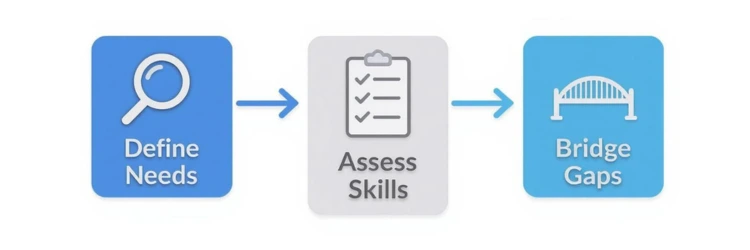
This visual guide breaks down the core stages of the process. As the infographic shows, it’s a simple journey in three phases: defining what you need, assessing what you have, and then bridging that divide. That cyclical flow is important—it highlights that identifying skill gaps is a continuous process, not just a one-and-done project.
Quick Overview of the Skill Gap Analysis Process
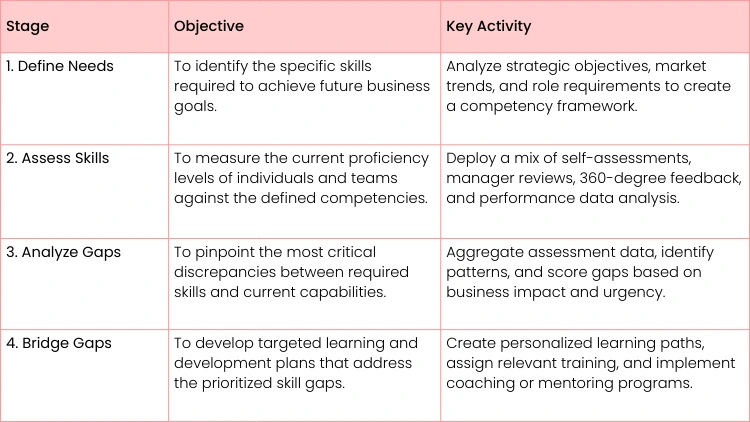
To help you get started, this table provides a high-level overview of the skill gap analysis process.
This roadmap breaks the process down into manageable stages, making it easier to implement a structured approach within your own organization.
These numbers paint a clear picture: failing to act means leaving money on the table and falling behind competitors. The problem is so widespread that leaders are exploring every possible solution.
A skill gap analysis is a proactive business strategy, not a reactive HR task. It directly connects workforce planning to your company's financial performance and long-term sustainability.
Understanding this connection is the first step toward building a stronger organization. For a deeper look into this topic, you might be interested in this guide on why nearly half of workers need upgrading.
Aligning Your Goals with Future Skill Needs
Before you even think about assessing a single employee, you need a clear destination. A skill gap analysis is only as good as the strategic goals it's meant to support. It’s all about mapping out where your company is headed and then working backward to figure out the skills you'll need to get there.
Think about your big-picture objectives for the next three to five years. Simply looking at current job descriptions is like driving while only looking in the rearview mirror—it tells you where you’ve been, not where you’re going.
From Business Goals to Essential Skills
The first real step is translating those high-level business goals into a tangible list of essential skills. This isn't a solo exercise; it starts by asking targeted questions in meetings with department heads and leadership.
Are you planning to launch a new AI-powered product line? Your focus immediately shifts to skills like machine learning engineering, natural language processing, and data ethics. An effective analysis will pinpoint exactly what level of proficiency you need in each of those areas.
Or maybe the goal is to expand into a new international market. In that case, you're looking for competencies in cross-cultural communication, regional sales tactics, and international compliance law.
This translation process is where the real strategic value comes in. It moves the conversation from vague business objectives to a concrete workforce plan, building a critical foundation for everything that follows.
A Practical Example in Action
Let's put this into practice. Imagine a mid-sized software company, "InnovateTech" that sets a strategic goal to become a leader in sustainable technology within three years.
Their leadership team gets together and translates this goal into specific skill requirements across different departments:
- Product Development: They'll need engineers with expertise in green coding (writing energy-efficient code) and materials science for creating eco-friendly hardware.
- Marketing: The team must build skills in sustainability marketing and ESG (Environmental, Social, and Governance) reporting to communicate their value proposition authentically.
- Sales: The sales force needs training on how to articulate the long-term ROI of sustainable tech to enterprise clients, moving beyond simple feature-benefit talking points.
By defining these future-state skills, InnovateTech now has a clear benchmark. They can assess their current workforce against these specific, forward-looking needs rather than relying on outdated role descriptions.
Looking Ahead Three to Five Years
Projecting skill needs is a discipline in itself. While you can't predict the future, you can make educated forecasts based on industry shifts and your own strategy. This is where you connect your analysis to what's happening in the broader market. For a deeper dive, check out this guide on monitoring future trends to stay ahead of the curve.
The most effective skill gap analysis isn’t a snapshot of today. It’s a roadmap for tomorrow, built by deconstructing your company’s long-term vision into the human capabilities required to achieve it.
To make this forward-looking approach practical, start by talking to your key stakeholders. Ask them questions designed to uncover what's coming next.
Questions to Ask Department Heads:
- What major projects or initiatives are on the roadmap for the next three years?
- What new technologies or processes do you anticipate your team adopting?
- Which roles on your team are most likely to evolve, and how?
- What skills do our top competitors have that we currently lack?
Their answers will give you the raw material needed to build a competency model that is genuinely strategic. This ensures your efforts are aimed at building the workforce you'll need, not just patching up the one you have today.
Choosing the Right Assessment Methods
Once you've translated your strategic goals into a clear list of must-have skills, it's time to figure out what you're working with. This is where the rubber meets the road—moving from theory to the practical work of mapping your team's current abilities. A single approach is rarely enough; We've found that the most accurate picture emerges when you layer different assessment types to get a complete, 360-degree view.
To accurately pinpoint skill gaps, you'll need effective learning assessment strategies that go way beyond a simple pop quiz. The real goal is to measure not just what people know, but what they can actually do with that knowledge.
Combining Subjective and Objective Data
A truly robust skill gap analysis balances subjective insights with hard, objective performance data. If you lean too heavily on one, you'll get a skewed perspective. You really need both to understand the full story of your team's capabilities.
- Subjective Assessments: Think of these as the "human element". They include self-evaluations, manager reviews, and peer feedback. This is where you get valuable context on things like confidence levels, perceived strengths, and individual career aspirations.
- Objective Assessments: This is the quantifiable stuff—project completion rates, sales quotas, customer satisfaction scores, and technical skills tests. This data shows the real-world impact of their skills (or lack thereof).
Let's say a marketing team's self-assessment shows high confidence in SEO. But when you look at the project data, you see a consistent struggle to execute a successful keyword strategy, and key metrics like organic traffic growth are flatlining. That disconnect is exactly what a blended assessment strategy is designed to uncover.
Uncovering the Critical 'Experience Gap'
One of the biggest hurdles we see companies facing today isn’t just a skills gap, but an experience gap. This is the crucial difference between knowing a concept in theory and being able to apply it effectively under real-world pressure.
Recent data really drives this point home. A Deloitte survey found that a staggering 66% of managers and executives feel that recent hires lack sufficient preparation or experience for their roles. This deficit can be even more damaging than a traditional skill shortage. It highlights that our assessments have to move beyond just testing theoretical knowledge.
The experience gap is where skills break down under pressure. An employee might ace a test on project management theory but crumble when trying to lead a team through a tight deadline with shifting requirements.
To spot this gap, you have to look at how skills are applied in practice. This means using methods that either simulate real work or analyze how someone has performed in similar situations in the past.
A Practical Toolkit of Assessment Methods
Building a comprehensive view of your team's skills requires pulling from a few different playbooks. No single method tells the whole story, but when you combine them, you start to see a detailed and actionable picture.
Here’s a look at some of the most effective methods to have in your toolkit.
Employee Self-Assessments
These are a fantastic starting point for getting employees invested in their own development. The trick is to avoid bias by designing surveys with clear, behavior-based questions.
- Bad Question: "Rate your communication skills from 1-5." (This is way too vague and subjective).
- Good Question: "How confident are you in your ability to present complex data to a non-technical audience?" (This is specific and tied to a real-world context).
For more on this, this guide on crafting pre and post-training survey questions is packed with useful examples.
Manager Evaluations
Managers have a front-row seat to an employee’s day-to-day performance, challenges, and strengths. Their evaluations provide a crucial layer of validation, confirming strengths and identifying gaps the employee might not even see in themselves.
360-Degree Feedback
This method gathers anonymous feedback from an employee’s manager, peers, and direct reports. It offers a truly holistic view, often uncovering how an individual's skills are perceived across different working relationships. For instance, a leader might be seen as a brilliant strategist by their boss but perceived as a poor communicator by their direct reports. That’s a gap worth knowing about.
Behavioral Interviews
Don't just ask about skills, ask for proof. Use structured interviews to ask employees to describe past situations where they actually used specific skills. Instead of asking "Are you a good problem-solver?", try this: "Tell me about a time you faced an unexpected obstacle in a project and how you resolved it." Their answer reveals their real problem-solving process, not just their opinion of it.
Skills and Knowledge Tests
For hard skills, you can't beat a standardized test. This could be anything from coding challenges for developers and proficiency tests for software like Adobe Creative Suite or Salesforce, to case study analyses for business strategists.
Work Sample Reviews and Simulations
This is, hands down, one of the best ways to assess the experience gap. Ask employees to complete a task that mirrors their real work. Have a graphic designer create a sample social media ad. Ask a salesperson to conduct a mock discovery call. This shows you exactly how they apply their skills in a practical, job-relevant scenario.
Comparison of Skill Assessment Methods
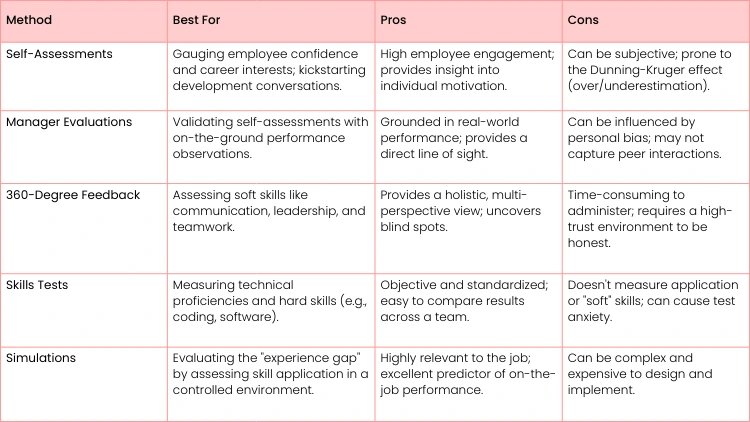
To help you decide which methods are right for your team, here’s a quick breakdown along with their pros, cons, and ideal use cases.
Choosing the right mix from this table depends entirely on the skills you're trying to measure. For a sales team, you might combine manager evaluations with mock discovery call simulations. For a software team, you might use skills tests alongside 360-degree feedback on collaboration.
Turning Raw Data into Actionable Insights
Okay, so you’ve run your assessments and the data is pouring in. That’s a great first step, but it's only half the battle. A spreadsheet full of numbers and notes is just noise until you turn it into a clear story that points you toward smart decisions.
This is where the real work begins—translating all that raw information into a clear narrative about your team’s capabilities.
Without a solid analysis plan, you’ll just be drowning in data points, completely missing the insights you set out to find. The goal here is to spot the patterns, visualize them, and build a prioritized action plan.
Visualizing Gaps with a Heat Map
One of the best tools we've found for this is a skills heat map. It’s basically a grid that uses simple color-coding—think red, yellow, and green—to show proficiency levels across your teams at a glance. It's incredibly powerful because it cuts through the complexity and immediately shows you where the bright spots and problem areas are.
Let’s say you're looking at your engineering team. A heat map might instantly show a sea of green (proficient) for Python, but a glaring patch of red (beginner) for "secure coding practices". Suddenly, you're not just looking at data anymore. You've uncovered a critical business vulnerability that needs attention.
The purpose of data analysis isn't just to report numbers; it's to tell a compelling story. A good heat map or chart should make the most urgent skill gaps impossible to ignore.
This kind of visualization is a game-changer when you're figuring out how to identify skill gaps. It shifts the conversation from individual performance to strategic, team-wide patterns.
A Practical Framework for Categorizing Gaps
Once you can see the gaps, you need to sort them out. Let's be honest, not all skill gaps carry the same weight. Some are five-alarm fires, while others are small embers you can tackle down the road. Bringing some order to the chaos is key to focusing your efforts effectively.
Here’s a simple but effective framework we use to categorize every gap we find:
- Hard Skills vs. Soft Skills: Is this a technical problem (like knowing a specific software) or a behavioral one (like communication)? The solution for each is completely different.
- Critical vs. Nice-to-Have: Does this gap stop someone from doing their core job? That’s critical. Or is it a skill that would be great to have but isn't essential right now? That’s a nice-to-have.
- Widespread vs. Isolated: Is one person struggling, or is an entire department missing a key competency? A widespread gap is a systemic issue and needs a much bigger response.
Using this lens, that messy list of gaps starts looking like a clear, strategic map. If you want to get better at presenting these findings, this guide on data storytelling for risk analysts has some great tips for turning data into a narrative that gets people to act.
Prioritizing Based on Strategic Business Goals
With everything neatly categorized, it's time to prioritize. And for that, you need to look back at the business goals you defined at the very start of this process. The most important skill gaps are always the ones standing in the way of achieving those goals.
Here’s a practical way to score each gap:
- Business Impact: On a scale of 1-5, how badly does this skill gap hurt our ability to hit a key business objective?
- Urgency: On a scale of 1-5, how soon do we need this skill? Is it for a project kicking off next month, or for a long-term goal three years out?
Multiply the two scores to get a "Priority Score". Just like that, the gaps with the highest scores jump to the top of your list. This simple math ensures your training budget is aimed squarely at the problems that actually matter to the business.
This kind of analysis can also reveal bigger trends. For example, the demand for AI talent is expected to outstrip supply by a 3.2:1 ratio in 2025, which could leave over 1.6 million jobs unfilled. If you spot an emerging AI gap in your own company, you're not just solving an internal problem—you're getting ahead of a massive global talent shortage.
Creating Development Plans That Close the Gaps
Alright, you’ve done the hard work of pinpointing the most critical skill gaps. Now comes the fun part: turning all that analysis into action. The next move is to build a bridge from where your team is today to where you need them to be tomorrow. This is about crafting targeted development plans that your employees are actually excited about—not just another mandatory training they have to click through.
The goal here is to get away from generic, one-size-fits-all programs. We want to create Individual Development Plans (IDPs) that feel personal and empowering. A thoughtfully designed IDP shows your team you're invested in their careers, which is a massive driver for engagement and retention.
Crafting Empowering Individual Development Plans
A truly effective IDP isn't just a laundry list of courses. Think of it as a personalized roadmap connecting an employee's own career goals with the skills the business desperately needs. When you build it collaboratively, you get buy-in from the get-go, making development a shared responsibility.
Let's walk through a real-world scenario. Imagine a junior marketing specialist on your team has a clear gap in video editing—a skill your company has flagged as critical for its new content strategy. Instead of just assigning a random online course, her IDP could be a dynamic blend of learning experiences.
- Formal Learning: A specific online course on Adobe Premiere Pro.
- Social Learning: Weekly check-ins with a senior creative to review her work and get real-time feedback.
- Experiential Learning: A capstone project where she creates a two-minute promotional video for an upcoming product launch, giving her something tangible for her portfolio.
See the difference? This approach is far more engaging and sticky. It combines the "what" (theoretical knowledge) with the "how" (practical application and expert guidance), ensuring the new skill actually delivers business value.
A great development plan doesn't just check a box for "training". It creates a clear pathway for an employee to apply a new skill in a way that directly contributes to a business outcome, making their growth feel meaningful and impactful.
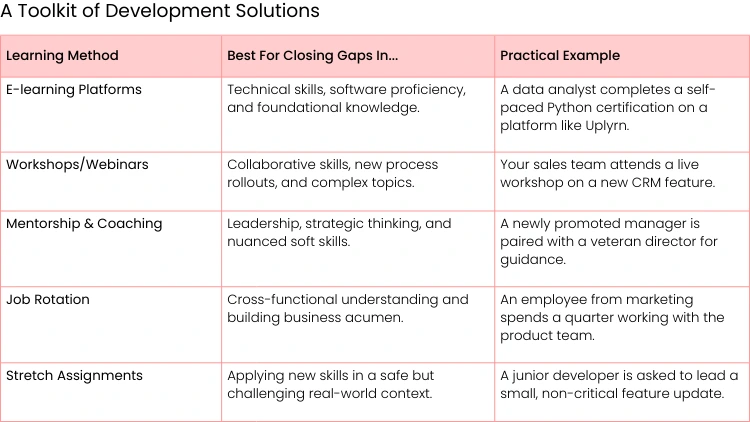
Blending Learning Methods for Maximum Impact
No single training method works for everyone, or for every skill. The most successful development strategies offer a rich mix of learning opportunities that cater to different needs and styles. This philosophy aligns perfectly with the 70-20-10 model, which suggests that learning is most effective when it’s 70% experiential, 20% social, and 10% formal.
Think of it as building a training toolkit. Your goal is to have the right tool ready for every type of skill gap you've uncovered.
By offering a diverse menu of options, you empower employees to take ownership of their own growth. If you're looking to flesh out your programs, exploring different employee training program examples can spark a ton of great ideas and provide proven frameworks.
Tying Development to Measurable Outcomes
Finally, every single development initiative has to be tied back to a measurable outcome. This is how you prove the ROI of your efforts and show that your training budget is a smart investment, not just an expense. This last step closes the loop, connecting your shiny new development plans back to the business goals you defined at the very beginning.
Don't get bogged down in completion rates. Focus on the metrics that actually move the needle.
- Before: A sales team’s average close rate is 18%. Your analysis identified a skill gap in handling objections.
- Action: The team completes a series of role-playing workshops and coaching sessions focused on overcoming common customer objections.
- After: Over the next quarter, the team’s average close rate climbs to 22%.
That 4% increase is a direct, quantifiable return on your training investment. By measuring the right KPIs—whether it's productivity, error rates, customer satisfaction, or sales figures—you can clearly demonstrate how closing skill gaps drives tangible business results.
Common Questions About Skill Gap Analysis
Once you start putting a skill gap analysis into practice, a whole new set of questions always seems to pop up. It's totally normal. Let's walk through some of the most common hurdles we see and get you some straightforward answers so you can move forward with confidence.
How Often Should We Be Doing This?
There isn't a single magic number here, but I can give you a solid rule of thumb. Aim to run a formal, company-wide analysis annually. This gives you a consistent benchmark to see how you’re progressing and spot any big, overarching trends that are developing.
But here’s the real secret: identifying skill gaps shouldn't be a once-a-year event. It needs to be a continuous part of how you operate.
For teams in fields that change at the speed of light—think tech, digital marketing, or R&D—managers should be doing informal check-ins at least quarterly.
And certain events should always be an immediate trigger for a fresh analysis:
- When you’re changing direction. Launching a new product, breaking into a new market, or adopting a major new piece of technology all demand a new look at your team's skills.
- Before a big project kicks off. You need to know if your team has the capabilities to deliver before you’re behind schedule.
- During organizational shifts. Anytime roles are redesigned or new departments are formed, you've fundamentally changed the skills you need to succeed.
What's the Difference Between a Skill Gap and a Competency Gap?
People often use these terms interchangeably, but it’s incredibly helpful to draw a clear line between them. Getting this right ensures your analysis has both depth and breadth.
A skill is the practical ability to do something specific and tangible. Think of it as a tool in a toolbox.
- For example: Writing Python code, using Adobe Photoshop, or running a targeted ad campaign on LinkedIn. These are all concrete abilities you can measure.
A competency, on the other hand, is much broader. It's the powerful combination of skills, knowledge, and behaviors that truly drives successful performance in a role.
- For example: "Strategic Thinking" is a competency. It’s not just one thing—it involves a mix of skills like data analysis, market research, and forecasting, all working together. "Leadership" is another classic example, blending skills like communication, delegation, and emotional intelligence.
A truly effective analysis has to look at both. Fixing a coding skill gap is a tactical win, but addressing a leadership competency gap is what moves your entire organization forward.
How Do I Share the Results Without Crushing Morale?
Honestly, this is probably the most critical part of the whole process. How you frame the results will make the difference between an employee feeling criticized and feeling like you're investing in their future.
The key is to position the skill gap analysis as a positive move focused on growth and development, not a scorecard of weaknesses.
When you sit down with an employee to discuss the findings, your language is everything.
- Don't say this: "Your assessment showed a weakness in data visualization."
- Try this instead: "As our company shifts to more data-driven decisions, we see data visualization as a huge growth opportunity for you. We want to invest in helping you become a go-to expert in this area."
See the difference? This collaborative approach changes the entire tone. It’s no longer a top-down mandate; it's a shared plan for their professional growth. It makes people feel supported and valued, turning a potentially tough conversation into a genuinely motivating one about their career.
Ready to turn your skill gap insights into real training plans? With Uplyrn, you can build personalized learning paths that target the exact needs of your team. From hard technical skills to broad leadership competencies, our platform gives you the tools to build a workforce that's ready for whatever comes next. Discover how Uplyrn can help you close your skill gaps today.


Leave your thoughts here...
All Comments
Reply