









How to Improve Collaboration Skills for Strong Team Results

If you've ever felt like your team is just a group of people working next to each other instead of with each other, you know how frustrating it can be. Improving collaboration isn't just about being friendly; it's about mastering a few core skills that turn a disconnected group into a powerhouse team.
Think of it this way: real collaboration hinges on a few key things. You need to get good at active listening, build genuine trust through transparency, and make sure everyone is pulling in the same direction with shared project goals. When these pieces click into place, communication opens up, and the team starts moving as one.
Jump To Section

Earn As You Learn
Earn 25% commission when your network purchase Uplyrn courses or subscribe to our annual membership. It’s the best thing ever. Next to learning,
of course.
Why Strong Collaboration Is Your Biggest Competitive Advantage
In a world of tight deadlines and complicated projects, the ability to work well with others has shifted from a "nice-to-have" soft skill to a critical business driver. Let's be honest, poor teamwork is more than just annoying—it's often the direct cause of failed projects and missed opportunities.
When people work in their own little bubbles, you get duplicated effort, blown deadlines, and a serious dip in morale. It’s a huge, yet often invisible, drain on resources.
The cost of bad teamwork is frankly staggering. A huge 86% of employees point the finger at ineffective communication or poor collaboration as the main reason for workplace failures. That number alone should tell you everything you need to know. Nailing collaboration isn't just for a happier team; it’s for a healthier bottom line.
The Power of A Collaborative Environment
When a team truly collaborates, the magic goes way beyond just hitting a deadline. A team that’s in sync becomes a genuine source of innovation and incredible efficiency.
The numbers don't lie. Teams that collaborate well work 15% faster, produce 73% better work, and are 60% more innovative. On top of that, their job satisfaction shoots up by 56%. It’s proof that good teamwork is a win for the company and for every single person on the team.
These statistics make it clear: putting effort into how you work with others is a direct investment in your own career and the company's future. When people feel safe enough to share ideas and take risks, you get smarter problem-solving and a much more resilient culture. This is the very foundation of truly exceptional, high-performing teams.
What Does Great Collaboration Look Like?
So, what are the essential ingredients for a truly collaborative team? It really boils down to three core pillars that transform a group of individuals into a unified force. A great team isn't just about having talented people in the same room; it's about mastering the art of working together.
We'll get into the nitty-gritty details throughout this guide, but here's a quick look at the core components of a collaborative powerhouse.
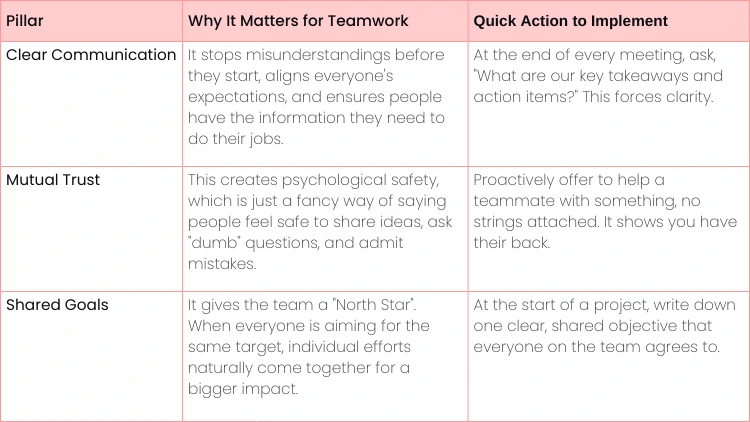
The Three Pillars of Effective Collaboration
This table breaks down the fundamental elements you need to build strong collaboration skills on any team.
Mastering these three pillars isn't an overnight fix, but focusing on them is the fastest way to build a team that doesn't just work together, but wins together.
Mastering Communication and Constructive Feedback
You can't have great collaboration without great communication. It's the absolute bedrock. When information flows freely and feedback is actually helpful, teams sidestep the costly mix-ups that can completely derail a project.
It’s not just about talking, either. It’s about making sure everyone is truly on the same page.
Think of it like this: a team that doesn't communicate well is like an orchestra where every musician is playing from a different sheet of music. The talent might be there, but the result is pure chaos. This is exactly why mastering communication is a non-negotiable step to improve collaboration skills.
Moving Beyond Assumptions with Active Listening
One of the biggest hurdles to solid teamwork is assuming everyone understands things the same way you do. So often, we listen just so we can form our reply, not to actually comprehend what's being said. That’s a recipe for disaster. Active listening is the antidote.
- Practical Example: A designer presents a new layout in a project meeting. The project manager looks it over and says, "Looks good, but can we make it more engaging?" The designer nods, but what does "engaging" even mean? Bolder colors? More interactive bits? Without getting more specific, that designer could waste days on revisions that miss the mark entirely.
This whole mess is avoidable. It just takes two simple active listening techniques:
- Paraphrasing: The designer could respond, "Just so I'm clear, when you say 'more engaging', are you thinking we should add animations, or were you picturing a brighter color palette?"
- Asking Clarifying Questions: Or they could ask, "Could you show me an example of a site you find engaging? That would give me a better sense of what you're looking for?"
Actionable Insight: These simple questions turn a vague, fuzzy request into a solid, shared goal. They kill ambiguity and prevent the wasted time and frustration that comes from working on bad assumptions. For a deeper look at these techniques, you can explore more ways to improve your communication skills and completely change how your team interacts.
Giving Feedback That Builds Instead of Blames
Feedback is crucial for any kind of improvement, but it can crush morale if it's delivered poorly. The secret is to make it about the work or the action, not the person.
A great tool for this is the Situation-Behavior-Impact (SBI) model. It helps you frame feedback in a way that’s objective and leads to a solution.
So, instead of a blunt and accusatory statement like, "You're always late with your reports", which just puts people on the defensive, the SBI model gives you a better way to structure the conversation.
The Situation-Behavior-Impact Framework: A Practical Example
- Situation: "During our weekly sprint review this morning..." (This nails down the specific time and place).
- Behavior: "...I noticed the marketing report wasn't submitted." (This describes exactly what happened, with no judgment).
- Impact: "...which meant we couldn't finalize our budget for the next campaign and had to push the decision back." (This explains the real-world consequence).
Actionable Insight: This approach takes the blame out of the equation and gets everyone focused on solving the problem. It shifts a potentially tense confrontation into a collaborative talk about process and results—something that's especially important for remote teams, where digital communication can easily lead to misunderstandings.

Building Trust and Psychological Safety in Your Team
Trust isn't just a fluffy team-building buzzword; it's the bedrock of any truly high-performing team. When trust is missing, collaboration grinds to a halt. The real secret sauce is fostering psychological safety—a shared belief that the team is a safe place to take risks and be vulnerable without fear of being shot down or embarrassed.
This safety net is what allows people to actually ask questions, admit they made a mistake, or pitch a wild idea that just might work. It's the one thing that separates teams that innovate from those that just stagnate. If you want to know how to improve collaboration skills, you have to start by building this trust, brick by brick.
Model Vulnerability to Encourage Openness
Trust has to start somewhere, and it usually starts at the top. But it's built by everyone. When leaders and team members are willing to show a little vulnerability, it gives everyone else the green light to do the same. This isn't about oversharing your personal life; it's just about being human and transparent.
- Practical Example: A manager kicks off a meeting by saying, "My first take on this project's strategy was off the mark, and I was wrong about that assumption. Let's rethink this together." That simple admission completely changes the room's dynamic, making it okay for others to admit their own missteps.
Psychological safety is the belief that you won’t be punished or humiliated for speaking up with ideas, questions, concerns, or mistakes. It’s a prerequisite for creativity and effective problem-solving.
Actionable Insight: You can foster this by creating a weekly "Wins & Lessons" segment in your team meeting. Everyone shares one success and one "lesson learned" from a mistake. This normalizes imperfection and focuses the team on growth.
Celebrate Intelligent Failures
To unlock real innovation, you have to completely reframe how your team thinks about failure. Not all failures are the same. A "sloppy failure" that comes from cutting corners is worlds away from an "intelligent failure"—a well-planned risk that simply didn't work out.
Practical Example: Imagine a new marketing campaign underperforms.
- The Trust-Destroying Response: "Whose idea was this? We poured money into this, and it’s a huge disappointment." This instantly kills any future appetite for risk.
- The Trust-Building Response: "Okay, the result wasn't what we aimed for, but this was a valuable experiment. What did we learn that we can use for the next campaign?"
Actionable Insight: The second response celebrates the attempt and laser-focuses on learning. When you openly discuss these "intelligent failures" especially in remote settings, it sends a clear message that trying is valued more than just playing it safe. You can explore more practical tips by learning about the prominence of psychological safety.
With employee engagement dipping to a low of 64%, creating this safe space is non-negotiable. The data is clear: employees in trusting, collaborative workplaces are 5.4 times more engaged. And considering that 17% of employees admit to asking AI questions they’re afraid to ask their colleagues, building a culture where direct feedback is welcome is the perfect antidote. For more on this, check out the 2026 workforce trends report.
Using Collaboration Tools to Work Smarter Not Harder
Technology can be a double-edged sword. On one hand, it can supercharge your team's collaboration; on the other, it can just create a mess of digital chaos. Tools like Slack, Asana, or Microsoft Teams are fantastic, but they’re only as good as the team habits built around them. Honestly, getting good at using these platforms is a huge part of learning how to improve collaboration skills in any modern job.
If you don't set some ground rules, these tools quickly become a source of constant noise and distraction. A never-ending waterfall of notifications and disorganized channels makes it nearly impossible to focus on the work that actually moves the needle. But with a bit of strategy, you can transform them from a distraction into a productivity powerhouse.
Establish Clear Digital Etiquette
First things first: you need a "user manual" for how your team talks to each other online. This simple step gets rid of the guesswork and makes sure everyone is on the same page, which is a lifesaver for remote and hybrid teams. This guide on how to work virtually but collaborate effectively is a great place to start building these rules.
Practical Examples:
- Channel Purpose: Be specific. Create dedicated channels for projects (like #project-phoenix), casual chats (#watercooler), or high-priority updates (#announcements-only). This keeps conversations organized and easy to find.
- Response Times: Set clear expectations. For example: "For DMs, reply within 3 hours. For mentions in a channel, reply by end of day." This little bit of clarity can seriously cut down on team anxiety.
- Using Mentions: Use the @ mention with purpose. For instance: use @name for direct actions needed, and @channel only for critical, team-wide announcements.
Actionable Insight: Just by setting these expectations, you can turn a chaotic digital space into an orderly one. It also dials down the digital noise that so often leads to burnout and kills productivity.
It’s a bit of a paradox. While 62% of employees feel collaboration platforms help them perform better, a shocking 64% admit they waste at least three hours a week because of inefficient digital habits. With 80% of us now relying on these tools, getting this right isn't just a "nice to have"—it's critical for success.
Create Clarity with Project Templates
One of the biggest time-sucks is teams starting every single project from a blank slate. You can avoid this by creating a standardized project template in whatever tool you prefer, whether it's Asana, Trello, or Jira. A good template ensures nothing important gets missed.
Actionable Insight: Your template should automatically lay out:
- Key Phases: Break the project down into clear, predictable stages (e.g., Discovery, Design, Development, Launch).
- Standard Tasks: Pre-populate each phase with the usual tasks and even assign default owners. For example, in the "Launch" phase, pre-create tasks like "Final QA Check" and "Draft Announcement Email".
- Due Date Formulas: Set up timelines that automatically adjust based on the project’s start date.
This does more than just save time; it ensures every project gets started with a clear structure and that everyone knows who's responsible for what from day one. This is especially true for distributed teams, where having the right remote team collaboration tools is absolutely essential for keeping everyone aligned.
Finally, don't sleep on the AI assistants popping up in these tools.
- Practical Example: Use an AI assistant to summarize a long chat thread into bullet points before a meeting, so everyone is up to speed in 60 seconds. Leaders are already reporting that 73% of their employees are more productive with a little AI help.
Navigating Conflict and Aligning on Shared Goals
Let's get one thing straight: disagreement is a normal, even productive, part of any high-performing team. So many people panic at the first sign of conflict, thinking it means their collaboration is broken. The opposite is often true. When handled right, friction is what sparks the best ideas.
The secret is to stop treating disagreements as personal attacks. It’s not a battle. It’s a puzzle you have to solve together. The moment you shift the focus from "me versus you" to "us versus the problem", you're on the path to a real breakthrough.
From Conflicting Ideas to Hybrid Solutions
- Practical Example: A marketing team is hashing out a product launch. The data analyst is all in on a targeted ad campaign, pointing to past performance metrics. Meanwhile, the creative lead is pushing for a big, splashy viral video to build brand buzz, even if the ROI is fuzzy. They’re at a standstill.
A good facilitator can steer them toward a hybrid solution:
- Validate both perspectives: "Okay, so we need measurable results from the ads, but we also want a campaign that makes a real splash with a creative video. Both are crucial."
- Bridge the gap: "How can the data from past campaigns help us target the audience for this new video? What creative elements can we test?"
- Build a blended strategy: The team ends up using the analyst’s data to pinpoint the perfect audience for the creative’s video concept. They decide to run small, targeted ad tests with the video before a full-scale launch.
Actionable Insight: This process didn't just resolve a conflict; it created a far better strategy that incorporated both data-driven precision and creative ambition. For more in-depth techniques, check out this guide on how to resolve conflicts in your teams.
Keeping Everyone Focused on the North Star
The single most powerful tool for preventing minor squabbles from derailing your team is a crystal-clear, shared goal. This is your team's "North Star". When every single person is aligned on that ultimate destination, every debate becomes about finding the fastest way to get there.
A well-defined shared goal acts as a tiebreaker. When opinions clash, the team can ask a simple, powerful question: "Which of these options gets us closer to achieving our main objective?"
Actionable Insight: This "North Star" can't be some vague mission statement. It needs to be specific. For example, forget "increase sales". A much better goal is: "Achieve a 15% increase in new customer acquisition by the end of Q3 by launching three new lead-generation campaigns."
That level of clarity is a game-changer. It makes it easy to weigh every decision, ensuring every ounce of effort is pulling the team in the same direction. It turns potential fights into productive conversations.
Your Personal Action Plan for Better Collaboration
Knowing the theory behind great collaboration is one thing. Actually putting it into practice day-in and day-out? That’s where you’ll see the real change. Think of this as your personal roadmap for turning good intentions into solid, reliable habits.
We'll walk through a simple 30-day challenge that zeroes in on one core skill each week. This isn't about some massive, intense overhaul. It's about small, consistent actions that add up to a big difference in how you work with others.
A 30-Day Collaboration Challenge
The goal here is to break down these big ideas into small, manageable weekly sprints. Consistency will always beat intensity when it comes to building new skills.
Week 1: Master Active Listening
This week, your entire focus is to listen with the intent to understand, not just to wait for your turn to speak.
- Daily Practice: In at least one conversation each day, make a point to paraphrase what the other person said before you offer your own thoughts. Something as simple as, "Okay, so if I'm hearing you right, the top priority is X because of Y..." can be a game-changer.
- End-of-Week Gut Check: Ask yourself: Did I uncover any new information or see a different perspective just by listening more carefully?
Week 2: Give Feedback That Actually Helps
It’s time to practice giving feedback that is objective and genuinely useful. We'll use the Situation-Behavior-Impact (SBI) model to keep things focused on actions, not personalities.
- Daily Practice: Look for one opportunity to give either positive or constructive feedback. Frame it using the SBI model, even if you just jot it down for yourself. For example, "In this morning's meeting (Situation), when you presented the new data (Behavior), it helped everyone get on the same page about our next steps (Impact)."
- End-of-Week Gut Check: How did focusing on specific behaviors and their impact change the tone of the conversation?
Week 3: Intentionally Build Trust
Trust isn't built in grand, sweeping gestures. It's forged in the small, everyday moments of reliability and support.
- Daily Practice: Find one moment to proactively offer help to a teammate before they have to ask. It could be as simple as, "I've got a bit of downtime this afternoon. Do you need a second pair of eyes on that presentation before you send it off?"
- End-of-Week Gut Check: Did that small act of support change the dynamic with that person for the rest of the day or week?
Week 4: Keep Everyone Pointed North
This week is all about keeping the main thing the main thing. Your job is to constantly tie daily tasks and discussions back to the team's bigger, shared goals.
- Daily Practice: In a team meeting or a casual discussion, ask one question that reconnects the conversation to your "North Star". For instance, "Quick question—how does this decision move us closer to our Q3 objective?"
- End-of-Week Gut Check: Did bringing the focus back to our shared goal help us make a decision faster or sidestep a minor disagreement?
From Conflict to Common Ground
Let's be real: disagreements are going to happen. They're a natural part of any team that's pushing boundaries. But they don’t have to derail everything. With the right approach, you can steer that friction toward a shared goal. Conflict, when you facilitate it correctly, isn't a roadblock. It’s actually a direct path to getting everyone aligned on what truly matters.
Frequently Asked Questions
We get a lot of questions about the nitty-gritty of improving collaboration skills. Here are some quick answers to the most common ones we hear, designed to help you handle those specific, real-world challenges.
How Can I Improve Collaboration Skills When I Work Remotely?
When you're not sharing an office, you have to be much more intentional about communication. Make a habit of proactively sharing what you're working on and how it's going, rather than waiting for someone to ask. And whenever you can, hop on a video call for important check-ins—it helps maintain that crucial human connection.
- Actionable Insight: A key tactic is to rely on shared project management tools to create a single source of truth for tasks and deadlines. For example, ensure every task in Asana has an owner and a due date. This simple habit eliminates ambiguity and keeps everyone aligned, regardless of time zones.
Getting good at asynchronous communication is also a game-changer.
- Practical Example: Instead of a quick "Here's the doc" message, write a clear, detailed update that gives your team all the context they need: "Here is the Q3 proposal draft. I've highlighted the two sections needing your input on page 4. Please add comments by EOD Friday." This cuts down on the endless back-and-forth.
What Is the First Collaboration Skill I Should Focus On?
If you're going to focus on just one thing, make it active listening. It’s the starting block for everything else. You can't build trust, align on goals, or work through a disagreement until you genuinely understand where your colleagues are coming from.
- Actionable Insight: Practice listening to truly comprehend what’s being said—and just as importantly, what’s not being said. Don’t just wait for your turn to talk. For example, in your next meeting, try to summarize the previous speaker's point before adding your own. Nailing this one skill lays the groundwork for all your other collaborative efforts and will give you the fastest, most noticeable results.
Ready to turn these skills into career-defining strengths? Uplyrn offers expert-led courses and personalized mentoring to help you master the art of collaboration. Find your path to professional growth at Uplyrn.


Leave your thoughts here...
All Comments
Reply