









How to Improve Memory Retention: Tips to Boost Your Brain

Improving your memory isn't about having a "gift" for it—it's about having the right strategies. The real secret is moving away from passive learning, like re-reading your notes for the tenth time, and diving into active engagement with the information. That’s what builds the strong neural pathways you need for long-term recall.
Jump To Section

Earn As You Learn
Earn 25% commission when your network purchase Uplyrn courses or subscribe to our annual membership. It’s the best thing ever. Next to learning,
of course.
Why Your Memory Is More Skill Than Gift
So many of us fall into the trap of thinking great memory is something you're just born with. It’s a common myth, and frankly, a discouraging one. It makes you feel like you're stuck with what you've got.
But the science tells a completely different story. Neuroscience shows that our brains are incredibly adaptable, constantly forming new connections throughout our lives. This means memory is much more like a muscle than a fixed trait. You can train it. Just like hitting the gym makes your body stronger, using specific techniques can make your brain better at remembering things.
Shifting from Passive to Active Learning
The biggest hurdle most of us face is relying on passive review. We've all been there: rereading chapters, highlighting text, and feeling productive. This creates an "illusion of competence". You recognize the material, so you feel like you know it, but you haven't actually tested if you can pull it out of your brain from scratch.
Actionable Insight: The next time you finish reading a report or an article, close it immediately and write down the three most important takeaways. This simple act forces you to switch from passive recognition to active recall, strengthening your memory of the content.
To really start improving your memory, you have to shift your entire mindset. Think of every learning opportunity as a chance to actively grapple with the material. This guide is packed with practical strategies to help you make that switch. For a deeper dive into the mechanics of it all, exploring how the brain learns can give you some powerful context for the techniques we're about to cover.
Here are a few practical examples of how to be an active learner today:
- Question everything. Instead of just reading that "mitochondria are the powerhouse of the cell", ask yourself, "How do they generate energy? What would happen if they stopped working?" This creates deeper connections.
- Summarize in your own words. After watching a tutorial video, pause it and explain the steps out loud as if you were teaching a coworker. This immediately reveals what you don't fully understand.
- Create your own examples. If you're learning about a marketing concept like "A/B testing", don't just memorize the definition.
- Actionable step: Sketch out two different email subject lines for a product you use and decide which metrics you'd track to see which one "wins".

Mastering Cognitive Techniques for Long-Term Recall
If you really want information to stick, you have to stop just consuming it and start actively engaging with it. Think of your brain like a muscle—you can’t build strength by just watching others lift weights. Cognitive techniques are the targeted workouts that turn flimsy, short-term memories into solid, long-term knowledge.
And these aren't just tricks for students cramming for an exam. They’re practical tools for professionals learning new software, creatives memorizing presentation points, or anyone trying to finally make that new skill stick. The core idea is simple: make your brain work to retrieve information, don’t just spoon-feed it.
Embrace the Power of Active Recall
Active recall is arguably the single most effective strategy for cementing memories. It's the simple act of trying to remember something without looking at the answer. This is the complete opposite of passive review, like re-reading your notes, which often just creates a false sense of confidence.
- Practical Example: If you're learning a new programming language like Python, don't just read about a for loop over and over. A much better approach is to close the book and try to write a simple for loop from scratch that prints the numbers 1 through 10. That little moment of struggle—and then successfully retrieving the information—is what builds strong neural pathways.
Here are a few actionable ways to work active recall into your routine:
- Flashcards: A classic for a reason.
- Actionable tip: Instead of just putting a term on one side and a definition on the other, write a question on the front (e.g., "What are the three main benefits of SEO?") and bullet points on the back. This forces deeper processing.
- The "Brain Dump": After a meeting or a study session, grab a blank piece of paper and write down everything you can remember. Only after you’ve squeezed your brain dry should you look at your notes to fill in the gaps.
- Teach a Concept: Try explaining what you've just learned to someone else.
- Practical example: If you just learned how to use a new feature in Excel, grab a colleague and walk them through it. This process forces you to organize your thoughts and immediately exposes the areas where your understanding is shaky.
Use Spaced Repetition to Beat the Forgetting Curve
Your brain is a forgetting machine by design. It has to be, or you'd be overwhelmed with useless information. It's constantly trying to ditch information it thinks is unimportant. Spaced repetition works with this natural tendency by reintroducing information at the exact moment you're about to forget it.
Each time you successfully recall something, the interval before the next review gets longer.
- Practical Example: Imagine you're trying to learn 20 new Spanish vocabulary words. Instead of drilling them all every single day, a spaced repetition system might show you a new word again after one day, then three days, then a week, and so on.
- Actionable insight: Use an app like Anki or Quizlet, which have this algorithm built-in. Simply input your facts, and the app will handle the scheduling for you, ensuring you review information at the most optimal time for retention.
Spaced repetition basically hacks the forgetting process. It sends a powerful signal to your brain that says, "Hey, this piece of information is important. Don't throw it away—move it into long-term storage." It's a scientifically proven way to learn more in less time.
Build a Memory Palace
The Method of Loci, also known as a "memory palace" is a ridiculously powerful mnemonic device. It works by leveraging your brain's incredible spatial memory. You associate pieces of information with specific locations along a mental journey you know inside and out, like a walk through your own home.
Let's say you need to remember a five-item shopping list: apples, bread, milk, eggs, and coffee.
- Front Door: First, picture shiny red apples piled up so high on your doormat you can barely get the door open.
- Hallway: As you step inside, you have to climb over a giant, warm loaf of bread that's blocking the entire hallway.
- Kitchen: You walk into the kitchen and see a waterfall of milk flowing out of the sink and onto the floor.
- Living Room: On top of your television, you see fragile eggs balanced in a precarious pyramid.
- Bedroom: Finally, you're hit with the powerful aroma of freshly brewed coffee coming from a pot right next to your bed.
To recall the list, you just take a mental walk through your house and "see" the items. The more vivid, absurd, and multi-sensory you make the images, the better they'll stick.
Actionable insight: For a presentation, place your first key point at your front door, your second in the hallway, your third on the living room couch, and so on. This gives you a reliable mental map to follow, reducing your reliance on notes.
These cognitive strategies are proven to be effective across all age groups. In fact, a meta-analysis covering nearly 50 years of research found that memory training provides measurable benefits for older adults, showing clear improvements over control groups. You can learn more about these findings on memory training benefits.
On top of that, understanding your own learning style can make these techniques even more powerful. Check out this guide on the 9 types of intelligence and how they learn for some deeper insights.
Building a Smarter Study and Learning Workflow
Let's be honest: effective learning isn't about the sheer number of hours you pour into a textbook. It's about how you structure those hours to work with your brain's natural memory processes, not against them. A smart workflow is what turns passive reading into active, sticky knowledge.
Instead of just re-reading your notes until your eyes glaze over, a structured workflow builds proven retention techniques right into your study sessions. This means you’re not just scheduling time to learn new stuff, but also intentionally making time to recall and review what you've already covered. This is the secret sauce for building knowledge that actually lasts.
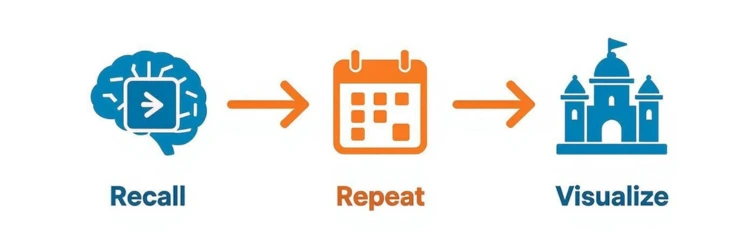
Think of it as a simple, powerful cycle. This is how you take a new idea from a fleeting thought to a permanent fixture in your mind.
The whole game is about moving from simply recognizing information to being able to recall it cold. We do that through repetition and then lock it in by connecting it to other ideas, often through visualization.
Test Your Understanding With the Feynman Technique
One of the most powerful reality checks for your understanding is the Feynman Technique. It’s named after the Nobel Prize-winning physicist Richard Feynman, and its genius is its simplicity. The core idea? You don't truly get something until you can explain it in simple terms.
Here’s a practical example of how to use it:
- Grab a Concept: Pick anything you're trying to learn. Let's use the financial concept of "compound interest".
- Teach It to a Kid: Write down an explanation for a 12-year-old. You might write: "Imagine you have $100 and it earns 5% interest. After a year, you have $105. The next year, you earn 5% on the whole $105, not just the original $100. So your money starts making its own money."
- Find Your Weak Spots: If you struggle to explain the difference between simple and compound interest, that's your gap.
- Go Back and Simplify: Review the definition and try again until the explanation is crystal clear and uses simple analogies.
This method forces you to go beyond just recognizing terms on a page and actually internalize how things work.
Visualize Connections With Mind Maps
Let's face it, our brains are not designed to remember long lists of abstract facts. That's where mind mapping comes in. It turns all that messy information into a visual, organized diagram that’s way easier for your brain to process and recall. It basically mirrors how your brain connects ideas naturally.
- Practical Example: If you’re learning about digital marketing, you'd stick "Digital Marketing" in the center of a page. Then, you'd draw branches out for "SEO", "Content Marketing" and "PPC". Under "SEO", you could add smaller branches for "Keyword Research", "On-Page SEO" and "Link Building".
Actionable insight: Use different colors for each main branch. This simple visual cue helps your brain categorize and separate information, making the map even easier to recall during a test or meeting.
Design a Weekly Retention Schedule
Of course, using all these cool techniques requires a plan. A solid weekly schedule carves out specific time for both learning new things and actively reviewing old material. This is what helps you finally break that awful "cram and forget" cycle. It's one of the most practical study techniques for students and lifelong learners alike.
A schedule builds review right into your learning process, making memory retention a consistent habit, not just a last-minute panic.
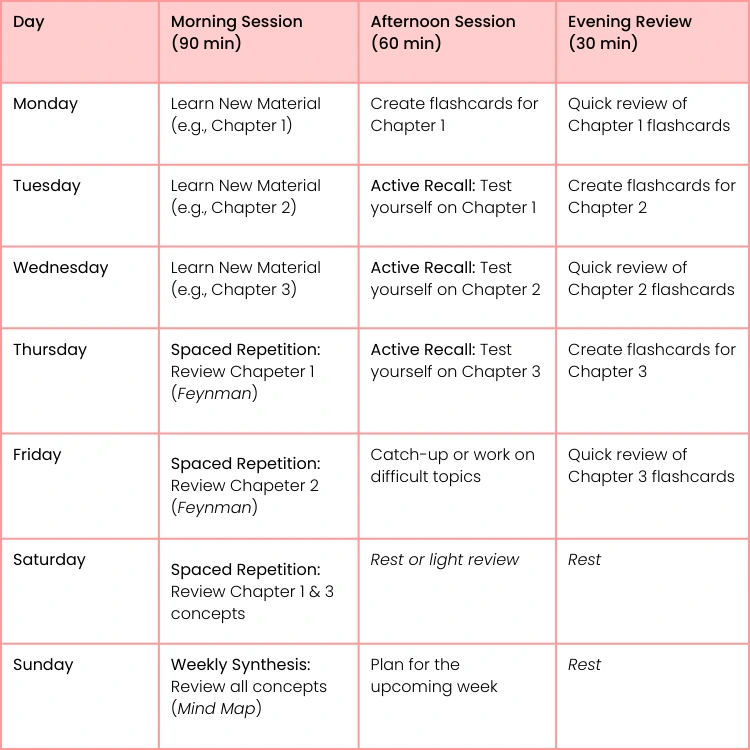
Sample Weekly Study Schedule for Maximum Retention
Here’s a sample table you can adapt for any subject. Notice how review sessions are built-in from day one, using both active recall and spaced repetition principles. This is an actionable template you can use today.
This structure ensures you're constantly revisiting information at increasing intervals, which is the key to moving it from your short-term to your long-term memory. Tweak the times and topics to fit your own needs, but keep the core principles of recall and repetition.
The Surprising Link Between Lifestyle and Memory
All the cognitive tricks in the world won't do much good if your brain isn't getting what it needs on a biological level. It's a common oversight. We focus so much on the how of learning that we forget the physical foundation that makes it all possible.
Think of it like this: you can have the most sophisticated software imaginable, but if you're running it on outdated, sluggish hardware, you’ll never see what it's truly capable of. Your lifestyle—what you eat, how much you move, and the quality of your sleep—is the hardware maintenance for your brain. These aren't just fluffy wellness tips; they’re core components of any serious memory improvement strategy.
Fuel Your Brain with the Right Foods
What you put on your plate has a direct, measurable impact on your brain's structure and function. Your brain is a high-performance machine, and it needs premium fuel to build and repair cells, fight off damage, and keep the lines of communication between neurons clear.
Certain foods are absolute powerhouses for cognitive health. Making a conscious effort to include them in your diet is one of the easiest, most practical steps you can take. If you want to dive deeper into building a solid routine, this guide on the everyday basics for optimal health is a great place to start.
Here are a few brain-boosters with actionable tips to add to your next grocery list:
- Fatty Fish: Salmon, mackerel, and sardines are swimming in omega-3 fatty acids.
- Actionable insight: Aim for two servings per week. A simple practical meal could be a baked salmon fillet with roasted vegetables.
- Blueberries: Packed with anthocyanins, these berries have anti-inflammatory and antioxidant effects.
- Actionable insight: Toss a handful into your morning oatmeal, yogurt, or smoothie for an easy cognitive boost.
- Walnuts: The only nut with a significant amount of the plant-based omega-3 alpha-linolenic acid (ALA).
- Actionable insight: Keep a small bag of walnuts at your desk for an afternoon snack instead of reaching for chips or candy.
Move Your Body to Solidify Memories
If you want to fire up your brain, get your body moving. Physical activity does more than just get your heart pumping; it floods your brain with oxygen-rich blood and triggers the release of growth factors that help create new brain cells and connections.
And you don't need to sign up for a marathon to see the results. In fact, short bursts of activity can make a huge difference, especially when timed correctly. Research has shown that a little bit of exercise right after learning can significantly boost how much you remember.
- Practical Example: A study found that older adults who hopped on a stationary bike for just a few minutes after a learning task recalled more information the next day. It turns out movement acts like a "save button" for your brain, helping to kickstart the memory consolidation process.
Actionable Insight: A simple 20-minute walk after a study session isn't just a break; it's an active step in cementing what you've just learned. The next time you finish an important online course module, immediately put on your shoes and go for a walk around the block.
So next time you finish a module on Uplyrn or wrap up a dense work presentation, resist the urge to just sit there. Get up, go for a quick walk, or even do a few stretches. You might be surprised at how much clearer things feel—and how much more you recall later on.

Your Brain's Nightly Filing System: Using Sleep to Lock in Learning
Think of sleep as more than just hitting the pause button. It’s actually a highly active and critical phase for learning, where your brain gets to work sorting, filing, and reinforcing everything you took in during the day. This essential process is called memory consolidation.
If you're not getting enough quality sleep, you're essentially throwing away a good portion of your hard work. During different sleep stages, your brain transforms flimsy short-term memories into solid, long-term knowledge. It's a powerful, built-in tool that any serious learner needs to master.
The Science of Sleep and Memory Reactivation
One of the most fascinating areas of sleep science is a process called Targeted Memory Reactivation (TMR). The idea is simple: by re-exposing your sleeping brain to subtle cues from your study session—like a particular sound or even a scent—you can prompt it to prioritize and strengthen those specific memories.
- Practical Example: Say you were studying French vocabulary while smelling a faint rose scent from a diffuser. If you have that same scent in your room while you sleep, it acts as a signal to your brain to get to work on those specific French words.
The big takeaway here is that what you do right before bed can directly impact what your brain decides to keep. A quick review of key ideas before you turn out the lights essentially primes your brain for its nightly consolidation shift.
This isn't just a neat theory; the science backs it up. Studies have shown that memory reactivation during sleep really does improve how much you remember. One study, for example, found that TMR boosted memory retention by up to 27% compared to control groups. It’s a clear demonstration of how a simple intervention can make a real difference.
Actionable Sleep Strategies for Better Recall
Protecting your sleep is non-negotiable if you want an effective learning strategy. Both deep slow-wave sleep and REM sleep are vital, but they do different jobs. Slow-wave sleep is key for locking in facts and figures, while REM sleep is more involved with procedural skills and emotional memories.
To get the most out of your brain's natural process, try these simple, actionable habits:
- The 15-Minute Wind-Down: Spend the last 15 minutes before bed doing a quick, low-stress review of the most important concepts from your day.
- Actionable insight: Instead of trying to re-learn everything, just look over your mind map or flip through your top 5 flashcards. Don't cram—just gently revisit.
- Build a Solid Routine: Going to bed and waking up around the same time, even on weekends, strengthens your body's natural circadian rhythm. This leads to higher-quality sleep stages, which is exactly what you need for memory consolidation. For a simple but powerful technique, check out this guide on finding your "off switch" with a simple sleep trick.
And if you're looking for an extra edge, exploring various supplements for better sleep might help you get the restorative rest you need to wake up sharper.
Your Questions on Memory Improvement Answered
When you start digging into memory improvement, a lot of practical questions pop up. How fast can you actually see results? Is it too late to start if you're getting older? I've rounded up the most common questions I hear to give you clear, straightforward answers.
How Long Does It Take to See Improvements?
You can get small wins almost immediately. Seriously.
- Practical example: Next time you get someone's name at a party, say it back to them ("Nice to meet you, Sarah") and then silently repeat it to yourself three times. That micro-repetition can make a huge difference just minutes later.
For more noticeable changes, you'll need a bit of consistency. Stick with techniques like active recall and spaced repetition for a few weeks, and you’ll start to feel a real shift in how much you remember. The kind of significant, lasting change that really sticks, though? That comes from building solid habits over a few months.
Can I Still Improve My Memory as I Get Older?
Absolutely. It’s a complete myth that your brain just goes downhill with age. Your brain has this incredible ability to adapt and forge new connections, a process called neuroplasticity, and it doesn't stop when you hit a certain age.
- Practical insight: Many older adults find that tying new information to existing, strong memories is especially effective. For instance, to remember a new neighbor's name is "Baker", you could associate them with your favorite bakery. This leverages a lifetime of well-established neural pathways. It's truly never too late to start training your brain for better recall.
What Is the Single Best Technique for a Student?
If I had to bet on just one technique, it would be active recall. We've all been there—passively re-reading notes until our eyes glaze over. It feels productive, but it’s really just creating an "illusion of competence". You recognize the material, but you can’t actually pull it out of your head when it counts.
Actionable Insight for Students: At the end of each study week, create a one-page "cheat sheet" from memory alone. Write down all the key formulas, dates, and concepts you can. Only after you're finished should you check your notes to see what you missed. This is a perfect active recall exercise.
That retrieval process is what actually builds and strengthens the neural pathways, making it the most powerful way to lock in knowledge for the long term. You can do this with flashcards, practice tests, or even just by explaining a concept out loud to a friend.
Are Memory Enhancing Supplements Effective?
This is a big one. While the supplement industry is booming with "brain boosters", the scientific evidence for most of them is pretty thin or mixed at best. The most proven path to a better memory is paved with lifestyle choices, not pills.
Good nutrition from whole foods—like the omega-3s in fish or the antioxidants in berries we talked about earlier—is a great start. Add in regular exercise and quality sleep, and you have the true cornerstones of cognitive health. If you are thinking about supplements, your first stop should always be a chat with a healthcare professional for personalized advice.
Ready to stop just reading and start doing? Uplyrn is a great place to put these strategies into practice. It’s a dynamic learning environment where you can apply active recall, spaced repetition, and other powerful techniques across thousands of courses. Start building a stronger memory and unlocking new skills today at Uplyrn.


Leave your thoughts here...
All Comments
Reply