









How to Improve Self Discipline and Master Your Willpower

Improving self-discipline isn't about forcing yourself through sheer willpower; it's about building a system of smart habits and a supportive environment. The key is to see discipline as a skill to be developed, not a trait you're born with, by starting with small, consistent actions.
Jump To Section

Earn As You Learn
Earn 25% commission when your network purchase Uplyrn courses or subscribe to our annual membership. It’s the best thing ever. Next to learning,
of course.
Rethinking What Self-Discipline Really Means
Let’s be honest, the term "self-discipline" often conjures images of rigid schedules, joyless sacrifice, and an endless internal battle. We tend to think of it as a rare personality trait—something you either have or you don’t.
This perspective is not only intimidating but also fundamentally wrong. True discipline isn't about punishment or brute force; it's about intelligent self-management.
It’s a practical skill that anyone can cultivate through consistent practice. Instead of viewing it as a limited resource you can just run out of, think of it as a muscle. The more you use it strategically on small, manageable tasks, the stronger it becomes over time.
This approach helps you avoid the burnout that comes from relying on willpower alone, a common pitfall that leads to decision fatigue and makes life feel harder.
The real magic happens when you shift your focus from massive, intimidating goals to tiny, repeatable actions. Instead of a vague commitment to "get fit", you commit to a 10-minute walk after lunch every single day. That small win builds momentum and self-trust, making the next step feel so much easier.

Mindset Shift From Myth to Reality
Before we dive into the "how", let's clear up some common misconceptions. This table breaks down the old-school myths about discipline and replaces them with a more practical, evidence-based reality.
Internalizing these realities is the first and most crucial step. It moves you from a place of fighting yourself to a place of working with yourself.

The Real-World Impact of Small Actions
The cumulative effect of these small, disciplined choices has a profound impact on long-term well-being. This isn't just theory; it's backed by some pretty serious data.
Take the findings from the Household, Income and Labour Dynamics in Australia (HILDA) Survey. It shows powerful links between self-control and major life outcomes. For every one-point increase on a self-control scale, individuals were:
- 8 to 10 percentage points less likely to be obese
- 9 to 10 percentage points less likely to engage in excessive drinking
- 7 percentage points more likely to have emergency savings
This data illustrates a crucial point: discipline isn't about being perfect. It's about making slightly better choices consistently, which compound into significant improvements in your health, finances, and overall quality of life.
Key Takeaway: Stop treating self-discipline as a test of your willpower. Start treating it as a strategic skill focused on building small, positive habits that automate success and reduce the need for constant motivation.
This mindset shift is the foundation for everything else. By moving from a mindset of force to one of finesse, you empower yourself to build the life you want, one deliberate action at a time.
Engineer Your Environment for Automatic Success
Ever feel like you’re in a constant battle with yourself? That’s because relying on pure willpower to fight temptation is a losing game. It’s a finite resource, and eventually, it runs out.
But here’s the secret: the most disciplined people aren't superhuman. They're just smarter about how they set up their world.
They don’t waste energy wrestling with internal urges. Instead, they focus on managing their surroundings, a powerful concept known as choice architecture. It’s all about designing your environment to make the right decisions the easiest ones.
You stop forcing yourself to do the right thing and simply make it the path of least resistance. You’re not just hoping for better self-discipline; you’re engineering it directly into your daily life.
Reduce Friction for Good Habits
Think about a habit you want to build. Now, identify every tiny obstacle—every single point of friction—that stands in your way. The goal is to hunt down and eliminate them.
Let's say you want to work out every morning. Don't leave it up to your groggy, half-asleep self to make that happen.
- Actionable Insight: The night before, lay out everything you need: gym clothes, shoes, socks, water bottle. Put it all right next to your bed. Make it the first thing you see when you wake up.
- Practical Example: Someone committed to a morning run doesn't just set an alarm. They have their running shoes by the door, their coffee maker prepped, and their alarm clock on the other side of the room so they have to get out of bed to turn it off.
This small bit of prep work removes the decision-making process when your motivation is at its lowest. Suddenly, going for that run is easier than not going.
Increase Friction for Bad Habits
Now, let's flip the script for the habits you want to break. Instead of trying to resist them with sheer grit, you need to add layers of friction to make them inconvenient.
If mindless phone scrolling is your vice, don’t just tell yourself to stop. Make it physically harder to even start.
- Actionable Insight: Bury those distracting social media apps in a folder on the very last page of your home screen. Log out of your accounts every time you use them. Having to re-enter your password is a surprisingly effective deterrent.
- Practical Example: Set your phone to grayscale mode. You’d be amazed how unappealing those vibrant app icons become in black and white, reducing the dopamine hit you get from looking at them.
Key Takeaway: Every extra step you add between yourself and a bad habit is a precious moment for your rational brain to jump in and say, "Wait, is this what I really want to be doing?"
This strategy works for anything. Want to eat healthier? Stop bringing junk food into your house in the first place. Trying to watch less TV? Unplug it after you're done and put the remote in a drawer in another room. By adding friction, the undesirable choice becomes a deliberate effort, not an automatic default.
Optimize Your Social Environment
Your environment isn't just what's in your house; it's also who's in your life. The people around you shape your behaviors and expectations more than you might realize.
To really lock in your self-discipline, you have to be intentional about your social circle.
- Actionable Insight: Find an accountability partner. Teaming up with a friend for workouts is a game-changer. Knowing someone is waiting for you makes you 95% more likely to actually show up.
- Practical Example: If you're trying to write a book, join a local or online writing group where members share weekly progress. The positive peer pressure and shared commitment create a powerful support system that keeps you on track.
- Limit Negative Influences: If some friends consistently lead you toward habits you're trying to quit, you might need to consciously limit your time with them in those specific situations. For instance, suggest meeting for coffee instead of going out for drinks.
When you align your physical, digital, and social worlds with your goals, you create an incredibly powerful system for success. This proactive approach is the foundation for building real, lasting discipline and is a crucial part of unlocking the power of routine in your daily life. You make good choices easy, and success becomes almost automatic.

Building Habits That Actually Stick
Self-discipline isn’t something you’re born with; it’s built. It’s forged not in a single moment of inspiration, but through the small, consistent actions you take every single day. The goal is to stop relying on fleeting motivation and instead create a system of habits that eventually run on autopilot. This is where we turn abstract goals into concrete, daily practices.
The real power here is sustainability. When you focus on building healthy habits that actually stick, you conserve your precious willpower for the moments you truly need it. You're not just trying harder; you're working smarter by engineering behaviors that support your long-term vision.
Decoding the Habit Loop
At its core, every habit—good or bad—follows a simple neurological pattern that scientists call the habit loop. Understanding this three-part framework is the first step to rewiring your brain for success. It’s the behind-the-scenes script that runs without you even thinking about it.
- The Cue: This is the trigger, the thing that tells your brain to kick into automatic mode. It could be a time of day (your morning alarm), a place (your desk), an emotional state (feeling stressed), or an action you just completed (finishing dinner).
- The Routine: This is the action itself, the behavior you perform. It’s the habit, whether that's grabbing a cookie, mindlessly scrolling through your phone, or lacing up your running shoes.
- The Reward: This is what satisfies the craving your brain was after. The reward reinforces the loop, telling your brain, “Hey, that worked. Let’s do it again next time.”
Practical Example: You feel tired in the afternoon (Cue), so you grab a sugary snack (Routine), which gives you a quick energy spike (Reward). Your brain connects that cue with the reward, and boom—a habit is born.
Actionable Insight: To change it, don't fight the cue. Just swap the routine. When you feel that afternoon slump, try a brisk five-minute walk instead. This can provide the same energy boost you were craving, helping to reprogram the loop.
Make Good Habits Ridiculously Easy
The single biggest reason new habits fail? We make them too hard. We get a jolt of motivation and decide to go from zero to one hundred, which almost always leads to burnout and quitting.
The secret is to make the initial action so small that it feels silly not to do it.
This is the magic of the Two-Minute Rule. Whatever habit you want to build, scale it down into a two-minute version.
- Practical Example: “Read more” becomes “Read one page”. “Go for a run” becomes “Put on my running shoes”. “Meditate for 20 minutes” becomes “Sit and breathe for 60 seconds”.
- Actionable Insight: The goal isn't the immediate result. The goal is to master the art of showing up. Once you've nailed the starting ritual, you can build on it. This small-scale approach creates momentum and, more importantly, trust in yourself. That’s far more valuable than a single, heroic effort.
Stacking Habits for Effortless Consistency
One of the most powerful strategies for building a new habit is to piggyback it onto an existing one. It’s a technique called habit stacking, where you anchor a new behavior to something you already do without thinking. You're using the momentum of an old habit to carry the new one.
The formula is dead simple: After/Before [Current Habit], I will [New Habit].
- Practical Example: "After I pour my morning coffee, I will write down one thing I'm grateful for." Or, "Before I check my phone in the morning, I will drink a full glass of water."
- Actionable Insight: Look for a reliable daily anchor point. Your morning routine is often the best place to start. For instance, tethering a new habit to brushing your teeth is highly effective because it's something you do consistently without fail.
This isn’t just about being more productive; it’s a direct investment in your future self. Research backs this up, showing that self-discipline is a game-changer. A longitudinal study from 2002 found that self-control was a better predictor of academic success than IQ. Students with higher self-control had better grades and fewer absences, proving that discipline is a dynamic skill that directly fuels achievement.
Ultimately, understanding the reasons why it's important to develop good habits is often the motivation we need to stick with it for the long haul.
How to Beat Procrastination for Good
Procrastination is the silent saboteur of self-discipline. It’s that magnetic pull toward anything but the task you know you should be doing, often masquerading as "productive" multitasking or some last-minute planning.
Let’s be clear: beating it isn't about conjuring up a magical burst of motivation. It's about building a practical toolkit for those moments when your motivation has completely checked out. And that process starts with getting brutally honest about why we delay things in the first place.
More often than not, procrastination has nothing to do with being lazy. It's an emotional regulation problem. We actively avoid tasks that make us feel bad—bored, inadequate, anxious, or overwhelmed. Putting it off gives us a temporary hit of relief, but this only feeds the cycle, making the task even more intimidating when we finally have to face it.
Identify Your Procrastination Triggers
Your first move is to become a detective of your own behavior. When do you find yourself drifting? What specific feelings or situations are pulling the strings?
- Fear of Failure or Perfectionism: Are you putting something off because you’re terrified you won’t do it perfectly? This "all-or-nothing" mindset is paralyzing. It makes doing nothing feel safer than producing something that's less than flawless.
- Task Aversion: Is the job just… boring? Unpleasant? Seriously difficult? We're all wired to seek pleasure and avoid pain, so it's no wonder that tedious work becomes the number one thing we want to put off.
- Decision Fatigue: Do you delay simply because you're overwhelmed by choices? When a project feels too big or the path forward isn't clear, the mental energy required just to decide where to start can lead to a total shutdown.
Actionable Insight: For one day, keep a "procrastination journal". Every time you catch yourself avoiding a task, jot down what you were supposed to be doing and how you were feeling at that exact moment. You might notice a pattern, like you always start scrolling social media right when you feel overwhelmed by a complex work report. Recognizing that connection is half the battle.
Key Takeaway: Procrastination is rarely a time-management issue. It's an emotion-management issue. If you can address the underlying feeling—the anxiety, boredom, or self-doubt—taking action becomes infinitely easier.
Practical Strategies to Take Back Control
Once you know what triggers you, you can start using strategies designed to short-circuit the habit. The goal is to make starting as painless as possible and manage the discomfort that fuels your urge to delay.
The Pomodoro Technique is a classic for a reason. It's simple: work in focused, 25-minute sprints, then take a short 5-minute break. This method breaks intimidating projects into bite-sized pieces and almost turns the process into a game. Knowing you only have to truly focus for a short burst makes it far less daunting to just begin.
Another incredibly effective method is something called temptation bundling. This is where you pair an action you want to do with an action you need to do.
- Actionable Insight: Only let yourself listen to your favorite podcast while you're doing chores around the house.
- Practical Example: Save the next episode of that show you’re binge-watching and only allow yourself to watch it while you're on the treadmill.
This little trick links the immediate gratification of the fun activity to the task you've been avoiding, effectively hijacking your brain's reward system to work for you, not against you. If you want to explore more ideas, checking out different ways to overcome procrastination can give you even more tools for your arsenal.
The science on this is crystal clear: building self-discipline is one of the most powerful weapons against the tendency to procrastinate. Research consistently shows a significant inverse relationship—as self-discipline goes up, procrastination goes way down. One study even found that people who were coached to improve their self-discipline saw a major drop in their procrastination scores compared to a control group.
By figuring out your personal triggers and using these simple tools, you can start to systematically dismantle the habit of procrastination, one small win at a time. For an even deeper dive into this topic, check out this guide on how to overcome procrastination.
Your Four Week Self-Discipline Action Plan
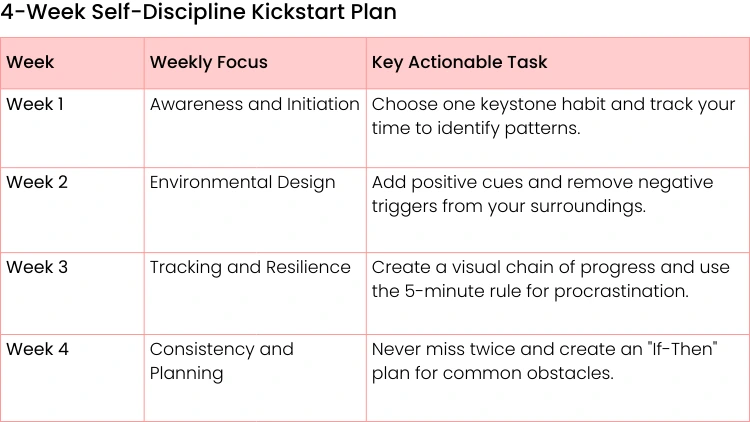
Knowing the strategies is one thing, but putting them into practice is where the real change happens. Think of this four-week plan as your roadmap to building self-discipline systematically, without getting overwhelmed. Each week builds on the last, turning abstract ideas into concrete, daily actions.
This isn't about a complete life overhaul overnight. It’s about laying one brick at a time, creating a strong foundation of habits and self-awareness that will serve you long after these four weeks are done. Let's get started.
Week 1: Identify and Start Small
The first week is all about groundwork. We'll start with self-awareness and then pick a single, high-impact habit to focus on. Why just one? Because trying to change everything at once is a classic recipe for burnout. Instead, we'll pinpoint one keystone habit—a small change that has a ripple effect, naturally triggering other positive behaviors.
Your main goal this week is to observe and then initiate. Pay close attention to your daily routines, your energy levels, and those moments when you feel your discipline start to slip.
- Actionable Insight: For the first three days, just track your time. Don't judge, just notice. Where does your time really go, especially during those unstructured gaps in your day? Use a simple notepad or a tracking app.
- Practical Example: By day four, it's time to choose one keystone habit. Maybe you noticed you feel sluggish after work. Your habit could be putting on your workout clothes the second you get home. It doesn't mean you have to work out, just that you complete that first step.
- Weekly Reflection: At the end of the week, ask yourself: What was the biggest obstacle to my new habit, and what's one tiny change I can make next week to smooth the path?
Week 2: Engineer Your Environment
With one habit in motion, Week 2 is all about optimizing your surroundings for success. Your environment is one of the most powerful—and most overlooked—drivers of your behavior. This week, you'll proactively remove temptations and set up visual cues that make your desired actions almost effortless.
Think of yourself as an architect of your own choices. You're designing a space where good habits are the path of least resistance.
- Actionable Insight: Real discipline isn't about resisting temptation; it's about removing it entirely. If there are no cookies in the house, you don't have to waste willpower trying not to eat them. Make the better choice the easier choice.
Your plan for this week involves two key environmental tweaks:
- Add Positive Cues: Want to read more? Leave a book on your pillow. Trying to remember to floss? Put the floss right on top of your toothpaste. Make your goals visible.
- Remove Negative Cues: If you get sucked into scrolling on your phone at night, start charging it in another room. If you snack mindlessly while watching TV, pre-portion a healthy snack before you sit down and put the rest away.
This proactive approach saves your precious mental energy for the tasks that truly matter.
Week 3: Implement Tracking and Tackle Procrastination
You've got a foundational habit and a supportive environment. Now it's time to introduce measurement and face procrastination head-on. Tracking your progress makes it tangible and incredibly motivating, and having a go-to strategy for procrastination puts you back in control.
This is the week you build momentum. It's all about consistency and resilience.
Implement a three-step method for beating procrastination the moment it strikes. The key to overcoming that urge to delay is recognizing the trigger, using a structured technique like the Pomodoro method to just get started, and then reinforcing that positive action with a small reward.
Your tasks this week are focused and direct:
- Actionable Insight: Keep tracking your keystone habit. A simple 'X' on a calendar works wonders. Your goal is to build a visual chain of success and do everything you can to not break it.
- Practical Example: Identify your number-one procrastination trigger, like avoiding paperwork. When you feel that familiar urge to put that specific task off, commit to working on it for just five minutes. Set a timer. Anyone can do five minutes, and you'll often find that just starting is the hardest part.
- Weekly Reflection: Ask yourself: What pattern did I notice right before I procrastinated? And what did it feel like to push through, even for just those five minutes?
Week 4: Build Consistency and Plan for Setbacks
The final week is about cementing your progress and preparing for the long game. Self-discipline isn't about being perfect; it's about being consistent and knowing how to recover when you slip up. A single missed day doesn't erase your progress unless you let it.
This week, the focus shifts from just starting to maintaining. You'll practice the crucial skill of getting right back on track after a mistake and start planning for the future. A powerful technique for maintaining momentum is to write your list of top 6 to-dos ready for tomorrow, which sets you up for success before the day even begins.
- Actionable Insight: Continue tracking your habit. If you miss a day, your only goal is simple: do not miss two in a row. This one rule is incredibly effective at preventing one off-day from turning into a downward spiral.
- Practical Example: Create a simple "If-Then" plan for your biggest challenge. For instance: "If I feel too tired to work out after work, then I will go for a 10-minute walk instead." This pre-planned response eliminates the need for tough in-the-moment decisions when your willpower is low.
- Weekly Reflection: What have I learned about myself over these four weeks? And how can I apply that knowledge to the next habit I want to build?
To give you a bird's-eye view, here is a quick summary of how the four weeks come together to systematically build your discipline.
This plan is a starting point. The real magic happens when you adapt it to your own life, learn from your experiences, and keep moving forward, one disciplined choice at a time.
Got Questions About Self-Discipline?
Even when you have a solid plan, the road to better self-discipline is full of twists and turns. Doubts creep in, especially when progress feels glacial or you hit a wall you didn't see coming. This is your go-to spot for troubleshooting those common sticking points with straightforward, practical answers.
Think of this as your personal FAQ for the discipline journey, designed to get you unstuck and back on track.
How Do I Stay Motivated When Progress Is Slow?
It’s easy to feel pumped up at the beginning. But what happens a few weeks in when the results aren’t as dramatic as you’d hoped? This is the exact moment most people throw in the towel, mistaking slow progress for no progress at all.
The secret is to shift your focus from the outcome to the process.
Stop measuring success by the number on the scale or the words on the page. Instead, measure it by your consistency. Did you show up today? That’s a win.
- Actionable Insight: Grab a calendar and a marker, or use a simple habit-tracking app. Every day you stick to your new habit, draw a big 'X' over the date. Your goal isn’t to lose 10 pounds this week; it’s just to not break the chain of Xs.
- Practical Example: If you’re learning to code, don't get hung up on building a full application right away. Instead, celebrate the fact that you put in your planned 30 minutes of practice today. The real victory comes from honoring your commitment to yourself, not from mastering a skill overnight.
This simple shift builds self-trust, which is a much more reliable fuel source than the fleeting high of quick wins.
What’s the Best First Step for a Beginner?
Starting from square one can feel like trying to drink from a firehose. There's so much advice out there. The single best thing you can do is pick one keystone habit and then shrink it down until it’s ridiculously easy.
A keystone habit is a small change that naturally triggers a cascade of other positive behaviors in your life.
Forget about a complete life overhaul. Your only mission is to build a tiny sliver of momentum in one specific area.
The most powerful thing you can do is prove to yourself that you are someone who follows through, even in a very small way. This builds a foundation of self-respect that makes every subsequent step easier.
Here’s how to get it done:
- Actionable Insight: Find your leverage point. Think about the one domino that, if tipped, would knock over others. Is it your chaotic morning routine? Your diet? Mindless screen time? Often, it's making your bed—it starts the day with a small win.
- Practical Example: Use the Two-Minute Rule. Whatever you choose, scale it down to a two-minute version. "Read every day" becomes "Read one page". "Go to the gym" becomes "Put on your workout clothes".
- Give It Your Full Focus: For the first week or two, this single tiny habit is your only priority. Don't add anything else to your plate. Master the art of showing up for this one task before you even think about what’s next.
What Should I Do When I Have a Bad Day?
Let’s be real: you will have a bad day. You’ll miss a workout, eat the junk food, or break your perfect streak. This isn't a failure—it's just a data point. The most disciplined people on the planet aren't perfect; they're just experts at getting back on track fast.
The biggest mistake you can make is letting one slip-up convince you to abandon the whole effort. This "all-or-nothing" mindset is the real enemy of long-term progress.
To fight back, adopt one simple but powerful rule: Never miss twice.
- Actionable Insight: If you miss a planned habit, take a moment to identify why. Were you too tired? Unprepared? Stressed? Understanding the reason helps you adjust your plan for next time instead of just feeling guilty.
- Practical Example: Let's say you committed to waking up at 6 AM every day. On Wednesday, you mashed the snooze button until 7:30 AM. Instead of writing off the entire day as a loss, your only job is to make absolutely sure you’re up at 6 AM on Thursday. One bad day is an accident. Two in a row is the start of a new habit you don't want.
When you focus on immediate recovery instead of dwelling on past perfection, you build resilience. You learn that a setback is just a temporary detour, not a dead end. This mindset is the true cornerstone of sustainable self-discipline.
Ready to build unshakable self-discipline with expert guidance? At Uplyrn, we offer a range of courses and mentoring designed to help you build the skills that matter. Discover how Uplyrn can support your personal and professional growth today.


Leave your thoughts here...
All Comments
Reply