









How to Improve Study Habits for Lasting Success

If you're serious about improving your study habits, the first move isn't to download a new app or buy a fancy planner. It’s to figure out what you’re actually doing right now. Before you can implement any new strategies, you have to get brutally honest with yourself by tracking your study sessions for a short period. This isn't about judging yourself—it's about gathering data to build a smarter, more effective plan.
Jump To Section

Earn As You Learn
Earn 25% commission when your network purchase Uplyrn courses or subscribe to our annual membership. It’s the best thing ever. Next to learning,
of course.
Pinpointing Your Current Study Habits
You can’t get where you’re going if you don’t know where you’re starting. That same logic applies perfectly to building better study habits. Before you jump into new techniques, you need a clear, unfiltered picture of your current approach.
Most of us think we have a pretty good handle on how we study, but the reality is often a wake-up call. You might feel like you put in a solid four hours, but how much of that was truly deep focus? Was it four straight hours, or was it fragmented by a constant stream of phone notifications and "quick" breaks? A simple one-week audit can reveal some surprising—and incredibly useful—patterns.
The Power of a Simple Study Audit
For just one week, your only job is to be an observer of your own behavior. Don't try to change anything yet. Just track. To get a really clear picture, you'll want to conduct a comprehensive time audit that gives you real insight into where your time and energy are going.
This simple process will help you answer some critical questions:
- When are you most productive? Are you a morning person who’s sharpest before noon, or do you hit your stride late at night?
- What are your biggest distractions? Is it the buzz of your phone, the allure of YouTube, or just the background noise from your family or roommates?
- How long can you really focus? Be honest. Pinpoint the moment your concentration starts to drift. Is it after 20 minutes? An hour?
- What methods are you currently using? Are you passively rereading your notes over and over, or are you actively working through practice problems?
Practical Steps for Tracking Your Habits
Getting started is way easier than it sounds. You don’t need any special software—a simple notebook or a basic spreadsheet is perfect. The only thing that matters is consistency.
Here's a real-world example: A biology student named Alex decided to track his study habits for a week. He went into it assuming he was putting in about 15 hours for his upcoming midterm. His log, however, told a different story. He only clocked 8 hours of true, focused study time. The rest was lost to scrolling social media, answering emails, and grabbing snacks.
Actionable Insight: Create a simple log for one week. For every study session, write down the start time, end time, the specific task (e.g., "Read Chapter 3 of History"), and any distractions that pulled you away. This data is your roadmap. Alex realized his problem wasn't a lack of time, but a lack of focused time. The data also showed his peak focus was between 9 AM and 11 AM, yet he always scheduled his study sessions for the late afternoon when he was already mentally drained.
This is the kind of personal insight that makes all the difference. It’s not just about finding your weaknesses; it’s about discovering your hidden strengths, too. You might find that studying in a quiet library triples your output, or that you retain information way better when you review notes right after a lecture.
If you find that the biggest hurdle revealed by your audit is simply getting started, this guide on how to overcome procrastination has some targeted strategies that can help.
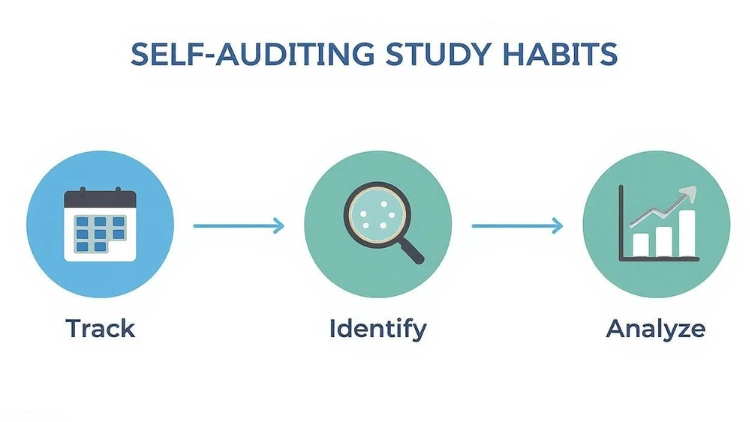
This infographic breaks down the self-auditing process into three simple, actionable phases.
By tracking, identifying, and analyzing, you're turning vague feelings about your studying ("I get distracted easily") into concrete data you can actually use ("My focus breaks every 25 minutes because of my phone").
By the end of one week, you'll have a detailed map of your personal study landscape. This baseline is the essential first step toward building a system that isn't just effective, but is designed specifically for you.
Building Your Foundation with Proven Study Techniques
Alright, you’ve taken a hard look at your current study habits. Now it’s time to swap out the old tools for something that actually works. If your go-to method is just rereading chapters and highlighting half the page, you're stuck in a passive loop that creates a dangerous illusion of knowing the material.
To really cement new knowledge, you have to get your hands dirty. You need to actively engage with the information and force your brain to do the heavy lifting.
Thankfully, cognitive science has already mapped out the most effective ways to learn. These aren't just clever "hacks"; they're fundamental shifts in how you approach studying that will help you stop wasting time and start building knowledge that lasts.
Master Information with Active Recall
If there's one change that will give you the biggest bang for your buck, it's shifting from passive review to active recall. This simply means pulling information out of your memory instead of just pushing it in. It feels tougher—because it is—but that extra effort is exactly what builds strong, reliable neural connections.
Think of it this way: passively reading your notes is like looking at a map of a city you've never been to. Active recall is like trying to draw that map from memory. Which one do you think truly teaches you the layout of the city?
Here’s how you can put active recall into practice today:
- Smarter Flashcards: Don't just flip a card and think, "Yep, knew that." Actually say the answer out loud or write it down before you check. This small change makes a massive difference.
- The Blank Page Method: After reading a chapter or finishing a lecture, grab a blank piece of paper (or open a new document) and jot down everything you can remember. Be as detailed as you can. Only then should you go back to your notes to fill in what you missed.
- Teach to Learn: Grab a friend, a family member, or even just a rubber duck and try to explain a concept in simple terms. This method, sometimes called the Feynman Technique, instantly reveals the gaps in your own understanding.
Actionable Insight: The next time you finish a chapter, close the book and spend five minutes summarizing the key points on a sticky note without looking. Stick this note inside the book cover. This simple action forces recall and creates a quick-reference summary for later.
Beat the Forgetting Curve with Spaced Repetition
Let's face it, our brains are built to forget. Spaced repetition is the scientifically-backed method to fight this natural tendency. The idea is brilliant in its simplicity: review information at increasingly longer intervals, which basically tells your brain, "Hey, this stuff is important—don't delete it!"
This process works by catching a memory just as it's about to fade. Each time you successfully recall it, that memory gets stronger and more resistant to being forgotten.
You don't need fancy software to get started. Here’s a low-tech way to do it:
- Make Flashcards: Create flashcards for the key concepts you need to learn.
- Set Up the Box System: Get three small boxes and label them "Daily", "Weekly" and "Monthly".
- Start Reviewing: All new cards go into the "Daily" box. Go through them every single day.
- Promote Your Cards: When you get a card right, move it up to the "Weekly" box.
- Keep Promoting (or Demoting): Review the "Weekly" box once a week. If you get a card right again, it graduates to the "Monthly" box. But if you get one wrong at any stage, it gets sent all the way back to the "Daily" box.
Practical Example: A language student learning Spanish vocabulary uses this system. The word "manzana" (apple) is easy, so it quickly moves to the "Monthly" box. But the verb "haber" is tricky, so it keeps getting sent back to the "Daily" box until it's mastered. This simple system automatically forces you to spend more time on the concepts you struggle with, making your study sessions incredibly efficient.
Weave Knowledge Together with Interleaving
Another fantastic way to upgrade your study habits is to mix things up. This is a technique known as interleaving. Instead of spending three hours straight on just history (that's called blocked practice), you’d spend one hour on history, one on biology, and then one on math.
I know, it feels less productive in the moment because your brain has to constantly switch gears. But that's the point! This struggle is what leads to deeper, more flexible learning. It helps you draw connections and see the subtle differences between various concepts.
A medical student, for example, might interleave their study of different diagnostic scans—X-rays, CT scans, and MRIs—rather than focusing on just one type at a time. This forces them to learn the distinct features of each, preventing them from simply memorizing a pattern.
The science on this is solid. A massive meta-analysis found a strong link between structured study habits and academic success, with a correlation coefficient between 0.52 to 0.60. This reinforces that how you study is often just as important as how much you study.
By combining these methods, you're not just studying harder; you're studying smarter. If you want to dive even deeper, check out this comprehensive guide on powerful study techniques for students for more practical strategies you can implement right away.
Designing an Environment for Deep Focus
So you've got some powerful study techniques in your back pocket. That’s great. But trying to use them in a chaotic environment is like driving a race car through a traffic jam—you have all that power, but nowhere to actually use it.
Your surroundings have a massive impact on your ability to concentrate. That's why engineering a space for deep focus is a core part of learning how to improve study habits. This isn't just about finding a quiet corner; it's about deliberately designing a physical and digital space that tells your brain, "Okay, it's time to work."
Crafting Your Physical Study Zone
Our brains are creatures of habit. They love cues. When you consistently use a specific spot only for studying, you build a powerful mental link. Eventually, the simple act of sitting down there will automatically shift your mind into focus mode.
You don't need a separate room to make this work, especially if you're in a noisy dorm or a busy family home. It could be a specific desk, a certain chair at the kitchen table, or your favorite spot in the library. The secret ingredient is consistency.
Here are a few practical ways to optimize your physical space:
- Declutter Ruthlessly: A messy desk equals a messy mind. Keep only what you absolutely need for your current task within arm's reach. Everything else? Put it away.
- Take Control of Sound: For many people, silence is golden. A good pair of noise-canceling headphones can be a total game-changer, blocking out roommates or family noise. Others, however, find that ambient sound—like the low hum of a coffee shop or a white noise app—actually helps them concentrate.
- Let There Be Light: Good lighting is non-negotiable. It reduces eye strain and helps keep your energy levels up. Natural light is always the best option, but a solid desk lamp pointed at your work area is the next best thing.
Actionable Insight: Choose one specific chair or corner of a desk in your home. For the next week, commit to only doing focused study in that spot. Don't scroll social media there, don't eat there. This creates a powerful trigger for your brain to switch into "study mode" the moment you sit down.
If you want to dig deeper into setting up your space, you can find more actionable strategies to focus while studying to eliminate those persistent distractions.
Conquering Digital Distractions
Let's be honest: in today's world, the biggest threats to deep focus are buzzing in our pockets. That "quick check" of social media can easily turn into a black hole that swallows an hour of your study time. Taming your digital environment is a must.
This is where a little concept called digital minimalism comes in. It’s all about being intentional with your tech. Instead of letting your devices dictate your attention, you decide exactly how and when you'll use them.
Here’s how you can put it into practice:
- Use Blocker Apps: Seriously, these are a lifesaver. Tools like Freedom or Cold Turkey can block distracting websites and apps for a set amount of time. It removes the temptation completely, forcing you to stay on task.
- Silence All Notifications: The constant pings, dings, and pop-ups are focus-killers. They are literally designed to pull you away from what you’re doing. Turn off every single non-essential notification on your phone and computer.
- Put Your Phone Away: The best solution is often the simplest. Put your phone in another room or tuck it away in your bag. Out of sight, out of mind.
Practical Example: A student preparing for exams sets up the "Freedom" app on their laptop. From 9 AM to 12 PM every weekday, it automatically blocks access to YouTube, Twitter, and all news sites. This removes the need for willpower and creates a guaranteed three-hour window of deep focus.
Your Mental Environment Matters, Too
While a perfect physical space is a huge help, your internal mindset is just as critical. Research often shows that intrinsic study behaviors—like your motivation and note-taking skills—are more predictive of success than external conditions alone.
This means you also have to cultivate a growth mindset, where you see challenges as opportunities to get better, not as roadblocks. When you get a problem wrong, don't just get frustrated. Ask yourself, "What can I learn from this mistake?"
Managing stress is also vital. When you feel overwhelmed, your ability to focus plummets. Make sure to incorporate short breaks, practice some deep breathing, or just go for a quick walk to clear your head. By managing your mental state, you ensure your mind is as prepped for deep work as your desk is.

Weaving a Study Schedule That Actually Works for You
So you've got a handle on some powerful study techniques and you’ve decluttered your workspace. That’s a massive head start. But without a solid plan, all that potential can fizzle out. A good schedule is the bridge that connects your great intentions to real, tangible academic progress.
Let’s be clear: this isn't about creating a rigid, minute-by-minute itinerary that shatters the moment life throws you a curveball. The real magic is in building a flexible, sustainable schedule that works for you, not the other way around. It needs to account for everything—classes, work, your social life, and, critically, your own energy levels.
Get Crystal Clear with Time-Blocking
One of the most effective ways to wrestle back control of your day is time-blocking. It’s a deceptively simple idea: you assign a specific task to a specific chunk of time on your calendar. So, instead of a vague to-do list item like "Study for Chemistry", your calendar gets a concrete appointment: "Review Chapter 4 Chem Problems, 2:00 PM - 3:30 PM."
This method is a game-changer for two big reasons. First, it forces you to be brutally honest about what you can realistically get done in a day. Second, it completely wipes out decision fatigue. You never have to waste precious mental energy deciding what to tackle next—the decision is already made. Just look at your calendar and go.
For instance, a student juggling classes and a part-time job could block out their afternoon like this:
- 1:00 PM - 2:30 PM: Blocked for Psychology Reading (Chapter 7)
- 3:00 PM - 7:00 PM: Work Shift
- 8:00 PM - 9:00 PM: Blocked for History Flashcard Review (Active Recall)
This isn't about filling every single minute. It's about being intentional with the time you do have.
The Pomodoro Technique: Work in Sprints, Not Marathons
Let's face it, long, grinding study sessions are a fast track to burnout. Our brains just aren't built for hours and hours of sustained focus. That's where the Pomodoro Technique comes in. It’s a time management method that honors the way our minds actually work.
The concept is brilliant. You work in short, intense sprints and then take a short break to recharge. This rhythm keeps your energy high and stops mental fatigue from setting in, which is usually when we start scrolling through our phones.
Here’s the breakdown:
- Pick one—and only one—task to focus on.
- Set a timer for 25 minutes and work without any interruptions.
- When the timer dings, take a 5-minute break. Get up, stretch, grab some water.
- After you've done four of these "Pomodoros", give yourself a longer, well-deserved break of 15-30 minutes.
Actionable Insight: The next time you feel stuck on a big assignment, commit to just one Pomodoro. Tell yourself, "I only have to work on this for 25 minutes." This makes even the most intimidating tasks feel approachable. Usually, that’s all it takes to build the momentum you need.
Map Out Your Week Like a Pro
A great schedule always starts with knowing what’s most important. Set aside just 15 minutes at the start of each week to glance over your syllabi, deadlines, and upcoming exams. Your job is to identify the "big rocks"—the non-negotiable tasks that absolutely have to get done.
Once those priorities are clear, you can start slotting them into your weekly schedule. And be specific! "Study" is too vague. Define what it actually means.
Don’t Forget to Build in Some Breathing Room
Here’s the number one reason study schedules fail: they’re too rigid. Life happens. An assignment takes longer than planned, a friend has an emergency, or you just wake up feeling off. A good schedule has to be able to bend without breaking.
Leave some empty blocks in your calendar. This buffer time is your safety net for catching up, running errands, or—and this is important—just doing nothing. It stops one small hiccup from derailing your entire week.
And finally, schedule your downtime with the same seriousness as your study time. Treating breaks, hobbies, and social events as actual appointments on your calendar is crucial. Burnout is the real enemy of effective learning, and a well-rested brain will always outperform an exhausted one.
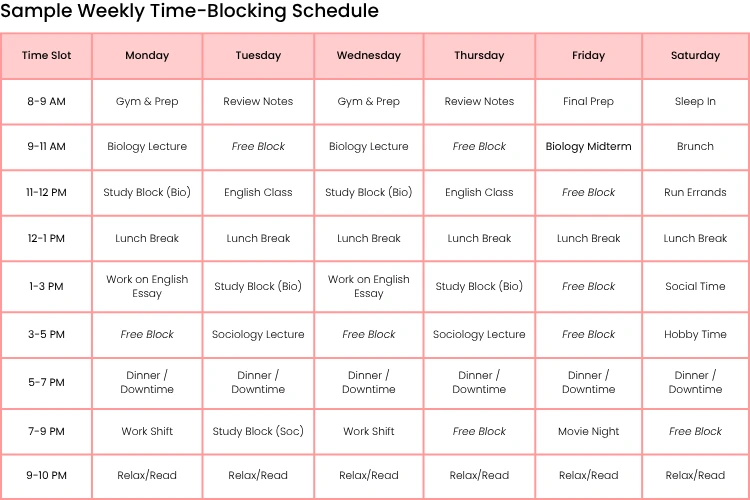
Here’s a look at how you might structure your week using a time-blocking approach.
This kind of structured planning guarantees you're chipping away at what truly matters. If you're looking to take this even further, diving into different time management strategies for students can give you an even bigger arsenal of tools.
Tracking Progress and Adapting Your Strategy
The best study habits aren't set in stone—they’re living, breathing systems that you have to fine-tune over time. Think of it like an athlete reviewing game footage. You need to create your own personal feedback loop to see what’s actually working and what’s just wasting your time. This isn’t about harsh self-criticism. It’s about becoming a scientist of your own success, making small, smart adjustments along the way.
Without tracking, you're just guessing. You might feel like those late-night cram sessions are productive, but the data could easily show you’re just spinning your wheels. The goal here is to shift from assumptions to evidence, making sure every minute you spend studying is as effective as possible.
Setting Up Your Personal Feedback Loop
First things first, you need to define what "success" even looks like for you. This means picking a few simple things you can consistently track. If you make it too complicated, you'll ditch it within a week. Keep it basic.
Your system can be a simple notebook, a spreadsheet, or a habit-tracking app on your phone. The tool doesn't matter as much as choosing metrics that are both meaningful and dead simple to measure.
Consider tracking a few of these key performance indicators (KPIs) for your studies:
- Focused Study Hours: Use a timer to log the actual number of minutes you spend in deep, uninterrupted work each week. No multitasking allowed.
- Practice Quiz Scores: Keep a running list of your scores on practice tests or chapter quizzes. This is hard data that shows what you’ve truly absorbed.
- Concept Confidence Rating: After a study session, rate your confidence from 1-5 for each topic you covered. This quickly flags the areas that need another pass.
By focusing on these numbers, you turn a vague goal like "get better at studying" into a concrete, measurable mission.
The Weekly Review: A Five-Minute Gut Check
Collecting data is pointless if you never look at it. Set aside just five or ten minutes at the end of each week for a quick review. This isn't another study session; it's your chance to zoom out and see the bigger picture.
During this weekly check-in, ask yourself three simple questions:
- What Worked This Week? Did that new time-blocking schedule for Tuesday afternoons feel incredible? Did using active recall for your history class finally make the dates stick? Acknowledge your wins so you can do more of what works.
- What Didn’t Work? Were you constantly distracted on Thursday mornings? Did you realize that passively reading your biology textbook led to a terrible quiz score? Be brutally honest about the flops so you can fix them.
- What Will I Change Next Week? Based on your answers, commit to one small, specific adjustment. Don't try to reinvent the wheel all at once.
Actionable Insight: You notice your biology quiz scores are low, and your log shows you only used passive reading. Your change for next week could be: "I will create flashcards for Chapter 5 and use the blank page method after each reading session." This is exactly how you build an ongoing learning cycle for your own study process.
Adapting and Overcoming Plateaus
Your strategies will have to evolve. What works for a math class might be useless for a literature course. As you master certain techniques or as your courses change, you need to stay flexible. That adaptability is the real key to long-term success.
This isn't just theory. A major study in Bangladesh after pandemic-related school closures found that a structured intervention focused on boosting self-study hours led to a 13.53 percentage point increase in students moving to higher study-hour brackets. This proves that making targeted, adaptive changes to your routine builds academic resilience—a skill every student needs.
Ultimately, you’re trying to build a system that serves you. By consistently tracking your progress and making small, intelligent adjustments, you move beyond just studying hard and finally start studying smart. This iterative process is the final, crucial piece of the puzzle.
If you're looking for more guidance on this, discover how to create an ongoing learning cycle in this detailed guide.
Got Questions?
Even the most dialed-in study plan runs into snags. It’s totally normal. Knowing how to troubleshoot these common issues is what separates students who succeed long-term from those who get stuck.
Think of this as your quick-reference guide. When you hit a wall or feel unsure what to do next, these answers will get you moving again without derailing your progress.
How Long Until My New Study Routine Feels Natural?
You’ve probably heard the old “21 days to form a habit” myth. The reality? It’s a lot messier than that. Research shows the average time is actually closer to 66 days, but the true range is huge—anywhere from 18 to 254 days.
Actionable Insight: Don't focus on the timeline; focus on the streak. Aim to perform your new habit (like one 25-minute study session) every day. If you miss a day, your only goal is to not miss two in a row. This "never miss twice" rule fosters consistency over perfection. Those small, steady efforts are what build real, lasting change.
I Can Only Start With One Thing. What's the Best Study Technique?
If you’re going to pick just one new strategy to implement, make it Active Recall. This is the simple—but incredibly powerful—act of pulling information out of your brain, not just cramming it in. It feels harder because it works better, forging stronger, more durable memory connections.
Here are a few dead-simple ways to start:
- Flashcards: Say the answer out loud before you flip the card. No cheating.
- Practice Problems: Actually work through the problem without glancing at the answer key first.
- Explain It: Try to teach a concept to a friend, a pet, or even just the wall.
Practical Example: A psychology student preparing for a test on different theories doesn't just re-read their notes. Instead, they open a blank document and try to write a one-paragraph summary of Freud's psychoanalytic theory from memory. Only after they're finished do they compare it to their notes to see what they missed. This mental strain is the sign of real learning happening.
How Do I Beat Procrastination and Just Get Started?
Procrastination almost always boils down to one thing: feeling overwhelmed. The task just seems too big. The secret is to break it down into a first step so small it feels almost ridiculous not to do it.
Instead of a terrifying to-do item like "Study for Final Exam", try something like:
- "Read two pages of Chapter 5."
- "Do one single practice problem."
- "Review my flashcard deck for 10 minutes."
The Pomodoro Technique is your best friend here. Committing to just 25 minutes of focused work is manageable for anyone. More often than not, just starting is all it takes to build the momentum you need to keep the ball rolling.
Ready to take your skills to the next level with expert guidance? At Uplyrn, we connect you with courses and mentors to help you master new subjects and advance your career. Explore our courses today.


Leave your thoughts here...
All Comments
Reply