









How to Increase Self Awareness: A Practical Guide to Growth

To truly increase your self-awareness, you need a two-pronged attack: honest introspection combined with candid feedback from people you trust. This powerful mix helps you understand your own internal world—your values, passions, and triggers—while also seeing how your actions actually land with those around you.
It's about turning the lens inward, for sure, but also being brave enough to listen to outside perspectives. The actionable insight here is simple: schedule a 15-minute "self-review" at the end of your week, and once a month, ask one trusted colleague a specific question about your impact.
Jump To Section

Earn As You Learn
Earn 25% commission when your network purchase Uplyrn courses or subscribe to our annual membership. It’s the best thing ever. Next to learning,
of course.
Why Self-Awareness Is Your Most Powerful Skill
Ever feel like you're just going through the motions? Like you're reacting to your day instead of intentionally shaping it? That feeling is incredibly common, and it almost always points back to a lack of self-awareness. It's not some vague, "soft skill"—it’s a concrete tool for getting back in the driver's seat of your own life.
Think of it as the foundational skill that makes every other skill better. Once you truly understand yourself, you can manage your emotions, communicate more effectively, and make decisions that actually line up with what you want. It's what moves you from being a passenger to being the pilot.
- A practical example: a self-aware manager knows their impatience spikes under deadline pressure. Instead of snapping at their team, they proactively block off solo "deep work" time to manage their stress, improving both their well-being and team morale.
From Personal Goal to Global Trend
This push for self-knowledge isn't just a personal journey anymore; it’s a massive global movement. The personal development market, which is driven in large part by self-awareness practices, is valued at a staggering USD 53.24 billion this year and is only expected to grow.
This economic boom signals a collective shift. More and more, we're valuing introspection and the pursuit of an intentional life.
Ultimately, building self-awareness is the first real step toward living a more authentic life. By understanding who you are at your core, you can start making choices that are genuinely your own. You can dive deeper into this with this guide to understanding what authenticity really is.
The Two Sides of the Self-Awareness Coin
Self-awareness isn't just one thing. It's a dynamic dance between two very different, but equally important, types of understanding. Getting a handle on both is the key to balanced growth.
Getting a feel for both is non-negotiable for a complete picture.
A fascinating study by organizational psychologist Tasha Eurich revealed a huge gap: while 95% of people think they're self-aware, the reality is that only 10-15% truly are. That discrepancy is exactly why we can't just rely on our own self-assessment; we need that external feedback to ground us in reality.
Self-awareness is about focusing on the reality of your behavior, not just the story you tell yourself. It's the honest audit that separates your intentions from your actual impact.
Here's a quick breakdown of the two pillars of self-awareness.

Practical Techniques to Build Your Inner Observer
Knowing what self-awareness is gets you to the starting line. But real change? That happens when you stop thinking and start doing. It's all about building your "inner observer"—that quiet, neutral part of you that can watch your own thoughts and feelings without getting swept away by them.
This isn’t about adding another huge task to your plate. Forget vague advice. Let's get into specific, evidence-backed exercises you can weave into your life, starting right now. Whether you have five minutes between classes or thirty minutes to unwind at night, these small, consistent habits are what lead to real clarity.
Ground Yourself with Mindful Practices
Mindfulness is the foundation of self-awareness. It's the simple practice of paying attention to right now, pulling you out of autopilot and into a conscious relationship with yourself.
A fantastic starting point is the Body Scan. The goal isn’t to change how you feel, but simply to notice it.
How to do it: Find a quiet spot to sit or lie down. Close your eyes and bring your full attention to the soles of your feet. Just notice any sensations—warmth, tingling, pressure—without judgment. Then, slowly guide that awareness up through your body, section by section: legs, torso, arms, neck, and head. The whole thing can take just five minutes.
Practical Example: You’re staring at a textbook, but anxiety about an upcoming exam is making it impossible to focus. Instead of fighting it, you do a five-minute Body Scan. You notice your shoulders are tense and your stomach is tight. Recognizing these physical signals as a stress response—not laziness—allows you to take a quick walk to release the tension before returning to your studies with a clearer mind.
Another game-changer is the Mindful Pause. Think of it as your emergency brake for emotional reactions.
The goal of the Mindful Pause isn't to suppress your emotions, but to create a sliver of space between an emotional trigger and your reaction. In that space lies the power of conscious choice.
Actionable Insight: The next time you receive a frustrating email, commit to taking three slow, deep breaths before you even start typing a reply. This tiny action interrupts the knee-jerk emotional reaction and allows you to respond thoughtfully instead of defensively. For a deeper dive, you can learn to pause to understand your reactions with this detailed guide.
Uncover Patterns Through Journaling
While mindfulness tunes you into the present moment, journaling helps you connect the dots over time. It’s a powerful tool for metacognition—literally, thinking about your own thinking. Writing things down creates a physical record of your inner world, making patterns you’d otherwise miss or ignore.
Don't just list what you did. Use targeted prompts to go deeper.
- Prompt 1: What energy did I bring into my interactions today? (Were you collaborative, defensive, anxious, or supportive?)
- Prompt 2: Where did I let my ego or insecurities take the lead? (Did you sidestep a tough task for fear of failure? Did you jump to take credit for something?)
- Prompt 3: When did I feel most authentic today, and when did I feel least authentic? (What situations or people bring out the real you?)
Practical Example: A manager starts journaling with the "What energy did I bring?" prompt. After a week, she notices a pattern: she brings anxious, rushed energy into Monday morning meetings, setting a negative tone for the day. Armed with this awareness, she begins prepping for the meeting on Friday afternoon. The result? She starts the week feeling calm and prepared, which completely shifts her team's dynamic.
Seek Feedback the Right Way
Looking inward is only half the picture. To tackle your blind spots, you need external self-awareness—a clear understanding of how other people see you. But the classic "Do you have any feedback for me?" is usually a dead end. It’s too broad and puts people on the spot.
A much better way is to ask specific, forward-looking questions.
Actionable Insight: Instead of a vague request, try this script with a trusted colleague: “I’m working on being more concise in meetings. In our last project update, was there one part of my summary that felt too long or confusing?” This question points to a specific event and behavior, making it easy for them to give you actionable feedback without feeling like they're launching a personal critique. To dig further, check out an unfiltered guide for high achievers on how to be more self-aware that offers more hands-on strategies.
Making these practices a regular part of your life is a powerful form of self-care. In fact, 32% of U.S. consumers engage in daily self-care, with another 43% doing so weekly. Starting with just 10 minutes of daily meditation can boost your metacognition by 22%, making it much easier to spot and work through those personal blind spots.

Using Modern Tools for Deeper Self-Insight
Let's be real: traditional methods like mindfulness and journaling are fantastic, but they're not the only game in town. We can actually use technology—the very thing that often distracts us—as a powerful, objective lens to speed up our self-awareness journey.
This isn't about replacing deep introspection. Think of it as augmenting it. When you use the right tools, you can uncover patterns, habits, and triggers that your own mind might be too busy (or too stubborn) to see on its own.
Turning Feelings into Data with Digital Trackers
The easiest way to dip your toes in is with a mood or habit tracker. These apps give you a simple, structured way to log how you're feeling, your energy levels, and what you're doing each day. After a while, all that data starts to form a visual map of your own personal ecosystem.
Practical Example: You feel like you’re always tired. After tracking your energy levels for a month, you discover a crystal-clear pattern: your energy tanks every time you skip your lunch break to work through it. This data gives you a non-negotiable reason to protect that 30-minute break, directly improving your afternoon productivity and well-being.
When you consistently log your internal state alongside external events, you shift from guesswork to evidence-based self-understanding. You’re no longer just reacting to feelings; you’re analyzing the data behind them.
This data-first approach to self-improvement is catching on in a big way. It’s a key reason the self-improvement market is projected to grow from $59.2 billion to $64.6 billion this year. For professionals, the payoff is huge—highly self-aware people can boost a company’s success by 20-30% simply by communicating better.
AI Journaling and Guided Mindfulness Apps
Digital journaling has come a long way from being a simple notepad on your phone. Modern platforms use AI to analyze what you write, flagging recurring emotional themes, shifts in your sentiment, or even words you use over and over. Imagine an app gently pointing out that you’ve mentioned feeling "overwhelmed" every Tuesday afternoon for the past month. That’s a powerful clue.
Mindfulness apps have also become incredibly sophisticated, offering guided sessions for almost any situation you can think of.
- Nervous before a big presentation? There’s a five-minute breathing exercise for that.
- Can't shut your brain off at night? Pop on a session designed to quiet a racing mind.
- Frustrated after a tough conversation? You can find a meditation focused on letting go of resentment.
Actionable Insight: Download a mindfulness app and find a 3-minute "breathing space" meditation. The next time you feel stressed or overwhelmed at your desk, put on your headphones and do that exercise. It's a quick, private way to reset your nervous system in the middle of a busy day. And if you're looking for other great ways to get your thoughts in order, check out this guide on how to declutter your mind doing this mind mapping exercise.
Personality Frameworks as Starting Points
Frameworks like the Enneagram, Myers-Briggs (MBTI), or the Big Five can be incredibly useful, but there’s one big catch: they are mirrors, not labels.
Think of them as a starting point for reflection, not a box to cram yourself into. For example, finding out you align with a specific Enneagram type can give you a whole new vocabulary to understand your deepest fears and motivations. It can shine a light on tendencies you’ve always felt but never knew how to articulate, giving you a solid foundation to explore why you react the way you do.
Choosing the Right Self-Awareness Tool for You
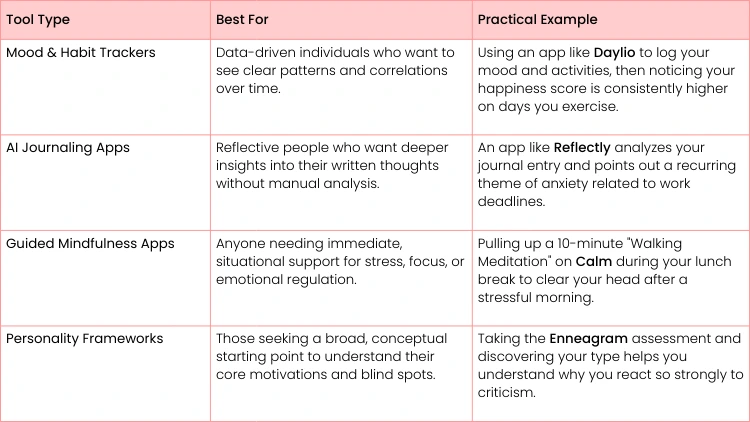
With so many options out there, it's easy to get overwhelmed. The key is to find a tool that fits your personality and goals. Are you a data nerd who loves charts, or do you prefer guided, reflective prompts? Here’s a quick breakdown to help you decide.
Ultimately, the "best" tool is the one you'll actually use consistently. Don't be afraid to experiment with a few different types to see what clicks for you. The goal is progress, not perfection.
Your 90-Day Action Plan for Self-Awareness
Knowing the techniques for self-awareness is one thing, but actually turning them into habits is a whole different ballgame. Let's be honest: knowledge without a plan is just an idea that collects dust. This section lays out a concrete, 90-day roadmap to take these concepts from theory to an ingrained part of your daily life.
Think of this less as a rigid prescription and more as a flexible framework. It’s designed with tangible milestones to keep you motivated and give you clear benchmarks for tracking your progress. The goal is to make this journey manageable, not just another overwhelming task on your to-do list.
Month 1 (Days 1-30): Building the Foundation
The first 30 days are all about consistency over intensity. The goal here is simple: establish the core habits of introspection. Don't worry about uncovering profound truths just yet. We're just building the muscles of observation.
Your mission is to carve out just ten minutes a day for two key practices: a five-minute journaling session and a five-minute mindfulness exercise. That’s it. This tiny commitment is easy to stick with even on the busiest days, which is the secret to making a new habit stick.
Actionable Insights for Month 1:
- Journaling: To make this a habit, "stack" it onto something you already do. For example, decide to journal for five minutes right after you finish your morning coffee, before checking your phone. Use a simple prompt like, "What's one thing I'm feeling anxious about today, and one thing I'm looking forward to?"
- Mindfulness: Use a timer for five minutes. Sit comfortably and focus on the sensation of your breath. When your mind wanders (which it will), your only job is to notice and gently bring your attention back. This isn't about emptying your mind; it's about practicing the act of noticing.
The purpose of this first month isn't mastery; it's repetition. By showing up for just ten minutes every day, you are sending a clear signal to your brain that self-reflection is now a priority.
Month 2 (Days 31-60): Deepening Your Insight
Okay, you've got the basic habits down. Now it's time to add a few layers that move you from simple observation to deeper analysis. In this phase, we'll bring in external perspectives and more structured reviews to start connecting the dots.
Keep up with your daily practices, but add two new weekly tasks: seeking one piece of targeted feedback and conducting a weekly emotional review. This shifts your focus from just recording experiences to actively spotting patterns and understanding how your internal world is showing up externally.
Practical Examples for Month 2:
- Seeking Feedback: Ask a friend, "Last night when we were discussing our plans, I got a little defensive. What did you observe about my tone?" This is specific and shows you're already self-reflecting, making it safer for them to be honest.
- Weekly Emotional Review: Every Sunday, read your journal entries. Create two columns: "Triggers" and "Bright Spots". Note down the specific events or interactions that consistently led to feelings of frustration (triggers) or joy (bright spots). This turns your journal into a data set.
Month 3 (Days 61-90): Applying Your Awareness
The final 30 days are all about putting your newfound self-awareness into action. Insight without application is just interesting trivia about yourself. This is where you bridge the gap between knowing and doing.
Your challenge for this month is to choose one specific goal and consciously use your self-awareness to move toward it. This could be professional, like leading your team with more empathy, or personal, like improving communication in a key relationship. You’ll continue your daily and weekly habits, but now you have a clear target for them.
Actionable Insights for Month 3:
- Professional Goal: You've identified through your review that you tend to interrupt people in meetings. Your goal this month: in every meeting, write down your thought instead of saying it immediately. Then, wait for a natural pause to speak. This gives you a concrete action to change your behavior.
- Personal Goal: You realize you avoid difficult conversations about finances with your partner. Your goal is to schedule one 20-minute, low-pressure "money check-in" each week. Use your journal beforehand to clarify your own feelings and what you want to achieve in the conversation.
This structured application is where the magic happens—it’s how you learn to use your insights for real-world improvement. This focused approach is also a cornerstone of personal growth, and you can dive deeper into structured approaches by learning about goal setting with the Wheel of Life in this detailed guide.
By the end of this 90-day plan, you'll have the tools not just to understand yourself, but to actively and intentionally shape your life.
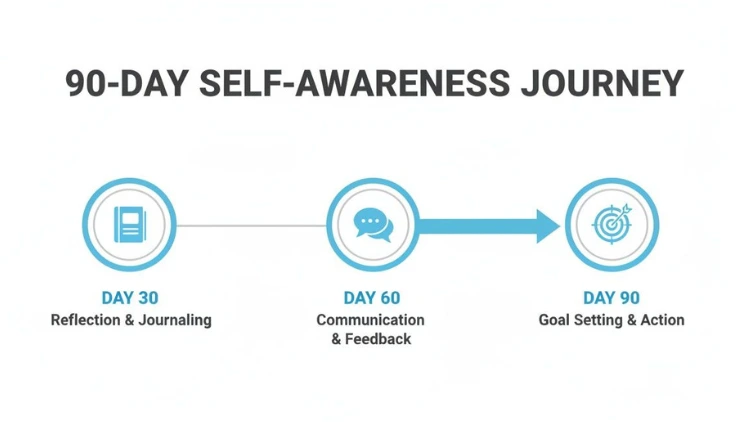
This infographic gives you a bird's-eye view of the phased approach, showing how the journey unfolds from building foundational habits to applying them in the real world.
As you can see, each 30-day block layers on top of the last, methodically deepening your insight without overwhelming you.
Overcoming Common Roadblocks on Your Journey
The path to greater self-awareness is rarely a straight line. It’s more like a winding trail with some unexpected dips and climbs. While the techniques themselves are simple enough, the emotional reality of applying them can be a different story.
Knowing what these roadblocks are ahead of time is half the battle. It helps you navigate the journey with confidence instead of getting thrown off course.
True self-discovery often means digging up truths you’d probably rather leave buried. You might realize a core belief is actually holding you back, or that a habit you thought was harmless is hurting your relationships. This kind of discomfort isn't a sign you're failing—it's a signal you're making real progress.
Handling Uncomfortable Truths
When you first start journaling or meditating, you might notice some not-so-flattering patterns. Maybe it's a surprising amount of insecurity, a flash of envy, or a short fuse you didn't realize you had. The first instinct for most of us is to either shut down or start beating ourselves up. This is a classic sticking point.
The trick is to lean into curiosity over criticism.
Actionable Insight: The next time you notice an uncomfortable feeling like jealousy, don't just stew in it. Get out your journal and ask, "What is this feeling trying to tell me? What need or desire is underneath it?" For example, jealousy of a colleague's promotion might be a signal that you're craving more recognition or challenging work yourself. This reframes the emotion as helpful data.
Your goal isn't to become some perfect being who never feels negative emotions. It's to become an aware person who can observe those feelings without letting them hijack the driver's seat.
When Feedback Stings
Asking for feedback is one of the fastest ways to see your blind spots, but it can be painful. Even when you specifically ask for it, hearing that your communication style comes off as dismissive or that you seem disorganized can feel like a punch to the gut. The ego immediately goes into defense mode.
A powerful mindset shift here is to reframe feedback as a gift. Someone took a social risk to give you information that could genuinely help you grow. Start by thanking them for their honesty, even if it stings.
Here’s a practical way to process it without getting defensive:
- Write it down verbatim. Don't argue with it in your head or try to soften it. Just write down exactly what you heard.
- Give it 24 hours. Let that initial emotional flare-up die down before you try to analyze it. This step is crucial.
- Find the kernel of truth. Even if 90% of the feedback feels totally off-base, look for the 10% that might have some validity. That tiny piece is where your growth is.
Practical Example: A manager is told her feedback can be "intimidating". Her initial reaction is defensiveness. After 24 hours, she reflects and realizes that while she doesn't intend to intimidate, she often gives feedback while walking down the hallway, which can feel abrupt. Her actionable step is to schedule short, seated one-on-ones for any future critiques.
Staying Consistent When Progress Feels Slow
It’s easy to stay motivated when you're having big "aha!" moments. But what about those weeks when your journal entries all sound the same or your mindfulness practice feels more like a chore than a relief? This is where a lot of people fall off the wagon, assuming their efforts aren't paying off.
This feeling usually pops up when we try to do too much, too soon. If you’re feeling overwhelmed or just plain unmotivated, scale it back to one core practice.
Actionable Insight: If your 10-minute daily habit feels like too much, shrink it to a "two-minute rule". Commit to journaling for just two minutes or meditating for just two minutes. The act of starting is often the hardest part. By making the barrier to entry ridiculously low, you maintain the consistency of the habit, which is far more important than the duration.
Often, this inconsistency is just a sneaky form of procrastination, a common hurdle in any self-improvement effort. Getting to the bottom of your personal procrastination triggers is key. You can dig deeper with this detailed guide on how to overcome procrastination and find strategies to get back on track.
Remember, the goal here is sustainable, long-term growth, not a short-term sprint to perfection.
Turning Self Awareness into Meaningful Action
Figuring yourself out is just the beginning. The real journey starts when you put that knowledge to work. Think of increasing self-awareness not as a final destination, but as an ongoing practice of tuning into your own internal radio station. The whole point is to close the gap between who you know you are and how you actually live your life.
This is where abstract insights become concrete choices. All those core strategies we've talked about—mindfulness, journaling, asking for feedback—are your tools. They’re what you'll use to build a life that genuinely reflects your values, rather than one dictated by old habits or what everyone else expects.
From Insight to Impact
The final step is always about application. It’s about using what you’ve learned to consciously make your relationships better, handle challenges with a bit more grace, and build a career or academic path that feels right.
Meaningful action is the bridge between self-awareness and a well-lived life. It’s the conscious decision to use your inner knowledge to shape your outer world.
The final message here is one of empowerment. You now have the methods to understand your own internal operating system.
Your call to action is simple but powerful: pick just one technique from this guide. That's it, just one. Commit to practicing it for the next seven days. That small, consistent effort is exactly how real, lasting change begins.
Frequently Asked Questions About Self Awareness
As you start digging into this work, you're going to have some questions. That’s a good thing. Think of them less like roadblocks and more like signposts telling you that you’re actually on the path. Getting them answered just helps you navigate the journey with a bit more confidence.
Let's tackle some of the most common ones I hear.
How Long Does It Take to See Results?
The honest answer is that self-awareness isn't a destination with a finish line; it’s a lifelong practice.
But that doesn't mean you have to wait years to feel a difference. Far from it. Most people feel real, tangible shifts in their mindset, how they handle their emotions, and even the quality of their decisions within just a few weeks of consistent effort.
Practical Example: After just two weeks of daily journaling, you might suddenly realize that your afternoon slump is directly correlated with checking stressful news sites during your lunch break. This immediate insight allows you to make a small change—like going for a walk instead—that has a huge impact on your day. The 90-day plan we laid out is designed to create these small, compounding wins.
Is It Possible to Be Too Self Aware?
This question gets to the heart of a really important distinction. There's a massive difference between healthy self-awareness and its toxic cousin, unhealthy rumination.
Healthy awareness is like being a neutral observer of your own mind. It’s noticing, "Hey, I felt a flash of envy when my coworker got praised." This insight gives you the power to explore that feeling and choose a more constructive response.
Rumination, on the other hand, is getting stuck on a negative feedback loop. It's the voice that says, "I'm such a jealous person, I'll never be good enough."
Awareness gives you the data to take positive action. Rumination keeps you trapped in a negative story with no exit. The whole key is to observe your thoughts and feelings with curiosity, not judgment, and then use what you learn to move forward.
Actionable Insight: If you find yourself ruminating, get physical. Go for a brisk walk, do 10 pushups, or put on loud music and dance for a minute. This breaks the mental loop by shifting your focus to your body, giving you the space to approach the thought with fresh eyes later.
What Is the Best Technique for a Total Beginner?
If you’re just starting out and feeling a little overwhelmed, my advice is always the same: start with journaling.
It’s the perfect entry point. You don’t need any special skills or fancy equipment—just a notebook or a notes app on your phone. Its real power comes from creating a physical record of your internal world.
Actionable Insight: Don't stare at a blank page. For your first week, just answer this one question every night: "What's one thing that surprised me today?" It could be an external event or an internal reaction. This prompt is simple, non-intimidating, and immediately starts training you to look for the unexpected in your daily life, which is a cornerstone of self-awareness.
Ready to turn these insights into a structured learning path? At Uplyrn, we provide courses and expert mentorinig to guide your personal development. Start your journey and unlock your potential.


Leave your thoughts here...
All Comments
Reply