









How to Learn Digital Marketing: A Beginner's Roadmap

Learning digital marketing is about understanding how different online pieces fit together to help a business grow. The most effective way to start is by getting a solid handle on the core channels—like SEO, social media, and email—and then immediately applying what you've learned through hands-on projects.
Jump To Section

Earn As You Learn
Earn 25% commission when your network purchase Uplyrn courses or subscribe to our annual membership. It’s the best thing ever. Next to learning,
of course.
Your Digital Marketing Starting Point
Jumping into the world of digital marketing can feel overwhelming, but it's a journey anyone can start today. The trick is to stop thinking of it as one massive subject. Instead, picture it as a team of specialists working toward a single goal: growing a business. Each specialist has a unique skill, but they’re most powerful when they work together.
This first section is your launchpad. We'll cut through the jargon and get straight to the core concepts. By mapping out the main pillars and how they connect, you'll have a clear idea of the landscape and can decide where you want to dig in first.
Understanding The Core Pillars
To make this super practical, let's imagine a local bakery called "Sweet Bites" that wants to start selling its custom cakes online. They have a killer product, but right now, they're invisible on the internet. How can digital marketing get them in front of hungry customers and drive sales?
Here’s a breakdown of how each pillar would play a role in their success:
- Search Engine Optimization (SEO): This is all about helping customers find Sweet Bites on Google.
- For example, by optimizing their website for keywords like "custom birthday cakes near me", they start showing up right when people are actively looking to buy.
- Pay-Per-Click (PPC) Advertising: If they need results fast, Sweet Bites can run Google Ads. They might target a phrase like "last-minute wedding cakes" and pay only when someone actually clicks their ad. This puts them directly in front of highly motivated, ready-to-buy customers.
- Content Marketing: The bakery could start a blog with helpful posts like "5 Creative Kids' Birthday Cake Ideas". This isn't a direct sales pitch; it's about building trust and positioning Sweet Bites as the local expert, attracting parents who are planning parties. We actually cover how to build a strategy like this in this guide to marketing made simple.
- Social Media Marketing: They can post stunning photos of their cakes on Instagram and run a giveaway for a free cake on Facebook.
- A practical example would be creating a "design your dream cake" contest, encouraging user engagement and shares. This is perfect for building a community and getting people excited about their brand.
- Email Marketing: After someone buys a cake, Sweet Bites can invite them to join an email list for a 10% discount on their next order. This is a classic move to encourage repeat business and build a loyal customer base.
Actionable Insight: Digital marketing isn't about becoming an expert in everything overnight. It's about understanding how each channel—from SEO to email—contributes to the bigger picture. Start by picking one channel, like social media for the bakery, and execute a small campaign. This hands-on experience is more valuable than months of passive learning.
The demand for people who get this is absolutely exploding. The digital marketing industry is on track to hit over $786.2 billion by 2026, with digital ad spending alone reaching an incredible $601.8 billion in 2023. That kind of massive growth is exactly why learning these skills is such a smart career move right now.

Mastering SEO and Content Fundamentals
Let’s move from theory to practice with two of marketing’s most powerful engines: Search Engine Optimization (SEO) and Content Marketing. Think of them as a tag team. When they work together, they create a sustainable way to pull the right people toward a business—not by shouting at them with ads, but by genuinely helping them.
The only way to really learn digital marketing is by doing it. So, let's roll up our sleeves and walk through a mini-project for a fictional local business: a pet grooming service called "Pawsitively Clean".
Their goal is straightforward: attract more local dog owners who need grooming, especially with the hot summer months rolling in.
Finding What Customers Are Searching For
First, Pawsitively Clean needs to figure out what their potential customers are actually typing into Google. This is called keyword research, and it’s the bedrock of any solid SEO strategy. We can get our feet wet with free tools like Google Keyword Planner.
Instead of just guessing what people want, we'd dig for the specific phrases they use. For example:
- "dog grooming near me" (This person is ready to book, like, now.)
- "summer grooming tips for dogs" (They're looking for advice and information.)
- "how to keep dogs cool in summer" (They have a problem and need a solution.)
- "best dog groomer [your city]" (They're comparing local options.)
Actionable Insight: This isn't just a technical exercise; it's about getting inside your audience's head. Since 93% of online experiences start with a search engine, getting this right is critical. Your action step is to open Google, type in a keyword for a local business you know, and look at the "People also ask" section. This is a goldmine for content ideas that directly answer real customer questions.
By finding these keywords, we’ve built a list of topics that we know people are interested in. No more guesswork. If you want to go deeper on the tools and tactics, check out this guide on how to use Google's keyword tool with competitor research.
Creating Content That Helps and Ranks
With our keyword list in hand, the next job is to create content that answers the searcher's question better than anyone else. Let's pick the keyword "summer grooming tips for dogs" and outline a blog post that solves a real problem for pet owners.
A strong, practical outline might look like this:
- Title: 5 Essential Summer Grooming Tips to Keep Your Dog Happy and Healthy
- Intro: Explain why proper summer grooming is so important, mentioning risks like heatstroke.
- Tip 1: Brush, Brush, Brush: Talk about how regular brushing prevents painful matting and improves air circulation.
- Practical example: Include a short video or GIF showing the correct way to brush a long-haired dog.
- Tip 2: The Right Haircut: Bust the myth that shaving double-coated dogs keeps them cooler (it doesn't!).
- Tip 3: Protect Their Paws: Offer simple advice, like walking on grass instead of hot pavement.
- Tip 4: Flea & Tick Patrol: Remind them why pest control is extra important in warmer months.
- Tip 5: Hydration Station: Share easy ways to keep dogs hydrated and cool.
- Conclusion: Quickly summarize the tips and add a clear call-to-action: "Ready for a professional summer groom? Book an appointment at Pawsitively Clean today!"
This approach connects directly with what the audience needs, builds trust, and naturally positions Pawsitively Clean as the expert. Once you get the hang of this, you can branch out into different forms of content creation to expand your skillset.

Driving Immediate Results with Paid Ads
While SEO is your long game for building a strong foundation, sometimes you just need to make a splash right now. That's where paid advertising comes in. It’s the fastest way to get your business in front of the right people, giving you instant visibility and data on what’s working.
Let's ditch the theory and get practical. Imagine you're handed a $500 budget to run a Facebook Ads campaign for a brand-new local yoga studio. The goal is simple: get people through the door.
Crafting Your First Facebook Ad Campaign
Your first move isn’t writing clever ad copy. It's figuring out exactly who you're talking to. If you're vague, you're just wasting money. We'll use Facebook's powerful targeting tools to pinpoint your ideal customer.
- A practical example of an audience profile for our yoga studio:
- Demographics: Women, ages 25-45.
- Location: Anyone living within a 10-mile radius of the studio.
- Interests: People who've shown interest in pages about Yoga, Lululemon, Wellness, and Meditation.
Now that you know who you're targeting, you can craft an offer they can't refuse. A “First Class Free” promo is a fantastic, low-risk way to get new people to try the studio.
Your ad copy can be simple and direct: "Find your calm. Your first yoga class is on us! Claim your free pass today and discover our new studio." Pair that with a serene photo or a quick video tour of the space, and you've got an ad that’s built to convert.
Actionable Insight: The secret to paid advertising is precision. You aren't just buying ad space; you're buying access to a hand-picked audience. Your action step is to go into Facebook Ads Manager (even without a running ad) and use the "Audience Insights" tool to build a sample audience. See how specific you can get. This practice costs nothing and builds a critical skill.
Understanding Google Search Ads
Let's switch gears to Google Ads. While Facebook helps you find people based on what they like, Google helps people find you when they're actively searching for something. The intent is sky-high.
Think about the difference between these two search terms for our yoga studio:
- "Yoga for beginners": Someone typing this is in the learning phase. A practical approach is to target them with content, like a blog post or guide.
- "Yoga classes near me": This person is ready to buy. They're looking for a local studio to visit right now, making this an incredibly valuable keyword for a search ad.
By bidding on "yoga classes near me", your ad can pop up at the very top of the search results. If you want to dive deeper into more advanced strategies, you can learn how programmatic advertising automates this buying process on a massive scale.
So, how do you know if your $500 is actually doing its job? You need to track the right metrics.
- Click-Through Rate (CTR): This tells you the percentage of people who saw your ad and clicked it. A low CTR could mean your image or your message isn't resonating.
- Cost Per Acquisition (CPA): This is your bottom line—how much it costs to get one person to sign up for that free class.
- For example, if your CPA is $5, you know it's costing you five bucks to get each new potential customer in the door.
Watching these numbers tells you the real story of your campaign. It lets you make smart, data-driven tweaks instead of just guessing what to do next.
Building a Portfolio That Gets You Hired
Let’s be honest. Theory is great, but a killer portfolio is what lands you the interview. It’s the tangible proof that you can walk the walk. This is where you turn your fresh skills into a collection of work that opens doors.
The best part? You don’t need a paying client to get started. The secret is to create your own experience. Dive into hands-on projects that prove you can think strategically and, more importantly, get things done.
Launch Your First Portfolio Projects
Stop waiting for the perfect opportunity and start creating. A solid portfolio shows your range, so try to knock out a few small-scale projects. Perfection isn't the goal; it's about showcasing your process, your wins, and what you learned.
Here are three practical project ideas you can get rolling on this week:
- The Pro-Bono SEO Audit: Find a local charity with a website that could use a little love. Use free tools like Google's PageSpeed Insights to run a basic audit.
- A practical example would be identifying that their images are too large and slowing down the site. Put your findings into a simple slide deck highlighting 3-5 key areas for improvement.
- The Etsy Shop Content Plan: Know someone with an Etsy shop? Offer to build them a three-month content calendar. Do some keyword research, outline a few blog post ideas, and map out a series of social media posts.
- For instance, for a candle shop, you could suggest a post titled "How to Make Your Scented Candles Last Longer".
- The Personal Blog Ad Campaign: Start a simple blog. Set up a Google Ads account and run a small-budget campaign—even $50 is enough—to send traffic to one of your articles. The win is getting hands-on experience setting up a campaign, writing ad copy, and tracking metrics like Click-Through Rate (CTR).
Actionable Insight: A portfolio isn't a gallery of flawless victories. It's a collection of case studies. Your action step is to document one of these projects. Take "before" and "after" screenshots. Write a simple paragraph explaining: "Here was the problem, here is how I approached it, here were the results, and here is what I learned."
Showcasing Your Work Effectively
Once you've wrapped up a project, documenting it is just as crucial as the work itself. Don't just list what you did; show it.
Get in the habit of taking screenshots. Grab the "before" and "after" of a site's SEO score, a Google Analytics chart showing a traffic spike, or the performance dashboard from your ad campaign.
For each project, write up a brief case study explaining your goals, the steps you took, and the results. A simple, professional website on a platform like WordPress or Squarespace is the perfect place to host these. Think of it as your living resume. For more tips on this, check out this guide on how to build your personal brand.

Your Realistic Timeline From Novice to Job-Ready
Learning digital marketing isn't a race; it’s a journey in stages. If you try to master everything at once, you're signing up for burnout. A much better approach is to break it down into manageable chunks. This roadmap gives you clear goals for each phase, turning a massive undertaking into a series of achievable wins.
Let's map out what your first year could look like.
Months 0 to 3: Building Your Foundation
Your first three months are all about immersion. The goal is to get a solid grasp of the core pillars—SEO, PPC, content, email, social—and see how they all fit together. Think of it like learning the basic grammar of a new language before you try to write a novel.
Here's your action plan:
- Get the Core Concepts Down: Dedicate time to understanding what each channel does.
- Tackle a Mini-Project: Do something small to make the concepts real.
- A practical example: Use a free tool like Google Keyword Planner to find five valuable keywords for a local coffee shop's blog.
- Follow the Pros: Start following well-known marketing experts on LinkedIn or X (formerly Twitter). Their day-to-day insights are like a real-time pulse on the industry.
By the end of this phase, you should be able to confidently explain how a simple digital marketing campaign works.
Months 3 to 6: Picking a Lane and Getting Your Hands Dirty
Okay, you've surveyed the landscape. Now it's time to start digging deeper. By now, you've probably found a channel or two that you enjoy. This is where you pick your lane and go deep.
Actionable Insight: The most valuable marketers are "T-shaped". They have a broad understanding of all channels (the top of the T) but deep expertise in one or two areas (the stem of the T). Your action step is to choose your "stem" now.
Your goal now is to shift from learning about a topic to actively doing it. It’s time to get your hands dirty with projects substantial enough for your portfolio.
Here's what to do:
- Choose Your Focus: Pick one or two specializations that complement each other, like Content Marketing and SEO, or Paid Social and PPC.
- Build a Real Portfolio Piece: Launch a project that shows you can execute.
- For example, write and publish a three-part blog series for a personal blog, fully optimized for specific keywords, and then create a simple plan to promote it on social media.
- Get Certified: A certification shows you're serious.
Months 6 to 12: Polishing Your Skills and Getting Job-Ready
The final stretch is about turning your practice into a profession. This is where you polish your skills, build your network, and get ready to hit the job market. You should be able to not only do the work but also show tangible results.
Your final action plan:
- Refine Your Specialty: Go beyond the basics. If you chose SEO, start learning about technical SEO audits. If it's PPC, dive into advanced bidding strategies.
- Network with a Purpose: Don't just lurk in online marketing communities—participate.
- A practical example would be answering a question in a Facebook group about a tool you've learned to use. This builds visibility and credibility.
- Build Your Portfolio and Resume: This is your sales pitch. Turn your projects into clear case studies that detail the "what", the "how" and the "so what" (your results). Then, tailor your resume to highlight these projects and skills.
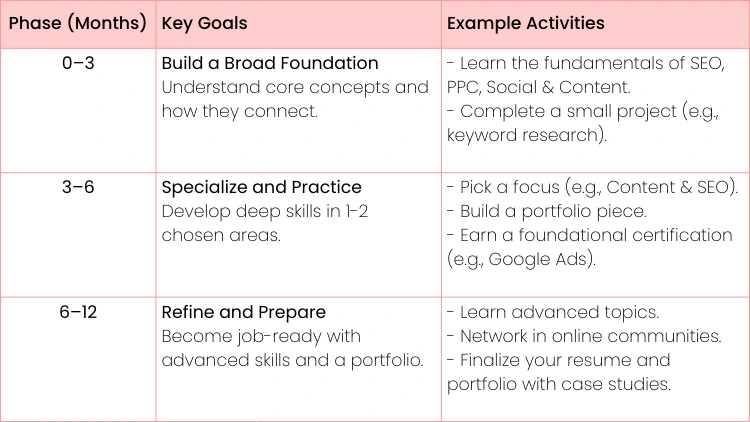
Digital Marketing Learning Roadmap
To make it even clearer, here's a quick summary of the journey. Think of this table as your cheat sheet for staying on track.
This roadmap provides a proven structure for building the skills and confidence you need to land your first role in digital marketing.
Common Questions for Aspiring Marketers
As you start diving into digital marketing, you're going to have questions. Getting straight, practical answers helps cut through the noise so you can focus on what actually matters—building skills that get results.
Do I Need a Degree for a Digital Marketing Job?
Honestly? Not really. In digital marketing, what you can do almost always trumps a piece of paper. Employers are far more interested in seeing that you can deliver tangible results.
Your ability to drive outcomes is what truly counts. Completing respected certifications, building a portfolio, and showing you understand key metrics will make a much stronger impression than a diploma alone.
Which Digital Marketing Skill Is Most in Demand?
This is a big one. Right now, skills across SEO, Content Marketing, and Paid Media (think Google and Facebook Ads) are consistently hot. Data analytics is another monster skill because if you can't measure your campaign performance, you're flying blind. A smart approach is to get a broad understanding of all channels first, then go deep on one or two. This "T-shaped" marketer profile is incredibly valuable.
Actionable Insight: Don't just learn the theory behind a hot skill; prove you can apply it. For example, if you pick SEO, don't just put "knows SEO" on your resume. Show a potential employer the keyword research you did for a local coffee shop and the blog post you wrote to rank for those terms. That’s how you stand out.
How Much Can a Beginner Earn?
In the United States, entry-level digital marketing gigs typically land somewhere between $45,000 and $60,000 a year. This can swing depending on where you live, the size of the company, and the specific role. As you get more experience and specialize in high-demand areas like PPC, your earning potential can jump up pretty quickly.
How Do I Get Experience with No Job?
The classic chicken-and-egg problem. It’s totally solvable. The trick is to get scrappy and create your own opportunities to build a portfolio.
- Offer your services for free to a local small business or a non-profit you care about.
- Start your own blog or YouTube channel.
- A practical example: Start a blog reviewing local hiking trails. This is a perfect sandbox for practicing content creation, keyword research ("best hikes near me"), and SEO.
- Run a small-budget ad campaign for a personal project or a friend's side hustle.
These are the kinds of projects employers love to see because they show initiative and a real passion for marketing.
And once you've got those projects under your belt, acing the interview is the final hurdle. To help you prepare, check out this guide on the interview skills that will get you hired.


Leave your thoughts here...
All Comments
Reply