









How to Play Guitar: A Practical Guide for Beginners

So you want to learn guitar? Awesome. It really just boils down to a few key things: picking an instrument that makes you want to play, learning a handful of basic chords, getting a feel for rhythm, and then just sticking with it.
Most people can strum through their first simple songs within 1-3 months. The secret is focusing on small, daily wins instead of trying to become a rockstar overnight. An actionable insight for today: just pick up the guitar and hold it for five minutes. That's a win.
Jump To Section

Earn As You Learn
Earn 25% commission when your network purchase Uplyrn courses or subscribe to our annual membership. It’s the best thing ever. Next to learning,
of course.
Choosing Your First Guitar and Essential Gear
Walking into a guitar shop (or browsing online) for the first time is a blast, but it can also be a bit overwhelming. Your very first decision—which guitar to get—is a big one. It's going to shape your whole learning experience, from how your fingers feel on the strings to the kinds of songs you can play.
The great thing is, there has never been a better time to be a new player. The guitar world is huge right now, with U.S. sales pushing past $1.8 billion by 2023. That means you have a ton of quality, affordable options to choose from.
Find the Right Guitar for Your Music
Honestly, the best way to pick a guitar is to think about the music you already love. Do you see yourself playing acoustic folk songs around a campfire? Or are you dreaming of cranking out some powerful rock riffs? Your taste in music is your best compass here. A practical example: if you love Ed Sheeran, get a steel-string acoustic. If AC/DC is your jam, you'll feel more at home with an electric.
A Few Must-Have Accessories
Once you've got your guitar, you only need a couple of other things to get started. Don't worry about buying a ton of expensive gear right away.
- A Clip-On Tuner: This is non-negotiable. An out-of-tune guitar sounds terrible and will train your ear incorrectly.
- Actionable insight: Buy a tuner like a Snark or D'Addario Micro. They are affordable and reliable.
- A Guitar Strap: Even if you plan on playing sitting down, a strap helps hold the guitar in the right position. This is huge for developing good posture from day one.
- A Few Picks: Also called plectrums, these come in different thicknesses. A variety pack is your best bet so you can experiment and see what feels best in your hand.
- Practical example: Start with a "Medium" thickness pick (around .73mm); it's a great middle ground for both strumming and picking single notes.
The most important thing is to choose a guitar that makes you want to play it every single day. An expensive guitar collecting dust in the corner won't teach you a thing.
Getting set up with the right gear builds a solid foundation for your playing. If you want to dive deeper into different types of guitars and other musical tools, you might be interested in exploring various instruments to find your perfect match.
A Quick Comparison of Beginner Guitars
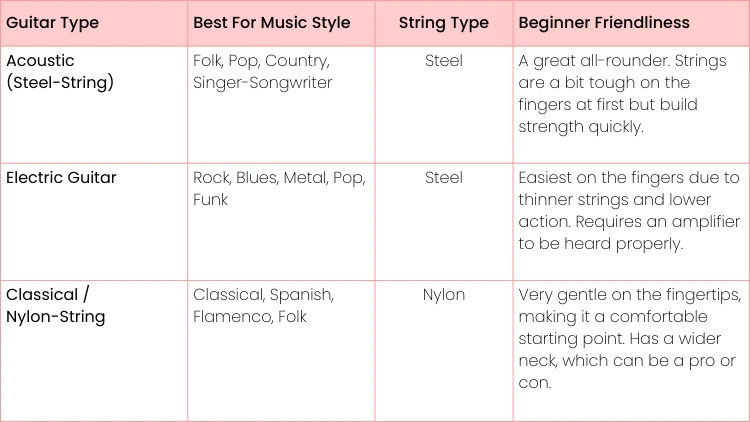
To make it even clearer, let's break down the three main types of guitars you'll be looking at. Each one has its own personality, and knowing the differences will help you make a confident choice.
Ultimately, there's no "wrong" choice here. It’s all about finding the instrument that feels right for the music you want to make.
How to Hold and Tune Your Guitar Correctly
Before you can even think about playing your first song, you need to get comfortable holding the guitar. This might sound basic, but how you hold the instrument literally impacts everything else—your comfort, your ability to play cleanly, and the good habits you build from day one.
Think of your posture as the foundation of your playing. If you're slouched over, your back will start aching, and you’ll severely limit how well your hands can move. The goal is to sit up straight, preferably in a chair without arms, and rest the guitar's waist on your right thigh (assuming you're right-handed).
This classic position lets your fretting hand glide up and down the neck without being responsible for holding the guitar's weight.
Getting the Perfect Posture
Nailing your posture early on prevents strain and just makes playing feel more natural. It’s worth taking a minute to check this every time you pick up the guitar.
- Sit Tall: Keep your spine straight but don't be rigid. You want to be relaxed, not hunched over trying to see the fretboard.
- Angle the Neck: The headstock—the part with the tuning pegs—should be angled slightly up. Think parallel to the floor or a little higher. This is a game-changer for reaching chords.
- Keep it Close: Let the back of the guitar rest gently against your chest and stomach. This gives you way more control and makes the instrument feel like an extension of you.
Here's a pro tip: practice in front of a mirror. It’s the fastest way to spot and fix bad habits, like a drooping guitar neck, before they become second nature.
Demystifying the Tuning Process
Honestly, nothing will kill your motivation faster than an out-of-tune guitar. It just sounds wrong. The good news is that tuning is a simple skill to pick up, and modern tools make it ridiculously easy. You’ll want to do this before every single practice session.
Standard guitar tuning, from the thickest string (6th string, closest to your face) to the thinnest (1st string), is E-A-D-G-B-E.
Need a way to remember that? The classic mnemonic is Eddie Ate Dynamite, Good Bye Eddie. Or, our personal favorite: Elephants And Donkeys Grow Big Ears.
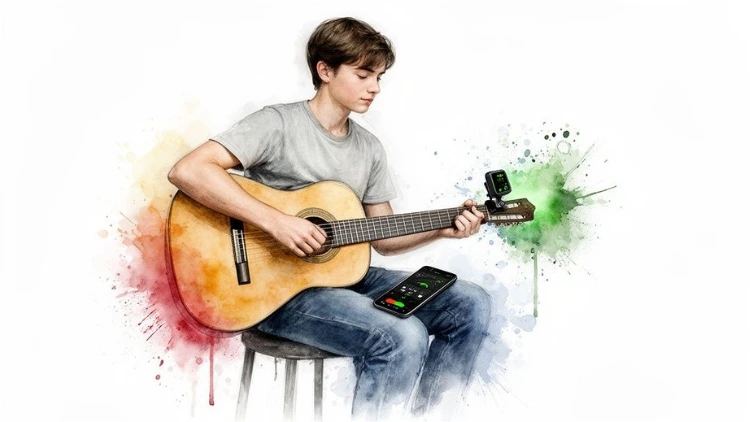
A clip-on tuner is your best friend here. Just clip it onto your headstock, pluck a string, and it’ll tell you if the note is sharp (too high) or flat (too low). From there, you just slowly turn the matching tuning peg until the tuner gives you the green light for the correct note.
- Actionable insight: Always tune up to the note. If your string is sharp (too high), tune it down below the note and then bring it back up to pitch. This helps the string hold its tuning better.
Learning Your First Three Essential Chords
Chords are the true building blocks of music, but you don't need to learn dozens of them to get started. Far from it. We’re going to focus on three of the most common, most useful chords in all of music: G Major, C Major, and D Major.
Once you get these three shapes under your fingers, you'll be amazed at how many hundreds of popular songs are suddenly within your reach.
Your First Chord: G Major
Let’s kick things off with the G Major chord, a cornerstone of rock, pop, and country music. It might feel like a bit of a stretch for your fingers at first—that's totally normal—but you'll be using this one constantly.
Here's how to form it:
- Middle Finger: Press it down on the 3rd fret of the low E string (the thickest one at the top).
- Index Finger: Place this on the 2nd fret of the A string (the next one down).
- Ring Finger: Stretch this one over to the 3rd fret of the high E string (the thinnest one at the bottom).
Now, strum all six strings. Hear a weird buzz or a muted thud? That usually means one of two things. Either press down a little firmer, or check your finger posture. Your fingers should be arched like a little claw, so only your fingertips are touching the strings they're supposed to.
- Practical example: Play each string in the chord one by one. This helps you pinpoint exactly which finger is causing the buzz.
Master the C Major and D Major
Next up are C Major and D Major. These two are best friends with the G chord, and together they form one of the most common and recognizable progressions in music history.
- C Major: This one feels a bit more compact. It uses your first three fingers on the A, D, and B strings. When you strum, aim to hit only the bottom five strings, avoiding the thickest low E string.
- D Major: This chord creates a neat little triangle shape on the G, B, and high E strings. For this one, you'll strum only the bottom four strings.
The real secret to playing guitar isn’t just knowing the chord shapes; it's being able to switch between them smoothly. Try this exercise: set a one-minute timer and just practice "chord hopping" from G to C, back and forth, without stopping. Then do the same for C to D. This is how you build that all-important muscle memory.
Developing a Solid Sense of Rhythm
Knowing your chord shapes is one thing, but making them actually sound like music? That all comes down to rhythm. Think of your strumming hand as a pendulum. Your main goal is to get it swinging back and forth with a steady, consistent, and confident motion. This internal clock is what transforms clunky chord changes into a smooth, flowing song.
Let's start by building that foundation with the simplest pattern you can imagine.
- Actionable insight: Mute the strings with your fretting hand and focus only on your strumming arm. Grab a G chord and just strum down once for every beat in a simple four-count measure: "One, two, three, four." That’s it. Don't worry about anything else except keeping that timing perfectly even. A metronome app set to a slow 60 beats per minute will be your best friend here.
Introducing the Down-Up Strum
Once you feel solid with those steady downstrums, it's time to bring the upstroke into the mix. The most common strumming pattern you'll hear in countless songs is a simple "down-up" motion. Your hand will keep that same pendulum swing, but now you'll hit the strings on the way down and on the way up.
Try this foundational pattern, and make sure you count it out loud: "1 and 2 and 3 and 4 and
- Strum down on the numbers (1, 2, 3, 4).
- Strum up on the "ands."
This simple movement is the rhythmic engine behind thousands of songs. The real secret is to keep your wrist relaxed and your arm moving constantly, even when you intentionally miss the strings to create different rhythmic feels.
Your hand should always be moving, whether it's hitting the strings or not. This continuous motion is the key to locking into a groove and making your strumming sound effortless and natural.
The Basics of Picking Notes
Of course, guitar isn't just about strumming chords. You'll also want to play melodies by picking individual notes. The most efficient way to get started is with alternate picking—a strict down-up-down-up motion with your pick.
- Practical example: Take the thinnest string (high E) and play it open four times, picking down-up-down-up. Then move to the B string and do the same. This simple exercise builds fundamental coordination.
As you get more comfortable, delving into the fundamentals of music theory can really help you understand how melodies and chords fit together. And when it comes to rhythm, training your ear is just as critical as training your hand.
Playing Your First Easy Songs
Alright, this is the moment we've been working towards. All that time spent building calluses, memorizing chord shapes, and getting a feel for rhythm is about to pay off. We're going to take those separate skills and finally turn them into actual music.
The plan is simple: we'll use the G, C, and D chords you've already got under your fingers to play some classic songs you definitely know.
The key here is to not get overwhelmed. Don't try to play a whole song perfectly from start to finish. Instead, break it down. Just focus on the verse for a bit, then move to the chorus. Get the chord changes feeling comfortable in one section before you even think about the next.
Three-Chord Songs for New Guitarists
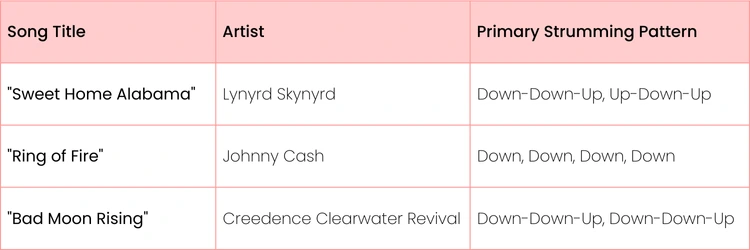
To get you started, here are a few songs that are practically a rite of passage for new guitar players. They're built on the same handful of chords, which proves you don’t need anything fancy to play something that sounds great.
You'll notice the core of these songs is just moving between G, C, and D. Start with a super simple, all-downstrum pattern to just practice the chord changes. Get that motion smooth.
- Practical example: For "Sweet Home Alabama", practice switching from D to C, then to G, using just one down-strum per chord. Repeat that sequence over and over until it's fluid. Once you’re not stumbling over the chords, then you can bring in the song’s specific strumming pattern.
A quick tip: singing and playing at the same time is tough. The trick is to get the guitar part so locked in that it becomes muscle memory. Practice the chords and strumming until you don’t have to actively think about your hands. That frees up your brain to focus on the lyrics.
Getting through your first complete song is a huge deal. It's the point where you stop feeling like someone just practicing and start feeling like you can actually play the guitar. This is the win that will keep you motivated for everything else to come.
Creating a Practice Routine You Can Actually Stick With
Let’s bust a myth right now: you don't need to practice for hours every day to learn guitar. The real secret weapon is consistency. It’s far more effective to pick up your guitar for short, focused sessions every day than it is to grind through a long, draining practice once a week.
The magic really starts to happen in just 15-20 minutes a day. That’s all it takes. This small, daily commitment builds crucial muscle memory and keeps everything fresh in your mind, but without the risk of burning out. Before you know it, practice stops feeling like a chore and becomes a rewarding part of your day.
Building Your Weekly Schedule
Instead of just noodling around aimlessly, give your practice some structure. Having a plan makes sure you're hitting all the essential skills without getting stuck in a rut. Giving each day a specific focus keeps things interesting and productive.
Here’s a simple schedule you can steal or adapt:
- Monday & Thursday: Chord Day. Really drill down on getting clean finger placement and making smooth, confident transitions between G, C, and D.
- Actionable insight: Use the "one-minute changes" exercise: see how many times you can switch cleanly from G to C in 60 seconds.
- Tuesday & Friday: Rhythm Work. Fire up a metronome and lock in your down-up strumming pattern. Feel the groove.
- Wednesday & Saturday: Song Day. Time to put it all together! Apply your chords and rhythm to one of the easy songs we talked about earlier.
- Sunday: Rest or Play. Take a well-deserved day off, or just have fun with the guitar. Try to pick out a melody you know, or just experiment with sounds.
This balanced approach is incredibly powerful. To really make this habit stick, check out this guide on the power of routine.
A pro tip: Don't just practice what you're already good at. Deliberately spend a few minutes on that one chord change or strumming pattern that feels awkward and clumsy. That's exactly where the real progress is hiding.
And it seems learners everywhere are catching on to the power of a good plan. The global guitar lessons market hit a staggering USD 2.42 billion in 2024 and is expected to almost double by 2033. It’s clear proof that having structured guidance is what turns aspiring beginners into actual, confident players. You can dig into more of these stats over at this expanding guitar lessons market.
Common Beginner Guitar Questions
Every single person who picks up a guitar for the first time runs into the same handful of issues. Knowing what they are ahead of time makes it so much easier to push through that initial awkward phase and actually stick with it.
Let's talk about finger pain. Yes, it's completely normal, and honestly, it's a good sign! It means you're on your way to building up those necessary calluses. To get through it, try keeping your practice sessions shorter, maybe around 15 minutes at a time. Also, check your guitar's "action"—that's the height of the strings off the fretboard. If it's too high, you're forced to press down way harder than you need to. The worst of the soreness should fade in a week or two.
Another big one is, "How long will this take?" With consistent, daily practice of about 20-30 minutes, most beginners can strum their way through a few simple songs within 1-3 months. This whole process is tied to how our brains build new habits and skills. It’s a fascinating topic, and you can dive deeper into it by reading this insightful journey into how the brain learns.
What Guitar Should I Start With?
An acoustic is a fantastic default choice. Its steel strings are a bit tougher to press down, which forces you to build up that crucial finger strength right from the get-go.
But here’s the real secret: the best guitar is the one that makes you want to pick it up and play. If you dream of shredding rock solos, starting on an electric is a great move. The strings are usually thinner and closer to the fretboard, making them easier on your fingertips, which can be a huge confidence booster. Taking a moment to understand the broader cultural impact of music might even help you feel a deeper connection to whichever instrument you choose.
The most important thing is consistency over intensity. Short, daily practice builds muscle memory and skills far more effectively than one long session per week.
Ready to move beyond the basics with structured, expert-led guidance? Uplyrn offers courses to help you master guitar and achieve your musical goals. Explore our lessons and start your journey today.


Leave your thoughts here...
All Comments
Reply