









A Practical Guide on How to Retain Information Better
To really make information stick, you have to actively fight your brain's natural tendency to forget. It’s a battle we all face. The most effective way to win is by combining a few powerful techniques: reviewing information at strategic intervals (spaced repetition), forcing your brain to pull out what it knows (active retrieval), and getting enough quality sleep to lock it all in.
Jump To Section

Earn As You Learn
Earn 25% commission when your network purchase Uplyrn courses or subscribe to our annual membership. It’s the best thing ever. Next to learning,
of course.
Why We Forget and How to Fight It
Have you ever crammed for hours for a presentation, felt confident, and then just a few days later, found that the key statistics and talking points have completely evaporated? It’s incredibly frustrating, but it’s not a personal failing. It's just how our memory works, a phenomenon perfectly captured by the "forgetting curve".
This curve shows a steep drop-off in how much new information we retain within just hours or days if we don’t do anything to reinforce it. Without a conscious effort, a huge chunk of what you learn is simply lost to the ether.
The good news? You can absolutely flatten that curve and learn how to retain information for the long haul. The secret isn't about having a "photographic memory" or trying to stuff more facts into your brain in one sitting. It's about working with your brain's own systems, not against them.
Your Foundational Toolkit for Memory
To turn fleeting facts into deep, lasting knowledge, you need a solid toolkit built on cognitive science. Passive methods like re-reading your notes might give you a comforting sense of familiarity, but they do very little for long-term recall. You have to get active. If you want to dive deeper into the science behind this, you can explore more about how the brain learns in this insightful journey.
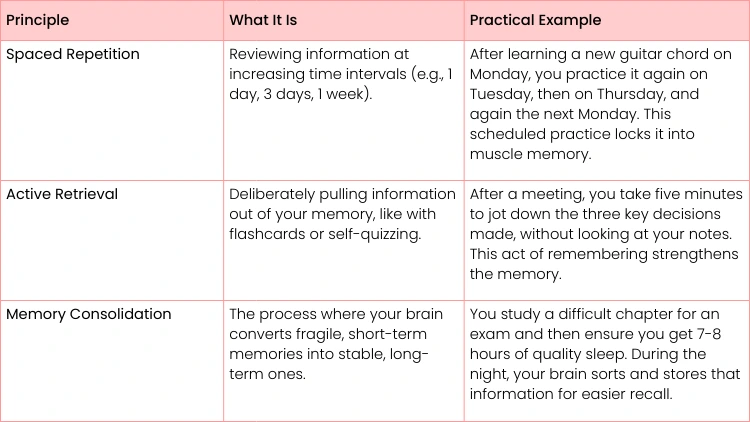
This guide is built around three core principles—the bedrock of any effective learning strategy.
I've broken down these three essential, evidence-based learning principles in the table below. Think of this as your core memory toolkit; mastering these will transform your ability to retain information for good.
Your Core Memory Toolkit
By weaving these three pillars—spacing, retrieval, and sleep—into your study routine, you create a powerful system that works in harmony with your brain's natural architecture.
Actionable Insight: Start small. Pick one new piece of information you learned today—a name, a fact, a skill—and set a reminder on your phone to recall it tomorrow afternoon. This simple act combines both active retrieval and spaced repetition.
Using Spaced Repetition to Build Lasting Knowledge
If active recall is the exercise that builds memory muscle, then spaced repetition is the training schedule that actually gets you results. It’s easily one of the most powerful, evidence-backed ways to move knowledge from short-term recall into your permanent toolkit. Forget cramming—this is about strategically reviewing information at increasing intervals, forcing your brain to work just hard enough to pull it back from the brink of being forgotten.
Think of it like watering a new plant. You don't dump a month's worth of water on it at once and hope for the best. You give it just enough at spaced intervals—every few days—to keep the soil moist and help the roots grow deep. Reviewing a concept five times in one night is like drowning the plant; reviewing it once a day for five days is how you help it thrive.
This method is so effective because it directly combats the brain's natural "forgetting curve", interrupting the process right before a memory fades completely. Each successful recall after a break reinforces the neural pathway, basically telling your brain, "Hey, this is important. Hang onto it."
Putting Spacing into a Real-World Context
Let’s say you're a marketing pro trying to get the hang of a new analytics platform. The typical approach is to sit through a two-hour webinar, try to absorb everything at once, and then feel completely lost a week later when you actually need to build a report. Sound familiar?
A spaced repetition approach would look completely different and, frankly, work much better.
Here’s how you could apply it:
- Day 1 (Monday): You learn one specific function, like how to set up a custom dashboard. You play around with it a few times until it feels right.
- Day 2 (Tuesday): You don't even look at the dashboard function. Today, you focus on something new, like creating audience segments.
- Day 3 (Wednesday): Now for the important part. You try to remember how to build that custom dashboard from Day 1 without looking at your notes. That little bit of struggle is where the magic happens. After you succeed (or peek at your notes for a hint), you can practice the segmentation skill from Tuesday.
- Day 7 (The next Monday): A full week after you first learned it, you revisit the custom dashboard again. This time, the recall will feel much easier, and the memory will be significantly stronger.
This feels way less intense than cramming, yet it’s profoundly more effective for long-term retention. To truly lock in what you've learned, it's essential to utilize periodic reviews that revisit information at these optimal moments.
How to Implement Spaced Repetition Easily
You don't need a complicated system to get started. The real goal is to make reviewing information a simple, repeatable habit. And the science is solid: a huge meta-analysis of 254 studies found that spaced practice boosted recall by a median of 10–30% on delayed tests compared to cramming.
Here are two practical ways to integrate this into your routine:
- The Low-Tech Calendar Method: Perfect for a handful of important concepts. Just set calendar reminders for yourself. Learn something new on Monday? Create events to review it on Tuesday, Friday, and again the following Friday. It’s simple, free, and it works.
- The High-Tech App Method: If you're tackling a large volume of information—like a new language, medical terms, or coding syntax—smart flashcard apps are your best friend. Apps like Anki or Quizlet use algorithms to automatically schedule when you should see each flashcard based on how well you know it. They take all the guesswork out of the equation.
Actionable Insight: Spaced repetition isn't about studying more; it's about studying smarter. Download a free flashcard app like Anki today and create just five cards for something you want to learn. Commit to reviewing them whenever the app notifies you. This small habit builds the foundation for a powerful learning system.
Which method you choose really depends on what you're learning. For mastering core concepts, a simple calendar might be all you need. But if you're trying to memorize hundreds of facts, an automated app will save you a ton of time and mental energy. For a deeper dive into techniques that pair perfectly with this approach, check out this guide on study techniques for students.
No matter the tool, the principle is the same. When you intentionally space out your learning and combine it with the effort of active recall, you’re creating the ideal conditions for your brain to learn and—more importantly—to remember.

Putting Active Retrieval into Practice
Real learning isn’t about passively absorbing information—it's a mental workout. The heavy lifting happens when you pull information out of your memory, not just when you put it in. This is the simple but powerful idea behind active retrieval, also known as "practice testing". It’s about shifting from being a spectator to an active participant in your own learning.
Think about it. Rereading a chapter feels productive, but it often just creates an illusion of familiarity. Your brain recognizes the words on the page, sure, but that doesn’t mean you can actually recall the concepts from scratch. Active retrieval forces you to struggle a bit to reconstruct that knowledge, and it’s that very struggle that forges strong, lasting neural pathways.
This isn't just a hunch; it's backed by solid evidence. Testing yourself consistently blows passive studying out of the water for long-term retention. One major analysis found that students who used frequent self-quizzing boosted their final test scores by 10–30% compared to those who just reread the material.
Ditch Passive Highlighting for Active Recall
Highlighting is one of the most common study habits out there, and also one of the least effective. It makes your textbook look busy and important, but it’s a fundamentally passive act. The good news is you can easily turn it into an active exercise.
Instead of dragging a highlighter across the page as you read, try this:
Practical Example:
- Read a section or a few paragraphs of an article.
- Close the article or look away from your screen.
- Now, summarize the key points out loud to a friend (or your pet!) or jot them down in your own words, entirely from memory.
This simple switch forces your brain to retrieve and process the information, not just recognize it. You’ll immediately spot the gaps in your understanding, which is far more valuable than a page full of yellow stripes.
Actionable Insight: The goal isn't just to see the information again; it's to recreate it. After your next meeting or class, take two minutes to write down the three most important takeaways without consulting your notes. This "retrieval habit" will cement key information in minutes.
Use the Feynman Technique to Find Your Blind Spots
A particularly powerful form of active retrieval is the Feynman Technique, named after the Nobel Prize-winning physicist Richard Feynman. He was a master at explaining incredibly complex topics in simple, intuitive ways. The technique operates on a straightforward premise: if you can't explain something simply, you don't really get it.
Here’s a practical example of how it works:
- Pick a concept: You want to master "supply and demand" for an economics class.
- Teach it to a beginner: Grab a notebook and write down an explanation as if you were teaching it to a 12-year-old. For example: "Imagine everyone wants the hot new video game, but the store only has a few copies. That's high demand and low supply, so the price goes up..."
- Find your gaps: You might realize you can't simply explain why the supply curve slopes upward. Bingo. That's your knowledge gap.
- Go back and learn: Return to your textbook to understand the concept of "production costs". Once you get it, refine your simple explanation until it's smooth and clear.
This method is brilliant because it forces you to go beyond just memorizing definitions. You have to engage with the material deeply enough to simplify it, which is one of the most potent forms of retrieval practice there is.
Weaving Retrieval into Your Daily Routine
Active retrieval isn't just for students cramming for an exam. It’s a flexible tool you can integrate into any learning process to make information stick.
For Professionals (Practical Example):
- Prepping for a presentation? Don't just click through your slides. Practice delivering the core message of each one from memory. Only glance back at the slide to check your accuracy after you’ve tried.
- Learning new software? After you watch a tutorial on creating a pivot table in Excel, close it and try to perform the task yourself without any help. That little bit of struggle to remember the steps is exactly what locks it in.
For Students (Practical Example):
- After a lecture, spend ten minutes that evening writing down everything you can remember in a "brain dump". Then, compare your brain dump to your actual notes to see what you missed.
- Using flashcards? If you’re unsure of an answer, don't just flip the card over. Force yourself to say an answer out loud, even if it’s a total guess. The attempt to retrieve is more important than being right every time.
These small, consistent retrieval habits are far more effective than hours of passive review. The key is to make retrieval a constant, active part of how you learn.

Using Sleep to Supercharge Your Memory
Most of us treat sleep like an inconvenience—a necessary pitstop that cuts into precious study time or productivity. But that’s a huge misunderstanding. Sleep is one of the most powerful learning tools you have. Skipping it is like trying to build a house without letting the cement set.
While you're asleep, your brain is anything but idle. It’s actively replaying, sorting, and cementing the day's experiences. This process, called memory consolidation, is your brain's filing system. It moves important information from the fragile short-term storage of the hippocampus to the much more durable long-term storage in the cortex. This is how new information transforms into lasting knowledge.
Why All-Nighters Are a Total Waste of Time
We’ve all been there. A big exam looms, and pulling an all-nighter feels like the only way to cram everything in. It’s a classic move, but it’s far more damaging than you think. You might feel like you’re loading up your brain, but you're actually sabotaging the very biological process that makes memories stick.
When you skip sleep, you pull the plug on memory consolidation. The new information you desperately tried to stuff in remains weak and unstable, making it almost impossible to recall under pressure the next day. Think of it like editing a document and then closing the program without hitting "save"—all your hard work is lost.
This is exactly why you can study for ten hours straight, feel like you know the material inside and out, and then draw a complete blank during the test. Your brain never got the chance to do its job and file anything away.
Actionable Insight: Sleep isn't just about feeling rested; it’s a critical, non-negotiable phase of the learning cycle itself. Instead of studying one hour later tonight, go to bed. Use that "extra" hour tomorrow morning when your brain is refreshed. You'll learn faster and retain more.
The Simple Power of a Pre-Sleep Review
Here’s the good news: you can actually use this nightly consolidation process to your advantage. One of the most effective, low-effort tricks I've come across is the pre-sleep review. It’s ridiculously simple but yields impressive results.
About 15 minutes before you plan to go to sleep, do a quick, focused review of the most important or difficult material you covered that day. This isn't the time to learn anything new. Just briefly scan your notes, flip through some flashcards, or look at a summary of the key concepts.
This simple act primes your brain. You’re essentially telling it, "Hey, this stuff is important. Pay attention to it tonight." As you sleep, your brain will then prioritize consolidating and strengthening those specific memories, making them significantly easier to pull up the next day.
A Practical Pre-Sleep Routine in Action
Let's say you're studying for a biology exam and just can't get the Krebs cycle to stick. Instead of re-reading the whole dense chapter right before bed, you'd just:
- Spend 10-15 minutes looking at a diagram of the cycle.
- Try to verbally explain the main steps to yourself once or twice.
- Close the book and go to sleep.
That’s it. This targeted review acts like a "tag" for your brain, signaling which memories need to be moved to the front of the consolidation queue.
Combine Sleep and Spacing for Maximum Results
The memory boost from sleep becomes even more powerful when you pair it with other techniques, especially spaced repetition. Sleeping after a learning session is a great start, but the real magic happens when you combine these two strategies.
The science on this is clear. A good night's sleep after learning something new can improve retention by 20–25% compared to staying awake for the same period. When you layer that with a spaced-review schedule, you amplify those memory gains even further. You’re not just learning; you’re building a truly robust framework for long-term knowledge.
Ultimately, shifting your mindset to see sleep as an active part of your learning strategy is a game-changer. For more tips on getting better rest, check out this article on a simple but effective sleep trick. It's not about finding more hours in the day—it's about making the hours you already have count.
How to Build Your Personal Retention Workflow
Knowing the principles of memory is one thing, but actually putting them to work is another game entirely. The secret to making information stick isn't just knowing about spaced repetition or active retrieval—it's building those concepts into a repeatable, personal system. This is where you graduate from theory to practice and see real results.
Creating this workflow doesn't have to be some monumental task. It’s all about a simple, structured routine you can bend to your own goals, whether you're staring down final exams or trying to master a new skill for work. The idea is to create a blueprint you can start using today.
A Practical Retention Workflow for Students
Let's say you're a college student with a massive history exam coming up in two weeks. The classic (and ineffective) approach is to cram—frantically rereading chapters and highlighting everything in sight the night before. Let's build something better, a workflow designed for knowledge that lasts.
Here’s a practical week-by-week breakdown:
- Monday (New Material): You attend the lecture or read the chapter on the American Revolution. That night, instead of just rereading, you create 30-40 digital flashcards covering key dates, people, and ideas using an app like Quizlet.
- Tuesday (First Retrieval): The very next day, you run through those flashcards. This first active recall session is absolutely crucial. Make sure to star any cards that give you trouble.
- Wednesday (Interleaving): Switch gears and focus on a different class, like biology. This interleaving—mixing subjects up—forces your brain to build stronger, more distinct pathways for both topics.
- Thursday (Spaced Review): Time to revisit the American Revolution flashcards. Your app should be smart enough to show you the ones you struggled with more often. This is your first real "spaced" review.
- Weekend (Consolidation Quiz): Grab a blank sheet of paper and write down the answer to a broad prompt like, "Summarize the main causes of the revolution". Do it purely from memory. Then, check your answers against your notes to find and patch up the weak spots.
This kind of structured cycle keeps you constantly pulling information from your brain, not just passively looking at it. It's the core of developing an ongoing learning cycle that builds on itself over time.
A Practical Retention Workflow for Professionals
Now, let's pivot to a professional scenario. Imagine you're a software developer tasked with learning a new framework, like React, for a big project. Your goal isn't to pass a test; it's to actually apply this skill.
Here’s a practical structure for your week:
- Monday (Focused Learning): Spend a solid hour on a tutorial covering a core concept, like "React Hooks". Right after, build a tiny, single-feature app using only what you just learned. This hands-on application is a powerful form of retrieval.
- Tuesday (Spaced Retrieval): Before diving into anything new, try to rebuild yesterday's mini-app from scratch without watching the tutorial again. That feeling of struggle as you recall the syntax and logic? That's your brain cementing the knowledge.
- Wednesday (New Concept): Move on to the next topic, maybe "State Management". And just like before, immediately build a small project to apply it.
- Friday (Synthesis and Review): Take the concepts from Monday and Wednesday and combine them into a slightly more complex app. This forces you to not only recall individual facts but also understand how they fit together.
Actionable Insight: For skill-based learning, your "retrieval practice" should be active application. Don't just quiz yourself on definitions; force yourself to use the skill in a real-world context. Schedule a 30-minute "application block" on your calendar the day after learning a new skill.
Choosing the Right Tools for Your Workflow
The right tools can make all the difference by automating the boring parts of this process, freeing you up to focus on the actual learning.
- Digital Flashcard Apps (Anki, Quizlet): If you're memorizing a lot of facts, these are non-negotiable. They use smart algorithms to handle your spaced repetition schedule, prompting you to review information at the perfect moment.
- Note-Taking Platforms (Notion, Obsidian): These apps are more than just digital notebooks. You can build in self-quizzing features with toggles that hide answers, or even install plugins that automatically resurface old notes for a quick review.
If you really want to create a comprehensive system for lasting knowledge, think about building a Notion Second Brain. It’s a fantastic way to capture, organize, and connect all your ideas in one place.
Got Questions About Improving Your Memory?
As you start weaving these powerful learning strategies into your daily routine, you're bound to have some questions. It's totally normal. Shifting from passively reading to actively recalling information is a big change, so let's clear up a few common sticking points.
How Quickly Will I See a Difference in My Memory?
You'll feel the impact of active retrieval almost immediately. For example, quiz yourself the day after learning something new, and you'll see just how much more effective it is than simply re-reading your notes. It shines a spotlight on exactly where the gaps are.
The deep, lasting benefits of spaced repetition, however, take a bit longer to show up. Think of it like starting a new workout routine. You might feel great after one session, but the real, measurable strength is built over several weeks of consistent effort.
Is It Better to Focus on One Technique or Use Them All?
These techniques aren't meant to be used in isolation; they're designed to work together as a single, powerful system. They amplify each other, creating a learning workflow that's far more effective than any one method on its own.
A great combined workflow looks something like this:
Practical Example:
- You learn a new Excel formula on Monday.
- On Tuesday, you use active retrieval by trying to write the formula from memory.
- You then schedule reviews using spaced repetition (e.g., reminders for Thursday and next Tuesday) to practice it again.
- And of course, always get a good night's sleep to lock it all in.
This synergy is what builds truly durable, long-term memory.
What Should I Do if I Miss a Scheduled Review?
Don't sweat it. The system is resilient, and perfection is not the goal here. Just do the review as soon as you can and get back on your regular schedule.
Actionable Insight: The key is consistency over perfection. Missing one review is no big deal. The real mistake is letting one slip-up derail the entire process. If you miss a review, do it first thing the next day before moving on to new material.
Most dedicated spaced repetition software will even adjust the timing for you automatically, so you don't have to overthink it. Keep moving forward.
Are These Methods Effective for Any Type of Information?
Absolutely. While these principles are famous among students memorizing facts and language learners drilling vocabulary, they are fundamentally universal. They apply to pretty much anything you want to remember for the long haul.
Whether you're a professional learning a new software, a musician memorizing a complex piece of music, or just someone trying to remember names and faces from a networking event, applying active retrieval and spaced repetition will dramatically improve how well you retain that information.
At Uplyrn, we believe that learning how to learn is the most important skill you can build. Our courses are designed not just to teach you new subjects, but to equip you with the mental tools and strategies to make that knowledge stick for a lifetime. Explore our platform and start your journey toward more effective learning today.


Leave your thoughts here...
All Comments
Reply