









How to Set SMART Goals That Drive Real Results

Setting SMART goals is all about turning a fuzzy wish into a concrete plan. The framework is beautifully simple: make your objective Specific, Measurable, Achievable, Relevant, and Time-bound. This approach gives you the clarity and structure you need to stop dreaming and start doing.
Jump To Section

Earn As You Learn
Earn 25% commission when your network purchase Uplyrn courses or subscribe to our annual membership. It’s the best thing ever. Next to learning,
of course.
Your Blueprint for Meaningful Achievement
Let's be real—vague goals like "get in shape" or "be more productive" almost never pan out. They don't have a clear direction or a finish line, which is a fast track to frustration and giving up. This is exactly where the SMART framework becomes your secret weapon.
It’s not some rigid, corporate formula. Think of it as a powerful thinking process that brings your ambitions into sharp focus. It’s the difference between vaguely hoping you’ll end up somewhere nice and plugging the destination into your GPS.
The Origin of a Powerful Idea
The real strength of this framework is its simplicity. It dates back to the early 1980s, when management consultant George T. Doran first wrote about SMART goals in a November 1981 article in Management Review. He wanted to help managers ditch fuzzy objectives and zero in on concrete results.
The idea caught on like wildfire. Soon, corporate giants like General Electric and Procter & Gamble were using it to sharpen their strategic planning.
By breaking down your goals into these five components, you create a clear roadmap. Each element forces you to answer critical questions about your objective, ensuring it’s well-defined and grounded in reality.
This structured approach helps you see potential roadblocks, line up your resources, and most importantly, stay motivated. A huge piece of this puzzle is making sure your goals actually matter to you. For a deeper look at this, check out this guide on how to not lose sight of your values when making goals.
What Each Component Means
Before we get into the nitty-gritty of applying this, let's do a quick breakdown of what each letter in the SMART acronym really means.
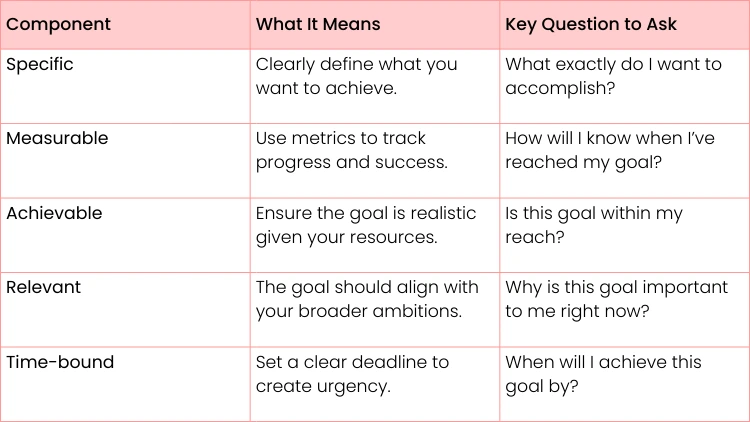
The SMART Goals Framework at a Glance
This table gives you a quick summary of each component and the core question it answers. It's a great reference to keep handy as you start building your own goals.
Having this mental checklist helps internalize the framework. For more on putting these ideas into action, explore this guide offering a practical framework for real results.
Breaking Down the SMART Framework
Alright, we’ve covered the ‘what’ of SMART goals. Now for the fun part: turning that theory into action. This is where we get our hands dirty and dissect each letter of the acronym—Specific, Measurable, Achievable, Relevant, and Time-bound—with real-world advice you can actually use.
Think of each letter as a filter. You pour a vague wish in the top, and by the time it passes through all five, you have a concrete, actionable plan at the bottom.
Let's start with the absolute foundation of any goal worth chasing.
S is for Specific: Get Crystal Clear
Vague goals are motivation killers. Seriously. "Get better at my job" or "Be healthier" are wishes, not targets. They give you nothing to aim for.
To make a goal Specific, you have to answer the classic "W" questions:
- What do I actually want to accomplish here?
- Why is this goal important to me right now?
- Who needs to be involved for this to happen?
- Where will I work on this?
- Which resources or constraints do I need to consider?
Answering these questions forces you to move from a fuzzy idea to a sharply defined objective. It’s the difference between saying "I want to drive north" and "I'm driving to Seattle for the tech conference next Tuesday."
For the Professional:
- Before: "I want to improve our team's performance."
- After: "I will implement a new project management system, specifically Asana, for the marketing team to reduce missed deadlines on client projects."
For the Student:
- Before: "I need to study more."
- After: "I will dedicate two hours every Tuesday and Thursday evening to reviewing lecture notes and completing practice problems for my Calculus II class, and I'll do it in the quiet section of the university library."
M is for Measurable: Know When You've Won
If you can't measure it, you can't manage it. Simple as that. The Measurable part of your goal is all about defining what success looks like in cold, hard numbers. It answers the question, "How will I know I've actually done it?"
Metrics create milestones. They give you feedback and let you celebrate small wins along the way, which is a huge motivator. This could be a specific number, a percentage increase, or even a simple "yes/no" for completion.
Ever wonder if writing goals down actually works?
A 2015 study from the Dominican University of California found that people who meticulously wrote down their goals were a staggering 42% more likely to achieve them than those who just kept them in their heads. Turning abstract ideas into concrete, measurable plans is a game-changer.
For the Professional:
- Before: "Increase sales."
- After: "Increase our quarterly sales revenue by 15% by acquiring at least 10 new enterprise clients."
For the Team Leader:
- Before: "Improve team communication."
- After: "Reduce the number of project revisions caused by miscommunication by 25%, which we'll track through our project management software."
A is for Achievable: Set a Realistic Challenge
Your goals need to stretch you, but they shouldn't break you. The Achievable component is about finding that sweet spot between ambition and reality. An unrealistic goal just sets you up for failure and burnout, and nobody wants that.
Ask yourself honestly: "Is this goal even possible with my current skills, resources, and time?" If the answer is no, what’s the smaller, foundational goal you need to hit first? This isn’t about thinking small. It’s about building a ladder to your big ambitions instead of trying to leap to the top in a single bound.
For the Student:
- Before: "I'll get a perfect 100 on every single exam this semester." (Ambitious, but maybe too much pressure!)
- After: "I will achieve an average grade of 90% or higher in my biology course by attending all tutorials and submitting every assignment on time."
For the Professional:
- Before: "Double our website traffic in one month." (Possible? Maybe. Probable? Unlikely.)
- After: "Increase organic website traffic by 20% over the next quarter by publishing eight new SEO-optimized blog posts."
R is for Relevant: Make Sure It Matters
A goal can be specific, measurable, and achievable, but if you don't actually care about it, your motivation will fizzle out. The Relevant piece of the puzzle ensures your goal aligns with your bigger picture—your values, your career path, your long-term objectives.
It answers the most critical question of all: "Why am I even doing this?"
A relevant goal feels purposeful. It's a stepping stone to something bigger, which makes it much easier to stay committed when you hit the inevitable roadblocks.
Getting a clear view of your life's priorities can make this step much easier. When you know what truly matters, you can see exactly how a new goal fits in. We explore this in this guide on goal setting with the Wheel of Life.
For the Team Leader:
- Before: "Have the team learn a new software." (But why?)
- After: "The customer support team will complete the advanced Zendesk certification. This is directly relevant to our company-wide objective of increasing customer satisfaction because it will help improve our average ticket resolution time."
For the Student:
- Before: "Learn to code." (Okay, but to what end?)
- After: "I will complete an introductory Python course online this semester. This is highly relevant because proficiency in this language is a key requirement for the data science internships I plan to apply for next year."
T is for Time-Bound: Give It a Deadline
Without a deadline, a goal is just a dream that sits on your to-do list forever. The Time-bound element creates a healthy sense of urgency and gives you a clear finish line to race towards.
A target date forces you to prioritize and stops procrastination in its tracks. It helps you break down the goal into smaller, manageable steps with their own mini-deadlines. You move from a vague "someday" to a concrete "by when".
For the Professional:
- Before: "I want to get a promotion."
- After: "I will complete all required leadership training modules and successfully manage the upcoming product launch by the end of Q3. This will make me eligible for a senior manager role in the next promotion cycle."
For the Team Leader:
- Before: "We need to update our onboarding materials."
- After: "Our team will review, update, and digitize all new-hire onboarding documents, with the full project completed and launched by March 1st."
See SMART Goals in Action with Real Examples
Theory is great, but seeing how to set SMART goals in the real world is where the magic really happens. It’s one thing to understand the framework, but it's another entirely to apply it to your own unique situations. Let's move past the simple breakdown and look at some fully-formed SMART goals for different scenarios.
This is the part where a fuzzy idea gets sharpened into a tangible plan of action. We’ll walk through a few mini case studies to show you the thought process behind making a goal Specific, Measurable, Achievable, Relevant, and Time-bound.
The Small Business Owner Boosting Sales
Imagine a small business owner who runs an online shop for handmade leather goods. Her initial goal is simple and, frankly, ineffective: "I want to sell more products online." That's a wish, not a strategy. Let’s rebuild it the SMART way.
- Specific: She needs to clarify what she'll sell and where. She decides to zero in on increasing sales of her best-selling item, the "Artisan Leather Journal" through her existing Shopify store.
- Measurable: How will she know she's succeeded? She sets a clear target: a 20% increase in monthly revenue from just that product.
- Achievable: A 20% jump is ambitious, but it’s not a pipe dream. She has enough materials to make more journals and can realistically ramp up her marketing without having to hire new staff.
- Relevant: This goal directly fuels her bigger business objective of increasing overall profit and cementing the journal as her shop's signature item.
- Time-bound: She gives herself a non-negotiable deadline: "by the end of the next fiscal quarter (in three months)."
The final SMART goal: "I will increase online sales revenue for the 'Artisan Leather Journal' by 20% through my Shopify store over the next three months by running targeted social media ad campaigns and an email marketing promotion to my existing customer list."
The Fitness Enthusiast Training for a Marathon
Now, let's picture someone whose goal is to "get fit enough to run a marathon". It’s a fantastic ambition, but it lacks the structure needed to actually get through training. Without clear milestones, it's way too easy to lose motivation or just spin your wheels.
- Specific: The goal is to complete the full 26.2 miles of the official City Marathon.
- Measurable: Progress will be tracked by sticking to a structured training plan, bumping up the long-run distance by 1-2 miles each week, and keeping an eye on pace improvements.
- Achievable: This person has been running consistently for a year, can comfortably knock out a 10k, and has a full six months to prepare. The goal is a definite challenge, but it’s totally within reach.
- Relevant: This personal goal aligns perfectly with their values of health, discipline, and pushing their own physical limits.
- Time-bound: The race has a hard date: October 15th.
The final SMART goal: "I will complete the City Marathon on October 15th by following a 24-week intermediate training plan, successfully completing 90% of the scheduled runs, and finishing my final long run of 20 miles two weeks before the race."
The power of a well-defined goal is that it forces you to think through the process, not just the outcome. It’s no longer about "running a marathon"; it’s about executing a detailed plan that makes success feel inevitable.
The Project Manager on a Creative Deadline
Finally, let's look at a project manager leading a team to launch a new company website. The vague directive is to "launch the new website soon". This kind of goal just creates confusion and leaves the team without any real direction or priorities.
- Specific: The goal is to launch the redesigned, mobile-responsive company website, which includes five key pages (Homepage, About, Services, Blog, Contact).
- Measurable: Success is defined by completing all development and design tasks, passing user acceptance testing with fewer than 5 critical bugs, and getting the final sign-off from the department head.
- Achievable: The team has the right skills, the budget is already approved, and the project scope is clearly defined. All the pieces are in place.
- Relevant: The new website is a critical company objective for improving brand image and generating more leads. Knowing where to focus is key; for more on this, you can learn how to reach your goals by narrowing your focus in this guide.
- Time-bound: The final launch date is set for the end of Q2, specifically June 30th.
The final SMART goal: "My team will launch the new five-page, mobile-responsive company website by June 30th, ensuring it passes quality assurance testing with fewer than five critical bugs and receives final stakeholder approval one week prior to launch."
These examples show just how applying the SMART criteria can transform a general wish into an actionable, motivating, and crystal-clear plan.
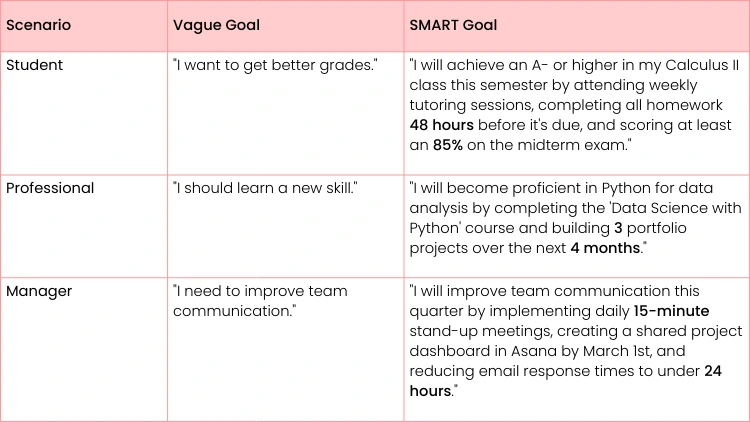
SMART Goal Transformation Before and After
Seeing the before-and-after of a goal is one of the best ways to grasp the power of this framework. A vague wish just doesn't have the same motivating pull as a sharp, well-defined objective.
Here’s a quick comparison of some common, ineffective goals and their powerful SMART counterparts.
The difference is night and day. The SMART versions provide a clear roadmap, telling you exactly what to do and how to know if you're on track. They remove the guesswork and replace it with a clear, actionable plan.
Common Goal Setting Mistakes to Avoid
Knowing how to set SMART goals is a huge advantage, but even the best plans can go sideways. The road to actually achieving what you set out to do is often littered with common tripwires that can completely kill your momentum. Spotting these pitfalls ahead of time is your best defense.
One of the biggest mistakes I see is people treating the framework like a rigid checklist. They get so caught up in the acronym that they create goals that look perfect on paper but fall apart in the real world. You have to remember, SMART is a thinking tool, not an unbreakable cage.
Forgetting the Human Element
It’s surprisingly easy to get so wrapped up in the metrics and deadlines that you forget about the person who has to do all the work—you. This mistake usually shows up in one of two ways: setting goals that are wildly unrealistic or goals that are completely disconnected from what you actually care about.
The first, setting an impossibly high bar, is just a recipe for burnout. Aiming to "write a complete novel in one month" when you’ve never even finished a chapter is setting yourself up for disappointment. A much better approach is to break it down. What about a goal to "write one complete chapter of 5,000 words in one month"? That feels doable.
The second part is relevance. If you set a goal because you feel like you should—not because you genuinely want to—your motivation will vanish at the first sign of trouble. Your goals have to connect to your bigger "why". That's the fuel that gets you through the tough spots.
Misunderstanding the Time-Bound Component
Putting a date on a goal is critical, but it’s often done wrong. A 2025 Mooncamp report that surveyed over 12,000 professionals found that only 30% felt a real sense of urgency from their goal deadlines. This tells me a lot of people are just slapping a random date on their goals without building a real plan to get there.
The "T" in SMART isn't just about a final deadline; it’s about creating a timeline with milestones built in.
- Final Deadline: The ultimate finish line (e.g., "Launch the new website by December 31st").
- Milestones: The smaller, crucial steps along the way (e.g., "Finalize wireframes by October 15th", "Complete user testing by November 30th").
This turns a single, intimidating deadline into a series of smaller, more manageable steps. It lets you build momentum by celebrating the small wins, making the whole journey feel less overwhelming.
The "Set It and Forget It" Trap
This is probably the most common mistake of them all. You craft a brilliant SMART goal, you feel a surge of motivation... and then you stick it in a drawer and forget about it. A goal without a tracking system is really just a wish. Life happens, things get busy, and without a process for review, even your most important ambitions will fade into the background.
This is where a simple review routine becomes a game-changer. It could be a five-minute check-in every Sunday evening or a more detailed monthly review. The key is to create a recurring appointment with yourself to see where you are. Without it, your perfect plan stays just that—a plan. If you find your planning consistently falls flat, you might get some real value from these insights on why planning does not work and what to do about it.
By steering clear of these common errors—setting unrealistic goals, misusing deadlines, and forgetting to track your progress—you build resilience right into your process. It ensures you not only start strong but have the structure needed to cross the finish line.
How to Track and Review Your Goals Effectively
Look, setting a powerful SMART goal is just getting to the starting line. The real race is won in the follow-through—the consistent tracking and thoughtful review. A goal left unchecked is a goal forgotten. The trick is building a simple system that keeps your objective front and center without it feeling like a chore.
This turns your goal from a static wish into a living, breathing part of your weekly routine. It's the feedback loop you need to stay on course, make smart adjustments, and keep the fire lit when that initial burst of excitement starts to fade.
Establish a Sustainable Review Cadence
Your review schedule is the heartbeat of your goal. Without that steady rhythm, your progress will flatline. The right cadence really depends on your goal's timeline, but the core idea is the same: make it a non-negotiable appointment with yourself.
- For short-term goals (30-90 days): A weekly review is your best friend. Block out 15-30 minutes every Friday afternoon or Sunday evening to check in. No excuses.
- For long-term goals (6+ months): A monthly deep-dive works beautifully. It gives you enough runway to see meaningful progress while still being frequent enough to course-correct.
Let's say your goal is to "Increase organic website traffic by 20% in Q3". A quick weekly peek at your analytics dashboard is non-negotiable. But if you're aiming to "run a half-marathon in six months", a monthly review of your training logs and mileage progression will keep you on pace.
To make this even easier, you could explore some of the best habit tracking apps out there. They can automate reminders and visualize your progress, making the whole process feel less like work.
Ask the Right Questions During Check-Ins
A review isn't just about staring at numbers on a screen; it’s about reflection. It’s about understanding the story behind the data. During each check-in, get brutally honest with yourself by answering these questions:
- What progress did I actually make this week/month?
- What roadblocks smacked me in the face?
- What did I learn from those challenges?
- Is my current strategy still the right one, or do I need to pivot?
- What is the one thing I need to do next week to move the needle?
These questions stop you from just going through the motions. They force you to engage with your goal on a deeper level. If you need help organizing the actions that come out of this, check out this guide on using a task list template for prioritizing maximum productivity.
Pro Tip: Keep a simple "goal journal"—digital or physical, whatever works for you—to log your answers. Over time, this becomes an incredible record of your journey, showing you just how far you’ve come and all the lessons you’ve picked up along the way.
Harness the Power of Accountability
Trying to achieve big things in a vacuum is incredibly tough. Seriously, just sharing your goals with someone you trust can be a game-changer. Research has shown that when people shared their goals with a friend and sent them weekly updates, their success rate skyrocketed to around 78%. That’s the undeniable power of putting yourself on the hook.
This person doesn’t need to be your drill sergeant. Think of them as a supportive sounding board who just checks in, asks how it's going, and celebrates your wins with you. Sometimes, a quick weekly text or a five-minute call is all it takes to keep your goal top-of-mind and give you that little extra nudge when you need it most.

Still Have Questions About SMART Goals?
Even with the best framework in hand, you're bound to hit a few snags. That’s perfectly normal. Getting good at setting SMART goals is less about following a rigid formula and more about learning how to troubleshoot the common hurdles that pop up. Let's tackle some of the most frequent questions I hear.
What if My Goal Is Hard to Measure?
This one comes up all the time, especially with goals tied to personal development or soft skills. If your goal feels too abstract, like "get better at leading my team", you're right—you can't just slap a number on that.
The trick is to stop trying to measure the feeling and start measuring the behaviors that lead to it. What actions would someone with great leadership skills take? Break it down.
For example, instead of that vague goal, you could reframe it like this: "I will complete a certified leadership course and schedule one-on-one feedback sessions with each of my three direct reports by the end of this quarter." Suddenly, it's tangible. You’re tracking completions and actions, not a fuzzy concept of "improvement".
How Often Should I Review My Goals?
The honest answer? It depends entirely on your timeline. There's no magic number.
A short-term goal, like a project you need to wrap up in 30 days, probably needs a quick weekly check-in. It keeps you on track and prevents last-minute scrambles. For your bigger, year-long ambitions, a monthly or quarterly review makes more sense. You need to give yourself enough time to actually make progress between check-ins.
The most important thing is consistency. Block out time for it in your calendar and treat it like a non-negotiable meeting. Whether it’s 15 minutes every Friday or an hour on the first of the month, scheduling it is what makes it happen.
What if I Fail to Meet a SMART Goal?
First, take a breath. Failing to hit a goal isn’t a personal failing; it’s a data point. The whole point is to learn and adjust, not to achieve perfect execution on the first try.
Now, put on your detective hat and figure out what went wrong. Was the timeline completely unrealistic? Did you lose motivation because the goal wasn't actually relevant to your bigger picture? Be brutally honest with yourself.
This is a massive stumbling block even for big companies. A 2015 Harvard Business Review poll found that only 11% of managers felt their companies gave them the resources they needed for strategic goals. It’s no wonder things fall through. On the flip side, companies like Anheuser-Busch InBev managed to get over 100,000 employees aligned, hitting 90%+ of their targets. The difference was alignment and realistic resourcing. You can dig into more goal-setting statistics and corporate success stories if you're curious.
Use what you’ve learned from the miss. Recalibrate, adjust the plan, and build a new, smarter SMART goal.
Ready to turn those goals into reality? At Uplyrn, we provide the courses and mentoring to help you acquire the skills you need for success. Start your learning journey with us today!


Leave your thoughts here...
All Comments
Reply