









PHP vs. JavaScript Showdown: Developer Battle for the Future

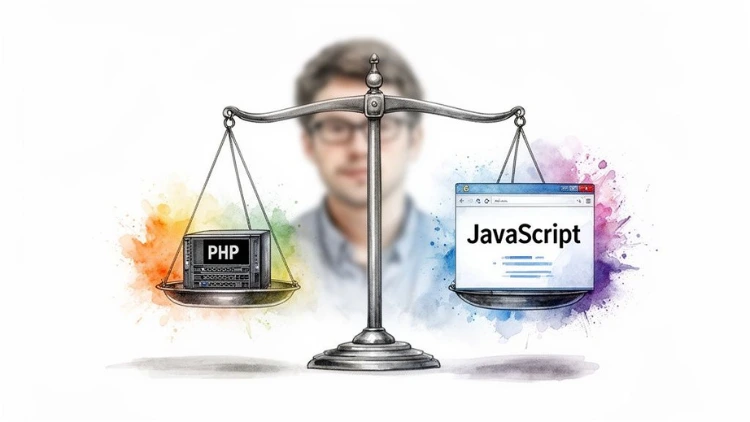
When you pit PHP vs. JavaScript against each other, the core difference isn't just syntax—it's their home turf. At its heart, PHP is a purely server-side language. It lives and breathes on the server, handling the heavy lifting behind the scenes. JavaScript, on the other hand, started life in the browser but has since expanded to the server with Node.js, making it a true full-stack contender.
This one distinction is huge. It means PHP has traditionally owned backend logic, while JavaScript can now build an entire application, from the user's screen all the way to the database.
Jump To Section

Earn As You Learn
Earn 25% commission when your network purchase Uplyrn courses or subscribe to our annual membership. It’s the best thing ever. Next to learning,
of course.
A Quick Answer for Aspiring Developers
So, which one should you choose? It really boils down to what you want to build. PHP is still an absolute powerhouse for the traditional web. It excels at creating dynamic web pages and managing content-heavy sites, which is why it's the engine behind massive platforms like WordPress.
In contrast, JavaScript has become the go-to for modern, highly interactive applications. Its ability to work on both the frontend and backend makes it an incredibly versatile choice for building anything from real-time chat apps to complex single-page applications (SPAs) that feel fast and fluid.
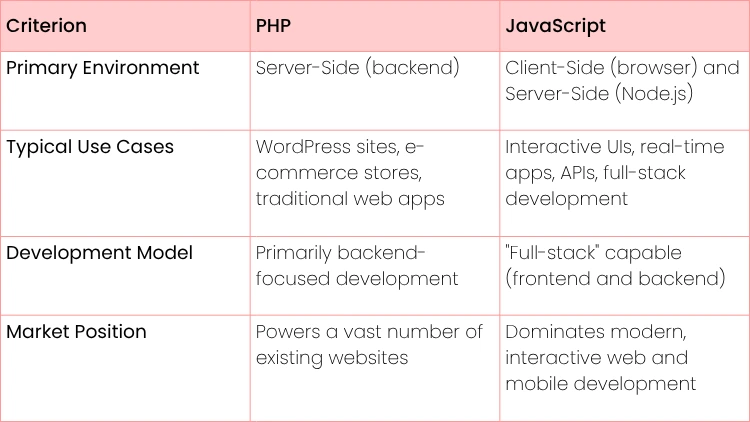
PHP vs JavaScript At a Glance
To cut through the noise, this table gives you a quick snapshot of where each language stands and what it's best used for.
Think of this table as your cheat sheet for understanding their core roles in the web development world.
You might be surprised to learn just how dominant PHP remains. As of March 2026, PHP powers a staggering 71.8% of all websites where the server-side language is known. This incredible market share persists because it's exceptionally reliable and battle-tested for backend tasks.
Making the right choice at the beginning of your journey is a critical first step. If you're just getting started and need more guidance, be sure to check out this guide on how to learn programming for beginners.
Comparing Syntax and Execution Models
To get a real feel for the PHP vs. JavaScript matchup, we have to look past the surface and dig into their core architecture. At first glance, both languages share a C-style syntax that can seem pretty similar. But the real story is in the details—how they handle variables, define functions, and, most importantly, how they actually run the code. These differences are what truly define where each language excels.
In PHP, the syntax feels a bit more traditional and, some would say, rigid. Variables always start with a dollar sign ($), which makes them impossible to miss. Functions are declared with a clear, straightforward pattern, creating a predictable structure that many developers find easy to pick up.
JavaScript, on the other hand, is all about flexibility. You can declare variables using var, let, or const, and each one comes with its own scoping rules. This is incredibly powerful, but it can also be a headache for beginners who are still getting the hang of managing state and scope in an application.
Code Syntax: A Practical Comparison
Let's see this in action. Here’s how both languages handle a simple task: creating a variable and a function. This side-by-side look really shines a light on those subtle but important differences.
PHP Example: Declaring a Variable and Function
<?php
// Variables are always prefixed with a dollar sign
$greeting = "Hello from PHP!";// A simple function to print the message
function showGreeting($message) {
echo $message;
}showGreeting($greeting); // Outputs: Hello from PHP!
?>
JavaScript Example: Declaring a Variable and Function
// Variable declared with 'let' for block scope
let greeting = "Hello from JavaScript!";// A simple function to log the message to the console
function showGreeting(message) {
console.log(message);
}showGreeting(greeting); // Outputs: Hello from JavaScript!
While these snippets look quite similar, the real separation happens when we look at how this code executes on a server.
Execution Models: Synchronous vs. Asynchronous
This is probably the most critical differentiator between PHP and server-side JavaScript (Node.js). PHP runs on a synchronous, multi-threaded model. When a request hits the server, a new process or thread is spun up to handle it. The code is then executed line-by-line, and nothing else happens for that user until the current task is complete.
This synchronous method is tried-and-true for traditional web apps. Every user request is handled in isolation, which makes the development process simpler and more predictable. A practical example is a user submitting a contact form. PHP processes the form data, validates it, saves it to a database, and sends a confirmation email—all in a single, blocking sequence. It's a perfect fit for where the server needs to finish one job before moving on.
Node.js, in stark contrast, uses a single-threaded, asynchronous, event-driven model. It juggles all incoming requests on a single thread, relying on an "event loop" to manage everything. When a time-consuming I/O task kicks off (like a database query or an API call), Node.js doesn't just sit there and wait. It immediately moves on to the next task and circles back to handle the result once it’s ready.
- Actionable Insight: If your app involves many users interacting in real-time (like a live chat), Node.js is the clear choice. Its asynchronous model can handle thousands of simultaneous connections efficiently. For a traditional e-commerce site where a user's checkout process is a step-by-step sequence, PHP’s simpler synchronous model is often easier to manage and debug.
If you're interested in the nitty-gritty of how programming languages are processed, you can learn more about compiled vs. interpreted languages in this article. Ultimately, this fundamental architectural choice is often the deciding factor when picking between PHP and JavaScript for your backend.
The Ecosystem Battle: Frameworks and Tooling
A programming language is only as good as the tools it comes with. The right ecosystem can mean the difference between launching a project in a few weeks or getting stuck in development hell for months. This is where the real fight between PHP and JavaScript heats up, as each brings a completely different philosophy to the table.
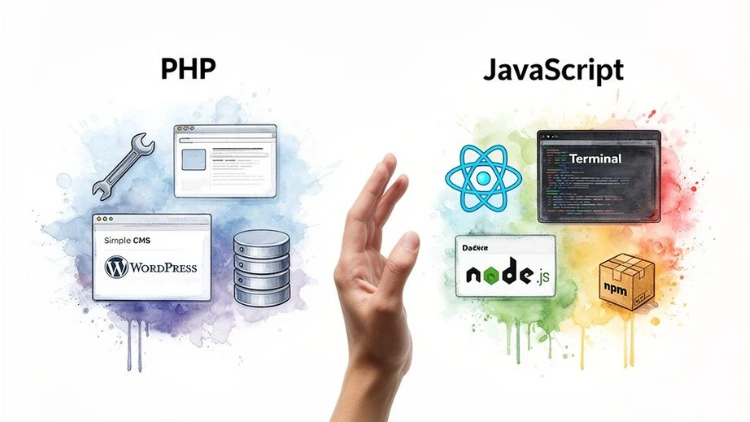
PHP's world is built around stability and having everything you need in one box. Its tools are laser-focused on creating solid, content-heavy websites and complex applications with surprising speed. This "batteries-included" approach is a huge plus for teams that just want to get things done.
JavaScript, on the other hand, offers a sprawling, specialized universe. It's a modular free-for-all where you hand-pick libraries and frameworks for both the front and back end. This gives you incredible freedom but also makes you the architect responsible for fitting all the pieces together.
PHP’s Cohesive and Powerful Toolkit
The undisputed king of the PHP ecosystem is Laravel. It’s a framework that developers genuinely love for its beautiful syntax and features that just make sense. Laravel is designed to get you moving fast by solving all the boring, repetitive problems for you.
- Practical Example with Artisan CLI: This is your command-line Swiss Army knife. It automates tedious tasks. For instance, running php artisan make:model Post -mcr instantly instantly generates a Model file for database interaction, a Migration file to create the posts table, and a Controller file to handle web requests related to posts. This saves you from manually creating three separate files and writing boilerplate code.
- Eloquent ORM: An Object-Relational Mapper that makes talking to your database feel natural. Forget writing clunky SQL. With Eloquent, fetching a user and their blog posts is as simple as User::with('posts')->find(1);.
And then there's WordPress. It's more than just a framework; it's a full-blown Content Management System (CMS) that runs a staggering 40% of the entire internet. If you're building a blog, a company website, or an online store (using WooCommerce), nothing beats the speed of the WordPress ecosystem with its endless themes and plugins.
- Actionable Insight: If your project is a classic web application—like a SaaS platform with user accounts and billing—the Laravel ecosystem will get you from idea to launch much faster. Its built-in tools for user authentication, job queues, and testing mean you can focus on building features, not reinventing the wheel.
JavaScript’s Modular and Expansive Universe
The JavaScript ecosystem is a story of two different worlds: the frontend and the backend. For creating the part users actually see and interact with, the "Big Three" frameworks—React, Angular, and Vue—are the go-to choices. They're the engines behind modern Single-Page Applications (SPAs) that feel incredibly quick and fluid.
On the backend, Node.js has built its own massive ecosystem. While Node.js itself is just the environment that runs the code, frameworks like Express.js give you a lean, no-frills starting point for building APIs and web servers.
This modularity is a double-edged sword. You have the freedom to pick the absolute best tool for every single task, but you also carry the burden of making sure they all play nicely together. A practical example: in a Node.js project, you'll need to install and configure an ORM like Prisma for database access, a validation library like Zod for data integrity, and a testing framework like Jest—all separate decisions and setups.
If you're curious about what that looks like in practice, checking out some Node.js project ideas for all skill levels is a fantastic way to see how these different pieces come together.
Performance and Scalability for Real-World Workloads
Performance is easily the most heated debate in the PHP vs. JavaScript world. But here's the thing: most benchmarks and speed tests completely miss the mark. The real question isn't "which is faster?" but rather, "which is built for the type of work my application does?"
It all comes down to whether your workload is I/O-bound or CPU-bound.
Sure, Node.js historically had a reputation for being the speed king. But modern PHP has been hitting the gym. The introduction of the Just-In-Time (JIT) compiler in PHP 8.0 was a massive leap forward, giving it a serious speed boost for CPU-heavy jobs and closing much of that old performance gap.
PHP Shines with Synchronous, CPU-Intensive Tasks
PHP's synchronous, multi-threaded approach is perfect for tasks that need to happen one after the other.
- A practical example is a script that generates a PDF invoice. This involves fetching data, performing calculations, rendering the PDF layout, and saving the file—all CPU-intensive operations that happen in a clear, sequential flow.
For this kind of job, PHP is a natural fit. Its blocking nature actually makes the code simpler to write and debug. You just read the file, process the data, and send the email—all in a clear, sequential flow. You're not wrestling with callbacks or promises for a problem that is inherently step-by-step.
For content-heavy platforms like a WordPress blog or a Magento e-commerce store, and especially for backend batch processing, PHP's architecture gives you a stable and predictable foundation.
Node.js Dominates with Asynchronous, I/O-Bound Loads
This is where server-side JavaScript truly flexes its muscles. The non-blocking, event-driven I/O model inside Node.js is engineered from the ground up to juggle thousands of simultaneous connections without getting overwhelmed.
Imagine you're building a food delivery app's API. It might get hit with hundreds of requests per second for driver locations, order statuses, and menu updates. These are classic I/O-bound operations—the app spends most of its time just waiting for data from the database or other microservices.
Node.js handles this with incredible efficiency. Instead of stopping and waiting for a database query to finish, it fires off the request and immediately turns its attention to the next one. This ability to manage extreme concurrency makes it the undisputed champion for:
- Real-time applications like chat services, online games, and live-updating dashboards.
- Microservices that need to fire back API responses almost instantly.
- Single-Page Applications (SPAs) that constantly make small, frequent data requests.
Actionable Insight: To choose correctly, analyze your core application loop. Is your app mostly waiting for network or database responses? Use Node.js. Is it doing heavy data processing or complex calculations on the server in a single request? PHP is likely a better, simpler fit. The performance debate isn't about a universal "winner" but about which tool is right for the job.
If you're building high-performance APIs and find yourself drawn to this style of concurrency, it's also worth looking at other languages built for the task. You can get a sense of this powerful paradigm if you decide to master Golang programming, which is also famous for how it handles concurrent tasks.
Job Market Trends and Salary Expectations (2025-2026)
When you're picking a language to build your career on, you're not just choosing syntax—you're making a serious investment. Looking at the job market for PHP vs. JavaScript tells a very interesting story.
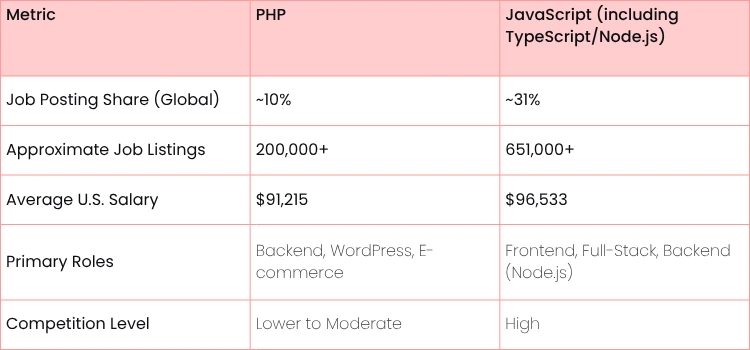
Based on data from 2023-2024, the numbers paint a pretty clear picture. JavaScript, especially when you bundle in its popular superset TypeScript, absolutely dominates the job boards. It snaps up a massive 31% of all developer job postings, which translates to over 651,000 open roles. PHP, while still a major player, comes in with a 10% share, representing around 200,000 jobs.
- A practical example of this trend: Fire up a job board like Indeed and search for "React Developer" in a major city; you'll see hundreds of listings. A search for "Laravel Developer" in the same city will yield fewer, but often more specialized, roles at web agencies or established companies.
Salaries tell a similar tale. In the U.S., a JavaScript developer can expect to earn an average of $96,533 per year. Their PHP counterparts aren't far behind, averaging around $91,215. That extra bump for JavaScript developers often comes from having skills in modern frameworks and TypeScript.
JavaScript: The Path of Broadest Opportunity
If your main goal is to have the most job options possible, the JavaScript ecosystem is the undeniable winner. The demand is huge and covers a wide range of roles, from frontend gurus to backend wizards and versatile full-stack engineers.
Actionable Insight: For a new developer who wants to get hired quickly, focusing on a modern JavaScript stack is a smart bet. A solid learning path looks like this:
- Start with core JavaScript to build a strong foundation.
- Master a popular framework like React.
- Add Node.js to your toolkit for backend capabilities.
This trifecta makes you a prime candidate for jobs at fast-moving startups, massive tech corporations, and everything in between. As you start looking, knowing how to prepare for coding interviews will be just as important as your technical skills.
PHP: A Stable and Less Competitive Niche
While JavaScript boasts bigger numbers, PHP offers a different flavor of career security. It's the engine behind a gigantic slice of the web, including almost every WordPress site on the planet. This foundation creates a steady, reliable demand for developers who can build, maintain, and extend these systems.
- Actionable Insight: The PHP job market is often less crowded. This means you could be up against fewer candidates for a given role. A practical strategy is to specialize. Instead of being a general "PHP developer", brand yourself as a "WooCommerce Performance Expert" or a "Laravel API Specialist". This focus makes you a high-value candidate for a specific set of employers.
Choosing to specialize in PHP can be a brilliant strategic move. Becoming a Laravel expert or the go-to person for custom WordPress plugins allows you to carve out a valuable niche that’s hard to compete with. This path is perfect if you enjoy working with proven, battle-tested technologies and want to make a direct impact on small and medium-sized businesses.
In the end, it all comes down to what you want for your career. If you’re after a ton of options and high growth potential, JavaScript is calling your name. But for a secure, specialized career maintaining the web's backbone, PHP is still an excellent and dependable choice. For more tips on actually landing that first role, check out this guide on how to get a software engineering job.
To give you a clearer side-by-side view, here’s how the job market breaks down for both languages, with projections for the near future.
Job Market Comparison: PHP vs. JavaScript (2025-2026 Data)
This table shows that while JavaScript offers a larger pond to fish in, the competition is also much fiercer. PHP, on the other hand, offers a more concentrated and stable market.
A Practical Guide to Choosing Your Language
When it comes to the PHP vs. JavaScript debate, there's no single "best" language. The only thing that matters is which one is best for you and what you want to achieve in your career.
So, instead of a one-size-fits-all answer, let's break it down based on who you are and where you want to go. We'll look at three common developer paths and give you some real, actionable steps for each.
Go with JavaScript for a huge, fast-growing market, or specialize in PHP for a secure, less crowded field. Your own goals will tell you which path gives you a better return on the time you invest in learning.
Picking a Path That Fits Your Goals
The Aspiring Freelancer
If your goal is to build up a client list fast, especially with small to medium-sized businesses, PHP is your most direct route to getting paid. A staggering number of businesses run on WordPress, creating a constant need for theme customization, plugin development, and general maintenance.
- Actionable First Project: Get your hands dirty by building a custom WordPress theme from the ground up. Or, create a simple plugin, like one that adds a custom contact form or social media sharing buttons. This gives you a real portfolio piece you can show directly to potential clients.
The Startup Founder
So, you need to build a Minimum Viable Product (MVP) and you need it to scale fast, with all the real-time features users expect today. The full-stack JavaScript ecosystem is your friend here. Using Node.js on the back end and a framework like React on the front end lets you build a complete, modern app with just one language.
- Actionable Insight: This unified approach is a game-changer for speed. A practical example is building a team chat feature. With a full JavaScript stack, the same data structures (e.g., a Message object) can be used on both the server and the client, reducing mental overhead and potential bugs. You’re not just developing faster; you’re also simplifying hiring down the road.
The Corporate Developer
Looking to land a job at an established tech company or a large enterprise? Versatility is the name of the game. While JavaScript (and its popular superset, TypeScript) is king in most modern corporate environments, a ton of big companies still rely on critical systems built with PHP.
- Actionable Insight: Knowing both makes you a more valuable and adaptable candidate.
- A practical example: an e-commerce giant might use a modern React-based storefront (JavaScript) but rely on a legacy Magento backend (PHP). A developer who can debug an issue across that entire stack is incredibly valuable. If this path is for you, explore more data on PHP's market position to help shape your learning strategy.
PHP vs. JavaScript: Your Questions Answered
When you're weighing PHP against JavaScript, a few questions always seem to pop up. Let's tackle them head-on with some straight, practical answers to help you make your decision.
Is PHP Becoming Obsolete in 2026?
Not a chance. While JavaScript frameworks certainly get more of the spotlight these days, PHP is still a massive force on the web. It powers over 70% of all websites that have a known server-side language.
That's a testament to its staying power and the huge influence of platforms like Wordpress, Drupal, and Magento. Modern PHP is fast, secure, and gets regular updates. All those existing PHP sites mean there's a steady, reliable demand for developers, making it a solid career path, especially in agency and e-commerce work.
Can I Get a Job with Only PHP or Only JavaScript?
Absolutely, but the job you get will look quite different depending on which you choose.
- With only PHP, you're perfectly positioned to build a great career.
- A practical example of a common role is a "WordPress Developer" at a digital marketing agency, where you would spend your days building custom themes for clients or developing plugins to extend site functionality.
- With only JavaScript, you're opening the door to a wider range of modern developer jobs. You could be a frontend specialist working with React or Vue, a backend engineer using Node.js, or even a mobile developer with React Native.
Actionable Insight: If you want the most career flexibility and the highest earning potential, your best bet is to become a full-stack developer. Knowing both frontend JavaScript and a strong backend language—whether that's PHP or Node.js—will open up the most opportunities and make you a more resilient job candidate.
Which Language Is Easier for a Complete Beginner?
For someone just starting out, PHP often feels more straightforward, especially for server-side work. Getting set up is simple with tools like XAMPP, and because you can embed it right into HTML, the initial learning curve isn't as steep.
- A practical example: a beginner can create a single file, index.php, write some HTML, and then add <?php echo "Hello, World!"; ?> to immediately see dynamic output in their browser.
JavaScript's world, with all its build tools and package managers, can feel a bit much at first. Plus, its asynchronous nature is a common stumbling block for new programmers. That said, JavaScript has a gigantic community and more learning resources than you can count, which helps tons of beginners find their footing and succeed.
At Uplyrn, our focus is on building skills that get you hired. Whether you go with the stability of PHP or the versatility of JavaScript, our expert-led courses are built to take you from a total beginner to a working professional. Start your journey with us today.


Leave your thoughts here...
All Comments
Reply