









Your Skills Gap Analysis Template: A Practical Guide

A skills gap analysis template is a structured document—usually a spreadsheet—that helps you pinpoint the difference between the skills your team has and the skills your business needs to hit its goals. Think of it as a clear, repeatable way to measure, understand, and then act on any talent shortfalls. Its real value is turning an abstract problem into a concrete action plan.
Jump To Section

Earn As You Learn
Earn 25% commission when your network purchase Uplyrn courses or subscribe to our annual membership. It’s the best thing ever. Next to learning,
of course.
Why a Skills Gap Template is a Strategic Tool
Let's stop thinking about skills gap analysis as just another HR chore. A well-designed template is actually a secret weapon for any proactive talent strategy. It transforms a messy, complicated challenge into a straightforward, repeatable system. The real goal here isn't just filling out paperwork; it's about building a workforce that's resilient and ready for whatever comes next.
This kind of tool helps you shift from a reactive hiring model—that frantic scramble to find talent when a crisis hits—to a much more strategic one. When you standardize how you measure and track skills, you get a clear, data-driven picture of your entire organization's capabilities. This isn't just about plugging the holes you have today; it's about seeing the ones that are coming tomorrow.
From Reactive Fixes to Proactive Strategy
Imagine a marketing team noticing their campaign performance is slipping. Without a system in place, the immediate reaction might be a desperate search for a "social media expert". But with a template, a manager can systematically check the team against crucial future skills like AI-powered analytics or programmatic advertising proficiency. This reveals a specific, fixable gap long before it blows up into a crisis.
Actionable Insight: Don't just list generic skills. The more specific your template's skill list is, the more actionable your results will be. Instead of "Social Media", break it down into "LinkedIn Ad Campaign Management", "Organic TikTok Content Strategy" and "Community Management on Discord".
Taking a structured approach like this gives you a few major advantages that directly impact the bottom line:
- Standardized Measurement: It gets everyone on the same page. When all employees are evaluated against the same clear criteria, you remove the guesswork and create a consistent baseline for skills across every single department.
- Data-Driven Decisions: This is where you swap gut feelings for hard data. You can finally prioritize your training budgets and hiring efforts where they'll actually make the biggest difference.
- Future-Proofing the Workforce: A good template forces you to look ahead. You start identifying the skills your team will need in two, or even five, years, which ensures your talent development is perfectly aligned with your long-term business goals.
- Improved Employee Engagement: People want to grow. When they see a clear path for their own development that's based on objective analysis, they feel far more invested in their work and the company's future.
A skills gap analysis template turns an abstract problem like "we need better skills" into a concrete, measurable plan. It’s the bridge between knowing your business goals and having the right people to make them happen.
Building a Foundation for Growth
Ultimately, using a skills gap analysis template gives you a roadmap for strategic growth. It informs succession planning by highlighting potential leaders and the specific skills they need to cultivate. With studies showing a massive need for upgrading worker skills, just winging it is no longer an option. If you want to dive deeper, you might explore a comprehensive guide to your skills gap analysis template for some additional perspectives.
By understanding precisely where your talent gaps lie, you can invest smartly in training, reskilling, and strategic hiring. This creates a competitive edge that's tough for anyone else to copy. It's a methodical process that helps you understand the skills gap and why nearly half of workers need upgrading.
Laying the Groundwork for Your Analysis
Before you even think about opening a spreadsheet, let's talk about prep work. The success of your skills gap analysis hinges entirely on what you do before the analysis begins. A fancy template is worthless if the information you feed it is weak. Getting this foundation right is what makes the difference between a bureaucratic exercise and a strategic game-changer.
The first move? Deciding on your scope. It’s incredibly tempting to try and analyze everyone and everything all at once. Resist that urge. That approach almost always leads to burnout and fuzzy, unusable results. Start small. Be specific.
Define Your Scope and Focus
Are you zoning in on a single, make-or-break role? A specific team that’s critical to a new project? Or maybe a whole department that’s about to go through a major shift? Each of these scenarios needs a slightly different lens.
- Individual Role Analysis: Perfect for high-stakes positions or for building clear career ladders.
- Practical Example: Analyze the "Senior Data Scientist" role to map out exactly what technical and leadership skills a mid-level analyst needs to develop to be promoted.
- Team-Level Analysis: Use this for project teams or departments staring down a new challenge.
- Practical Example: A customer support team needs to adopt a new AI chatbot platform. Your analysis would focus specifically on skills like "AI conversation design", "chatbot performance analytics" and "escalation protocols for AI".
- Organizational Analysis: This is the big one, and it's best saved for major strategic planning cycles.
- Practical Example: The company is shifting to a subscription-based model. Your analysis would identify company-wide gaps in "customer success management", "recurring revenue finance" and "subscription marketing".
A tightly defined scope is your best friend. It prevents analysis paralysis and delivers actionable insights fast. You can always broaden your scope later on.
Pinpoint Your Future-State Skills
With your scope locked in, it's time to look ahead. The real goal here isn't just to map the skills your team has today; it’s about figuring out the skills they’ll need to win tomorrow. Your company's strategic goals are your North Star for this part of the process.
Imagine a marketing team whose company is going all-in on data-driven campaigns. Their "future-state" skills list wouldn't just say "social media marketing". It would be way more granular.
Example: Marketing Team Future Skills
- Predictive Analytics for Campaign ROI
- AI Content Optimization Tools
- Marketing Automation Workflow Design
- Advanced Customer Data Platform (CDP) Management
A huge piece of this puzzle is identifying critical skills required for roles specific to your industry. This isn't just a nice-to-have; it's essential. The World Economic Forum projects that by 2030, about 39% of a worker's core skills will need to change, with a massive surge in demand for tech skills. This forward-looking mindset is everything.
Gather Your Essential Inputs
Okay, last step before we build. You need to ground your analysis in reality, which means gathering the right source materials. This is where you get the objective data to define both current and future skill requirements. Don't rely on guesswork.
Non-Negotiable Inputs for Your Analysis:
- Strategic Business Plans: This is your roadmap.
- Actionable Insight: If a strategic goal is "Increase customer retention by 20%", you should immediately look for skills related to customer experience, data analysis of churn indicators, and proactive communication.
- Future-Focused Job Profiles: Ditch the dusty, outdated job descriptions. Sit down with managers and write profiles for what a role will look like 18-24 months from now.
- Performance Review Data: This gives you a solid baseline of where people are today. It’s a great starting point for assessing current strengths and spotting obvious development needs. This data collection is also a key part of any good training needs analysis and learning development strategy.
- Industry Trend Reports: Look outside your own four walls. See what experts and competitors are saying about the future of work in your field. This helps you validate the future skills you’ve brainstormed and makes sure you aren't operating in a bubble.
By nailing down your scope, looking to the future, and gathering these inputs, you’re building a rock-solid foundation. This prep work turns building the template from a chaotic mess into a smooth, strategic process.
How to Build Your Skills Gap Analysis Template
Alright, let's get our hands dirty and turn all this theory into a practical tool you can start using today. Building an effective skills gap analysis template isn't about fancy software; you can create a powerhouse version with something as simple as Google Sheets or Microsoft Excel.
The real magic is in the structure. By setting up the right columns, you create a system that transforms subjective observations into objective, actionable data. Let's walk through how to build the framework for your analysis, column by column.
The Core Columns of Your Template
Think of your spreadsheet as a grid designed for clarity. Each row will track a specific skill for one employee, and every column captures a vital piece of the puzzle. This setup is crucial for gathering consistent data, whether you're looking at one person or an entire department.
Here are the absolute must-have columns for your template:
- Employee Name: Who is being assessed?
- Job Role: What is their current position?
- Critical Skill: The specific competency we're measuring.
- Current Proficiency: Where their skill level is right now, based on a standard scale.
- Target Proficiency: The skill level needed for them to crush it in their role.
- Gap Score: The calculated difference between the target and current levels.
- Priority Level: How urgent is it to close this gap? (e.g., High, Medium, Low).
This simple layout is your foundation. It's clean, intuitive, and gives you everything you need to pinpoint your biggest development opportunities.
Defining Skills with Precision
That "Critical Skill" column? It’s where most analyses go wrong. Vague inputs lead to vague outputs. If you just write "Communication", you'll get a fuzzy, unhelpful picture. You have to get more specific and focus on observable behaviors.
Practical Example: Instead of a single, broad entry for "Communication", try breaking it down like this:
- Technical Writing: Can they produce clear, concise documentation for complex processes?
- Client Presentation Skills: How effective are they at conveying project updates to stakeholders?
- Cross-Functional Collaboration: Do they proactively share information and work well with other teams?
Breaking skills down this way makes the assessment far more accurate. Remember to include both hard (technical) skills and soft skills. It's easy to get hyper-focused on coding languages or software proficiency, but ignoring core competencies is a huge mistake. A well-rounded view is essential—for example, looking at the seven soft skills that empower engineering and technical professionals can provide a more balanced perspective for your template.
Establishing a Clear Proficiency Scale
To make your "Current" and "Target" proficiency ratings meaningful, you need a standardized scale. This is hands-down the most critical step for making your analysis objective. A simple 1-5 scale works perfectly, but the secret is attaching clear, behavior-based descriptions to each number.
Without these descriptions, one manager’s "4" is another’s "3", which makes your data unreliable.
A well-defined proficiency scale removes subjectivity. It forces assessors to evaluate based on observable actions, not gut feelings, leading to a more accurate and defensible analysis.
Automating the Gap Calculation
Now it's time to let the spreadsheet do the heavy lifting. The "Gap Score" isn't something you should be calculating in your head. A simple formula will automate it, saving you time and preventing simple math errors.
Actionable Insight: In the "Gap Score" column, just type in this formula (assuming "Target" is in column E and "Current" is in column D):
=E2-D2
Drag that formula down for every row, and you're done. The result is an instant, objective measurement of each skill gap. A positive number shows a gap to address, a zero means they're on target, and a negative number highlights an area where they're actually exceeding expectations. This one calculation immediately flags your team's most pressing development needs.
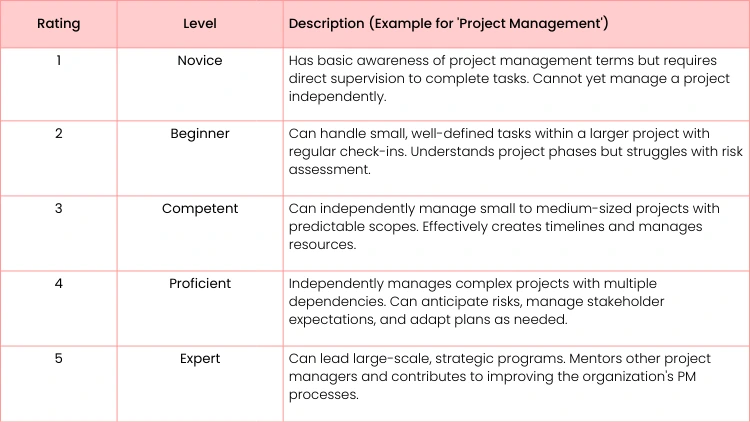
Below is a sample scale you can adapt for just about any skill. Notice how the descriptions provide concrete examples of what each level looks like in the real world, using "Project Management" as our example skill.
Sample Skill Proficiency Rating Scale
Use this behavior-based scale to consistently assess current and target skill levels in your template.
This kind of behavior-based scale is your best friend for consistency. When you set a Target of 4 for a Senior Project Manager, everyone involved knows exactly what excellence looks like.
From Data to Decisions: How to Read the Results
You’ve done the hard work, and your skills gap analysis template is finally complete. You're no longer staring at a simple roster of names and roles. Instead, you have a rich dataset—a clear snapshot of your team's current capabilities versus its future needs. But raw data is just the starting line. The real magic happens when you turn those numbers into a compelling story that drives meaningful action.
This is where you switch hats from analyst to strategist. It’s time to zoom out from individual scores to see the bigger picture. Your goal is to spot the patterns, pinpoint the most critical vulnerabilities, and build an undeniable case for investment that leadership can't ignore.
Moving Beyond Individual Scores
The first move is to aggregate your data. Seeing that one employee has a gap score of "2" for "Data Visualization" is useful for their personal development plan, but it doesn't scream strategic threat.
But what if you discover that 70% of your entire marketing team has a gap of "2" or more in that same skill? Now that tells a much more alarming story.
- Actionable Insight: Use a pivot table in your spreadsheet software to instantly calculate the average gap score for each skill across a team. This simple step brings your most widespread deficiencies to the surface in seconds.
Practical Example: A Customer Support Team. Imagine your analysis reveals these average skill gaps for your support crew:
- AI Chatbot Management: 3.1 (High Gap)
- Empathy and De-escalation: 1.2 (Low Gap)
- Advanced Ticketing System Features: 2.8 (Moderate Gap)
All of a sudden, you're not just looking at numbers. You have a clear signal that the team is critically unprepared for the new AI tools rolling out next quarter.
Prioritizing Gaps with a Strategic Lens
Not all skill gaps are created equal. A massive gap in a low-priority skill is far less dangerous than a smaller gap in a mission-critical competency. This is where you have to balance the size of the gap with its strategic importance to the business.
Practical Example: A sales team analysis highlights two major gaps: a big one in "Presentation Design" and a moderate one in "Using AI-Powered CRM Tools". While the presentation gap might be numerically larger, the CRM gap is directly tied to the company's big goal of improving sales forecasting and efficiency. That makes the CRM gap the top priority, hands down.
Your most urgent priority is always the intersection of a significant skill gap and a high-impact business objective. This framework helps you focus your limited resources where they will deliver the greatest return.
Visualizing Your Findings for Maximum Impact
You can have the most insightful data in the world, but if you can't communicate it clearly, it won't lead to change. Simple data visualization is your secret weapon for getting buy-in from leadership. Instead of dropping a dense spreadsheet on their desk, transform your key findings into charts they can understand at a glance.
- Bar Charts: Perfect for comparing the average gap scores for different skills side-by-side.
- Heat Maps: A fantastic way to show the distribution of proficiency levels across a team for multiple skills at once.
- Stacked Column Charts: Great for illustrating the percentage of employees at each proficiency level (Novice, Competent, Expert) for a single critical skill.
These visuals make the story jump off the page. Think about the global shortage of AI talent—it’s a perfect example of a massive skills gap in a crucial strategic area. By 2025, the demand for AI roles is expected to outpace supply by a ratio of 3.2 to 1, creating a huge talent shortfall. Presenting data like this visually can really drive home the urgency. You can find more stats on the global AI talent shortage from SecondTalent.
Ultimately, your objective is to present a clear, data-backed narrative that connects skill gaps directly to business risks and opportunities. This approach shifts the conversation from "training is a cost" to "targeted development is a strategic investment". Analyzing your results this way also helps you figure out which training programs will actually work—a core principle you can explore further in this guide on how to use the Kirkpatrick Model for evaluating L&D impact.

Turning Your Analysis Into an Action Plan
Let’s be honest: an analysis without action is just an interesting academic exercise. Once your skills gap analysis template has done its job and pinpointed the priority areas, the real work begins. It’s time to translate those insights into a targeted development plan that actually closes the gaps you’ve found.
This is where you move from theory to reality. The goal isn't to roll out some generic, one-size-fits-all training program. A well-crafted action plan is a tailored strategy, mapping specific learning solutions to different needs and skill types. It’s about being deliberate and resourceful, ensuring every development dollar and hour spent delivers a real return.
Mapping Solutions to Specific Needs
Not every skill gap can be fixed with a simple online course. Companies often make this mistake—they default to one type of training for every problem, which is both inefficient and often ineffective. The right solution depends entirely on the nature of the skill you're trying to build.
Actionable Insight: Create a "development menu" that maps common skill types to proven solutions.
- Technical Skills (e.g., Python, SQL, Salesforce): These are usually best tackled with structured, hands-on learning. Offer online courses with coding sandboxes, virtual labs, or certified training programs where people can actually practice what they're learning.
- Process-Oriented Skills (e.g., Agile Project Management): For these, you’ll want to combine foundational knowledge from workshops or eLearning with real-world practice.
- Practical Example: Pair an Agile certification course with a requirement to shadow a certified Scrum Master on a low-risk internal project.
- Soft Skills (e.g., Leadership, Negotiation): These skills are notoriously tough to teach in a classroom setting. They’re best developed through experience—mentorship programs, role-playing scenarios, and targeted coaching from a seasoned leader are your best bets here.
The most effective action plans don't just list courses. They build a learning ecosystem where employees can acquire knowledge, practice new skills in a safe environment, and receive feedback to truly hone their abilities.
Building Your Development Action Plan
With your solutions mapped out, it's time to formalize the plan. This should be a living document, not something you create once and forget about. It needs clear goals, assigned ownership, and a way to track progress.
Action Plan Components
- Define a SMART Goal: Make every goal Specific, Measurable, Achievable, Relevant, and Time-bound. "Improve project management skills" is vague. A much better goal is, "Complete the PMP certification course and successfully lead one internal project by the end of Q3."
- Assign Ownership: Who is responsible for driving this forward? It's usually a team effort between the employee, their manager, and HR or L&D. The manager's role is absolutely critical for providing support and creating opportunities to apply new skills.
- Set a Timeline and Milestones: Break the learning journey into smaller, manageable steps with clear deadlines. This keeps the momentum going and makes the overall goal feel less overwhelming.
- Establish a Feedback Loop: How will you know if the training is actually working? Schedule regular check-ins to discuss progress, challenges, and—most importantly—opportunities to use the new skill on the job.
The return on this kind of strategic investment can be massive. Look at AT&T, which is investing $1 billion by 2025 to reskill over 100,000 employees. This initiative led to an impressive internal fill rate of 40% for new tech management roles, proving the power of building talent from within.
Putting It All Together: A Practical Example
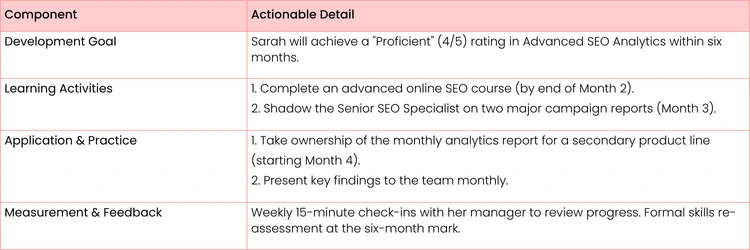
Let’s bring this to life. Imagine your analysis of the marketing team shows a high-priority gap in "Advanced SEO Analytics" for a mid-level marketer named Sarah.
This structured approach transforms a vague need ("we need better SEO skills") into a concrete, measurable plan that sets Sarah—and the business—up for success. For more inspiration, check out these excellent employee training program examples that show how different companies are tackling skill development.
Sarah's action plan might look something like this:
Got Questions? We’ve Got Answers.
Executing a skills gap analysis can feel like a massive undertaking, and it's totally normal for questions to pop up. Let's tackle some of the most common ones we hear so you can move forward with confidence and sidestep the usual traps.
How Often Should We Do This?
A full-blown, company-wide analysis once a year is a pretty solid benchmark for most companies. It lines up nicely with annual strategic planning, letting you sync up your talent development with the big-picture goals for the coming year.
But that’s not a hard-and-fast rule. If you're in a fast-moving field like tech or digital marketing, waiting a full year is like waiting an eternity. For those teams, a lighter, more focused review every six months—or even quarterly for mission-critical skills—is way more practical.
Actionable Insight: Don't treat your skills gap analysis as a one-and-done document. Think of it as a living, breathing tool that evolves with your business. Kick-off a major new project? Introduce a new piece of tech? That’s your cue to revisit the analysis for the teams involved.
What's the Biggest Mistake to Avoid?
Easy. The most common pitfall is focusing only on the skills needed for today's jobs. A skills gap analysis template is a powerful instrument, but it’s only as good as the vision you give it. If you only measure against current roles, you're always going to be playing catch-up.
A truly strategic analysis is always looking ahead. Your entire process has to start with the organization's future goals. For instance, if a key objective is to break into a new European market in two years, your analysis should be flagging gaps in "International Business Law" or "German Language Proficiency" right now.
Always work backward from where you want to be in three to five years to define the skills you'll need. That forward-looking approach is what turns a routine HR task into a game-changing talent strategy.
Can I Use This for My Own Career?
Absolutely! While we've talked a lot about teams, this template is an incredible tool for mapping out your personal career path. It gives you a structured, objective way to look at your own professional journey.
Practical Example: Let's say you're a junior developer with your sights set on becoming a "Senior Machine Learning Engineer". You can use the template to run a personal audit.
- Identify Future Skills: Dig into job descriptions and see what the industry is demanding for that senior role. You might list things like Natural Language Processing, Deep Learning Frameworks, or Cloud MLOps.
- Set Your Target: Decide what "great" looks like and assign a target proficiency, maybe a 4 out of 5, for each skill.
- Rate Yourself Honestly: Now, where are you really at with each of those skills? Be honest.
- Find Your Gap: The calculated gap score instantly shows you what your personal learning roadmap looks like.
Suddenly, you have a clear, actionable plan. You know exactly where to focus your energy—whether it's on online courses, new certifications, or just weekend projects—to close that gap and land your dream job.
Ready to turn your skills gaps into strengths? Uplyrn offers a complete ecosystem of courses, expert-led mentoring, and career tools designed to bring your action plan to life. Give your team the skills they need to win.


Leave your thoughts here...
All Comments
Reply