









10 Actionable Tips for Successful Online Learning in 2026

The explosion of online learning has unlocked unprecedented opportunities for skill development and career advancement. Yet, the freedom of a digital classroom comes with its own unique set of challenges. Simply logging into a course portal is not a guarantee of success. True mastery requires a deliberate and strategic approach that goes far beyond passive video consumption and occasional quizzes. Many learners find themselves grappling with procrastination, digital distractions, and the difficulty of translating theoretical knowledge into practical skills without the structure of a traditional classroom.
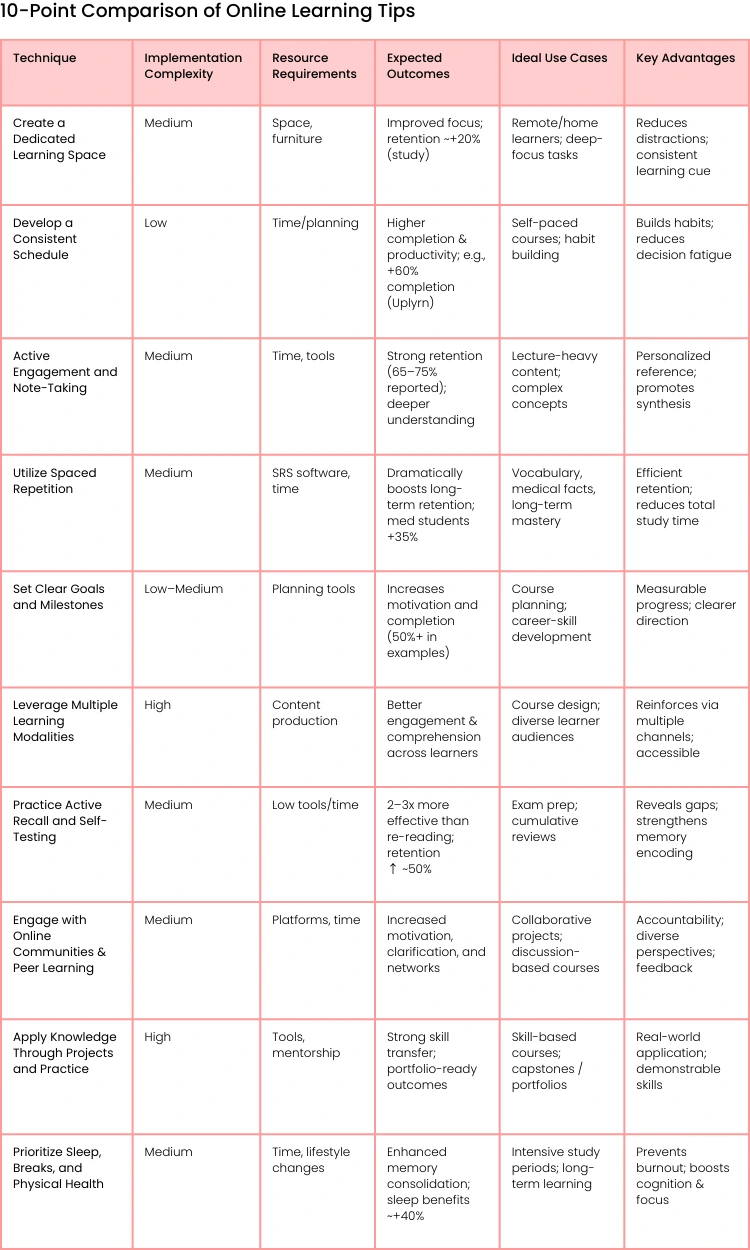
This guide is designed to be your definitive playbook, offering ten evidence-based tips for successful online learning. We will move past the generic advice and provide a comprehensive collection of actionable strategies you can implement immediately. Each tip is broken down into concrete examples, practical how-to steps, and quick takeaways to help you build a robust and effective learning routine. To truly embark on a successful online learning journey, it's essential to understand the science-backed principles that govern efficient knowledge acquisition and retention.
Whether you are a professional aiming to reskill with a platform like Uplyrn, a student pursuing a degree, or an individual dedicated to personal growth, these techniques will transform your approach. You will learn not just how to complete your courses, but how to absorb, retain, and apply new knowledge in a way that directly supports your personal and professional goals. It's time to build the habits that turn your educational investment into tangible, career-defining results. Let's begin.
Jump To Section

Earn As You Learn
Earn 25% commission when your network purchase Uplyrn courses or subscribe to our annual membership. It’s the best thing ever. Next to learning,
of course.
1. Create a Dedicated Learning Space
One of the most impactful tips for successful online learning is establishing a physical space dedicated solely to your studies. This simple act trains your brain to switch into "learning mode" the moment you sit down, creating a powerful psychological cue that helps you focus. When your study area is separate from where you relax or sleep, you minimize the mental friction of transitioning between leisure and work, leading to deeper concentration and improved productivity.
- Practical Example: A software development student might designate a specific corner of their living room as their "coding corner". When they sit at that desk, with their second monitor and mechanical keyboard, their brain knows it's time to focus on code. All entertainment devices, like a gaming console or TV remote, are kept out of sight.
How to Create Your Ideal Learning Zone
You don't need a separate room to create an effective learning space. Even a small corner of a room can work, as long as you apply a few key principles to optimize it for focus.
- Eliminate Clutter: Keep only essential learning materials within arm's reach, such as your laptop, a notebook, and pens. A tidy space leads to a focused mind. If you're struggling with organization, you can find strategies for how to declutter and organize your workspace.
- Control Your Environment: Ensure you have proper lighting to avoid eye strain during long study sessions. If your environment is noisy, invest in a pair of noise-canceling headphones to block out interruptions.
- Personalize for Motivation: Make the space inviting. Add a small plant, a motivating quote, or use a comfortable chair. A pleasant environment makes you more likely to spend productive time there.
Actionable Insight: Use a specific object to signal the start and end of your study time. For instance, turn on a dedicated desk lamp only when you're studying and turn it off the moment you're done. This small ritual reinforces the mental boundary.

2. Develop a Consistent Schedule
Just as a dedicated space prepares your environment for learning, a consistent schedule prepares your mind. Establishing a regular routine with fixed study times is one of the most powerful tips for successful online learning because it builds momentum and transforms studying from a chore into a habit. This consistency trains your brain to anticipate and enter "learning mode" automatically at scheduled times, dramatically reducing procrastination and decision fatigue.
- Practical Example: A marketing professional taking an evening course decides to block out every Tuesday and Thursday from 7:00 PM to 9:00 PM in their calendar for "Deep Work: SEO Course". They treat this block like an important meeting, letting family and friends know they are unavailable during these hours.
How to Build a Powerful Learning Schedule
Creating a schedule isn't about filling every free moment; it's about being intentional with your time. A well-designed routine should work with your natural rhythms, not against them.
- Identify Your Peak Energy Hours: Are you a morning person or a night owl? Schedule your most challenging learning tasks during the times when you feel most alert and focused.
- Start Small with Focused Sessions: If you're new to online learning, begin with short, 25-minute study blocks using the Pomodoro Technique. This prevents burnout and makes it easier to get started.
- Build in Buffer Time: Life is unpredictable. Add 10-15 minute buffers around your study blocks to account for interruptions or tasks that take longer than expected. For more ideas, you can explore effective time management strategies for students.
- Track Your Adherence: Use a simple checklist or app to track how well you stick to your schedule. This creates accountability and helps you identify what's working and what isn't.
Actionable Insight: Use the "Time-Blocking" method. Instead of a to-do list, schedule specific tasks into your calendar. For example, block "9:00 AM - 9:45 AM: Watch Module 3 video and take notes" and "9:45 AM - 10:00 AM: Review notes and create 3 flashcards".
3. Active Engagement and Note-Taking
One of the most transformative tips for successful online learning is shifting from passive consumption to active engagement. Simply watching lectures or reading text is not enough; true learning happens when you interact with the material by taking thoughtful, organized notes. This process forces your brain to process, synthesize, and reformulate information, which dramatically improves comprehension and long-term retention.
- Practical Example: While watching a video about project management methodologies, instead of just listening, a learner opens a notebook and creates two columns: "Agile" and "Waterfall". As the video explains each one, they jot down key features, pros, and cons in their own words under the appropriate column.
How to Master Active Note-Taking
Implementing an active note-taking strategy is straightforward and can be adapted to any subject. The key is to create a system that encourages you to think critically about the material as you encounter it.
- Adopt a System: Use a structured method like the Cornell Note-Taking System, which divides your page into sections for main notes, cues, and a summary. This keeps your thoughts organized and primed for easy review.
- Review and Refine: The learning process doesn't end when the lecture is over. Revisit your notes within 24 hours to fill in gaps, clarify points, and write a brief summary. This simple habit reinforces memory significantly. If you need to review complex video content, consider techniques like transcribing videos to create a searchable text document for detailed analysis.
- Use Digital Tools Wisely: Applications like Notion or OneNote allow you to integrate text, images, and links into a cohesive learning system. Understanding the cognitive science behind these methods can further enhance their effectiveness; learn more about how the brain learns to optimize your approach.
Actionable Insight: After a lecture or chapter, don't just close your notes. Spend five minutes writing a 3-4 sentence summary in the "summary" section of your Cornell notes or at the bottom of the page. This forces you to identify and articulate the main takeaways.

4. Utilize Spaced Repetition
Simply learning new information isn't enough; you have to remember it. One of the most powerful evidence-based tips for successful online learning is utilizing spaced repetition. This technique involves reviewing material at increasing intervals over time, which interrupts the natural process of forgetting and moves information from your short-term recall into long-term memory.
- Practical Example: A student learning Spanish uses a flashcard app like Anki. After learning the word "manzana" (apple), the app shows them the card again in 10 minutes. If they get it right, it shows them again the next day. If they're correct again, it waits four days, then a week, and so on, optimizing the review schedule for maximum retention.
How to Implement Spaced Repetition
Integrating spaced repetition into your study routine is straightforward and can be done with simple tools or dedicated software. The key is consistent, spaced-out review sessions rather than last-minute cramming.
- Use Digital Flashcard Tools: Apps like Anki or SuperMemo are designed specifically for spaced repetition. You can create digital flashcards with key concepts, and the software will automatically schedule them for review.
- Combine with Active Recall: Don't just passively re-read your notes. When a concept comes up for review, try to recall the information from memory first before checking the answer. This retrieval practice is what makes the technique so effective.
- Keep Reviews Short and Focused: Your review sessions should be brief, often just 15-20 minutes a day. The consistency is more important than the length of any single session. For a deeper dive into evidence-based study techniques, explore how you can improve your memory and study skills.
Actionable Insight: Create "micro-review" habits. Dedicate the first 15 minutes of your commute or your morning coffee to reviewing your digital flashcards. This small, consistent effort is more effective than a single, long cramming session.
5. Set Clear Goals and Milestones
Navigating an online course without clear objectives is like sailing without a compass. One of the most critical tips for successful online learning is defining specific, measurable goals and breaking them into smaller milestones. This transforms a vague intention, like "learn Python" into an actionable plan, giving you direction, motivation, and a clear way to track your progress.
- Practical Example: Instead of a goal to "learn digital marketing", a learner sets a milestone: "By the end of this month, I will complete the Google Analytics module and earn the official certification". This is specific, measurable, and time-bound, providing a clear target to work towards.
How to Set Effective Learning Goals
The key is to move from broad ambitions to concrete, achievable steps. By structuring your goals, you create a roadmap that guides your study sessions and prevents you from feeling overwhelmed by the scope of a new subject.
- Use the SMART Framework: Make your goals Specific, Measurable, Achievable, Relevant, and Time-bound. Instead of "learn data analysis", a SMART goal would be: "Complete the first three modules of the Data Science with Python course and build one small data visualization project within the next 30 days."
- Create a Visual Tracker: Use a simple spreadsheet, a whiteboard, or a tool like Trello to visualize your progress. Seeing how far you've come is a powerful motivator to keep going. You can find more strategies for how to set personal goals to master this process.
- Celebrate Your Milestones: Acknowledge your achievements. Finishing a tough module or completing a project is worth celebrating. This positive reinforcement makes the learning process more enjoyable and sustainable.
Actionable Insight: Break down each course module into a checklist of actions. For a video lecture, your checklist could be: 1) Watch video, 2) Summarize key concepts, 3) Complete associated quiz, 4) Add 5 new flashcards to Anki. Checking these off provides a sense of accomplishment.

6. Leverage Multiple Learning Modalities
Relying on a single format, like watching lecture videos, can quickly lead to cognitive fatigue and incomplete understanding. One of the most effective tips for successful online learning is to engage with material through various formats. This multimodal approach caters to different learning preferences and reinforces knowledge by activating multiple neural pathways, leading to deeper and more durable learning.
- Practical Example: To understand a complex historical event, a student first watches a 20-minute video documentary (visual/auditory), then reads the corresponding chapter in their digital textbook (textual), listens to a podcast debate on the topic during their commute (auditory), and finally creates a timeline infographic using a free tool like Canva (kinesthetic/visual).
How to Mix Your Learning Formats
Integrating multiple modalities into your study routine doesn't have to be complicated. The goal is to create a dynamic learning experience that keeps you engaged and helps you connect ideas in new ways.
- Visualize Complex Ideas: If you're struggling with an abstract concept, search for an infographic, a mind map, or a short animated video that explains it visually. This can provide the "aha" moment that text alone cannot.
- Engage Auditory Learning: Supplement your visual and text-based learning by listening to a related podcast or an audiobook chapter while commuting or exercising. This reinforces concepts without requiring dedicated screen time.
- Teach to Learn: One of the most powerful ways to solidify your knowledge is to explain it to someone else. Try summarizing a complex topic in your own words, either by writing a short blog post or explaining it to a friend or study partner.
Actionable Insight: Create a "learning loop". For each major topic, plan a cycle: 1. Watch a video for an introduction. 2. Read an article for depth. 3. Do a hands-on exercise to apply it. 4. Explain the concept to a friend (or a rubber duck) to solidify it.
7. Practice Active Recall and Self-Testing
One of the most powerful tips for successful online learning is shifting from passive review to active recall. Instead of simply rereading notes or watching lectures again, the act of retrieving information from your memory strengthens neural pathways. This process, often called the "testing effect", forces your brain to work harder, leading to deeper and more durable learning.
- Practical Example: After watching a lecture on a new programming concept, a learner closes their notes and tries to write the code for a simple function from scratch on a blank screen. This act of trying to recall and apply the information reveals exactly what they have and haven't understood, far more effectively than rereading the code examples.
How to Implement Active Recall
Integrating self-testing into your routine doesn't require formal exams. You can build this powerful habit with simple, consistent actions that transform your study sessions from passive to active.
- Use the "Closed-Book" Method: After a study session, close your book and laptop. On a blank sheet of paper, write down everything you can remember about the topic. This practice of free recall is a potent learning tool.
- Explain Concepts Aloud: Pretend you are teaching the material to someone else. This forces you to organize your thoughts, simplify complex ideas, and identify areas where your understanding is weak.
- Utilize Flashcards and Quizzes: Use digital tools like Quizlet or create your own flashcards. Focus on cumulative quizzes that mix new material with older concepts to reinforce long-term memory through spaced repetition.
Actionable Insight: At the start of each study session, spend the first 5-10 minutes on a "brain dump". On a blank piece of paper, write down everything you remember from the previous session's topic without looking at your notes. Then, check your notes to see what you missed.
8. Engage with Online Communities and Peer Learning
One of the most overlooked tips for successful online learning is to actively connect with fellow students. Engaging in discussion forums, study groups, and online communities transforms learning from a solitary activity into a collaborative, social experience. This interaction provides accountability, introduces diverse perspectives, and solidifies your own understanding as you explain concepts to others.
- Practical Example: A student stuck on a coding bug posts a detailed question in the course's Slack channel, including a snippet of their code. Another student offers a suggestion, and a third student shares a link to a helpful article. Through this collaboration, the problem is solved in minutes, and all three learners gain a deeper understanding.
How to Leverage the Power of Peer Learning
Integrating social learning into your routine can significantly enhance your educational journey. Various coding bootcamps have built-in communities, but you can also find or create your own groups to maximize the benefits.
- Form a Small Study Group: Find 3-5 dedicated peers to form a study group. Use video calls to discuss complex topics, review assignments, and hold each other accountable for deadlines. This small-group dynamic fosters deeper connections and targeted support.
- Give and Receive Feedback: Peer feedback is an invaluable tool for growth. Learn to provide constructive criticism on others' work and be open to receiving it on your own. This process helps you see your work from new angles and identify areas for improvement.
- Expand Your Network: Join professional communities outside your specific course, such as relevant groups on LinkedIn or specialized forums like Reddit's r/learnprogramming. These platforms offer a broader perspective and connect you with individuals at different stages of their careers.
Actionable Insight: Set a weekly goal to interact with the course community. For example: "This week, I will ask one question in the forum and answer one question from another student." This small, consistent action builds connection and reinforces learning.
9. Apply Knowledge Through Projects and Practice
One of the most powerful tips for successful online learning is to move beyond passive consumption and actively apply what you learn. Converting theoretical knowledge into practical skills through projects, exercises, and real-world problem-solving cements your understanding in a way that simply watching lectures or reading text cannot. This hands-on approach builds a crucial bridge between knowing a concept and knowing how to use it effectively.
- Practical Example: After completing a course on graphic design principles, a learner doesn't just stop. They challenge themselves to create a brand identity (logo, color palette, typography) for a fictional local coffee shop and build a portfolio piece out of it. This project forces them to apply principles of balance, contrast, and hierarchy in a tangible way.
How to Implement Application-Based Learning
Integrating practical application into your studies from the beginning will accelerate your progress and build a portfolio of work that demonstrates your capabilities to potential employers.
- Build with Incremental Challenges: Begin with a simple, manageable project and gradually add complexity. For example, if you're learning web development, start by building a static one-page website, then add interactive features with JavaScript, and later connect it to a back-end database.
- Use Real-World Scenarios: Whenever possible, use real datasets or solve problems you genuinely care about. This not only makes the project more engaging but also provides you with valuable experience that mirrors professional work.
- Document Everything for Your Portfolio: Treat every project as a potential portfolio piece. Document your process, the challenges you faced, and the solutions you implemented. A well-documented project on a platform like GitHub is a powerful career asset.
- Seek and Integrate Feedback: Share your work with instructors, mentors, or peers. Constructive feedback is essential for growth, helping you spot errors and discover more efficient ways to solve problems.
Actionable Insight: Use the "one for me, one from the course" method. After completing a course project, immediately start a personal project using the same skills but applied to a topic you're passionate about. This solidifies learning and boosts motivation.

10. Prioritize Sleep, Breaks, and Physical Health
It's easy to overlook your physical well-being when engrossed in an online course, but your cognitive performance is directly tied to it. Prioritizing sleep, breaks, and physical health isn't a luxury; it's a core strategy for successful online learning. Your brain needs rest to consolidate information, breaks to prevent burnout, and physical activity to stay sharp. Neglecting these elements can sabotage your learning efforts, regardless of how many hours you study.
- Practical Example: A student notices their focus drops significantly after about an hour of studying. Instead of pushing through, they set a timer for 50-minute study blocks. During the 10-minute break that follows, they don't check their phone; instead, they stand up, stretch, walk to the kitchen for a glass of water, and look out a window to rest their eyes. They return to their desk feeling refreshed and ready to focus again.
How to Integrate Health into Your Study Routine
Building healthy habits doesn't require a complete lifestyle overhaul. Small, consistent actions can yield significant improvements in your focus, energy levels, and overall academic performance.
- Implement Strategic Breaks: Use a method like the Pomodoro Technique: study for 25-30 minutes, then take a 5-10 minute break. This prevents mental fatigue and keeps your concentration levels high throughout longer study sessions.
- Move Your Body: Incorporate at least 30 minutes of physical activity into your day. Aerobic exercise, such as a brisk walk or jog, is proven to enhance cognitive function and reduce stress.
- Stay Hydrated and Nourished: Keep a water bottle at your desk and sip it throughout your study time. Dehydration can quickly lead to a loss of focus and headaches, hindering your progress.
Actionable Insight: Establish a "digital sunset" rule. Stop looking at screens (including your phone and laptop) at least 60 minutes before your scheduled bedtime. Use this time to read a physical book or listen to calming music to help your brain wind down, improving sleep quality.
Launch Your Success with Uplyrn
The journey through the world of online education is not merely about logging in and watching videos; it's a dynamic, active process that demands intention, strategy, and the right tools. We've explored a comprehensive toolkit of tips for successful online learning, moving far beyond generic advice to provide actionable frameworks for true mastery. From establishing a dedicated, distraction-free learning space to developing a consistent, time-blocked schedule, you now have the blueprint to build a solid foundation for your educational pursuits.
The core message threaded through each strategy is a shift from passive consumption to active engagement. True learning happens when you move from simply receiving information to interacting with it. This means transforming note-taking into a synthesis of ideas, utilizing spaced repetition to cement knowledge in your long-term memory, and consistently practicing active recall to ensure you can retrieve what you've learned when you need it most.
From Theory to Tangible Results
Mastering these concepts is more than an academic exercise. It is the bridge between acquiring knowledge and achieving real-world outcomes. Consider the difference between two learners:
- Learner A passively watches course videos and reads materials. They may feel like they understand the content at the moment, but when faced with a practical problem or a job interview question, they struggle to apply their knowledge.
- Learner B applies the strategies we've discussed. They set clear milestones, engage with a peer community to discuss complex topics, and immediately apply new concepts to a personal project. This learner not only retains information more effectively but also builds a portfolio of work that demonstrates their competence.
This second approach is what transforms an online course from a line item on a resume into a catalyst for career advancement. By applying knowledge through projects, you build tangible proof of your skills. By prioritizing your physical and mental well-being with scheduled breaks and adequate sleep, you ensure you have the cognitive resources to learn deeply and sustainably. These aren't just "nice-to-have" habits; they are fundamental components of an effective learning system.
Key Takeaway: The ultimate goal of online learning is not just completion, but competence. The strategies outlined in this article are your pathway to building demonstrable skills that directly translate to career opportunities and personal growth.
Your Actionable Next Steps
To truly internalize these tips for successful online learning, don't just read them; implement them. Start small and build momentum.
- Choose One Strategy: Pick the tip that resonates most with your current challenges. Is your learning space chaotic? Start by dedicating 30 minutes to organizing it. Do you struggle with retention? Implement a spaced repetition tool like Anki for your current course.
- Schedule Your Learning: Open your calendar right now and block out your study time for the next week. Treat these appointments with the same seriousness as a work meeting.
- Find Your Community: If your course has a forum or community channel, make your first post today. Introduce yourself, ask a question, or offer help to another student. The act of engaging is a powerful motivator.
Embracing these practices means you are taking control of your educational journey. You are no longer just a student; you are the architect of your own success. This proactive mindset is precisely what employers and collaborators look for, and it's the most valuable skill you can cultivate through your online learning experience. The path is clear, the tools are in your hands, and the potential for growth is limitless.
Ready to apply these proven strategies in an environment built for success? Uplyrn integrates these principles directly into our platform, offering expert-led courses, dedicated mentor and coaching support to ensure you don't just learn, you achieve. Explore our courses and start building the future you envision today.


Leave your thoughts here...
All Comments
Reply