









What is Agile Methodology: A Practical Guide to Team Success

Agile is really just an iterative way of tackling projects—especially in software development—that helps teams deliver real value to their customers faster, and with a whole lot less frustration. Instead of putting all your chips on a single "big bang" launch at the very end, Agile is about delivering work in small, usable pieces.
Jump To Section

Earn As You Learn
Earn 25% commission when your network purchase Uplyrn courses or subscribe to our annual membership. It’s the best thing ever. Next to learning,
of course.
What is Agile Methodology: A Simple Analogy
Forget the tech jargon for a minute and talk about something more familiar: renovating a house.
Imagine you decided to do it the traditional way. That means you’d need a massive, detailed blueprint for the entire house before anyone could even think about picking up a hammer. Every single room, every light fixture, every paint color—all decided and locked in from day one. But what happens when you finish the kitchen and suddenly realize an open-plan living room would be so much better? Too bad. The plan is set in stone.
Now, let's try that again with an Agile mindset. Instead of a giant, all-or-nothing plan, you decide to focus on one room at a time. You start with the kitchen. Once it's done, you bring the homeowner in to see it. Based on their real, tangible feedback ("The island feels too big"), you might tweak the plan for the next room. Maybe that open-plan idea isn't so far-fetched after all.
That, in a nutshell, is Agile. It’s a rhythm of building, learning, and adapting in short, focused cycles.
Embracing Change and Collaboration
When you boil it down, Agile is more of a mindset than a rigid set of rules. It’s built on the idea that flexibility and collaboration are your greatest assets. It accepts the reality that requirements will change and that the best ideas often come from self-organizing teams who work hand-in-hand with their customers.
This is a huge departure from older models where projects were mapped out in strict, sequential phases. This very adaptability is why its popularity has exploded; today, over 70% of organizations use Agile practices to build their software.
The goal of Agile isn’t just to be fast; it’s to learn and respond to change quickly, reducing the risk of building the wrong thing.
This iterative rhythm depends entirely on solid teamwork. Empowered teams collaborate daily, making constant small adjustments that keep the project aligned with what users actually need. Fostering that kind of environment is crucial, which is why it's so important to understand how to build high-performing teams.
By shipping value in small chunks, teams get critical feedback early and often. The result? Better products, happier customers, and a much saner development process.
Agile Core Concepts at a Glance
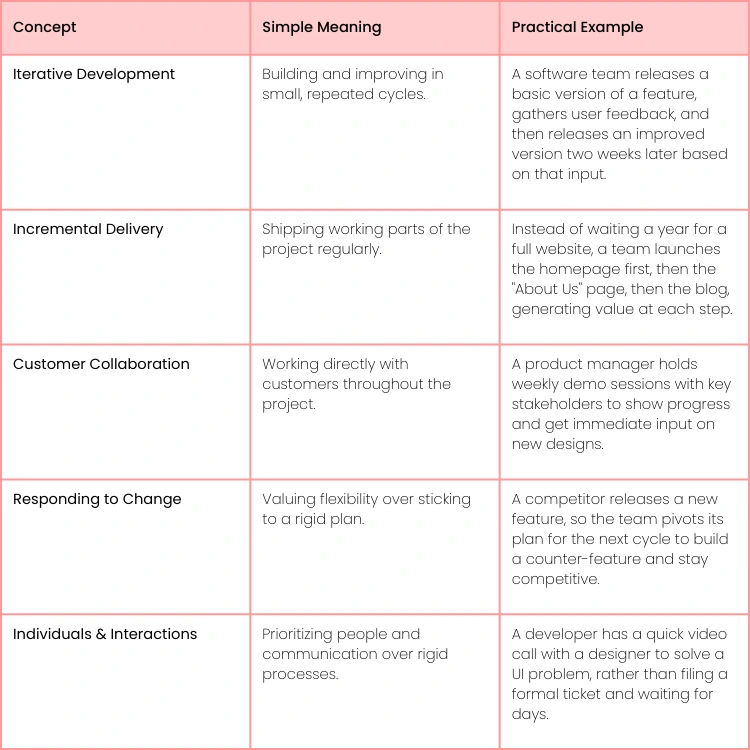
To make these ideas a bit more concrete, here’s a quick breakdown of the core concepts that drive the Agile mindset.
These concepts are the foundation of what makes Agile work. They shift the focus from rigid planning to adaptive execution, allowing teams to deliver what truly matters.
The Four Values Driving the Agile Manifesto
To really get what Agile is all about, we need to jump back to its origin story: the Agile Manifesto. It was cooked up in 2001 by a group of software developers who were just plain fed up with the rigid, documentation-heavy ways projects were being run.
The Manifesto isn't a rulebook. Think of it more as a declaration of priorities—a powerful statement that champions a more human-centered and effective way of building things.
These values aren't about throwing out the items on the right. It's about a fundamental shift in mindset, valuing the items on the left more. It’s about putting people and results ahead of rigid processes.
Individuals and Interactions Over Processes and Tools
At its core, Agile puts its faith in people and their ability to work together. Sure, processes and tools are needed, but they should serve the team, not the other way around. Nothing beats a direct conversation for solving problems quickly and effectively.
- Actionable Insight: Instead of relying solely on a project management tool, encourage your team to have a five-minute "huddle" via video call to resolve a confusing task. The clarity gained in minutes can save hours of back-and-forth comments.
Working Software Over Comprehensive Documentation
The truest measure of progress in an Agile project is a product that actually works. While some documentation is necessary, Agile pushes back against creating massive, exhaustive documents that are often outdated the minute they’re finished. The real focus is on shipping functional pieces of the product that deliver actual value.
Agile teams prioritize progress over paperwork. Delivering something a customer can see and use is always more valuable than creating perfect documentation that nobody reads.
- Practical Example: Rather than writing a 50-page technical specification document, an Agile team might create a simple user story with clear acceptance criteria and a basic wireframe. The rest of the details are figured out through conversations during development.
Customer Collaboration Over Contract Negotiation
Old-school projects often kick off with a massive, detailed contract that tries to predict every possible outcome. This can quickly create an "us vs. them" dynamic, where both sides are just trying to protect themselves from getting burned.
Agile completely flips this on its head by turning the customer into a partner.
Here’s how that plays out:
- The Old Way (Contract Negotiation): A team delivers a feature exactly as spelled out in a six-month-old contract. But the market has shifted, and the client isn't happy with the result. Too bad—the contract was fulfilled.
- The Agile Way (Customer Collaboration): The team shows the client their progress every two weeks. The client gives real-time feedback ("Our users are asking for a different feature first"), and the team adjusts its plan for the next cycle. The result? A final product that is relevant and far more likely to succeed.
Responding to Change Over Following a Plan
The Agile Manifesto accepts one simple truth: things change. Projects almost never go exactly as planned. Instead of treating change as the enemy, Agile teams welcome it as an opportunity to build a better product.
Having the ability to pivot and adapt is way more valuable than sticking to a rigid, upfront plan.
- Actionable Insight: At the beginning of each planning session, ask the question: "What has changed since we last planned?" This simple prompt encourages the team to proactively incorporate new information—like customer feedback or market shifts—rather than ignoring it to stick to the old plan.
Understanding Agile vs Waterfall Project Management
To really get what makes Agile tick, it helps to put it side-by-side with the old-school way of doing things: the Waterfall model.
Picture Waterfall as a train chugging along a fixed track. Before that train even leaves the station, the entire journey is meticulously planned—every route, every stop, every arrival time. Once it’s moving, there’s no changing course, even if a better destination pops up along the way.
Agile, on the other hand, is more like a nimble off-road vehicle. It has a destination in mind, sure, but it’s built to adapt its path based on the terrain it actually encounters. This one difference in flexibility changes everything, from planning and feedback to how each approach deals with risk.
This image really drives home how Agile puts people, working software, and adaptability first—a huge shift from the rigid plans and processes that define Waterfall.
Planning and Feedback Cycles
With Waterfall, all the planning is done in one massive, upfront phase. The team can spend weeks or even months trying to map out every single task from start to finish. You only really get feedback at the end of huge milestones, often long after the work is already done.
Imagine an e-commerce team spending three months designing every last feature for a new website. After another nine months of coding, they finally unveil it to stakeholders, only to find out that customer expectations have shifted and half the features are now obsolete. That’s Waterfall.
Agile completely flips this script. Planning happens in small, continuous bursts, usually called sprints. Teams plan in detail for just the next couple of weeks, build a small, usable piece of the product, and then immediately get feedback from real users or stakeholders. This constant loop keeps the project on track with what people actually want.
How Each Model Handles Risk
Risk is another area where the two couldn't be more different. Waterfall basically saves up all the risk for the very end of the project. You don't find out if you built the right thing until after you've spent all the time and all the money. If you got it wrong, the cost of failure is astronomical.
Agile tackles risk head-on, every single cycle. By shipping small, working pieces of the product early and often, teams can test their assumptions and spot problems while they’re still small and cheap to fix.
Agile doesn't eliminate risk—it manages it in small, digestible pieces. Each sprint is a chance to learn and correct course, dramatically reducing the odds of a major project failure.
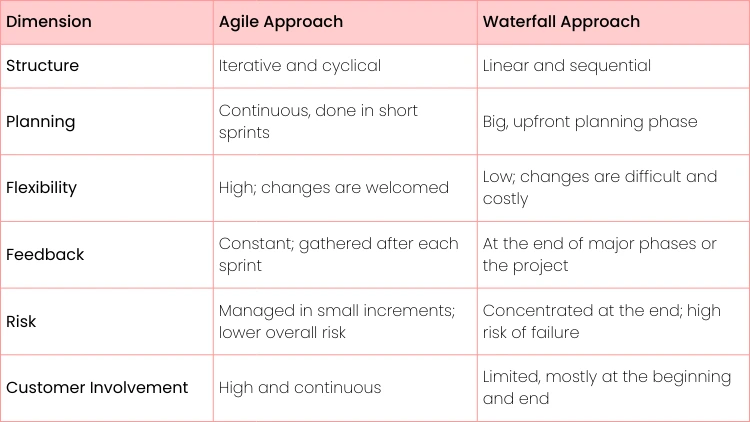
Let's break down these differences a bit more clearly.
Agile vs Waterfall Key Differences
Seeing them side-by-side makes the contrast obvious. One is built for predictability, the other for adaptability.
This core distinction is key to understanding the strengths of each approach. To dive deeper into how different frameworks operate, you can learn more about various types of project management methodology. Ultimately, choosing between them really comes down to what your project needs most.
If Agile is the overall philosophy, then frameworks like Scrum and Kanban are the specific game plans that bring it to life. While plenty of Agile frameworks exist, Scrum and Kanban are the undisputed heavyweights. They give teams the structure they need to actually do Agile day in and day out.
The Two Titans: Scrum and Kanban
Think of Scrum as being like a rugby team. It’s a very structured approach built around short, intense cycles called sprints, which typically last two to four weeks. The whole point is to have a potentially shippable piece of the product ready at the end of every single sprint. For teams adopting this rhythm, having the right tools is key, which is why many look into using Aonmeetings for agile project management and daily stand-ups to keep their cycles running smoothly.
This framework comes with defined roles (like a Product Owner and Scrum Master) and a set of regular meetings, often called ceremonies, that keep the team tightly coordinated and moving the ball down the field together.
Now, if Scrum is a rugby team, think of Kanban as a bustling restaurant kitchen. There are no sprints or fixed cycles. Instead, the entire focus is on creating a smooth, continuous flow of work. The goal is to get tasks (or "tickets") from "order placed" to "served" as efficiently as possible.
The heart of Kanban is the Kanban board, a visual representation of the team's workflow. It’s usually broken down into columns like "To Do", "In Progress" and "Done". The golden rule here is limiting Work in Progress (WIP)—meaning you can only have a certain number of tasks in the "In Progress" column at once. This prevents bottlenecks and stops the team from getting overwhelmed, just like a great chef wouldn't try to cook 20 different meals at the exact same time.
Kanban shares a lot of its DNA with Lean manufacturing, which also obsesses over optimizing flow and eliminating waste. If that sounds interesting, you can get a better handle on the core ideas in this guide on what is Lean management principles.
A Closer Look at the Frameworks
Scrum: For Structured, Iterative Progress
Scrum's magic lies in its rhythm. The sprint cycle creates a predictable cadence for planning, building, and reviewing work. This makes it perfect for complex projects where you know the requirements are going to change along the way. It forces the team to slice big, scary goals into small, achievable chunks.
- Practical Example: A team is building a new mobile banking app.
- They decide to work in two-week sprints.
- For their first sprint, they commit to building just one thing: the user login and authentication feature.
- Over the next two weeks, they plan it, build it, and test it.
- At the end of the sprint, they present a working login screen to stakeholders for immediate feedback before even starting the next feature.
Scrum's time-boxed sprints are its superpower. They create a natural sense of focus and urgency, making sure the team consistently delivers value and gets regular chances to adapt based on real feedback.
Kanban: For Continuous, Flexible Flow
Kanban is all about flow and flexibility. It shines in environments where priorities shift frequently and work arrives unpredictably. It's less rigid than Scrum, making it incredibly adaptable.
- Practical Example: An IT support team using a Kanban board to manage help tickets.
- New tickets land in the "Backlog" column as they come in.
- A support tech pulls a ticket into the "In Progress" column.
- The team has a WIP limit of 2 on that column, meaning a tech can only work on two tickets at a time.
- This rule prevents them from getting swamped and ensures a steady, efficient resolution of issues.
Which One Is Right for You?
The data shows both are incredibly popular. The 17th State of Agile Report found that a whopping 63% of Agile users stick to Scrum at the team level. But don't count Kanban out—it’s used by 56% of organizations, often mixed with other methods, proving just how versatile it is.
Ultimately, there’s no single "best" choice. It all comes down to your team and the nature of your work.
- Actionable Insight: Choose Scrum if you're building a complex product with evolving goals and need the structure of sprints to force prioritization and deliver value incrementally.
- Actionable Insight: Choose Kanban if you’re managing a continuous stream of similar tasks (like support tickets or content creation) and your main goal is to optimize workflow and deliver consistently.
The Real-World Benefits and Common Pitfalls
Switching to an Agile methodology is about much more than just tweaking your workflow; it’s about creating real, tangible business results. The true power of Agile comes from its cycle of shipping, learning, and improving. Instead of pouring months of work into a single, high-stakes launch, teams consistently deliver working pieces of the product.
This approach starts generating value almost immediately. It pulls in crucial early feedback and can even start boosting revenue far sooner than a traditional model. There's a reason Agile has become so dominant. Research from the State of Agile Report shows that companies using Agile methods average a 60% increase in both revenue and profit. What's more, with a project success rate of 75.4%, Agile teams simply outperform their traditional counterparts.
Maximizing Agile Benefits
Of course, getting those kinds of results means doing more than just going through the motions. To really tap into Agile's potential, you have to embrace the mindset behind the mechanics.
- Actionable Insight: Focus on Shippable Increments. The goal for every single sprint should be to produce something a customer could actually use. This isn't about being busy; it's about forcing clarity and making sure the team is always shipping real value.
- Actionable Insight: Embrace Early Feedback. Don't just accept feedback—chase it down. Actively schedule a 30-minute demo with stakeholders at the end of every cycle. This constant feedback loop is your single best defense against building the wrong thing.
- Actionable Insight: Empower the Team. Give your team the autonomy to decide how they get the work done. A self-organizing team isn't just a buzzword; it's a team that is more motivated, more innovative, and much faster at solving problems on its own.
Agile isn't a magic wand. It's a powerful tool that amplifies a team's ability to learn and adapt. Success hinges on a culture that truly values collaboration, transparency, and a relentless drive to get better.
Navigating Common Pitfalls
But let's be realistic—the road to Agile fluency is littered with traps. Knowing what they are is the first step to avoiding them and making your adoption a success.
One of the biggest hurdles is what people call "Agile in name only". This is when teams adopt the ceremonies, like daily stand-ups, but cling to their old, rigid ways of thinking. It's the perfect recipe for frustration without any of the promised benefits. Another huge risk is scope creep, which can spiral out of control if you don't have a strong Product Owner who is empowered to say "no" and fiercely guard the backlog.
Finally, the fast pace of short sprints can easily lead to burnout if you're not careful. "Sustainable pace" is a core Agile principle for a very good reason. It demands an environment of open communication where team members feel safe enough to raise a red flag. Building this foundation is absolutely essential, and understanding the prominence of psychological safety is a critical part of that journey. By anticipating these pitfalls, you can proactively build the supportive culture that Agile needs to truly take root and flourish.
How to Get Started with Agile Today
Jumping into the world of Agile doesn’t have to mean a massive, disruptive overhaul of everything you do. The best way to start is small. Focus on simple, impactful changes that show their value right away. Think of it as an evolution, not a revolution.
A great first move is to run a low-risk pilot project. Pick a small internal initiative or a new feature where the team can practice Agile principles without the crushing pressure of a major deadline. This creates a safe sandbox for them to learn, make mistakes, and figure things out.
Another incredibly practical starting point is simply visualizing your work. Whether it’s for your personal to-do list or a team project, setting up a basic Kanban board is a game-changer. Just create three columns: “To Do”, “In Progress” and “Done”. This simple act brings instant clarity and immediately highlights where work is getting stuck.
Your Actionable Checklist for This Week
You can start putting Agile into practice today with just a few concrete actions. The trick is to introduce one or two new habits and build momentum from there.
- Implement a Daily Stand-Up: Kick off each day with a quick, 15-minute meeting. Everyone on the team answers three simple questions: What did I accomplish yesterday? What am I working on today? Are there any roadblocks in my way? For some extra pointers, check out these tips on the key behaviors for facilitating highly productive project meetings.
- Hold a Mini-Retrospective: Before you wrap up for the week, carve out 30 minutes with your team. Talk about what went well, what was a struggle, and identify one single thing you can all commit to improving next week. For example, the team might agree, "Next week, we will update the status of our tasks on the board before the daily stand-up."
- Focus on a Single Task: This one sounds simple, but it’s powerful. Encourage everyone to focus on getting one task completely finished before they pick up another one. This simple switch helps limit "work in progress" and dramatically improves the team's flow.
As teams begin to adopt these new rhythms, managers often find their roles shifting from director to coach. Empowering your team is the name of the game. Learning more about mastering coaching skills for managers can be an invaluable step in supporting this change.
These small steps help demystify Agile, turning abstract concepts into tangible, everyday habits that get real results.
Frequently Asked Questions About Agile
Let's dig into some of the questions that always come up when people first start exploring Agile. Getting these answers straight can clear up a lot of the confusion and myths floating around.
Can Agile Be Used Outside of Software Development?
Absolutely. While Agile’s roots are firmly in software, its principles are so universal that they’ve spread everywhere. Today, you'll see marketing, HR, manufacturing, and even education teams using Agile because it's simply a better way to handle complex, unpredictable work.
- Practical Example: A marketing team uses a Kanban board to manage content creation. They can visualize their entire workflow with columns like "Idea", "Drafting", "Review" and "Published". This isn't just about organizing tasks; it lets them pivot in a heartbeat when a new market trend emerges or a campaign needs a quick adjustment.
The real insight here is that Agile is a framework for navigating uncertainty. Any project with shifting requirements and a need for quick feedback—from launching a new product line to planning a major event—can benefit from its adaptive DNA.
What Is the Role of a Manager in an Agile Team?
This is a big shift for a lot of people. In a traditional setup, the manager is often the director, assigning tasks and calling the shots. In an Agile world, that role completely transforms into a servant-leader or a coach. Their main job isn't to direct the team, but to enable it.
- Actionable Insight: Instead of asking "Is that task done yet?", an Agile manager asks, "What do you need to get this task done?" They focus on clearing obstacles—like getting a software license approved or chasing down a decision from another department—so the team can focus on their work.
Is Agile Just an Excuse for No Planning?
This is probably the biggest myth out there, and it couldn't be further from the truth. Agile isn't about no planning; it's about adaptive planning. It's a rejection of the old-school idea that you can perfectly map out a massive, complex project on day one and stick to it no matter what.
Agile teams actually plan all the time, just in smaller, more effective bursts. They’ll create a detailed plan for the next two-week sprint while keeping a higher-level roadmap for the long-term vision. This approach means they can actually respond to new information and changing customer needs without throwing the whole project into chaos. It makes the planning process more dynamic, more realistic, and ultimately, more successful.
Ready to build the skills for an Agile career? At Uplyrn, we provide the courses and expert guidance you need to master in-demand methodologies and advance your professional journey. Start learning with Uplyrn today.


Leave your thoughts here...
All Comments
Reply