









What is Cognitive Learning Theory and How It Works

Ever wonder how you really learn something? I’m not talking about just memorizing facts for a test, but that deep, lasting understanding that sticks with you. Cognitive learning theory dives right into that question, suggesting your brain is an active, thinking machine—not just a passive sponge soaking up information.
It focuses on all the crucial mental work happening behind the scenes: thinking, problem-solving, and remembering. This is what separates simple repetition from true comprehension.
Jump To Section

Earn As You Learn
Earn 25% commission when your network purchase Uplyrn courses or subscribe to our annual membership. It’s the best thing ever. Next to learning,
of course.
What Is Cognitive Learning Theory Explained Simply
Imagine your brain is a powerful computer. It doesn’t just store files; it has an operating system that actively processes data, organizes it, and decides what to do with it. That’s the core idea of cognitive learning theory. It’s less about what you learn and all about how your mind processes it.
This approach marked a major shift away from older ideas that only looked at observable behaviors. Instead of seeing learning as a simple reaction to a reward or punishment, cognitive theory explores the mental journey information takes to become real knowledge.
The Computer Analogy Of The Mind
The computer analogy is a fantastic way to grasp this. When you encounter something new, your brain gets to work on a few key tasks:
- Encoding: It takes in information from your senses and translates it into a format it can understand and use.
- Storage: It holds onto that information, whether for just a few moments in short-term memory or for a lifetime in long-term memory.
- Retrieval: It pulls that information back out exactly when you need it, like when you're solving a problem or answering a question.
This model explains why some study methods work so much better than others. Passively rereading a chapter is like having a file sitting on your desktop—it's there, but you haven't engaged with it. Actively quizzing yourself, on the other hand, forces your brain to encode, store, and retrieve, which strengthens the entire learning circuit. You can dive deeper into these mental mechanics in this guide on how the brain learns.
- Actionable Insight: The next time you study, don't just reread your notes. Turn them into flashcards or have a friend quiz you. This forces active retrieval, which is far more effective for long-term memory than passive review.
The Rise of Information Processing
This "brain as a computer" model truly took off with the development of information processing theory in the 1960s. It’s no coincidence that this happened right as computers like IBM's 1964 System/360 were becoming more common.
Psychologists proposed that our minds have three distinct memory systems: a fleeting sensory memory, a limited short-term (or working) memory that holds about 7±2 chunks of information, and a vast, nearly limitless long-term memory. By 1970, this perspective had completely reshaped the field, influencing roughly 60% of psychology textbooks around the world.
By understanding what cognitive learning theory is, you get a peek into your own mental "operating system". This gives you the power to learn more effectively, whether you're taking a course on Uplyrn or tackling any new skill.
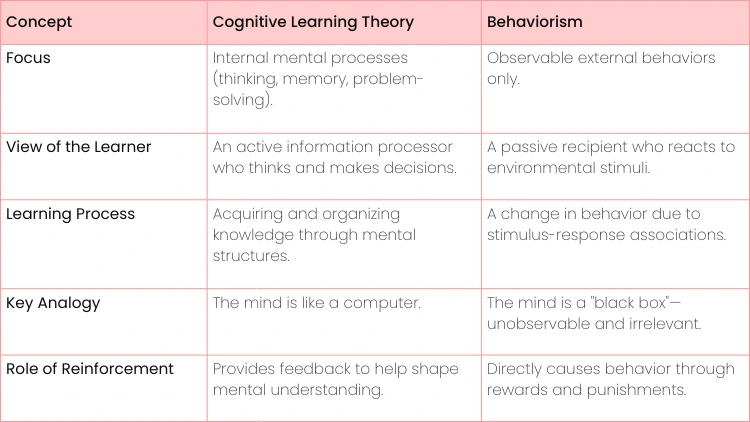
Cognitive Learning vs Behaviorism at a Glance
This table makes it clear just how different the two approaches are. Cognitive theory opened up the "black box" of the mind that behaviorism had ignored, giving us a much richer understanding of learning.
The Shift from Behavior to Brainpower
For a long time, the way we thought about learning was surprisingly simple. Go back to the early 20th century, and the big idea was behaviorism. This theory basically said learning was all about reacting to the world around us—a system of rewards and punishments shaping what we do.
It treated the human mind like a "black box". Since you couldn't see inside, you might as well ignore it and focus only on the behaviors you could see and measure.
This model wasn't entirely wrong. It’s great for explaining simple actions.
- A practical example is training a dog to sit using a treat. The action (sitting) is a direct response to a reward (the treat).
But what about the stuff that makes us uniquely human? Behaviorism had no good answer for how someone could write a song, learn French, or come up with a genius business strategy. These things clearly involve more than just getting a treat.
Opening the Black Box
The cracks in behaviorism's logic created a need for something new. Researchers started pushing back, arguing that to really get learning, we had to peek inside that black box and explore the mental gymnastics that behaviorism blew right past. This kicked off the "cognitive revolution"—a major shift from looking at outside actions to focusing on internal brainpower.
Pioneers of this new movement made a radical claim: learners aren't just passive sponges soaking up information. They are active thinkers who reason, connect ideas, and solve problems. This shift made it clear that understanding how different minds work is key to teaching effectively. You can dive deeper into these differences in this article on the 9 types of intelligence and how they learn.
This new approach, cognitive learning theory, stormed onto the scene in the 1950s and 1960s. It was a complete break from the rigid world of behaviorism, which was championed by figures like B.F. Skinner. Instead of just observing actions, cognitivism dove into the complex, buzzing world inside our heads. The idea caught on fast. By the 1970s, this way of thinking was already shaping over 70% of curriculum designs in major U.S. school districts, pushing for active recall over mindless repetition.
Why This Shift Still Matters
Getting this history isn't just for a pop quiz; it has a direct impact on how you and I learn right now. The ideas born from the cognitive revolution are the bones of every effective, modern learning strategy out there.
- Actionable Insight: Instead of just rereading a manual to learn a new software, try a cognitive approach. Watch a quick tutorial (information intake), then immediately try to replicate the task on your own without the video (active recall and problem-solving). This builds a much more durable skill.
Build knowledge, not just consume it. By actively engaging your mind through exercises, projects, and real-world problems, you’re putting the core lesson of the cognitive revolution to work—and learning in a way that actually sticks.
Exploring the Core Principles of Cognition
To really get what cognitive learning theory is all about, you have to look under the hood at how your brain actually works. Think of it as a mental toolkit—a collection of core processes that turn raw information into real, lasting knowledge. Once you understand these tools, you can start learning with much more purpose.
Schemas: The Brain's Filing System
A central idea in cognitivism is the schema (or schemata, if you want to get formal). Schemas are basically mental frameworks or "filing cabinets" your brain creates to organize everything it knows. They’re like pre-packaged bundles of related information that help you process new experiences without starting from scratch every time.
- A practical example: You have a schema for "restaurant". It includes concepts like menus, waiters, ordering food, and paying a bill. When you enter a new restaurant, you aren't confused; you activate this schema and know exactly what to do.
- Actionable Insight: When tackling a complex new subject, consciously build a schema for it. Before diving into details, sketch out a mind map of the main ideas and how they connect. This creates a mental map, making it much easier to slot in new information as you learn it.
Information Processing and Memory
Cognitive theory often pictures the brain as a kind of organic computer. This information processing model suggests learning happens in a sequence: information comes in through your senses, gets juggled in your working memory, and—if all goes well—is eventually stored in your long-term memory.
Of course, a huge part of this is just understanding how memory works. We all know that information can fade over time, a phenomenon famously mapped by the Forgetting Curve. That's why techniques like spaced repetition are so powerful—they’re designed specifically to fight that natural decay and lock knowledge into long-term storage.
- Actionable Insight: Your working memory has its limits. If you try to cram too much new information into it at once, you create "cognitive load". This is why breaking down a complex project into smaller, manageable tasks is so effective. It prevents your brain's "RAM" from crashing.
The Power of Metacognition
This might be the most important principle of all. Metacognition is just a fancy word for "thinking about your own thinking". It's that internal voice that allows you to step back and check in with yourself. It's the part of you that asks, "Wait, do I actually understand this, or am I just skimming the words?"
This kind of self-awareness is absolutely critical for effective learning. It's a cornerstone of what many experts call deep reading, where you’re not just passively absorbing text but actively wrestling with it.
- A practical example: You finish a chapter in a textbook and try to summarize the main argument in your own words but find yourself stumbling. That moment of realization—"I don't get this part"—is pure metacognition. It's your brain flagging an area that needs another look.
- Actionable Insight: Get in the habit of constantly questioning yourself. At the end of a study session, ask: "What were the three big takeaways here?" or "How does this new information connect to something I already know?" This forces you to evaluate your own understanding.
Piaget and Developmental Stages
You can’t talk about cognitive learning without mentioning Jean Piaget. His work, which he began formalizing back in the 1930s, proposed that our ability to think develops through a series of predictable stages as we grow from children into adults.
While some of the finer details of his theory are still debated today, his proposed sequence of development has been upheld in over 90% of follow-up studies. This gives us a remarkably reliable roadmap for how our thinking naturally evolves from concrete and simple to abstract and complex.
Putting Cognitive Learning into Practice
Alright, we've covered the theory. But knowing the "what" and "why" of cognitive learning is only half the battle. The real magic happens when you start applying these ideas to your own life and work.
Here’s the thing: you’re probably already using many of these strategies without even realizing it. Once you can spot them, you can start using them intentionally to get much better results.
Let’s look at a few practical examples of how people use cognitive techniques to learn new skills and crush complex problems.
Building Mental Models with Mind Maps
Here’s a practical example: a history student facing a final exam on "The American Revolution" grabs a blank sheet and starts a mind map.
They put the main topic in the center. From there, they draw branches for major themes like "Causes", "Key Battles" and "Major Figures". Each of those branches then splits into smaller, more detailed points.
This isn't just a fancy way to take notes. It’s an active process of building a schema—a mental blueprint of the subject. It forces the student to connect causes to effects and people to events, creating a rich web of knowledge. When the exam comes, recalling information isn't about dredging up isolated facts; it's about navigating a map they built themselves.
Learning to Code by Chunking Information
Here’s another practical example: a new developer decides to learn Python, but the mountain of syntax, libraries, and functions feels impossible to climb. So, instead of trying to conquer it all at once, she uses chunking.
She breaks the huge topic into bite-sized pieces:
- Week 1: Focus only on basic syntax and data types.
- Week 2: Move on to control structures, like if-else statements and for loops.
- Week 3: Tackle functions and how to build them.
By mastering one small "chunk" at a time, she completely avoids cognitive overload. Each new concept clicks into place, building on the last one. It’s just like assembling lines of code into a working program—one block at a time. This is a classic example of how to retain information better by simply breaking things down.
- Actionable Insight: The next time you feel swamped by a big, intimidating topic, stop. Don't try to swallow it whole. Pinpoint the core components and tackle them one by one. It’s a simple cognitive shift that makes learning faster and way less stressful.
Solving Problems with Metacognition
- A practical example: a marketing team is tasked with launching a new product. Rather than just brainstorming slogans, they start with a framework built on metacognition.
First, they define the actual problem with clarifying questions: "Who is our exact audience?" and "What single problem does this product solve for them?" This is a quick metacognitive check to make sure everyone is on the same page.
Then, as they brainstorm, they hit pause after every ten ideas to evaluate their own thinking. They ask, "Are these ideas actually supporting our core message?" or "Are we just falling back into old habits?" This process of "thinking about their thinking" lets them spot dead ends, ditch weak concepts, and ultimately produce a far more creative and effective campaign.

How to Apply These Principles
Alright, so we’ve covered the theory. Now for the important part: How do you actually use this to learn faster and better?
Uplyrn wasn't just built to host videos. Its features are grounded in the science of how our brains actually work. Think of it less like a library of content and more like a gym for your mind. When you understand how the tools align with cognitive learning, you can turn passive watching into active skill-building.
Let's walk through how to make the platform work for your brain.
Build Robust Mental Models
Cognitive science is clear: building strong mental frameworks—or what experts call schemas—is the key to truly understanding a topic.
Think of each video lesson as a new file you're adding to a mental filing cabinet. The goal isn't just to stuff the file in there, but to know exactly what's inside and how it connects to the other files.
Actionable Insight:
- Don't just click through quizzes. Use them to genuinely test what you know and pinpoint the weak spots in your mental model. Every question forces you to retrieve information from your memory, which literally strengthens the neural connection.
- After a video, stop. Seriously, just pause and try to explain the main ideas out loud, in your own words. This small act of self-explanation is a shockingly powerful way to make sure the new information sticks.
When you do this, you’re not just memorizing facts. You're weaving a web of knowledge you can actually use down the road.
Learn by Doing with Project-Based Courses
Jerome Bruner, one of the heavy hitters in this field, was a huge advocate for discovery learning. The idea is simple: you learn best by tackling problems yourself. Project-based courses are built entirely on this principle. They push you out of the "theory zone" and into the real world of practical application.
By applying new skills to a real-world project, you are actively testing and refining your understanding. This process bridges the gap between knowing what to do and knowing how to do it.
- A practical example: instead of just reading about web design, you’ll actually build a website. This hands-on work forces you to problem-solve, make judgment calls, and see the direct results of your choices. That’s how you embed a skill so deeply it becomes second nature. If you're inspired to build your own course, we've got a great guide on how to create a successful online course.
Sharpen Your Metacognitive Skills
Metacognition—or "thinking about your thinking"—is the ultimate learning hack. It's your internal quality control system.
- Use Spaced-Repetition: This technique shows you information at increasing intervals, a scientifically proven method for moving knowledge from your flimsy short-term memory into solid long-term storage. Actively engaging with these tools is a deliberate metacognitive strategy.
- Leverage Mentor Feedback: When a mentor gives you feedback, the learning has just begun. Don't just fix the mistake and move on.
- Actionable insight: Ask yourself, "Why did I make that error? What was the flaw in my thinking?" This kind of reflection makes you more self-aware and stops you from making the same mistake twice. It turns a simple correction into a massive learning opportunity.
Your Cognitive Learning Questions, Answered
As we've journeyed through the world of cognitive learning, a few questions naturally pop up. This theory is a big one, touching on everything from memory to problem-solving. So, let's clear up some of the most common points to make sure these ideas really stick.
What’s the Main Difference Between Cognitive and Social Learning Theory?
The biggest difference is where they put the spotlight. Cognitive learning theory zooms right into your own mind—it's all about your personal mental hardware for thinking, reasoning, and remembering.
Social learning theory, pioneered by Albert Bandura, doesn't disagree with that, but it adds another crucial layer: we learn a massive amount from other people through observation, imitation, and modeling. It argues that our surroundings and the people in them are powerful teachers.
- A practical example: You learn the rules of chess (cognitive learning). But you learn a clever opening move by watching a grandmaster play online (social learning). Both are critical to becoming a good player.
How Can I Use Cognitive Learning to Study More Effectively?
You can start using cognitive strategies right now to make your study sessions count. Instead of just letting your eyes glaze over a textbook, these techniques force your brain to actively grapple with the material. That's what makes information stick.
Here are four simple but powerful strategies to try:
- Practice "Chunking": Don't try to swallow an entire topic whole. Break it down into smaller, bite-sized pieces. Master one section of a chapter before you even think about moving on to the next.
- Use "Elaboration": This is all about making connections. When you learn a new fact, ask yourself, "How does this connect to something I already know?" Link a historical event to a movie you've seen or a concept in another class.
- Prioritize "Active Recall": This one is a game-changer. Stop re-reading. Instead, close the book and try to pull the information straight from your memory. Quiz yourself, or better yet, try to explain it out loud to someone else.
- Engage in "Metacognition": Every so often, just stop and ask yourself: "Am I just recognizing these words, or do I truly understand this concept?" If you're not sure, you know it's time to change your approach and review.
Is Cognitive Learning Theory Still Relevant in the Age of AI?
Absolutely. In fact, it might be more important than ever. AI tools are incredible for finding information, but cognitive learning theory is what gives you the skills to manage that firehose of data and actually make sense of it.
- Actionable Insight: Use AI to generate a summary of a complex topic, but then apply a cognitive strategy. Turn that summary into a mind map or try to explain it to a friend without looking at the screen. This forces you to process and own the information, not just consume it.
This is the key. Cognitive learning teaches you how to look at AI-generated content with a critical eye, question its assumptions, and fit its useful parts into your own mental framework. It ensures AI becomes a powerful tool that supercharges your thinking, not a crutch that replaces it.
Are There Any Criticisms of Cognitive Learning Theory?
Of course. Like any big idea in science, it’s not perfect and has its critics. One of the main arguments is that the classic "brain as a computer" analogy, while a helpful starting point, is just too simple.
That model can sometimes ignore the huge role that emotions, motivation, and social context play in how we learn.
- A practical example: You might be perfectly capable of learning a new programming language (cognitive ability), but if you're feeling anxious and unmotivated (emotions), you'll struggle to retain anything.
Real-world learning is messy. We aren't just logical machines processing data; our feelings, our desire to learn, and the people we interact with have a massive impact on what we pay attention to and what we remember. Modern cognitive science is well aware of this, though, and researchers are constantly working to build a more complete picture that includes all these wonderfully human factors.
Ready to put these powerful learning principles into action? Start learning smarter, not just harder, by exploring our course catalog today. Discover your next skill on Uplyrn.


Leave your thoughts here...
All Comments
Reply