









What is Design Thinking Process: A Complete Guide
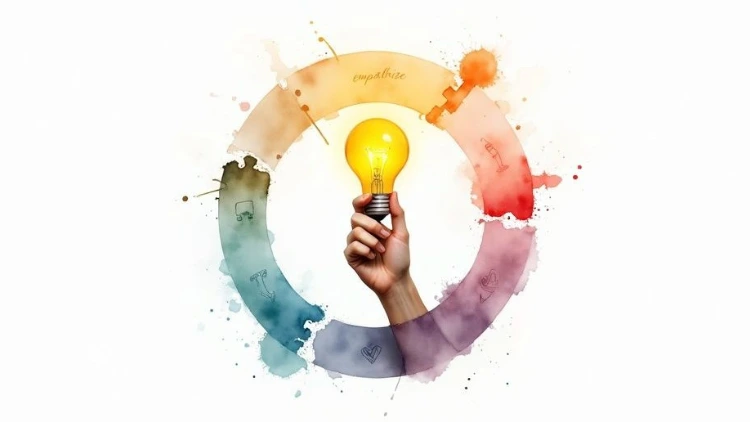
At its core, the design thinking process is a human-centered, iterative method for creative problem-solving. Think of it less like a rigid instruction manual and more like a detective's framework for cracking a complex case. Instead of jumping straight to a solution, you start with people, making sure you deeply understand their needs before anything else.
Jump To Section

Earn As You Learn
Earn 25% commission when your network purchase Uplyrn courses or subscribe to our annual membership. It’s the best thing ever. Next to learning,
of course.
What is the Design Thinking Process, Really?
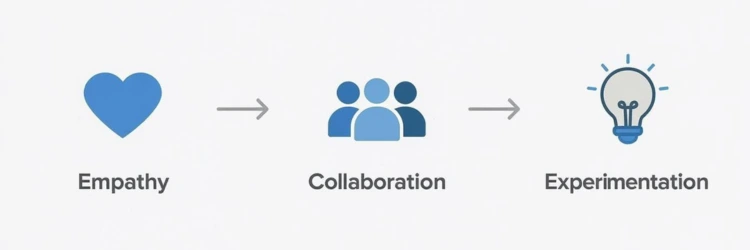
Let’s cut through the jargon. The design thinking process is really a mindset shift that champions empathy, collaboration, and experimentation. It forces teams to get out of their own heads, challenge their assumptions, and build solutions that people genuinely need and want.
This approach flips the traditional problem-solving model on its head. Instead of leading with technology or business goals, it always begins with human desirability. For a deeper dive into the foundational definition and core stages, you can explore another comprehensive guide on what is design thinking process.
A Modern Framework with Deep Roots
While the term feels very current, its origins trace back to intellectual shifts in the mid-20th century, finally hitting the mainstream in the 2000s. Stanford’s Hasso Plattner Institute of Design (better known as the d.school) was instrumental in packaging it into the five-stage process we know today.
This framework shifted the focus from pure technical feasibility to human desirability, a concept that sits at the very heart of creating a great user experience. This focus is also a key part of what this guide on what is user experience design explains in more detail.
Ultimately, the process gives you a reliable way to navigate ambiguity and tackle messy, complex challenges, all while ensuring the human perspective remains the true north for every decision you make.
The Core Idea: Putting People First
The whole framework is built on a simple but powerful idea: to create something meaningful for people, you must first understand their experiences, motivations, and pain points. This relentless focus on empathy ensures the final product or service isn't just functional, but actually resonates and solves a real-world problem.
The main tenet of design thinking is empathy for the people you're trying to design for. Leadership is exactly the same thing—building empathy for the people that you're entrusted to help.
This human-centered philosophy is what sets design thinking apart from other methods. It’s a structured way to approach creativity that helps teams ask better questions, generate more relevant ideas, and—most importantly—reduce the risk of building something nobody wants.
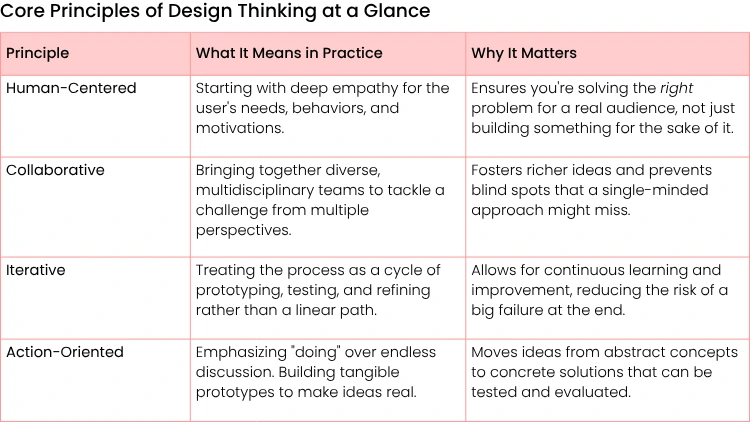
Before jumping into the step-by-step stages, it's helpful to understand the core principles that guide the entire process. These aren't rules, but rather foundational mindsets that keep your efforts grounded and effective.
These principles work together to create a flexible yet robust framework for innovation. They remind us that the goal is not just to find a solution, but to find the best solution for the people we're serving.
The Five Stages of Design Thinking
The design thinking process provides a structured path for teams to travel from a vague problem to a solution people actually want. While it’s often shown as a neat, linear progression, the reality is much more fluid. It’s a flexible, iterative cycle. This five-stage model—famously championed by Stanford’s d.school—breaks the journey down into Empathize, Define, Ideate, Prototype, and Test.
Think of it like this: You start in the Empathize phase by truly immersing yourself in your user's world, sometimes for weeks at a time, just listening and observing. Then, you pull all those insights together in the Define stage to nail down a crystal-clear problem statement. From there, Ideation is all about a no-holds-barred brainstorm to generate hundreds of ideas. The most promising ones are quickly mocked up in the Prototype phase, and finally, you get those rough models into users' hands for Testing to see what sticks.
Stage 1: Empathize
First things first: Empathize. This is the absolute cornerstone of the process. It’s where you consciously shelve your own assumptions and dive headfirst into understanding your users' real experiences, their motivations, and what truly frustrates them. You have to see the world from their perspective.
Let’s say a team is tasked with building a new public transit app. The old way would be to jump right into brainstorming features. The design thinking way is to start by empathizing with commuters.
How to Build Real Empathy:
- Conduct User Interviews: Don't just ask, "What features do you want?" That's a shortcut to boring ideas. Instead, ask open-ended questions like, "Walk me through your commute yesterday. What was the most frustrating part?"
- Practice Active Observation: Actually ride the bus with people. Watch how they juggle their bags, check schedules, and react to a delay. You'll learn more from their stressed sighs and confused glances than any survey could ever tell you.
- Immerse Yourself: Pretend you’re a tourist trying to figure out the transit system for the first time. The friction you feel is a goldmine of insight.
Actionable Insight: The goal of empathy is not just to collect data, but to uncover unspoken needs. People often don't know what they want until you show them a better way. By observing their workarounds and frustrations, you can identify opportunities they can't even articulate themselves.
Stage 2: Define
After soaking up all those stories and observations, you move to the Define stage. This is where you make sense of the chaos. The goal is to synthesize everything you've learned into a single, sharp problem statement—often called a Point of View (POV).
This isn't just an academic exercise. A well-defined problem becomes your team’s North Star, keeping everyone aligned and focused during the creative storm of ideation.
Our transit app team might notice a recurring theme: people aren't just worried about when the bus will get there, they're anxious about the entire journey.
A weak problem statement: "We need to build a bus tracking app." A strong problem statement: "Anxious daily commuters need a way to feel confident and in control of their entire journey, from their front door to their final destination, because unexpected delays and confusing transfers make their commute a constant source of stress."
See the difference? The second one focuses on a deep human need, not just a technical feature. This framing opens up a much richer territory for creative solutions. If you want to dig deeper, this guide on how to reframe the problem by replacing logic with emotion is a great next step.
Actionable Insight: A great problem statement should be inspiring and actionable. Frame it using the "How Might We..." format. For example: "How might we help anxious commuters feel in control of their journey?" This phrasing inherently invites creative solutions instead of just stating a problem.
Stage 3: Ideate
Now that you have your North Star, it’s time to Ideate. This stage is a free-for-all of creative thinking. It’s a judgment-free zone where the main goal is to generate a massive volume of ideas. No idea is too wild or too silly.
Here, quantity trumps quality. Seriously. The aim is to get all the obvious ideas out of the way so you can get to the truly innovative ones hiding beneath the surface.
Our transit app team gets together to brainstorm. They might use a technique like "Crazy Eights" where everyone furiously sketches eight distinct ideas in just eight minutes.
Ideas That Might Emerge:
- A "Journey Confidence" score that updates in real-time.
- Proactive alerts for upcoming transfers, complete with walking directions.
- A feature to share your live trip status with a family member.
- An offline mode that saves maps and schedules for dead zones.
By pushing beyond the obvious, the team uncovers ideas that directly tackle the anxiety and lack of control they identified in the Define stage.
Actionable Insight: Set a specific, ambitious goal for your ideation session, like "100 ideas in 30 minutes". This forces the team to move past their initial, safe ideas and embrace more unconventional thinking. Also, enforce a "defer judgment" rule to create a safe space for creativity.
Stage 4: Prototype
The Prototype stage is where ideas get real. A prototype isn't a polished product; it’s a quick, cheap, and simple model of your idea that you can use to test your core assumptions. Prototyping is about learning fast, not building perfectly.
These can be anything from rough sketches on paper to clickable digital mockups. The point is to create something tangible enough for a user to interact with and give you honest feedback.
The transit app team loves the "Journey Confidence" idea. But instead of spending weeks coding it, they build a low-fidelity prototype in an afternoon.
A Simple Prototype in Action:
- Paper Mockups: They simply sketch the key app screens on pieces of paper, showing how a user would see a confidence score for their trip.
- Role-Playing: One team member plays the "app" by switching out the paper screens, while another plays the "user" and tries to complete a task.
This incredibly simple method can instantly highlight confusing parts of the concept without a single line of code being written.
Actionable Insight: Build your prototype with a specific question in mind. Don't just build the whole idea. If you want to test whether users understand the "Journey Confidence" score, only prototype that single feature. This keeps your testing focused and your learning clear.
Stage 5: Test
Finally, it's time to Test. You put your prototype in front of real users and—this is the important part—you watch and listen. This isn't a sales pitch. It's a fact-finding mission to see what works, what doesn't, and why.
The best way to test is to show, not tell. Hand over the prototype, give the user a simple task ("Plan your commute to work for tomorrow"), and encourage them to think out loud.
Our team shows their paper prototype to a few commuters. One user looks at the "Journey Confidence" score and says, "What does 73% confident even mean? Just tell me if I’m going to be late." Boom. That one sentence is pure gold.
It tells the team their core idea is on the right track, but the execution is confusing. With that feedback, they can loop back to the Ideate or Prototype stage to refine the idea—maybe changing the score to a simple "On Time" or "Minor Delay". This cycle of building, testing, and learning is what makes design thinking so powerful. It ensures the final product isn't just cool, but genuinely useful.
Actionable Insight: Instead of asking "Do you like it?", ask "What would you expect this button to do?" or "Tell me what you're thinking right now." Open-ended questions will give you much richer feedback than simple yes/no answers.
This infographic captures the spirit of the whole process—it all starts and ends with people.
As you can see, the entire framework is fueled by empathy, thrives on collaboration, and is driven forward by constant experimentation.
Your Essential Design Thinking Toolkit
A great idea is one thing, but bringing it to life is a whole different ballgame. The design thinking process isn't just a set of abstract stages; it's a hands-on framework that runs on specific, battle-tested tools. Here, we'll move past the theory and give you a practical toolkit to navigate each phase with confidence.
Think of these tools like instruments in a detective's bag. You won't use every single one for every case, but knowing which to pull out at the right moment is what turns a good hunch into a solved mystery. Each method is designed to help you uncover insights, spark fresh ideas, and make your concepts tangible.
Let's unpack the essential tools that line up with each stage of the design thinking journey.
Tools for the Empathize Stage
The whole point here is to get out of your own head and step into your user's world. These tools are all about capturing and making sense of human experiences.
- Empathy Maps: This is a simple but incredibly powerful visual that helps you piece together your observations into a clear picture of a user. It’s a quadrant chart where you map out what a user Says, Thinks, Does, and Feels.
- Practical Example: Imagine a team designing a new banking app. They interview a young professional who says, "I really want to save more money." But his bank statements show he does a lot of impulse buying online. He thinks budgeting is too complicated and feels anxious about his financial future. That map just revealed a massive tension between his goals and his actual behavior—a perfect spot for a solution.
- User Personas: A user persona is a fictional character you create to represent a key user group. It's way more than just a demographic profile; it’s a vivid snapshot of their goals, motivations, and frustrations, often complete with a name and a photo.
- Actionable Insight: The key is to build personas from real user research, not just assumptions. This tool keeps your team laser-focused on a specific individual ("Would 'Anxious Alex' understand this feature?") instead of designing for a vague, generic "user".
Tools for the Define Stage
Once you've gathered all those empathy-driven insights, the next job is to frame a clear, actionable problem statement. These tools bring some much-needed clarity to the chaos.
- The '5 Whys' Technique: This is a deceptively simple method for digging down to the root cause of a problem. You just start with a surface-level issue and repeatedly ask "Why?" until you uncover what's really going on.
- Practical Example: A website has high cart abandonment. 1. Why? Users are leaving on the shipping page. 2. Why? They're surprised by the shipping costs. 3. Why? The cost isn't shown earlier. 4. Why? The system can't calculate it until an address is entered. 5. Why? We haven't built a shipping estimator tool. Suddenly, the root problem isn't the cost itself, but the user's surprise and lack of control.
- Customer Journey Mapping: This tool visualizes the entire experience a person has with your product or service, from the first time they hear about it to becoming a long-term user. It maps out each step, highlighting their actions, thoughts, and emotional state along the way. This is how you pinpoint those moments of friction and uncover opportunities for delight.
Tools for the Ideate Stage
Alright, time to open the floodgates and generate a ton of solutions. The focus here is on quantity over quality—you want to push past the obvious answers and see what's lurking beyond.
A common pitfall in ideation is falling in love with the first good idea. The real goal is to explore the entire solution space, because the tenth idea is often way more innovative than the first. True breakthroughs happen when you challenge those initial assumptions.
- Brainwriting: Instead of a traditional verbal brainstorm where the loudest voices can take over, brainwriting is a silent, written process. Each person jots down three ideas on a card, then passes it to the next person, who adds three more ideas inspired by what they just read.
- Actionable Insight: This technique is brilliant because it guarantees everyone contributes equally and helps build on each other's ideas in a really structured way.
- Storyboarding: Borrowed straight from the world of filmmaking, storyboarding helps you visualize how a user might actually interact with your solution. It's just a series of simple sketches that tell a story, helping your team think through the user's experience step-by-step and spot potential problems before you've built a thing. For more inspiration, checking out the 6 best crowdsourcing design platforms can offer a glimpse into how diverse ideas are visualized and brought to life.
Tools for the Prototype and Test Stages
This is where your ideas finally become tangible and get put in front of real people. The mantra for these stages is simple: "build to learn".
- Paper Prototypes: This is the fastest, cheapest way to make an app or website concept feel real. You just sketch the key screens on paper and let a user "interact" with them while you manually switch out the pages. It's absolutely perfect for testing core concepts and the general flow of information.
- Feedback Grids: During user testing, it's easy to get swamped with comments. A feedback grid helps you neatly organize everything into four quadrants: What Worked, What Could Be Improved, Questions, and New Ideas. This simple structure makes it a breeze to spot patterns in the feedback and decide what to do next.
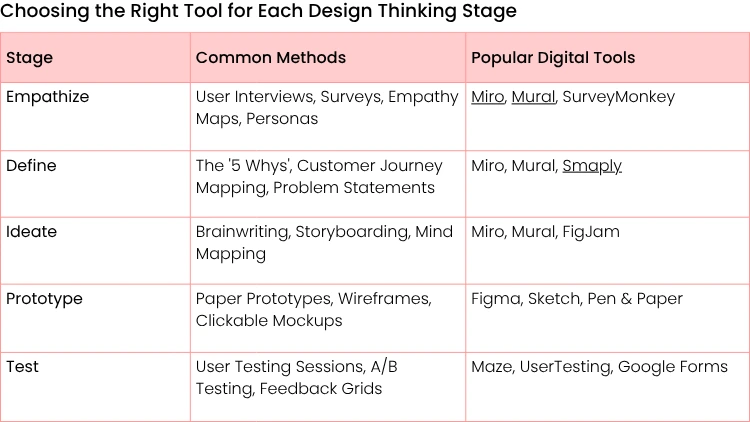
Navigating the toolkit can feel overwhelming at first, so here’s a quick-reference table to help you match the right methods and tools to each stage of your project.
Think of this table as your starting point. The best tool is always the one that helps your team communicate clearly and move forward with confidence. Don't be afraid to mix and match to find what works for you.
Seeing Design Thinking in the Real World
Frameworks and theories are great on paper, but how does design thinking actually hold up when the stakes are real? You truly see its power when organizations use it to solve messy, complicated problems. The stories that follow show just how a human-centered approach can lead to those breakthrough ideas that just click with people.
And this isn't just about feeling good. The numbers back it up. A major survey by the Design Management Institute found that companies deeply invested in these practices outperformed the S&P 500 by an incredible 211% over ten years. Big players have also reported that design thinking can slash development costs by up to 30% and shorten product cycles by 25-40%, all because they started listening to users early. You can dig into the specifics in this research on design thinking's impact.
It's proof that putting people first isn't just a nice idea—it's smart business.
Airbnb: From Near Failure to Global Phenomenon
It's hard to imagine now, but in its early days, Airbnb was on the verge of collapsing. They were struggling to get any traction, and their New York City listings were bringing in next to nothing. The founders had a hunch, but instead of getting lost in spreadsheets, they decided to follow the first rule of design thinking: empathize.
So, they flew to New York, booked their own listings, and actually lived with their hosts. It didn't take long to spot the problem. The photos of the apartments were terrible—dark, blurry, and totally unappealing. This wasn't an insight from a data model; it came from seeing the world through their users' eyes.
- The Problem: The listings just weren't compelling. Nobody felt confident enough to book a stay based on those crummy photos.
- The Solution: The founders rented a high-quality camera and went door-to-door, taking professional photos of the properties themselves. This obviously wasn't a long-term strategy, but it was a quick, tangible prototype to test their theory.
- The Result: The week after the new photos went live, the company's weekly revenue in NYC doubled. That small, empathy-driven experiment saved the company and laid the groundwork for its focus on trust and quality. It’s a great lesson to keep in mind when you're coming up with innovative awesome startup ideas of your own.
Actionable Insight: Don't be afraid to do things that don't scale at first. The goal of early prototyping isn't to build a perfect system. It's to learn what truly matters to your users as quickly and cheaply as you can.
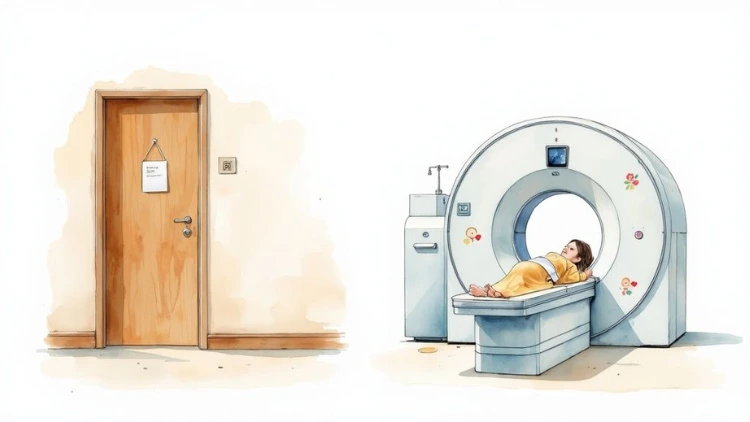
GE Healthcare: Redesigning the MRI Experience for Children
An MRI scan is unsettling enough for an adult. For a child, the loud, tight machine can be absolutely terrifying. Doug Dietz, a lead designer at GE Healthcare, had a gut-wrenching moment when he saw a young girl crying right before her scan. He realized he hadn't just designed a medical device; he had designed a scary monster.
That moment of empathy was the spark for a design thinking project that completely transformed the patient experience.
- Empathize: Dietz and his team didn't just read studies. They went to daycare centers to observe children and spoke with child life specialists to understand what makes kids feel engaged and safe.
- Ideate & Prototype: They came up with the "Adventure Series". The MRI machine was no longer a machine; it became a pirate ship, a spaceship, or a canoe. The entire room was decorated to match, and technicians were trained to guide the kids on an imaginative journey.
- Test & Impact: The results were nothing short of incredible. Before the redesign, 80% of pediatric patients needed sedation to get through an MRI. After the "Adventure Series" rolled out, that number plummeted to less than 10%.
GE didn't have to change the core MRI technology at all. They just had to reframe the problem from "How do we build a better machine?" to "How might we create a better experience for a child?"
Actionable Insight: Your user's emotional journey is just as critical as your product's technical performance. If you map out their feelings—anxiety, fear, excitement—you'll uncover powerful opportunities for innovation that your feature-focused competitors will completely miss.
Putting Design Thinking to Work on Your Team
Moving from theory to action is where the real fun begins with design thinking. The good news? You don’t need a massive budget or a fancy innovation lab to get started. All it takes is a willing team, a clear challenge, and a simple framework to guide you.
The objective here is to create a small, successful first run. This isn't about transforming the company overnight; it's about building confidence and showing people what this process can actually do.
One of the biggest hurdles is often getting buy-in from stakeholders who might be skeptical. Instead of hitting them with a long presentation full of theory, just show them results. Your best bet is to frame the first project as a low-risk experiment that tackles a specific, nagging problem the team already complains about.
Your First Team Exercise: The Wallet Project
A fantastic way to introduce the full design thinking cycle in less than an hour is the famous "Wallet Project" from Stanford's d.school. It's a fast, hands-on exercise that walks your team through all five stages using an object everyone understands.
Here’s the breakdown:
- Partner Up: Everyone pairs up with a colleague. Simple.
- Empathize (4 mins): Person A interviews Person B about their wallet. What do they love? What drives them crazy? What’s the story behind that old movie ticket stub they still carry? Then, you switch.
- Define (3 mins): Based on that interview, each person crafts a problem statement for their partner. Something like, "My partner needs a way to feel secure without lugging around a bulky, overstuffed wallet."
- Ideate (5 mins): Now, everyone rapidly sketches 5-7 wild ideas for a new wallet that solves their partner's specific problem. No idea is too out there. The crazier, the better.
- Prototype & Test (10 mins): Using whatever you have on hand—paper, tape, sticky notes—everyone builds a rough prototype of their best idea. Then you present it to your partner, get their immediate feedback, and see what works and what falls flat.
This quick exercise perfectly demonstrates the core ideas of empathy, quick iteration, and user feedback in a way that’s tangible and memorable.
Overcoming Common Hurdles
As you start using design thinking on real projects, you’re going to hit some bumps in the road. Knowing what they are ahead of time is half the battle.
- Resistance to Change: You’ll almost certainly hear someone call the process too "fluffy" or slow. The trick is to start small and score a quick win. Focus on a real problem where the results will be undeniable.
- Lack of Psychological Safety: People won't share their best, craziest ideas if they're afraid of being judged. Building an environment of trust isn't just a nice-to-have; it's a must. You can learn more about the critical role of the prominence of psychological safety in creative work.
- Tight Budgets: Design thinking doesn’t have to be expensive. Lean into low-cost methods like paper prototyping, mapping out customer journeys on a whiteboard, and conducting user interviews over a simple video call.
The most important thing is to just start. Don't wait for the perfect project or the perfect team. Pick a small, manageable problem and guide your team through one cycle. That little bit of momentum from a first success is what builds a lasting culture of innovation.
Got Questions About Design Thinking? We’ve Got Answers.
As teams start to get their feet wet with design thinking, a few questions almost always pop up. Getting straight answers can help pull back the curtain on the process, avoid common tripwires, and give your team the confidence to really run with it. Let’s tackle some of the most common ones.
Is the Design Thinking Process Always Linear?
It’s easy to look at the five stages—Empathize, Define, Ideate, Prototype, Test—and assume you have to follow them in a rigid, one-through-five order. But that’s a common misconception. The truth is, the process is incredibly fluid and non-linear. Think of it less like a straight line and more like a web of connected pathways you can jump between.
In the real world, teams are constantly looping back and forth between stages as they learn more.
- Practical Example: Imagine your team is testing a prototype for a new mobile banking app. During the Test phase, a user says they feel anxious because they can’t see their total account balance on the main dashboard. That one comment could send you right back to the Ideate stage to brainstorm new layouts. Or, it might push you all the way back to Empathize to dig deeper into the user's feelings about financial security.
This flexibility isn’t a bug; it’s a feature. It’s what allows you to adapt and refine your solution based on what you learn from real people.
Can Design Thinking Be Used by Non-Designers?
Absolutely. In fact, one of the most powerful things about design thinking is that it’s not just for designers. It's a problem-solving mindset that anyone can adopt, no matter their job title.
Engineers, marketers, project managers, and even teachers can apply its principles to their work. The whole point is to focus on empathy, collaboration, and experimentation—skills that are gold in any field. The key is simply embracing the mindset of putting your user first and staying open to creative solutions.
Actionable Insight: The real magic happens when you get a mix of people in the room. A marketer will spot problems an engineer might miss, and both will see things differently than a customer support agent. This diversity of thought is the fuel for truly innovative ideas.
How Long Does a Typical Design Thinking Process Take?
There’s no single answer here. The timeline for a design thinking cycle can vary wildly depending on the complexity of the problem and the scope of the project.
A focused workshop or a "design sprint" might run through a full cycle in just a few days. But for a much bigger challenge—like building a brand-new software product from scratch or completely overhauling a customer service experience—the process could stretch over several weeks or even months of continuous iteration.
What Is the Difference Between Design Thinking and UX Design?
This is a big point of confusion for many. The easiest way to break it down is this: design thinking is a broad problem-solving framework, while User Experience (UX) design is a specific discipline that often puts that framework into practice.
- Design Thinking can be applied to almost any challenge you can think of, from improving employee morale in an office to redesigning a hospital waiting room.
- UX Design is laser-focused on the interaction between a person and a product, whether it's an app, a website, or a physical device.
Basically, a UX designer is a specialist who leans heavily on the design thinking process to make sure the final product is useful, easy to use, and enjoyable for the person on the other end.
At Uplyrn, we believe that learning practical problem-solving methods like design thinking is crucial for career growth. Our courses are built by industry experts to give you the skills you need to tackle tough challenges and create solutions that matter. Explore our courses and start building your innovation toolkit today.


Leave your thoughts here...
All Comments
Reply