








What is Lifelong Learning: Practical Guide to Career Impact
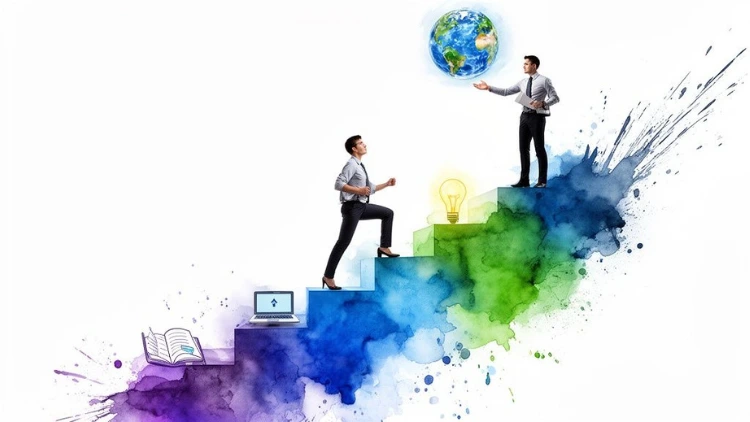
Lifelong learning is simply the continuous, voluntary, and self-motivated drive to keep learning, whether for personal growth or professional advancement. It’s not about stacking up degrees. It’s about cultivating a deep-seated curiosity that keeps you adaptable throughout your life—whether that means learning a new language, getting the hang of new software, or finally picking up that hobby you've always been interested in.
Jump To Section

Earn As You Learn
Earn 25% commission when your network purchase Uplyrn courses or subscribe to our annual membership. It’s the best thing ever. Next to learning,
of course.
Your Quick Guide to Lifelong Learning
Think about traditional education for a second. It often feels like a project with a definite start and a firm end date. You graduate, toss your cap in the air, and that's that.
Lifelong learning couldn't be more different. It’s more like a subscription service for your brain—an ongoing process that keeps you sharp, relevant, and connected to the world long after you've stepped out of a classroom. This mindset transforms learning from a formal, scheduled event into a natural, everyday habit.
This isn’t just about passively soaking up information, either. It’s an active choice to grow. For example, a graphic designer who mastered Adobe Photoshop a decade ago might decide to take online courses in Figma and UX design to stay competitive. On a more personal note, a retiree might dive into digital photography to unlock a new creative passion.
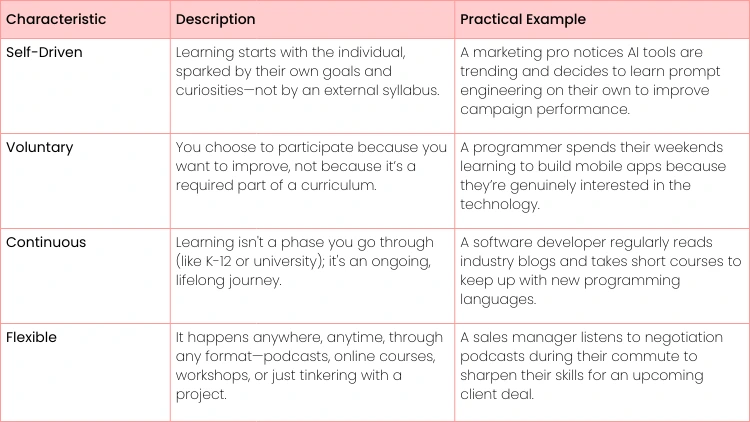
Key Characteristics of Lifelong Learning at a Glance
So, what does lifelong learning actually look like? To really get it, you have to see its core traits in action. Unlike the rigid world of formal schooling, this approach is all about flexibility and your own internal drive. If you're curious about building this mindset, this article on becoming an eternal learner is a great place to start.
This table really helps clarify the difference, breaking down the core components of a modern continuous learning mindset versus a more traditional one.
At its heart, lifelong learning is about empowerment. It puts you in the driver's seat of your own development, giving you the tools to adapt, innovate, and thrive no matter what changes come your way.
Why Continuous Learning Is No Longer Optional
In a world that’s constantly being reshaped by technology, professional skills now have a surprisingly short shelf life. Think of your current abilities like the software on your computer—without regular updates, they quickly become slow, incompatible with new systems, and eventually, obsolete. This is the new reality for everyone in today’s workforce.
The pressure to adapt is everywhere. A digital marketer who mastered social media ads five years ago now has to get their head around AI-powered analytics just to stay effective. A software developer who was an expert in one popular coding language might find themselves needing to learn three new ones just to keep up.
This isn’t some passing trend; it's a fundamental shift in how our economy works. The need for constant upskilling and reskilling is so critical that it’s fueling a massive global market.
The Economic Imperative to Keep Learning
This constant demand for new skills isn't just a personal challenge—it’s a major force driving the global economy. You can see this reflected in the lifelong learning market, which was valued at around USD 118.7 billion in 2025 and is projected to more than double to USD 231.4 billion by 2032. That incredible growth, highlighted in this detailed lifelong learning market report, sends a clear message: standing still means falling behind.
These numbers underscore the urgency for both individuals and companies. Businesses are pouring more money into their training budgets not just for growth, but for pure survival. They know that an adaptable, constantly learning workforce is their single greatest asset for navigating change. Ignoring this leads directly to a skills gap that requires urgent attention.
For today's professionals, learning isn't a one-time event. It’s a continuous cycle of updating, adapting, and growing. It’s the single most effective strategy for building a resilient, future-proof career.
The whole idea of lifelong learning really boils down to three core principles: being continuous, self-driven, and always focused on growth.
These traits show how modern learning is an active, ongoing process that you control. It’s about building a proactive mindset and taking charge of your own development, rather than just waiting for knowledge to come to you.
The Real-World Payoff of Lifelong Learning
It’s one thing to understand that continuous learning is important, but it’s another to see the direct benefits in action. For individuals, committing to lifelong learning is like taking out an insurance policy on your career—it builds resilience and leads directly to professional growth, higher earning potential, and much greater job security in a market that never stands still.
It's the difference between letting the future happen to you and actively building the one you want.
This commitment pays off big time for businesses, too. When a company creates a genuine learning culture, it’s not just checking a box on an HR form. It's making a powerful, strategic investment in its own future. These environments are proven to boost employee retention, spark game-changing innovation, and build a workforce that can pivot on a dime.
How You Can Maximize Your Career Impact
For working professionals, the benefits are immediate and tangible. Let’s imagine a project manager who starts noticing that data-driven decisions are becoming the new standard at her company. Instead of just sticking to what she knows, she decides to earn a certification in data analytics.
With this new skill set, she can suddenly:
- Lead More Effectively: She can now dive into complex data to forecast project timelines and allocate resources with incredible accuracy, moving beyond guesswork.
- Increase Her Value: She quickly becomes the go-to expert for data-informed strategy, making her indispensable to her team and leadership.
- Unlock New Opportunities: This single skill qualifies her for senior roles that demand a mix of management and analytical expertise, giving her salary potential a serious boost.
Even brushing up on old skills can have a surprising impact. Something as simple as taking an algebra refresher for adults can sharpen problem-solving abilities and open doors you didn't even know were there.
Fueling Corporate Growth and Agility
For companies, the return on this investment is just as clear. Pouring resources into employee development is the most direct path to a more capable, engaged, and motivated workforce. This isn't just a theory; a recent landmark study found that 51% of employers are planning to increase their training budgets in the next two years.
A culture of learning is a company's best defense against disruption. It transforms employees from passive workers into active problem-solvers who drive the organization forward.
If you’re curious about how this plays out in the real world, this deep dive on why training is important for employees breaks it down even further.
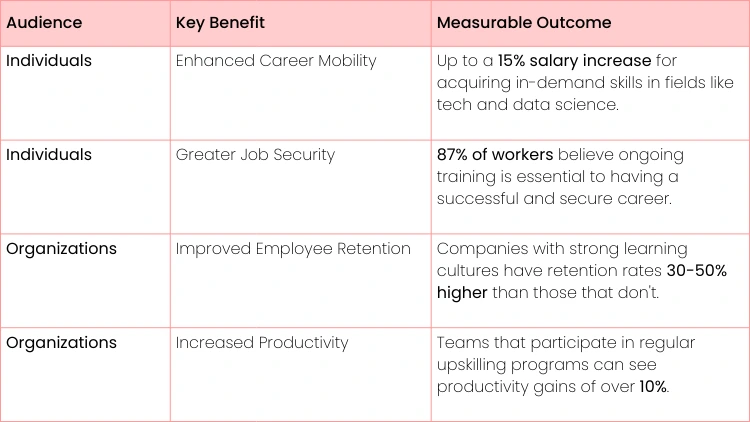
The numbers don't lie. Below is a quick look at the concrete returns you can expect from a commitment to lifelong learning, whether you're an individual or a business.
Return on Investment for Lifelong Learners
This table breaks down the tangible ROI of continuous learning for both individuals and organizations.
As you can see, the measurable outcomes for both employees and employers make the case for continuous development undeniable. It's a win-win that pays dividends for years to come.
Practical Ways to Embrace Lifelong Learning
Knowing the “why” behind lifelong learning is one thing, but actually doing it is where the magic happens. Trying to squeeze continuous learning into an already packed schedule can feel like a huge ask, but it’s more doable than you might think. The trick is to start small and build habits that stick.
Forget the idea that you need to go back to school or sign up for some massive degree program. Instead, think about learning as a series of small, deliberate actions that add up over time. This approach turns skill development from a chore into a natural part of your professional rhythm.
One of the best strategies is the "5-Hour Rule", a simple concept used by successful leaders like Bill Gates. The idea is to set aside one hour every weekday—or five hours a week—for intentional learning. This isn't time for answering emails or finishing daily tasks; it's protected time purely for growth.
Build Your Daily Learning Habit
A sustainable learning routine is all about finding what clicks for you. The real goal is to weave these activities into your day so seamlessly that you don’t even have to think about them.
Here are a few practical ways to get the ball rolling:
- Embrace Micro-Learning: Got a 15-minute commute? Use that time to listen to an industry podcast. Waiting for a meeting to start? Watch a quick tutorial on a new software tool. These small pockets of time add up.
- Leverage Professional Communities: Jump into industry-specific groups on platforms like LinkedIn or Slack. You’d be surprised how much you can learn just by reading discussions, asking questions, and absorbing insights from your peers.
- Actionable Insight: Each week, find one interesting question in a group and write a thoughtful reply. This forces you to organize your own knowledge.
- Schedule Learning Blocks: Treat learning like a client meeting—put it on your calendar. Blocking out dedicated time for reading, taking an online course, or just tinkering with a new skill makes it a priority.
- Actionable Insight: Set a recurring 30-minute appointment on your calendar for Tuesday and Thursday mornings labeled "Skill Development".
These small, consistent actions are what build a powerful lifelong learning habit. For a closer look at how to make this work, check out this guide on how to create an ongoing learning cycle.
Formal and Informal Learning Paths
Your learning journey can be a mix of everything, from formal, structured courses to casual, self-guided exploration. Thanks to the boom in online learning, quality education has never been more accessible. In fact, by 2025, it's expected that 49% of students worldwide will be involved in some form of online learning. The sector is set to grow over 200% from its pre-2019 levels. It’s a massive shift that has put skill-building right at our fingertips.
The modern learner doesn't choose between a formal course and an industry podcast—they use both. The most effective approach is a hybrid one that mixes structured knowledge with real-time insights.
To get even more out of your efforts, look into concepts like social learning, which brings a collaborative, community feel to online courses. A well-rounded approach might look something like this:
- Formal Learning: This is your structured path.
- Example: A graphic designer takes a certified online course to master UI/UX principles, earning a credential they can put on their resume.
- Informal Learning: This is your daily dose of knowledge.
- Example: That same designer follows industry leaders on social media, subscribes to insightful newsletters like UX Collective, and joins free webinars to keep a pulse on emerging design trends.
When you combine these methods, you build a skill set that's not just deep but also incredibly adaptable, getting you ready for whatever comes next.
Find Your Lifelong Learning Partner with Uplyrn
Knowing you need to keep learning is one thing, but figuring out how to do it can feel like a job in itself. That’s where having a real partner in your corner changes everything. We built Uplyrn to be more than just a library of courses; it’s a full support system designed to help you turn new knowledge into actual career growth.
Instead of just giving you videos and leaving you to connect the dots, Uplyrn tackles the real challenges of continuous learning head-on. Our ecosystem covers the most in-demand fields—think technology, business, and creative skills—so you can always find a path that lines up with where you want to go. The entire platform is built for tangible outcomes, bridging that critical gap between knowing something and being able to do it on the job.
From Learning to Earning
At the end of the day, the goal of professional development is to see a real return on your investment of time and energy. Uplyrn is obsessed with making that happen by tying your learning directly to your career path. This comes to life through two features that really set us apart.
First, you get access to one-on-one mentorship with industry experts. Imagine learning a new coding language and having a senior developer actually review your code. Or refining your marketing strategy with direct feedback from a CMO who’s been there and done that. This kind of personalized guidance is what helps you master skills fast and with real confidence.
Second, Uplyrn offers job opportunities through a jobs board. We connect you with companies looking for the exact skills you just learned.
The most effective learning doesn't end with a certificate—it ends with a new opportunity. A true learning partner helps you connect the dots between skills and career advancement.
With a community of over 10,000 successful students, we’ve seen this model work time and time again. Uplyrn gives you practical tools and a supportive framework to make sure your efforts lead to real, measurable results and empowers you to build a resilient, future-proof career.
Frequently Asked Questions About Lifelong Learning
Even when the idea of lifelong learning clicks, the practical questions start to surface. We all hit these same roadblocks—the little doubts and logistical hurdles that can stop a good intention in its tracks.
So, let's get straight to it. Here are the most common questions we hear, along with some real-world advice to help you move past them and build a learning habit that actually sticks.
How Do I Find Time for Learning with a Busy Schedule?
This is probably the number one question, and it’s rooted in a myth: that learning requires huge, empty blocks of time. The truth is, it’s not about finding more hours in the day. It’s about being smarter with the minutes you already have.
Consistency will always beat cramming. Instead of searching for that perfect, uninterrupted afternoon (it doesn’t exist), the trick is to weave learning into the fabric of your existing routine. This way, it stops feeling like another task on your to-do list and becomes a natural part of your day.
Here are a few actionable ways to make it happen:
- Book a "Learning Meeting": Put it on your calendar. Block out 30 minutes a couple of times a week, just like you would for a work call. Protect that time—it’s an appointment with your future self.
- Reclaim Your Commute: If you’re driving, swap the radio for an industry podcast or an audiobook.
- Practical Example: A sales professional could listen to "The Advanced Selling Podcast" on their way to work to pick up new closing techniques.
- Master the In-Between Moments: Have 10 minutes before a meeting starts? That's enough time to knock out one lesson in an online course or read a quick blog post. These tiny pockets of time add up faster than you think.
Is Formal or Informal Learning Better for My Career?
This feels like a trick question because it sets up a false choice. You don't have to pick one. The smartest professionals don’t see it as "either/or" but as "both/and". Think of it as having a full toolkit for your career—you need different tools for different jobs.
Formal learning is your foundation. It’s the structured degree, the certification, the course that gives you a credential. It’s fantastic for building deep knowledge in a new area and giving employers a clear signal that you have a specific skill set.
The real magic for your career happens when you blend the two. Formal learning gets you in the door with credentials, but informal learning gives you the agility to solve problems and stay relevant once you're there.
Informal learning, on the other hand, is all about staying sharp and agile day-to-day. It’s the stuff you do on your own—reading blogs from experts, attending webinars, listening to podcasts, or just messing around with a new piece of software. It’s how you keep up with what’s happening right now.
A great example is a software developer who gets a formal certification in cloud architecture to qualify for a senior role (formal). At the same time, she’s active in online coding forums like Stack Overflow and experiments with new libraries on personal projects to solve immediate problems at work (informal). That combination makes her not just qualified on paper, but incredibly effective in practice.
How Can I Measure the Results of My Learning?
Learning for the sake of learning is great, but for your career, you need to see a return on your effort. If you can’t connect your learning to real-world results, it’s easy to lose motivation. Tracking the ROI makes it tangible and gives you something to show for it.
First, you have to know what you’re aiming for. Before you even start a course, ask yourself: What’s the goal? A promotion? A raise? The confidence to lead a new project? Get specific.
Once you have a clear target, you can track your progress against it. Here are a few concrete ways to measure your impact:
- Update Your Profiles Immediately: The moment you finish a course or get a new skill down, add it to your resume and LinkedIn profile.
- Actionable Insight: Write a new post on LinkedIn summarizing what you learned and how you plan to apply it. This showcases your initiative.
- Volunteer for Harder Projects: The best way to prove you’ve learned something is to use it. Put your hand up for assignments that demand your new skills. When you deliver, that success is undeniable proof of your new capabilities.
- Watch Your Numbers: If you learned a skill related to your KPIs, track them!
- For example, if you took a course on data analytics, can you show a 10% increase in campaign conversions because of the insights you generated? That's a powerful metric for a performance review.
- Ask for More Money: This is the most direct ROI. Armed with new certifications and a portfolio of successful projects, you have powerful leverage to negotiate a higher salary during your next performance review.
When you start tracking outcomes like these, learning stops being a hobby and becomes what it truly is: a powerful strategic asset for your career.
Ready to turn your learning into tangible career growth? Uplyrn offers the courses, expert mentorship, and job opportunities you need to succeed. Start your journey today.


Leave your thoughts here...
All Comments
Reply