









What is Personal Development Plan and How to Make One

A Personal Development Plan (PDP) is more than just a to-do list for your ambitions. Think of it as a personal roadmap you design for your own growth, taking vague ideas like "I want to get better" and turning them into a clear, actionable strategy for your career and life.
Jump To Section

Earn As You Learn
Earn 25% commission when your network purchase Uplyrn courses or subscribe to our annual membership. It’s the best thing ever. Next to learning,
of course.
Your Blueprint for Personal and Professional Growth
Imagine trying to build a house without a blueprint. You might have a vision, but without a plan, you're just stacking bricks hoping for the best. Chaos is almost guaranteed, and the final result is anyone's guess. A Personal Development Plan is that essential blueprint for building your future self. It provides structure, direction, and a clear path forward.
This isn’t just some corporate buzzword tossed around in performance reviews. It's a genuinely practical tool for anyone who's serious about their growth. Whether you're chasing a promotion, learning a new skill, or finally tackling a creative project, a PDP helps you define exactly what success looks like and map out the steps to get there. It’s the critical difference between wishful thinking and intentional action.
Why You Need a PDP Now More Than Ever
In a world where skills and job roles are constantly shifting, passively waiting for growth opportunities to fall into your lap is a risky game. A PDP puts you firmly in the driver's seat of your own development journey. You become proactive, not reactive.
This push for continuous self-improvement isn't just a feeling; it's a massive global trend. The personal development market was valued at an incredible USD 48.4 billion in 2024 and is projected to skyrocket to over USD 86.5 billion by 2034. This explosive growth is fueled by everything from the urgent need for new AI-related skills to a powerful desire among younger generations to invest in their own upskilling, a trend highlighted in recent PwC reports.
A well-crafted plan helps you:
- Gain Crystal-Clear Clarity: It forces you to pause and honestly reflect on your strengths, weaknesses, and what you truly want.
- Supercharge Your Motivation: When you see your goals written down with clear, manageable steps, they suddenly feel tangible and much more achievable.
- Sharpen Your Focus: It acts as a filter, helping you prioritize what's important and confidently say "no" to distractions that pull you off course.
- Actually Track Your Progress: A PDP gives you measurable milestones. You can look back and see how far you've come, which is a powerful motivator to keep going.
From Vague Ideas to Concrete Actions
At its heart, the purpose of a PDP is to transform those abstract dreams into concrete, real-world steps. For example, the desire "to become a better leader" is a fantastic starting point, but it's far too vague to act on. A PDP is the tool that breaks this down into tangible, measurable tasks.
A Personal Development Plan is your commitment to yourself. It’s a formal declaration that you are investing in your own potential, turning passive hopes into an active pursuit of your best self.
Instead of that fuzzy goal, your plan would have specific actions like, "Complete a course on conflict resolution by the end of Q3" or "Actively mentor a junior team member for the next six months". This is why exploring a wide range of personal development strategies is so powerful. It gives you a structured way to not only identify your destination but also map out the exact route to get there.
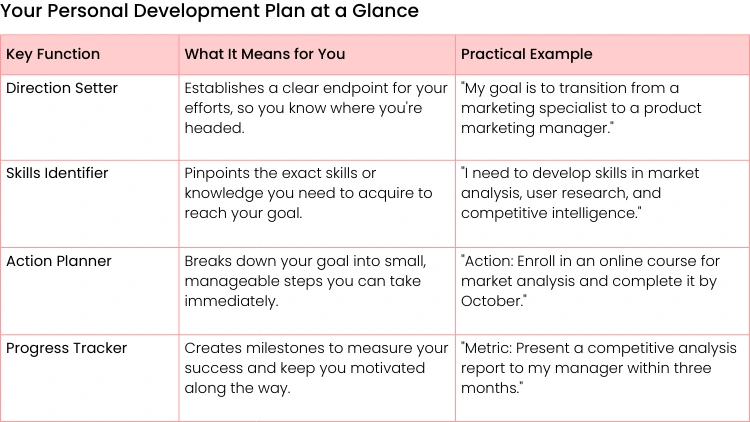
To put it simply, a PDP serves several core functions that guide your journey.
Here's a quick breakdown of what a PDP really does for you. This table shows how a PDP moves you from a broad ambition to a focused, step-by-step plan that you can start working on today.
The Building Blocks of a Powerful Plan
A truly effective Personal Development Plan (PDP) is way more than a list of things you hope to achieve someday. Think of it as a carefully designed blueprint, built from specific, interconnected parts that work together to turn your ambitions into actual, tangible reality.
Getting a handle on these building blocks is your first step toward creating a plan that genuinely works.
It’s a bit like building with LEGOs. You can have a box full of incredible pieces, but if you don't know what each one does or how they click together, you'll just end up with a colorful pile instead of a masterpiece. A powerful PDP is no different; it needs certain components to give it structure and purpose.
Let's break down the essential pieces you'll need to put together a plan that’s both inspiring and incredibly practical.
Start with Honest Self-Assessment
Before you can map out where you're going, you have to know exactly where you're standing right now. A self-assessment is your "you are here" marker on the map—an honest, clear snapshot of your current skills, knowledge, and mindset.
A fantastic and widely used method for this is the SWOT analysis. It gets you to pinpoint your:
- Strengths: What are you naturally good at? What do people always compliment you on?
- Practical Example: "I'm an excellent public speaker and can simplify complex topics for any audience."
- Weaknesses: Where do you tend to struggle? Which skills might be holding you back?
- Practical Example: "I avoid difficult conversations and lack conflict resolution skills."
- Opportunities: What's happening around you that you could take advantage of?
- Practical Example: "My company is expanding its data analytics team, and there's a need for people with project management skills."
- Threats: What external roadblocks could get in your way?
- Practical Example: "Automation could make parts of my current data entry role obsolete within two years."
This exercise gives you the raw material for your plan, making sure your goals are firmly planted in reality. To dig even deeper with another powerful self-assessment tool, check out this guide on goal setting with the Wheel of Life.
Define Crystal-Clear Goals
Once you have that clear self-assessment, you can start turning vague daydreams into solid objectives. The best goals are SMART goals: Specific, Measurable, Achievable, Relevant, and Time-bound. This simple framework is a game-changer for turning fuzzy wishes into targets you can actually hit.
A goal without a plan is just a wish. The building blocks of a PDP are what turn that wish into a tangible project with a clear finish line.
Just look at the difference:
- Vague Goal: "I want to be better at my job."
- SMART Goal: "I will complete a 'Python for Data Science' course and apply the skills to a small internal project within the next 3 months to improve my data analysis capabilities."
The second one leaves zero room for doubt. You know exactly what to do, how to measure it, and when it needs to get done.
Create a Step-by-Step Action Plan
Your SMART goal is the destination. Your action plan is the turn-by-turn navigation that gets you there. This is where you take that big, ambitious goal and chop it up into smaller, much less intimidating tasks.
For that Python course goal, your action plan might look something like this:
- Actionable Insight: Research and select an online Python course by the end of this week.
- Actionable Insight: Block out 5 hours per week in my calendar (Tuesdays and Thursdays, 7-9:30 PM) dedicated to coursework.
- Complete one module every two weeks to maintain steady progress.
- By month two, ask my manager for a small, non-critical work dataset to practice my new skills on.
This approach keeps you from feeling overwhelmed and helps build momentum. Every little step you check off is a small win that keeps you going.
Set Timelines and Success Metrics
Finally, every goal and every action step needs a deadline and a way to know if you've succeeded. A timeline keeps you accountable and moving forward.
- Timeline: Put a specific due date on each action item (e.g., "Finish the course by October 15th").
- Success Metrics: Define what "done" looks like. How will you know you've nailed it? (e.g., "Successfully build a script that automates a weekly report.")
When you put all these components together, you create a living, breathing document that guides your growth with focus and precision.
Why You Need a Development Plan Now More Than Ever
In a world buzzing with endless choices and rapid career shifts, it’s all too easy to feel like you’re just drifting along. A Personal Development Plan (PDP) is your anchor in that storm. It's your personal compass, giving you the clarity to cut through the noise and navigate your professional life with intention.
Simply put, a PDP is the difference between reacting to whatever comes your way and proactively shaping the future you want. Without one, your career can feel like a series of accidental steps instead of intentional strides toward a place you actually want to be. A plan forces you to stop drifting and start steering.
Gain Control in a Changing World
Putting together a solid plan for yourself is one of the best investments you can make. It’s a structured way to build up your skills and boost your employability, making you far more resilient when industries inevitably change. This is critical right now, as the skills that matter in the modern workforce are constantly evolving. It’s on us to proactively address any potential skills gap before it becomes a problem.
- Practical Example: A marketing professional who sees AI content tools emerging builds a PDP focused on mastering prompt engineering and AI strategy. Within a year, they don't just feel more secure—they've pivoted into a high-demand, more fulfilling role as an AI Marketing Strategist. That's the power of a proactive plan.
This hunger for structured growth isn't just a fleeting feeling; it’s a powerful generational trend. Recent workforce data shows that learning and development are huge priorities for younger workers, but many feel their employers aren't meeting that need. A 2025 Deloitte survey found that development opportunities were in the top three reasons Gen Z and millennials choose one employer over another. You can read the full Deloitte survey about workforce trends to get the whole picture on these shifting priorities.
A Personal Development Plan isn't about perfectly predicting the future. It's about building the skills, mindset, and resilience to thrive in whatever future comes your way.
Ultimately, a PDP puts you in the driver’s seat. It moves you from being a passenger in your career to the pilot, giving you the controls to navigate toward your own definition of success. Sometimes, that journey also requires looking inward to clear personal hurdles. If your plan involves deeper self-exploration, understanding the role of therapy in personal development can be an incredibly valuable part of the process.
How To Create Your First Personal Development Plan
Turning the ambition for personal growth into something real starts with building your first Personal Development Plan (PDP). This isn't just another document to fill out; think of it as your personal workshop for turning good intentions into a powerful, documented strategy. It's a practical tool designed to guide your journey, not a rigid assignment.
I'll walk through five core steps to build a simple yet effective plan. Each stage is designed to bring you clarity and create a roadmap you can start following today.
Start With A Self-Assessment
Before you can chart a course to where you're going, you need to know exactly where you're starting from. A self-assessment is just an honest inventory of your current skills, passions, strengths, and—most importantly—your areas for improvement. This foundational step makes sure your goals are grounded in reality.
Actionable Insight: Get started by asking yourself some direct questions. Grab a pen and paper and write down your unfiltered answers:
- What activities in the last month truly energized me and made me feel engaged?
- What tasks consistently drain my energy or leave me feeling frustrated?
- What single skill, if I developed it right now, would make the biggest impact on my career?
- What specific feedback have I received from managers or peers that I haven't acted on yet?
A critical first step is a thorough self-assessment, like understanding your leadership strengths and weaknesses, which can shine a light on key areas for growth.
This is all about getting clear on your starting point. From there, you can build the motivation you need to pursue meaningful development.
Define Your Future Vision
Once you have a clear picture of your present, you can start dreaming about your future. This isn't about setting vague wishes like "get better". It's about creating a compelling vision that actually pulls you forward. This vision becomes the "why" behind every action you'll take.
Your vision needs to be specific and inspiring. Instead of, "I want a better job", a far more powerful vision might be, "I want to be leading a creative team as a project manager within two years, where I can use my organizational skills to bring innovative ideas to life." That kind of clarity is what fuels real change.
Outline Actionable Steps
A vision without action is just a daydream. This is where you roll up your sleeves and break your big, intimidating goal into small, manageable, and concrete steps. These steps are the beating heart of your plan, turning your future vision into a practical, real-world project.
Practical Example: For someone aiming for that project management role, the action steps could look something like this:
- Research and enroll in a recognized project management certification course (like PMP or PRINCE2).
- Volunteer to manage a small, low-risk project within my current team to get some hands-on experience.
- Schedule informational interviews with three project managers in my network to learn about their career paths and daily challenges.
A well-structured personal development plan transforms your goals from overwhelming mountains into a series of small, climbable hills. Each step you complete builds momentum and confidence.
Set A Realistic Timeline
Every single action step needs a deadline. A timeline introduces accountability and creates a healthy sense of urgency, preventing your plan from gathering dust on a shelf. You need to assign realistic dates to each of your action steps, creating milestones along your journey.
Actionable Insight: This is what keeps procrastination at bay and allows you to track your pace. For example, "Complete project management certification course by December 31st" is a clear, time-bound target that you can work toward systematically. To dive deeper into structuring your objectives, check out this guide on how to set personal goals.
Decide How To Track Progress
Finally, you need to define what success actually looks like. How will you know when you've achieved your goal or completed a step? Establishing clear metrics helps you measure progress and—just as importantly—celebrate the small wins along the way. This is crucial for staying motivated.
Your progress metrics should be simple and easy to observe.
- For a course: The success metric is the certificate of completion.
- For managing a project: The metric is the successful delivery of the project, on time and within scope.
- For networking: The metric is completing the three scheduled interviews.
By following these five steps, you create more than just a document; you build a dynamic guide that empowers you to take control of your growth journey.
Common Mistakes to Avoid When Planning Your Growth
Knowing what not to do is just as important as knowing what to do. You can spend hours crafting the perfect personal development plan, but even the best intentions get derailed by a few common, easily avoidable mistakes. Sidestepping these pitfalls is the key to building a plan that actually works instead of one that just collects dust.
One of the quickest ways to fail is by setting vague, undefined goals. An objective like "I want to get better at communication" sounds great, but it’s impossible to measure. It gives you nothing concrete to act on. It's like telling your GPS you want to go "somewhere north"—you might start driving, but you'll never actually arrive.
- Actionable Insight: Instead, get specific. A much stronger goal is, "I will improve my communication skills by completing a public speaking workshop and presenting at two team meetings by the end of this quarter." Now you have a clear target to aim for.
The "Set It and Forget It" Trap
Another major pitfall? Creating a beautiful, detailed plan and then never looking at it again. A personal development plan isn't a static document you frame and hang on the wall. It’s a living, breathing guide that needs regular attention to stay relevant.
The fix for this is surprisingly simple: schedule a recurring check-in with yourself. Block out just 15-20 minutes on your calendar—maybe the first Friday of every month—to review your progress, adjust timelines, and celebrate what you’ve accomplished. This simple habit keeps your goals top-of-mind and ensures your plan evolves with you. If you find your planning efforts consistently fall flat, it’s worth exploring some of the common reasons why planning does not work and what to do about it.
Ignoring small wins is a recipe for burnout. Acknowledging your progress, no matter how minor, is the fuel that keeps your motivation high for the long journey of personal growth.
Finally, don't be too rigid. Life happens. Your career will present unexpected opportunities and your personal life will throw you curveballs. A plan that can't bend will eventually break. This has been a known issue since PDPs first emerged in the 1990s. Even in formal academic settings, studies show that only around 40% of people consistently follow through with their plans, proving just how easy it is to let them fade into the background.
Build flexibility into your strategy from the start. This allows you to seize new opportunities without feeling like you've gone completely off track.
Frequently Asked Questions About PDPs
Even with a solid plan in hand, questions are bound to pop up. Getting the practical side of managing your personal development plan right can be the difference between a document that gathers dust and a living tool that actually fuels your growth.
Let's tackle some of the most common questions we hear.
How Often Should I Review My Plan?
A personal development plan is definitely not a "set it and forget it" kind of thing. Think of it more like a GPS for your ambitions—it needs to recalibrate every now and then to keep you on the right path.
A great rhythm to get into is a quick monthly check-in. Just 15-30 minutes is all you need to see how you're tracking against your immediate action steps.
Beyond that, you'll want to schedule a more thorough review either quarterly or semi-annually. This is your chance to zoom out, assess your progress on the bigger goals, tweak your timelines, and make sure the whole plan still feels right for your long-term vision.
- Actionable Insight: Set a recurring calendar reminder right now for the first Friday of each month. Title it "PDP Check-in". It's a simple habit that keeps your goals from getting lost in the daily shuffle.
Can I Use a PDP for Goals Outside My Career?
Absolutely! While we often talk about PDPs in a professional context, the framework is incredibly versatile. It’s a powerful tool for driving intentional growth in any area of your life you care about.
Practical Examples: You can just as easily create a plan to:
- Learn a new language: With action steps like using a learning app for 20 minutes a day and finding a conversation partner online.
- Improve physical fitness: By setting clear goals for workouts, nutrition, and maybe even a milestone like running your first 5km.
- Master a creative hobby: Like learning guitar by blocking out specific practice hours each week and tracking the chords you’ve mastered.
What Is the Difference Between a PDP and a Performance Review?
This is a crucial distinction. While the two can certainly influence each other, they serve completely different purposes.
A performance review is almost always a look backward. It's your manager's evaluation of your past performance and how you stacked up against company objectives. The focus is squarely on your contributions within your specific role.
A performance review is about how you did for the company. A Personal Development Plan is about what you will do for yourself.
A Personal Development Plan, on the other hand, is a forward-looking document that you own and drive. It maps out your personal and professional growth goals, which often go far beyond the confines of your current job description. It’s your own proactive strategy for building the future you want.
Ready to turn those development goals into a reality? At Uplyrn, we provide the courses and expert mentoring to support every step of your journey. Explore our resources and start building your future today!


Leave your thoughts here...
All Comments
Reply