









Workforce Development Strategies to Future-Proof Your Team

In an era of rapid technological change and shifting market demands, the most resilient organizations are those that invest in their people. Stagnation is no longer an option. A reactive approach to hiring is insufficient; proactive talent cultivation is the new competitive advantage. The future of your business hinges on its ability to adapt, innovate, and grow, and that capacity is rooted directly in the skills and capabilities of your employees. This guide moves beyond theory to provide a comprehensive roundup of 10 proven workforce development strategies, complete with practical examples and actionable insights.
This article is designed as a practical toolkit. We will explore tangible methods for building a skilled, agile, and future-ready workforce. You will learn how to implement everything from structured apprenticeship and mentorship programs to targeted reskilling initiatives designed to close critical skills gaps. To truly future-proof your business, it's essential to integrate these development efforts into a comprehensive workforce planning strategy.
Whether you're an HR leader crafting a new learning and development plan, a department head aiming to boost team performance, or an individual contributor seeking to advance your career, these strategies offer a clear roadmap. We'll explore how to identify critical skill gaps, implement effective training, and create a culture of continuous learning that drives both individual growth and organizational success. Each section provides not just the "what" and "why" but the "how" ensuring you can translate these concepts into immediate, impactful action.
Jump To Section

Earn As You Learn
Earn 25% commission when your network purchase Uplyrn courses or subscribe to our annual membership. It’s the best thing ever. Next to learning,
of course.
1. Apprenticeship Programs
Apprenticeship programs are one of the most enduring and effective workforce development strategies, combining paid, on-the-job training with formal classroom instruction. This "earn while you learn" model allows individuals to gain practical skills and industry-recognized credentials under the guidance of experienced professionals, directly bridging the gap between theoretical knowledge and real-world application. Spanning from two to six years, these programs are designed to cultivate a pipeline of highly skilled talent in specific trades and industries.
This strategy is particularly powerful for tackling skilled labor shortages. By investing in apprentices, companies build a loyal, customized workforce trained to their specific standards and operational needs. For apprentices, it offers a debt-free path to a sustainable career, making it a mutually beneficial approach to talent development.
Why Use This Strategy?
Apprenticeships are ideal for industries facing a widening skills gap or an aging workforce, such as manufacturing, construction, healthcare, and IT. A practical example is Siemens USA, which partners with community colleges to offer a robust apprenticeship program that combines classroom learning with 3,200 hours of on-the-job training, creating a direct pipeline of skilled technicians. This model reduces recruitment costs, improves employee retention, and ensures a workforce trained to precise company standards.
Actionable Implementation Steps
To launch a successful apprenticeship program, organizations should follow a structured approach:
- Partner Strategically: Collaborate with community colleges, vocational schools, or industry associations like the U.S. Department of Labor to develop a registered curriculum.
- Actionable insight: Contact your local community college's workforce solutions department to co-design a curriculum that meets both academic standards and your specific business needs.
- Structure Mentorship: Assign each apprentice to a dedicated mentor. Define clear roles, responsibilities, and a 90-day performance milestone checklist for both the mentor and the apprentice to ensure consistent guidance.
- Offer Competitive Compensation: Attract high-caliber candidates by providing a competitive wage and benefits package.
- Actionable insight: Benchmark apprentice wages against local industry standards for entry-level roles to ensure your offer is attractive.
- Define Career Pathways: Create a visual roadmap showing how an apprentice can progress from program completion to a senior technician or team lead role within five years. This transparency is a powerful motivator.

2. Continuous Learning and Upskilling Programs
In today's fast-paced economy, continuous learning and upskilling programs have become critical workforce development strategies. This approach involves providing ongoing education and skill development to current employees, ensuring they can adapt to technological advancements and shifting market demands. Organizations foster a culture of learning through formal training, certifications, and professional development opportunities to maintain a competitive edge and boost employee engagement.
This strategy is a proactive response to the evolving nature of work. Rather than waiting for skills to become obsolete, companies invest in their talent pool to build a resilient, agile, and forward-thinking workforce. For employees, it provides clear pathways for career growth and demonstrates the company's commitment to their professional journey, which is a powerful driver of retention.
Why Use This Strategy?
Continuous learning is essential for any organization navigating digital transformation or facing rapid industry changes. A practical example is Amazon's $1.2 billion Upskilling 2025 initiative, which offers employees prepaid tuition for courses in high-demand fields like data science and nursing, even if those skills aren't directly related to their current role. This approach retains institutional knowledge while equipping employees with new competencies, preventing talent gaps before they emerge.
Actionable Implementation Steps
To build an effective continuous learning and upskilling program, follow these structured steps:
- Align Learning with Business Goals: Identify the critical skills your organization will need in the next 3-5 years.
- Actionable insight: For each strategic goal (e.g., "Increase market share through AI"), define 2-3 essential skills (e.g., "machine learning basics", "data visualization") and build learning modules around them.
- Leverage Technology: Implement a Learning Management System (LMS) or a Learning Experience Platform (LXP) to deliver, track, and scale training. To maximize the impact of these sessions, consider techniques like transcribing training workshops to create searchable resources.
- Protect Learning Time: Dedicate specific time during work hours for employees to engage in learning activities.
- Actionable insight: Implement "Focus Fridays" where employees are encouraged to spend two hours on pre-approved training courses with no meetings scheduled.
- Recognize and Motivate: Offer micro-credentials, digital badges, or certifications to recognize achievements. This gamifies the learning process and provides tangible evidence of new skills that employees can share.
3. Internship and Entry-Level Programs
Internship and entry-level programs are structured initiatives that serve as a critical bridge between academic learning and professional practice. These programs offer recent graduates and early-career individuals valuable, hands-on experience in a real-world environment, allowing them to apply their knowledge, build a professional network, and explore potential career paths. For organizations, they function as a strategic talent pipeline, enabling them to identify and cultivate future leaders.
This approach allows companies to assess potential hires on the job, evaluating their skills, work ethic, and cultural fit before making a long-term commitment. For participants, these programs provide invaluable industry exposure and a competitive edge in the job market, making it one of the most foundational workforce development strategies for building a robust talent pool from the ground up.
Why Use This Strategy?
This strategy is highly effective for organizations looking to attract fresh, innovative talent and reduce the risks associated with hiring inexperienced candidates. A practical example is Google's STEP (Student Training in Engineering Program) internship, which provides a 12-week immersive experience for first- and second-year undergraduate students, focusing on project work and mentorship to build a future pipeline of software engineers. This is ideal for industries that require a blend of formal education and practical, on-the-job training.
Actionable Implementation Steps
To design a high-impact internship or entry-level program, organizations should focus on structure and meaningful experience:
- Define Clear Learning Outcomes: For each intern role, create a one-page plan outlining 3-5 specific skills they will develop and the key projects they will contribute to. This transforms a simple job into a formative career experience.
- Implement Rotational Assignments: Allow participants to spend time in different departments.
- Actionable insight: A marketing intern could spend two weeks with the social media team, two with content creation, and two with analytics to gain a holistic understanding of the department's function.
- Provide Dedicated Mentorship: Assign each intern a "buddy" (a junior employee) for daily questions and a "mentor" (a senior employee) for bi-weekly career guidance meetings. This tiered support is crucial for their professional development.
- Create a Path to Full-Time Roles: Design a clear and transparent process for high-performing participants to transition into permanent positions.
- Actionable insight: Hold final presentations where interns showcase their project outcomes to hiring managers from relevant departments.
4. Skills Gap Analysis and Targeted Training
Skills gap analysis is a data-driven workforce development strategy that systematically identifies discrepancies between the skills your current workforce possesses and the capabilities required to meet future business objectives. It moves beyond generic training by pinpointing specific deficiencies, allowing for the deployment of highly targeted and cost-effective learning interventions. This strategic approach ensures that training investments directly address critical business needs and prepare the organization for upcoming challenges and opportunities.
By understanding precisely where skills are lacking, companies can allocate resources with surgical precision, whether through upskilling existing employees or recruiting new talent with the right competencies. This proactive method transforms training and development from a cost center into a strategic lever for growth, innovation, and competitive advantage.
Why Use This Strategy?
This strategy is essential for organizations in rapidly evolving industries like technology, finance, and healthcare. A practical example is how consulting firms like Deloitte use workforce capability assessments to help clients align talent with strategic goals. They might identify a gap in data analytics within a client's finance team and recommend a targeted training program on Power BI, directly linking the learning intervention to a business need for better financial modeling. By grounding training decisions in data, you ensure your workforce remains agile and future-ready.
Actionable Implementation Steps
To implement a skills gap analysis and targeted training program, follow these critical steps:
- Identify Future Needs: Start by defining the skills your business will need in the next 3-5 years.
- Actionable insight: Review your company's strategic plan and list the top three technologies or market shifts mentioned (e.g., AI integration, sustainability reporting). These are your starting points for future skills identification.
- Assess Current Capabilities: Use a mix of methods to measure existing skills, including self-assessments, manager evaluations, and skills testing platforms.
- Actionable insight: Create a simple survey asking employees to rate their proficiency in key skill areas from 1-5 to get a quick baseline.
- Analyze the Gaps: Compare the future needs with current capabilities to identify the most critical gaps. Prioritize them based on their potential impact on business performance.
- Develop Targeted Interventions: Create a tailored action plan. For a specific gap like "project management", this could involve a mix of Uplyrn courses for junior staff, PMP certification for mid-level managers, and agile methodology workshops for senior leaders. Learn more about conducting a training needs analysis to refine your approach.
5. Mentorship and Coaching Programs
Mentorship and coaching programs are relationship-driven workforce development strategies that pair experienced professionals with junior employees or peers. This approach fosters an environment of knowledge sharing, guidance, and support, accelerating skill acquisition and career progression. By creating formal channels for advice and development, organizations can cultivate talent from within, build a stronger leadership pipeline, and improve overall employee engagement.
These programs institutionalize supportive relationships, moving beyond informal watercooler chats to structured, goal-oriented partnerships. For employees, it provides a trusted advisor to navigate career challenges and opportunities, while for the organization, it builds a resilient, interconnected culture that enhances knowledge transfer and retention. Discover more about why having a mentor is important for professional growth.
Why Use This Strategy?
Mentorship is invaluable for organizations focused on developing future leaders, improving diversity and inclusion, and retaining top talent. A practical example is Cisco’s reverse mentoring program, where junior employees mentor senior executives on topics like social media and emerging tech trends. This not only transfers critical knowledge upward but also gives high-potential employees visibility with leadership. These programs are versatile, high-impact, and effective for onboarding, development, and collaboration.
Actionable Implementation Steps
To establish an effective mentorship or coaching program, organizations should focus on structure and support:
- Implement Smart Matching: Use structured matching criteria that consider an employee’s career goals, skill gaps, and professional background.
- Actionable insight: Create a simple intake form where potential mentees list their top three development goals, and mentors list their areas of expertise to facilitate purposeful pairings.
- Set Clear Expectations: Provide a "Mentorship Agreement" template that outlines roles, suggests a minimum meeting frequency (e.g., one hour per month), and establishes confidentiality to build trust.
- Train Your Mentors: Equip mentors with essential coaching skills.
- Actionable insight: Host a one-hour kickoff workshop for all mentors on the GROW (Goal, Reality, Options, Will) coaching model to provide them with a simple, effective framework.
- Measure and Recognize: Track progress through simple quarterly check-in surveys asking both parties to rate the relationship's effectiveness. Publicly celebrate a "Mentor of the Year" to encourage participation.

6. Reskilling and Career Transition Programs
Reskilling and career transition programs are comprehensive initiatives designed to equip employees with entirely new skills, enabling them to move into different roles within the organization or adapt to significant industry shifts. Unlike upskilling, which enhances current skills, reskilling prepares workers for new career paths, often in response to automation, technological disruption, or strategic business pivots. These programs are a proactive solution to talent displacement, turning potential job losses into opportunities for growth.
This strategy is crucial for building a future-proof workforce that can evolve alongside changing market demands. By investing in reskilling, companies retain valuable institutional knowledge and demonstrate a commitment to their employees' long-term careers, which significantly boosts morale, engagement, and retention. It is a powerful tool for navigating organizational transformation while supporting the workforce through change.
Why Use This Strategy?
Reskilling programs are essential for organizations undergoing significant technological or structural changes. A practical example is AT&T's Workforce 2020 initiative, where the company invested $1 billion to retrain over 100,000 employees for roles in areas like cloud computing and data science, successfully transitioning them from legacy telecom jobs. This strategy is ideal for industries facing rapid evolution, such as tech, finance, and manufacturing, allowing them to retain talent rather than undergo costly layoffs and rehiring cycles.
Actionable Implementation Steps
To implement a successful reskilling program, organizations should focus on holistic support for transitioning employees:
- Assess and Map Skills: Conduct a skills gap analysis to identify roles at risk and future skills needed.
- Actionable insight: Create a "career pathways" map showing how a customer service representative could transition into a data analyst role by completing specific training modules in SQL, Excel, and data visualization.
- Provide Comprehensive Support: Combine targeted technical training with career counseling.
- Actionable insight: Offer transitioning employees a dedicated career coach to help them update their resumes and practice interviewing for their new internal roles.
- Forge Employer Partnerships: If internal placement isn't possible, collaborate with companies in growth sectors.
- Actionable insight: A manufacturing company phasing out a production line could partner with a local logistics firm to create placement opportunities for its reskilled workers.
- Create Cohort-Based Learning: Group transitioning employees into peer support cohorts. This fosters a sense of community and provides mutual encouragement throughout the challenging process.
7. Partnerships with Educational Institutions
Forging strategic collaborations with educational institutions is a forward-thinking workforce development strategy that directly aligns academic curricula with real-world industry needs. By partnering with high schools, vocational schools, community colleges, and universities, companies can co-create learning experiences that produce graduates who are ready to contribute from day one. This approach bridges the persistent gap between theoretical education and practical workplace demands, creating a seamless transition for emerging talent.
This strategy proactively shapes the future talent pool, ensuring that students are learning the most relevant skills on the latest technologies. For educational institutions, it provides invaluable industry insights, resources, and career pathways for their students. For employers, it establishes a reliable, predictable pipeline of qualified candidates, significantly reducing hiring uncertainty and training costs.
Why Use This Strategy?
This approach is essential for industries undergoing rapid technological change, such as tech, finance, and advanced manufacturing. A practical example is the P-TECH model, co-developed by IBM, which creates six-year high school programs where students earn both a high school diploma and a no-cost, industry-aligned associate degree. Graduates receive priority consideration for jobs at IBM, ensuring a steady flow of skilled talent trained for tomorrow's challenges.
Actionable Implementation Steps
To build a meaningful educational partnership, organizations should focus on mutual value and clear objectives:
- Co-Develop Curriculum: Work directly with faculty to advise on or co-create courses.
- Actionable insight: Join a local community college's industry advisory board for your field. This provides a formal channel to give direct input on curriculum updates.
- Create Internship-to-Hire Pathways: Establish structured internship programs that serve as a direct pipeline to full-time employment.
- Actionable insight: Guarantee final-round interviews to any intern who meets performance expectations, creating a clear and motivating path to a job offer.
- Provide Tangible Resources: Support the institution by guest lecturing, providing modern equipment for labs, or sponsoring capstone projects. This investment demonstrates a genuine commitment to student success.
- Support Faculty Development: Offer "externships" for instructors to spend a week at your company.
- Actionable insight: This helps them stay current with industry practices and bring that real-world knowledge back to the classroom. Explore ways of bridging skill development in education and business for more ideas.
8. Digital and Technology Skills Training
Digital and technology skills training is a critical workforce development strategy focused on equipping employees with capabilities in digital tools, data analysis, programming, and emerging technologies. In an era of rapid technological transformation, this approach ensures the workforce remains competitive and can effectively leverage digital systems. It moves beyond basic computer literacy to build advanced competencies necessary for modern business operations.
This strategy is fundamental for organizational agility and innovation. By upskilling employees in areas like cloud computing, artificial intelligence, and cybersecurity, companies can adapt to market changes, improve efficiency, and drive growth. For employees, it opens doors to higher-paying roles and long-term career resilience in an increasingly automated world.
Why Use This Strategy?
This strategy is essential for any organization aiming to remain relevant in the digital economy. A practical example is Google's Career Certificates program, which offers industry-recognized credentials in fields like IT Support and Data Analytics. Companies can use these programs to upskill their existing non-technical staff, empowering them to fill in-demand tech roles internally rather than competing for scarce external talent.
Actionable Implementation Steps
To effectively implement digital and technology skills training, organizations should:
- Establish Tiered Learning Paths: Start with foundational digital literacy for all employees (e.g., proficiency in Microsoft 365) and create specialized tracks for technical, advanced, and leadership roles.
- Combine Theory with Practice: Integrate hands-on projects and labs into the curriculum.
- Actionable insight: For a cybersecurity training module, create a "capture the flag" exercise where employees must identify and fix vulnerabilities in a simulated network.
- Incentivize Certification: Tie the completion of certifications to tangible career benefits.
- Actionable insight: Offer a one-time bonus of $500 for employees who complete a relevant, pre-approved certification, motivating them to invest their time in learning.
- Stay Current and Accessible: Partner with accredited training providers and commit to updating the curriculum annually. Offer flexible learning options, including online and blended formats. Learn more about the role of VR in workforce development.

9. Diversity, Equity, and Inclusion (DEI) Workforce Development
Diversity, Equity, and Inclusion (DEI) initiatives are a strategic approach to workforce development that moves beyond compliance to actively build an organization reflective of society. This strategy involves intentionally creating pipelines for underrepresented populations, dismantling systemic barriers to entry and advancement, and fostering a culture where every employee feels valued and empowered. It recognizes that diverse talent pools are a source of innovation and competitive advantage.
A DEI-focused approach integrates equity into every stage of the employee lifecycle, from recruitment and hiring to training and promotion. It aims to correct imbalances and ensure that talent from all backgrounds has an equal opportunity to thrive. This creates a more resilient, creative, and high-performing workforce that better understands and serves a diverse customer base.
Why Use This Strategy?
DEI is a critical workforce development strategy for any organization looking to enhance innovation, improve decision-making, and attract top talent. A practical example is Salesforce's practice of conducting annual, company-wide equal pay audits and publicly sharing the results, investing millions to address any identified gender or racial pay gaps. This transparency and action builds trust and strengthens their employer brand.
Actionable Implementation Steps
To effectively integrate DEI into your workforce development, consider these focused actions:
- Conduct an Equity Audit: Start with a data-driven assessment of your current demographics, pay scales, promotion rates, and hiring practices to identify specific gaps.
- Set Measurable Goals: Establish clear, public-facing DEI goals with timelines.
- Actionable insight: Set a specific goal, such as "Increase the representation of women in technical leadership roles from 15% to 25% within three years" and assign a senior leader to be accountable for it.
- Redesign Recruitment Processes: Remove barriers by standardizing interview questions and using blind resume reviews.
- Actionable insight: Partner with organizations like the National Society of Black Engineers (NSBE) or women-in-tech groups to post jobs and expand your recruitment reach beyond traditional channels.
- Establish Sponsorship Programs: Go beyond mentorship by creating formal sponsorship programs where senior leaders actively advocate for the career advancement of high-potential employees from underrepresented groups.
- Embed Inclusive Leadership Training: Mandate training for all managers on topics like unconscious bias and psychological safety to ensure they are equipped to lead diverse teams effectively.
10. On-the-Job Training (OJT) and Structured Learning Programs
On-the-Job Training (OJT) is a foundational workforce development strategy where employees learn and develop skills directly within their work environment. Unlike informal shadowing, structured OJT is a systematic process that combines hands-on practice with clearly defined learning objectives, guided by experienced mentors or trainers. This approach allows new hires to become productive quickly while ensuring they master the specific processes, tools, and cultural norms of the organization.
This method integrates learning seamlessly into the daily workflow, making it highly relevant and immediately applicable. By structuring the training, companies can standardize skill acquisition, track progress against set milestones, and ensure consistent performance across teams. It transforms the initial employment period into a targeted, competency-building experience.
Why Use This Strategy?
Structured OJT is incredibly effective for roles that are highly practical and context-specific. A practical example is the OJT system at Toyota, which is a cornerstone of its manufacturing philosophy. New team members follow a detailed "Job Instruction" sheet and are coached by a certified trainer until they can perform a task to standard, ensuring quality and consistency. This strategy accelerates time-to-competency, reduces training costs associated with off-site programs, and boosts employee engagement.
Actionable Implementation Steps
To implement a successful structured OJT program, organizations should:
- Develop a Competency Framework: Create a detailed checklist of skills and tasks a new hire must master in their first 30, 60, and 90 days. This provides a clear roadmap for both the employee and their trainer.
- Select and Train Your Trainers: Identify experienced employees with strong communication skills to serve as trainers.
- Actionable insight: Provide them with a half-day "train-the-trainer" session on how to give constructive feedback and assess competency effectively.
- Integrate Blended Learning: Combine hands-on training with formal instruction.
- Actionable insight: Before a new retail employee practices on the cash register, have them complete a 15-minute e-learning module on your store's return policy.
- Establish a Feedback Loop: Schedule weekly 15-minute check-ins between the trainee, trainer, and manager to discuss progress, address challenges, and adjust the training plan as needed. Documenting these ensures accountability.
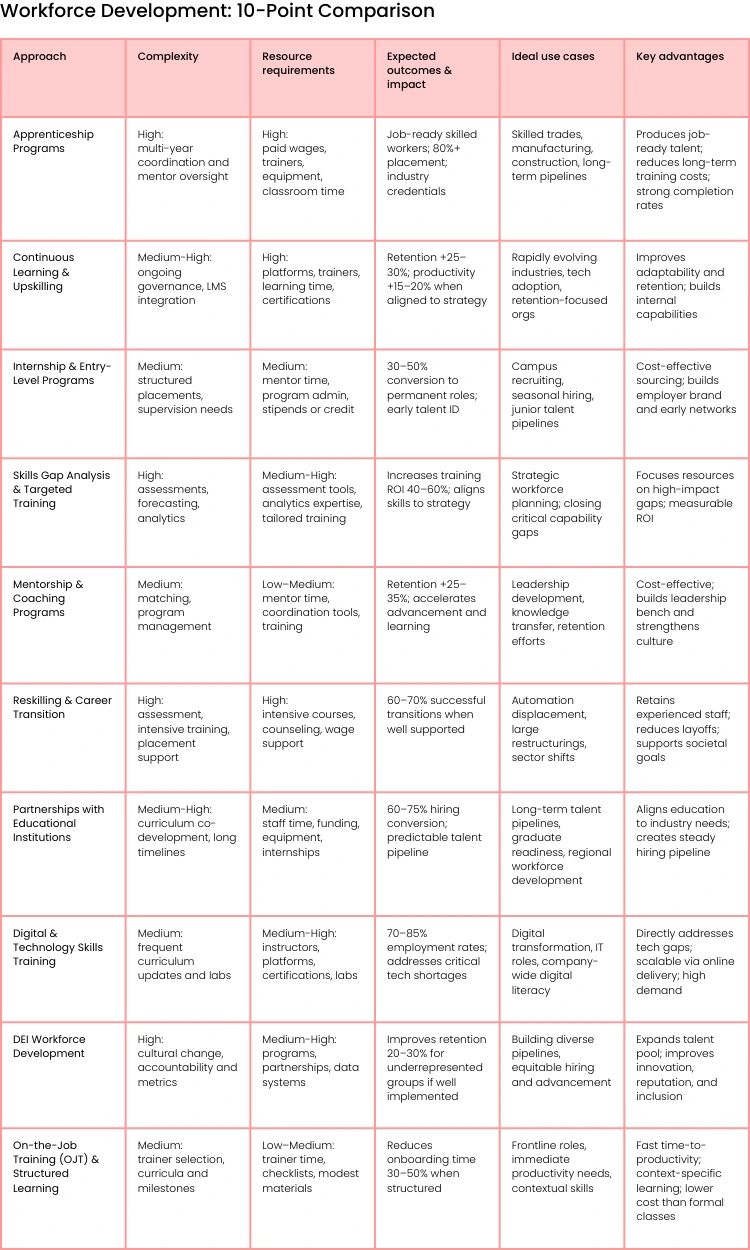
Putting Your Workforce Development Plan into Action
Navigating the landscape of workforce development can seem complex, but the ten distinct strategies we've explored provide a comprehensive roadmap for building a resilient, skilled, and engaged team. From the structured, hands-on learning of Apprenticeship and On-the-Job Training Programs to the forward-thinking nature of Digital Skills Training and Reskilling Initiatives, each approach offers a unique mechanism for closing critical skills gaps and fostering a culture of perpetual growth.
The common thread woven through these effective workforce development strategies is a commitment to proactive, intentional talent cultivation. It’s about moving beyond reactive hiring and instead investing in the human potential already within your organization and your community. Programs like Mentorship and Coaching, for instance, don't just transfer knowledge; they build leadership pipelines and strengthen organizational culture. Similarly, strategic Partnerships with Educational Institutions create a sustainable talent funnel, ensuring your future workforce is equipped with relevant, in-demand skills before they even walk through your doors.
Key Takeaways for Immediate Impact
To transform these concepts into tangible results, it’s crucial to distill the core principles into actionable takeaways. Don't view these ten strategies as a checklist to be completed, but as a menu of powerful options to be combined into a customized plan that aligns with your specific business objectives.
Here are the most important takeaways to guide your next steps:
- Start with Data, Not Assumptions: The most successful workforce development plans are built on a foundation of data. A thorough Skills Gap Analysis is non-negotiable. It provides the clarity needed to target your resources effectively, ensuring you’re solving the right problems with the right training interventions.
- Blend, Don't Isolate: The most robust strategies are not monolithic. An organization might combine a targeted Upskilling Program for its current IT team with a new Internship Program to cultivate early-career talent. This blended approach creates multiple pathways for talent development, catering to different career stages and learning preferences.
- Embed DEI into Every Initiative: Diversity, Equity, and Inclusion should not be a separate, siloed program. It must be an integral component of all your workforce development strategies, from ensuring equitable access to mentorship programs to designing inclusive apprenticeship opportunities. This holistic integration is what drives true organizational change and innovation.
- Empower Employees with Ownership: True engagement happens when employees feel they are active participants in their career journey, not just passive recipients of training. Provide them with tools and platforms that allow them to explore learning paths, track their progress, and see a clear connection between their development and future career opportunities within the company.
Your Action Plan: Moving from Strategy to Execution
The journey from a theoretical plan to a thriving learning ecosystem begins with a single, deliberate step. Instead of feeling overwhelmed by the breadth of options, focus on building momentum through a phased, iterative approach.
- Prioritize One High-Impact Area: Using your skills gap analysis, identify the one area where development would yield the greatest business impact. Is it leadership? Digital literacy? A specific technical skill? Start there.
- Launch a Pilot Program: Select one or two strategies from this article that directly address your prioritized need. For example, if leadership is the gap, launch a pilot Mentorship Program for a small cohort of high-potential employees. This allows you to test, learn, and refine your approach before a full-scale rollout.
- Measure, Solicit Feedback, and Iterate: Define clear success metrics for your pilot program from the outset. Track engagement rates, skill acquisition, and even business outcomes. Crucially, gather feedback from participants to understand what’s working and what isn’t, then use those insights to improve the program for the next cohort.
By embracing these powerful workforce development strategies, you are not merely filling vacant roles; you are building an agile, future-proof organization. You are investing in your people, demonstrating their value, and creating an environment where talent not only stays but thrives. This strategic commitment is the ultimate competitive advantage in today's dynamic world of work.
Ready to build a culture of continuous learning and implement these powerful workforce development strategies? Uplyrn provides a comprehensive platform where you can access expert-led courses, create customized learning pathways for your teams, and track skills development in real-time. Explore how Uplyrn can become the engine for your organization's growth and talent retention.


Leave your thoughts here...
All Comments
Reply