









How to Master the 5 Steps of the Writing Process

Writing isn't an act of spontaneous genius; it's a structured, repeatable system. Whether you're a student staring down a term paper deadline, a professional crafting a critical business proposal, or an expert at Uplyrn developing engaging course materials, understanding the 5 steps of the writing process is the key to transforming raw ideas into clear, compelling, and effective communication. This methodical approach demystifies the task, replacing the anxiety of the blank page with a reliable roadmap for success.
This guide moves beyond abstract theory to provide a concrete framework you can implement immediately. We will break down each of the five essential stages: Prewriting, Drafting, Revising, Editing, and Publishing. For each step, you'll find actionable insights, practical examples from both academic and professional settings, and tips to navigate common challenges. Following this structured method not only saves time and reduces stress but also consistently elevates the quality of your final product. To unlock your full potential and achieve flawless content, it's essential to deeply understand and apply this guide on how to Master the 5 Steps of the Writing Process. Let's begin building your skills, one step at a time.
Jump To Section

Earn As You Learn
Earn 25% commission when your network purchase Uplyrn courses or subscribe to our annual membership. It’s the best thing ever. Next to learning,
of course.
1. Step 1: Prewriting (Planning & Research)
Often overlooked in the rush to get words on the page, prewriting is the foundational first step of the writing process. This planning and research phase is where you build the blueprint for your entire project, ensuring it is focused, well-supported, and relevant to your audience. It involves gathering ideas, conducting research, and structuring your thoughts before a single sentence of the first draft is written.
Pioneered by figures like Donald Murray, this stage transforms writing from a linear task into a dynamic, cyclical process. It's not just about what you will write, but why you are writing and for whom. By dedicating time to prewriting, you lay a solid groundwork that makes the subsequent steps smoother and more effective.
How Prewriting Works in Practice
Prewriting isn't a single activity but a collection of techniques designed to explore a topic and organize information. The goal is to move from a vague idea to a clear, actionable plan.
- Practical Example (Student): A university student assigned a research paper on the economic impact of renewable energy might start by creating a mind map. The central idea ("Renewable Energy Economics") branches out into subtopics like "Job Creation", "Government Subsidies", "Impact on GDP" and "Investment Trends". This visual exploration helps them see connections and narrow their focus to a specific thesis, such as "Government subsidies have been the primary driver of job creation in the solar energy sector."
- Practical Example (Professional): A marketing professional at a tech startup needs to write a series of blog posts about a new software feature. They begin by creating detailed audience personas.
- For example, instead of just "project managers", they define "Alex, a PM at a mid-sized agency struggling to track team workload." This allows them to brainstorm specific blog titles like "How Our New Feature Ends Project Bottlenecks for Good", ensuring the content directly addresses the user's pain points.
- Practical Example (Uplyrn): An Uplyrn instructor planning a course on "AI in Digital Marketing" starts by researching emerging industry trends and job market demands. They analyze 10-15 recent job postings for "Digital Marketing Manager" to identify keywords like "AI-powered analytics" and "predictive modeling". This data directly shapes the course curriculum, ensuring it's not only informative but also strategically aligned with career advancement.
Actionable Tips for Effective Prewriting
To make the most of this critical first step of the writing process, integrate these strategies into your workflow.
- Actionable Insight (Freewriting): Set a timer for 10-15 minutes and write continuously about your topic without stopping to edit or judge. Don't worry about sentence structure. The goal is to bypass your internal critic and get raw ideas onto the page.
- For example, start with the prompt "What's the most important thing my reader needs to know about this?" and don't lift your pen until the timer goes off.
- Actionable Insight (Outlining): Don't start drafting without a map. Create a bullet-point outline that starts with your core message (thesis), lists 3-5 main points that support it, and includes at least one piece of evidence (a stat, quote, or example) for each point. This simple structure prevents rambling.
- Actionable Insight (Audience Definition): Before you write a word, answer these three questions: 1) Who is my primary reader? 2) What single action do I want them to take after reading? 3) What is the biggest question they have that I can answer? Answering these questions shapes your tone, vocabulary, and content depth.
Key Insight: Prewriting is an investment. The time you spend planning and researching pays dividends by preventing writer's block, reducing major revisions, and resulting in a more coherent and impactful final product.
For those looking to generate more innovative ideas, mastering different creative exercises is key. To dive deeper into structured idea generation, check out these top tips for a great brainstorm session. By investing in this initial discovery phase, you set yourself up for success throughout the entire writing journey.

2. Drafting (Writing First Draft)
Following the planning phase, drafting is the second step of the writing process where you transform your outline and ideas into prose. This stage is about momentum and creation, not perfection. The primary goal is to get the core message down on the page, creating the raw material you will refine in later steps. It’s about translating your blueprint into a tangible first version.
Popularized by authors like Anne Lamott with her "shitty first drafts" concept, this approach liberates writers from the pressure of getting it right the first time. The focus shifts from quality to completion. By silencing your inner editor and writing freely, you build a complete draft that serves as the clay you will later mold into a polished piece.
How Drafting Works in Practice
Drafting is the act of focused, sustained writing based on your prewriting plan. The objective is to articulate your main points, present your evidence, and build a narrative flow without getting bogged down by minor errors in grammar or style.
- Practical Example (Student): A high school student writing an essay on "The Great Gatsby" uses their outline to write one body paragraph at a time. They focus solely on explaining their argument about the American Dream, pulling in quotes and evidence as planned. They deliberately ignore spelling mistakes and awkward phrasing, knowing they can fix those details later during the editing step.
- Practical Example (Professional): A content writer at a marketing agency is tasked with creating a white paper on cybersecurity trends. They block out a two-hour "drafting session" and write the entire first version from introduction to conclusion. They use placeholders like [INSERT 2023 DATA ON PHISHING ATTACKS HERE] to avoid breaking their creative flow with on-the-spot research.
- Practical Example (Uplyrn): An Uplyrn instructor developing a new course on data analytics drafts the scripts for the first three modules in a single sitting. They use a conversational, informal tone as if speaking directly to a student. The initial draft might be repetitive, but it comprehensively covers the core concepts, creating a solid foundation for the polished video lessons.
Actionable Tips for Effective Drafting
To build momentum and overcome the blank page, use these practical strategies during the drafting stage of the writing process.
- Actionable Insight (Time-Blocking): Instead of a vague goal like "write the essay", set a specific, time-based goal. Use the Pomodoro Technique: set a timer for 25 minutes and write without distraction. When it rings, take a 5-minute break. This makes the task less intimidating and builds momentum.
- Actionable Insight (Strategic Procrastination): If you get stuck on the introduction, skip it. Jump to a section you feel more confident about.
- For example, write the "methods" section of a report or the "key benefits" section of a proposal first. Writing the easiest parts can clarify your thinking and make tackling the harder parts, like the introduction, much simpler.
- Actionable Insight (Embrace Imperfection): Give yourself permission to write a messy first draft. Use simple language, include notes to yourself in brackets like [EXPAND ON THIS LATER], and don't stop to look up the perfect word. The goal is to get a complete draft finished, not a perfect one.
Key Insight: The first draft’s only job is to exist. It is not meant to be a final product but rather a complete version of your ideas that you can systematically improve upon in the revision and editing stages.
A powerful draft is built on a strong command of language and structure. To further strengthen your foundation, explore these practical tips to learn how to improve your writing skills. By focusing on getting your ideas down first, you create the necessary substance for a truly exceptional final piece.

3. Revising (Content Improvement & Refinement)
Often confused with editing, revising is a distinct and crucial step in the writing process focused on the bigger picture. It’s not about correcting commas or typos yet; it's about re-seeing your work. This stage involves reviewing the draft to improve clarity, organization, and the overall effectiveness of your message. It is where you strengthen your arguments, clarify your ideas, and ensure the content truly meets the needs of your audience.
Popularized by educators like Donald Murray, who emphasized a revision-focused approach, this step treats writing as an iterative process of discovery. The goal is to evaluate the content on a structural level, asking what is working, what isn't, and how it can be fundamentally improved. Successful revision transforms a functional draft into a polished, persuasive, and impactful piece of communication.
How Revising Works in Practice
Revising is about making substantial changes to your content, not just minor tweaks. This could mean reorganizing entire sections, deleting redundant paragraphs, or adding new information to fill gaps in your argument. The focus is always on making the content better for the reader.
- Practical Example (Student): After drafting an essay on historical trade routes, a student realizes their argument is weak. During revision, they don't just fix grammar. They re-read the draft and find that their most compelling evidence is buried in the last paragraph. They decide to restructure the entire paper, moving that strong point to the beginning to grab the reader's attention immediately.
- Practical Example (Professional): A project manager writes a report for company stakeholders, but initial feedback suggests it is too dense. In the revision stage, they replace long paragraphs with bullet points, add a one-page executive summary at the beginning, and move highly technical data to an appendix. The revised document is clearer and better suited for a busy executive audience.
- Practical Example (Uplyrn): An instructor reviews student feedback for a course on "Advanced Data Analytics" and notices a high drop-off rate in Module 3. Revising involves more than correcting text. They re-record the video for that module to explain a complex algorithm using a simpler real-world analogy (e.g., comparing it to how a navigation app finds the fastest route) and add a new case study to show its practical application.
Actionable Tips for Effective Revising
To make the most of this critical third step of the writing process, approach your draft with a fresh, analytical perspective.
- Actionable Insight (Read Aloud): Before submitting anything, read your work aloud. This simple technique forces you to slow down and hear awkward phrasing, run-on sentences, and sections where the tone feels off. If you stumble while reading a sentence, your reader will likely stumble while reading it silently. Mark it for a rewrite.
- Actionable Insight (Reverse Outline): Create a new outline based on your existing draft. Read each paragraph and write down its main point in a single sentence. This helps you see the true structure of your draft and easily spot where the logical flow breaks down, where you repeat yourself, or where arguments are underdeveloped.
- Actionable Insight (Targeted Feedback): Don't just ask "What do you think?" when seeking feedback. Ask specific questions.
- For example: "Is my main argument in the introduction clear?" or "Can you tell me which section was the most confusing?" This guides your reviewer to provide concrete, helpful advice.
Key Insight: Revision is about being willing to make bold changes for the sake of clarity and impact. Don't be afraid to delete entire sections or completely restructure your draft if it makes the final product stronger.
Giving and receiving constructive criticism is a skill that fuels powerful revision. For guidance on improving this collaborative process, explore these techniques for giving feedback that inspires growth. By embracing revision, you ensure your writing doesn't just say what you mean, but that it resonates powerfully with your intended audience.

4. Editing (Technical Refinement & Proofreading)
Distinct from the broad strokes of revision, editing is the meticulous, final polish that elevates your writing from good to professional. This fourth step in the writing process zooms in on the technical details: grammar, spelling, punctuation, and style. It is the quality control phase where you refine the surface of your work, ensuring clarity, accuracy, and adherence to established conventions.
Standardized by influential guides like The Chicago Manual of Style and Strunk & White's The Elements of Style, this stage is about precision. Editing ensures your message is not just understood, but that it is presented with authority and credibility. By dedicating focused time to editing, you remove distracting errors that can undermine your argument and frustrate your reader.
How Editing Works in Practice
Editing is not a single, rushed read-through. It is a systematic check of your document against a set of standards, whether they are grammatical rules, a specific style guide, or formatting requirements. The goal is to catch and correct every technical error.
- Practical Example (Student): A student is submitting their final-year dissertation on supply chain disruptions. They create a short editing checklist. First, they use a grammar checker. Second, they do a "find and replace" for common mistakes they make (e.g., ensuring "just-in-time" is always hyphenated). Finally, they read the entire document backward, from the last sentence to the first, to focus solely on spelling errors without being distracted by the content's flow.
- Practical Example (Professional): A project manager is preparing a proposal for a client. The editing phase involves a peer review where a colleague checks for clarity and adherence to the company's brand voice. Then, they use a tool like Grammarly for a final check of grammar and spelling, ensuring the document appears professional and error-free before it is sent.
- Practical Example (Uplyrn): An Uplyrn course creator is finalizing a module on "Data Visualization with Python". They meticulously check every code snippet for correct syntax by running it themselves. They also create a style sheet to ensure all technical terms like "Matplotlib" and "Seaborn" are spelled and capitalized consistently across all video scripts and downloadable resources.
Actionable Tips for Effective Editing
To transform your draft into a polished final product, integrate these professional editing techniques.
- Actionable Insight (Change the Format): To spot errors your brain has started to ignore, temporarily change how the text looks. Increase the font size, change the font to something like Courier, or print the document out. This makes the text unfamiliar and helps your eyes catch mistakes you previously skimmed over.
- Actionable Insight (Create a Hit List): Keep a running list of your most common writing errors (e.g., "its vs. it's", comma splices, overuse of "that"). During your final editing pass, use the "Find" function (Ctrl+F or Cmd+F) to search for each item on your list and correct it specifically.
- Actionable Insight (Edit in Passes): Don’t try to fix everything at once. Read through your document multiple times, each time looking for a different type of error.
- For instance: Pass 1 for spelling errors. Pass 2 for punctuation. Pass 3 for checking that all hyperlinks and references are correct.
Key Insight: Editing is the final act of respect for your reader. It demonstrates that you value their time and attention by providing a clear, correct, and professional document free from distracting errors.
For professionals operating in a global market, impeccable communication is non-negotiable. To ensure your writing meets international business standards, consider exploring how to perfect your command of professional languages. A commitment to rigorous editing is a hallmark of effective and influential communication.
5. Publishing (Distribution & Sharing)
The final, crucial step of the writing process is publishing, where your polished work is released to its intended audience. This stage moves your content from a private document to a public asset, making it accessible, discoverable, and impactful. It involves selecting the right channels, promoting the content to ensure it reaches its audience, and gathering feedback to measure its effectiveness.
Popularized by the rise of digital platforms like content management systems and social media, publishing is no longer limited to traditional gatekeepers. Today, it’s a dynamic process of strategic distribution. This final step transforms your hard work into a tool that informs, persuades, or educates, determining who sees your work and what impact it has.
How Publishing Works in Practice
Publishing is more than just clicking "send" or "upload". It's a strategic launch that requires planning the distribution, promotion, and follow-up to maximize reach and engagement.
- Practical Example (Student): After finalizing a research paper, a student publishes their work on an academic blog like Academia.edu. To increase visibility, they also create a short, 3-tweet thread summarizing the key findings, including a link to the full paper and tagging relevant professors and research groups to spark discussion.
- Practical Example (Professional): A company creates a guide on "Agile Best Practices". They publish it as a PDF on their website, but the strategy doesn't stop there. They also create a 60-second summary video for LinkedIn, turn key stats into an infographic for Twitter, and send a targeted email to subscribers with a direct download link, maximizing the content's reach across multiple platforms.
- Practical Example (Uplyrn): An Uplyrn instructor launches a new course on "Data Visualization". The publishing process involves uploading the videos, creating a compelling course description with keywords like "Python", "Tableau" and "Data Storytelling", and coordinating the launch with Uplyrn's promotional newsletters. They also offer a launch discount to early enrollees to build initial momentum and reviews.
Actionable Tips for Effective Publishing
To ensure your content makes the impact it deserves, approach publishing with a clear strategy.
- Actionable Insight (Optimize for Discovery): Before hitting "publish", do basic keyword research. Use a free tool like Google Trends to see how people are searching for your topic. For a blog post on saving money, you might find that "how to budget" is a more popular search term than "personal finance tips". Use the more popular term in your title and headings to attract more readers.
- Actionable Insight (Choose the Right Channels): Don't publish everywhere. Identify the single platform where your target audience is most engaged. If you wrote a guide for software developers, sharing it on a niche forum like Stack Overflow or Hacker News will be far more effective than posting it on Facebook.
- Actionable Insight (Create a Promotion Plan): Plan three simple things you will do the moment you publish.
- For example: 1) Send an email to your newsletter subscribers, 2) Post it on LinkedIn and tag 3 colleagues who might find it useful. 3) Share it in a relevant online community or group. This simple checklist ensures your work gets an initial visibility boost.
Key Insight: Publishing is not the end of the writing process, but the beginning of your content's life. The goal is to connect your finished work with the right people to achieve your desired outcome, whether that's earning a grade, generating a lead, or helping someone learn a new skill.
For those creating longer-form content like books or extensive guides, the principles of strategic distribution are even more critical. To learn more about taking control of your launch, discover how to self-publish a book on Amazon and apply those lessons to any major content release. By mastering this final step, you ensure your voice is heard.
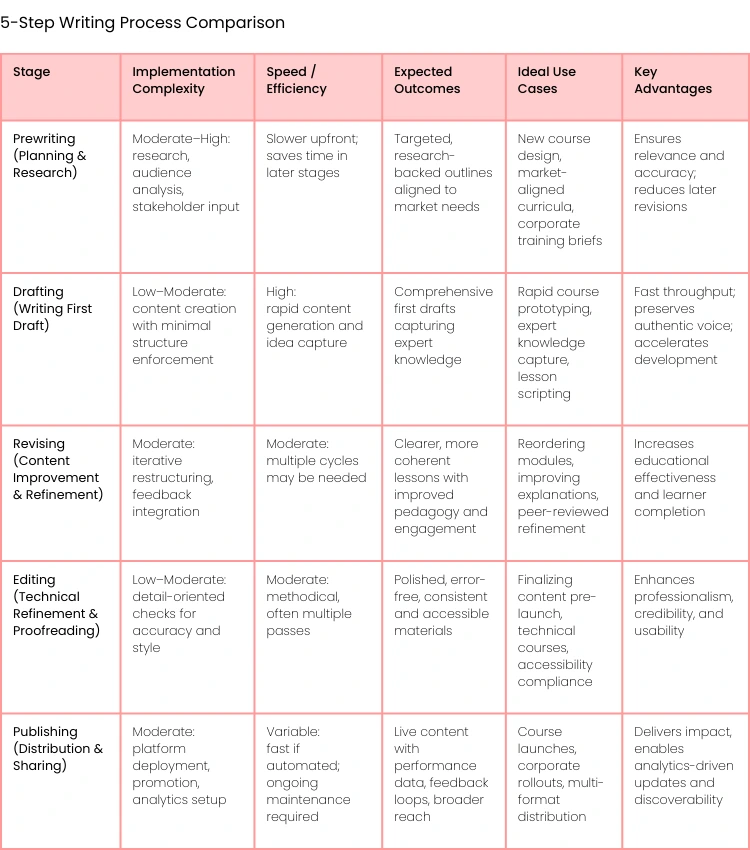
Put the Process to Work for You
Navigating the journey from a fleeting idea to a polished, impactful piece of writing can feel daunting. However, by embracing the 5 steps of the writing process, you transform this challenge into a manageable and even enjoyable creative endeavor. This structured approach demystifies writing, replacing the anxiety of the blank page with a clear, actionable roadmap.
We've explored how each stage builds upon the last:
- Prewriting lays the essential groundwork through brainstorming and research.
- Drafting is about getting your ideas down without the pressure of perfection.
- Revising focuses on the big picture, strengthening your argument and structure.
- Editing zooms in on the technical details, polishing grammar and style.
- Publishing sends your message out into the world to connect with your audience.
The true power of this framework lies not in its rigidity but in its flexibility. Think of it less as a linear path and more as a cyclical, iterative loop. You might find yourself returning to the prewriting stage during revision to gather more evidence, or you might draft a new introduction after editing the conclusion. This dynamic movement is a sign of a thoughtful, engaged writer.
From Framework to Habit
Internalizing these steps is the key to becoming a more confident and efficient writer. The goal is to make this process second nature, whether you're crafting a critical academic paper, a persuasive business proposal, or an engaging blog post. By consistently applying this structured method, you build a reliable system that supports your creativity and ensures a higher quality output every time.
To truly make the writing process work efficiently for you and produce consistent results, it’s beneficial to explore how to master your content creation workflow by understanding advanced strategies and tools. Integrating these five foundational steps into a broader workflow can significantly enhance your productivity and the impact of your work.
Ultimately, mastering the 5 steps of the writing process is about empowering yourself. It’s about taking control of your communication and ensuring your ideas are heard clearly and persuasively. Start applying this framework to your next project-big or small-and witness the profound difference a structured process can make. Your confidence will grow, your writing will sharpen, and your ability to connect with readers will soar.
Ready to apply these principles and elevate your professional communication skills? Explore the expert-led courses on business writing and content strategy at Uplyrn. Our practical, hands-on approach will help you master the writing process and achieve your career goals. Visit Uplyrn to start learning today!


Leave your thoughts here...
All Comments
Reply