









Career Development Programs for Employees That Drive Growth

Let's be honest: career development programs are no longer just a nice-to-have perk. They've become a core business strategy, and for good reason. It's a direct answer to the number one reason your best people are probably looking elsewhere: a lack of opportunities to grow.
By mapping out clear pathways for advancement, you can do more than just keep people around. You can build a more engaged, skilled, and resilient workforce that attracts even more top talent.
Jump To Section

Earn As You Learn
Earn 25% commission when your network purchase Uplyrn courses or subscribe to our annual membership. It’s the best thing ever. Next to learning,
of course.
Why Career Development Is Your Best Retention Tool
In today's job market, the whole conversation around retention has changed. The days of winning people over with surface-level perks are long gone. Your top performers aren't just looking for a job; they're looking for a future. They want an employer who's willing to invest in their professional journey.
This is where a solid career development program becomes one of the most powerful tools you have. When people can see a clear, achievable path forward within your company, their engagement and productivity skyrocket. More importantly, they’re far more likely to stick around for the long haul. If you ignore this, you're practically inviting your best employees to walk out the door and into the arms of a competitor who gets it.
From Cost Center to Profit Driver
Thinking of career development programs as just another expense is a classic, shortsighted mistake. The real return on investment shows up in tangible ways across the business:
- Slashed Hiring Costs: It's always cheaper to promote from within than to hire externally. You save on recruiter fees, job board postings, and the long, expensive process of onboarding someone new.
- For example, filling a mid-level manager role internally might save you $20,000+ in recruiter fees alone.
- Boosted Productivity: When your team learns new skills, they become more efficient and confident. That translates directly to your bottom line.
- A practical example: training your sales team on a new CRM can increase their call efficiency by 15%, leading to more closed deals.
- A Stronger Employer Brand: Becoming known as a place that grows talent makes you a magnet for high-potential candidates. It gives you a serious competitive edge in the hiring market.
The Real Cost of Stagnation
Feeling stuck is the silent killer of morale. For ambitious employees, hitting a professional ceiling usually means their next move is finding a new company. This isn't just a hunch; the data tells a stark story.
Recent 2024-2025 data shows that a lack of career development is the #1 controllable reason employees leave, responsible for a staggering 17.5% of departures.
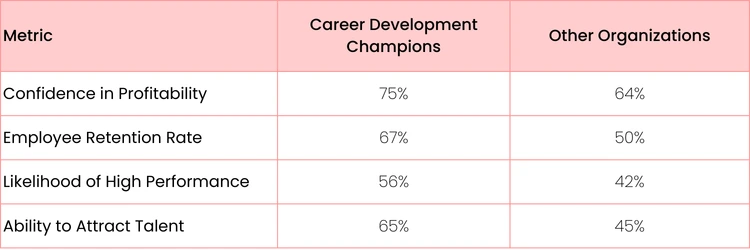
The difference this makes is huge. We see it all the time. Companies that champion career development see drastically better outcomes than those that don't. Just look at the numbers.
Here’s a quick breakdown of what separates the "Champions" from the rest:
The Business Impact of Strong Career Development Programs
The numbers don't lie. Investing in growth isn't just about making employees happy; it builds a stronger, more profitable business.
- Actionable Insight: Start tracking your "regrettable turnover"—the percentage of high-performers who leave. If that number is high, survey departing employees to ask specifically about growth opportunities. This data is your most powerful tool for making the business case for a development program.
Ultimately, a strong program more than pays for itself through better retention, higher performance, and a much healthier talent pipeline. To see how these pieces fit together, check out this guide on how to reduce employee turnover for more actionable strategies. It drives home the point that growth isn't just a benefit—it's your best defense against losing great people.
Designing a Program That Actually Works
Let's be honest: moving from theory to practice is where most great intentions fall flat. A truly effective career development program isn't just about giving people access to a course library—it’s about creating a living, breathing ecosystem designed to build real skills and generate career momentum.
The best programs always weave together different ways of learning. It’s not about finding one perfect solution; it's about blending several into a powerful, multi-faceted approach. Forget the one-size-fits-all model. Instead, think about combining in-house training, structured mentorship, and sponsored certifications to create a rich experience that feels personal, relevant, and genuinely useful.
Building Your Program's Core Components
Variety is the name of the game here. In 2023, companies invested an average of $954 per learner as they moved toward more diverse learning strategies. To build a program with real sticking power, you need to mix and match a few key elements.
Here are the cornerstones of a great program:
- In-House Workshops: These are fantastic for teaching company-specific stuff—your internal processes, proprietary software, or even just "the way we do things around here".
- A practical example is running a quarterly "Project Management the [Your Company] Way" workshop led by your own senior PMs to ensure everyone uses the same methodologies.
- Structured Mentorship: This one is a game-changer. We can't stress this enough. Data shows mentorship programs have an 80% organizational effectiveness rate.
- An actionable insight: create a simple sign-up form on your intranet for both mentors and mentees, matching them based on skills and career goals, not just departments.
- Sponsored Certifications: This is a clear, tangible incentive. Offering to cover the cost of industry-recognized qualifications (like a PMP for project managers or a Google Analytics certification for marketers) shows you're invested in their professional credibility.
It's no surprise that 43% of organizations are creating in-house development programs, while 42% implement mentoring and another 42% sponsor formal qualifications. The numbers don't lie—this blended approach works.
A truly impactful program isn’t just a single path; it’s a network of interconnected opportunities. It empowers employees to choose the learning formats that work best for them at different stages of their careers.
A Real-World Scenario
Picture a mid-size tech company that wants to build a stronger leadership pipeline. Instead of just buying a generic leadership course online, they get smart and build a multi-layered program.
First, they identify their high-potential junior developers and pair them with senior engineers in a formal mentorship program. Suddenly, these mentees are getting dedicated time for code reviews and high-level architectural discussions, which skyrockets their on-the-job learning.
At the same time, the company launches an internal training series on essential soft skills like client communication and team collaboration—things you don't learn in a coding bootcamp.
Then, for their current team leads, they sponsor an Agile certification course. This blend is perfect: the development is practical, it's supported by experienced colleagues, and it's validated by a respected external credential.
As you map out your own program, think about how to create a career development plan for individual roles. This helps you connect your program's offerings directly to an employee's personal career map. If you need a more detailed look at identifying these specific needs, this guide on conducting a training needs analysis is the perfect place to start.

How to Map Clear and Motivating Career Paths
Vague promises of "growth opportunities" just don't cut it anymore. Ambitious employees want to see a clear, tangible path forward, and if they don't see it with you, they'll find it somewhere else. This is where career mapping comes in—it’s how you turn an abstract idea into a concrete plan that shows someone exactly how to get from Point A to Point B in your company.
The whole point is to break down a career trajectory into specific, manageable stages. You’re defining the exact skills, competencies, and experiences needed to climb the ladder, which makes the whole process feel achievable instead of like some mysterious, behind-the-scenes decision. A well-defined map is one of the most powerful tools you can have in your arsenal.
From Role to Roadmap: A Practical Example
Let’s get practical. Imagine you want to map the journey from a Marketing Coordinator to a Marketing Director. Instead of leaving it up to chance, you can break that path into distinct levels, each with its own set of expectations.
- Marketing Coordinator (Level 1): This is all about execution. Think social media management, deploying email campaigns, and hands-on content creation.
- Key competency: attention to detail.
- Marketing Specialist (Level 2): Now, we're building strategic thinking. The focus shifts to SEO/SEM fundamentals, basic data analysis, and campaign planning.
- Key experience: successfully managing a small project from start to finish.
- Marketing Manager (Level 3): Welcome to leadership. This level demands skills in budget management, leading a team, collaborating across departments, and presenting results to stakeholders.
- Key skill: delegation and team motivation.
- Marketing Director (Level 4): This is where you set the vision. We're talking deep strategic planning, P&L responsibility, market analysis, and shaping the entire brand strategy.
- Key competency: commercial acumen.
Connecting Paths to Personalized Learning
Once you have the map, you need to build the roads. This means connecting each level to specific, relevant learning and development opportunities. A generic course catalog isn't going to work here; what you need is a personalized learning pathway.
Think about our Marketing Specialist who’s aiming for a Manager role. Their development plan shouldn't be random. It needs to be carefully curated based on a skill gap analysis.
- Actionable Insight: During performance reviews, managers should use the career map as a visual tool. Ask the employee, "Looking at the Marketing Manager level, which skill here do you feel least confident about? Let's find a resource to build that one skill in the next quarter."
A manager can use this map in one-on-one conversations to pinpoint any gaps. Does the employee need to get better at data analysis? The pathway should point them to a data visualization workshop. Do they lack experience presenting to leadership? Let's give them a low-stakes project where they can practice that skill with some coaching.
This proactive approach is also a cornerstone of effective succession planning best practices, ensuring you're constantly building your next generation of leaders from within.
By making career paths transparent and linking them directly to development resources, you demystify growth. You turn it from a vague corporate promise into a collaborative, visible, and highly motivating journey for everyone involved.
Boosting Engagement and Overcoming Participation Hurdles
Here’s the hard truth: even the most amazing, thoughtfully designed career development program will fall flat if nobody shows up. A classic mistake is falling for the "if you build it, they will come" fantasy. In reality, you have to earn that participation by knocking down the very real hurdles that keep your people from engaging.
Let's be honest, there's often a huge gap between an employee's desire to grow and their actual capacity to participate. They’re juggling heavy workloads, staring down deadlines, and feeling the constant pressure to deliver. From their perspective, "development" can easily feel like just one more task on an already overflowing plate.
Making Development an Easy "Yes"
To get real buy-in, you have to make participating as frictionless as possible. It’s all about removing the common barriers and hammering home the benefits—not just for the company, but for their individual career.
One of the most powerful ways to do this is with mentorship. It offers personalized, relevant guidance that feels like an immediate win.
- For example, pairing a new sales rep with a seasoned account executive isn’t just abstract training; it’s a direct line to on-the-job wisdom that helps them close deals faster. That's an investment they can feel.
The data from Gallup backs this up big time. While 57% of U.S. employees have done some on-the-job training, a surprisingly low 28% have ever had a mentor. Here's the kicker: 48% of employees in mentorship programs report high job satisfaction, a huge jump from the 29% of those who aren't mentored.
Crafting a Winning Communication Plan
Your rollout is every bit as important as the program itself. You need to think of it like an internal marketing campaign. Vague emails and boring announcements get ignored. Your communication has to be specific, continuous, and genuinely compelling.
Here’s a practical communication playbook to follow:
- A Clear Launch Announcement: Don't just send an email.
- Actionable step: host a 30-minute launch webinar. Show a demo of the learning platform, introduce the mentorship coordinators, and end with a Q&A to build excitement.
- Showcase Success Stories: As soon as you have them, highlight people who are using the program to get ahead.
- A practical example: publish a short interview on your intranet with an employee who got promoted after completing a specific learning path.
- Integrate with Performance Reviews: Weave development right into the fabric of your performance conversations.
- Actionable step: add a mandatory section to your performance review template titled "Career Development Goals for Next Quarter".
The whole point of your communication isn’t just to inform people; it’s to inspire them. You have to connect the dots, showing employees exactly how getting involved will help them hit their own personal career goals.
By actively promoting your program and embedding it into your company's DNA, you can drive up engagement in a big way. If you’re hungry for more ideas on building this kind of supportive culture, check out this guide on top employee engagement strategies.

Measuring the Real ROI of Your Program
To keep your career development programs funded and supported, you have to prove they actually work. This means moving beyond feel-good metrics like completion rates and focusing on the numbers that leaders and stakeholders truly care about.
Proving a clear return on investment (ROI) is how you elevate a program from a "nice-to-have" expense into an essential business strategy.
The trick is to directly connect your program's outcomes to the company's biggest goals. Are you trying to slash turnover? Supercharge productivity? Build a stronger leadership pipeline for the future? Your measurement strategy has to be baked in from day one, not bolted on as an afterthought.
Connecting Training to Financial Impact
Let's walk through a real-world scenario. Imagine a software company invests $50,000 in a leadership development program for its mid-level managers. Before the program, their turnover rate for senior developers was through the roof, costing them an average of $250,000 a year in recruitment fees and lost productivity.
A year later, they crunched the numbers.
The internal promotion rate from mid-level manager to senior leadership roles shot up by 30%. Because they filled more senior positions from their own talent pool, their external recruitment costs for those roles dropped by a whopping $120,000.
When you subtract the $50,000 program cost from the $120,000 in savings, they demonstrated a clear ROI of $70,000 in the first year alone. That's a story any executive will listen to.
- Actionable Insight: Create a simple dashboard to present your ROI. Show the program cost on one side and the financial gains (recruitment savings, productivity increases) on the other. Visualizing the data makes the impact undeniable.
Presenting a clear narrative like this, supported by hard numbers, is the single most effective way to secure ongoing budget and executive buy-in. To go even deeper into this, you should explore how to use the Kirkpatrick Model for evaluating L&D impact in this detailed guide.
Key Metrics for Measuring Program Success
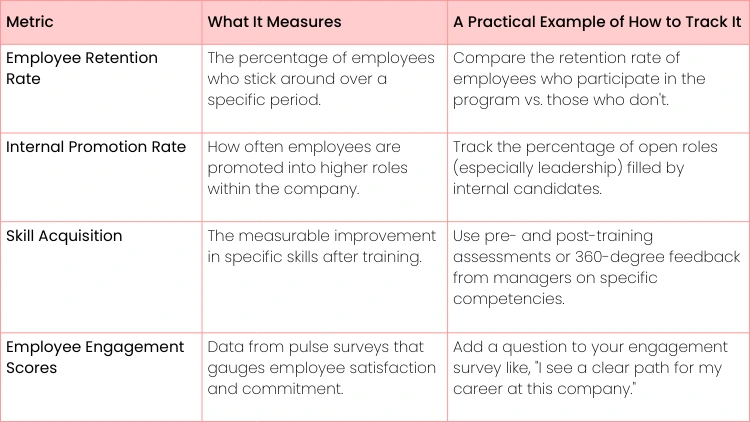
When you focus on the right Key Performance Indicators (KPIs), you can tell a compelling story backed by hard data. It completely changes the conversation from "how many people finished the course?" to "how did this program impact our bottom line?"
Here's a breakdown of the essential KPIs to track and what they really tell you about your program's effectiveness.
Got Questions About Employee Career Development?
Even when you're fully committed, rolling out a career development program can feel like navigating a maze. It’s totally normal for questions and a bit of uncertainty to pop up.
Let's tackle some of the most common questions we hear from leaders and HR pros. The goal here is to give you clear, no-nonsense answers that will help you build a program that actually works.
Who Is Really Responsible for Employee Development?
This is the classic question, isn't it? The short answer: it’s a team sport. While HR might be the architect of the program, making it successful is a shared responsibility.
Think of it as a three-legged stool. If one leg is wobbly, the whole thing tips over.
- The Organization: The company's job is to provide the framework—the resources, the tools, and a culture that genuinely supports growth.
- Practical example: providing a budget for each department to spend on approved certifications.
- The Manager: Managers are the make-or-break element. They're on the front lines, having those crucial career conversations, helping their team members pinpoint skill gaps, and pointing them toward the right opportunities.
- Actionable step: train your managers on how to have effective career coaching conversations.
- The Employee: At the end of the day, employees have to be in the driver's seat of their own careers. Their part is to be proactive—to seek out learning, finish the training, and actually talk to their managers about where they want to go.
- Practical example: setting up a recurring 1-on-1 with their manager dedicated solely to discussing career growth.
When all three are working together, that's when the magic happens.
How Do We Get Employees to Actually Participate?
Seeing low participation is a common headache, but it’s usually a sign of a deeper problem. Just launching a program and hoping for the best is a recipe for disappointment. You have to sell it internally and make it incredibly simple to get involved.
First off, connect development to real, tangible outcomes. Don't just announce a new course. Frame it as, "This project management certification is a key stepping stone to that team lead role you're interested in."
Next, weave it into the very fabric of your culture. Make development goals a standard part of performance reviews. When career growth becomes a normal topic of conversation, participation feels less like extra homework and more like a natural part of the job.
- Actionable Insight: Create "protected time" for learning. Encourage managers to block out one or two hours on their team's calendars each month dedicated to development activities. This signals that the company truly values it.
What’s the Best Way to Start If We Have a Small Budget?
You absolutely don't need a huge budget to make a big difference. In fact, some of the most powerful career development initiatives are surprisingly low-cost.
If you're starting small, focus on these high-impact, low-cost moves:
- Launch a Mentorship Program: Pairing your seasoned veterans with newer folks costs nothing but a bit of organization. The knowledge sharing and relationship building you get in return are priceless.
- Encourage Job Shadowing: Letting an employee spend a day with a different team is a fantastic—and free—way to build cross-functional awareness and open their eyes to other career paths right within your company.
- Use Your In-House Experts: You’ve got incredible talent already on the payroll. Tap your senior leaders or subject matter experts to host informal "lunch and learns" on topics they've mastered. It's a win-win.
Start by building a culture of learning. Once you show real results with these foundational steps, making the case for a bigger budget down the road gets a whole lot easier.
Ready to build a development program that attracts, retains, and inspires your best people? Uplyrn provides the tools and expert-led courses to create personalized learning pathways that tie directly to your business goals. Discover how you can empower your workforce and build your next generation of leaders.


Leave your thoughts here...
All Comments
Reply