








Creative Writing Classes: A Guide to Career-Building

That blank page can be intimidating. We’ve all been there. But you don't have to go it alone. Creative writing classes are your key to turning those fleeting ideas into powerful stories, giving you the structure and guidance to find and refine your unique voice.
This guide pulls back the curtain on these programs, showing you exactly how they help you build a complete storytelling toolkit, piece by piece.
Jump To Section

Earn As You Learn
Earn 25% commission when your network purchase Uplyrn courses or subscribe to our annual membership. It’s the best thing ever. Next to learning,
of course.
Your Journey Into the Craft of Storytelling
Think about creative writing less as some mystical art and more as a practical craft, like woodworking or painting. Passion is the fuel, absolutely, but a class gives you the tools and the blueprints. You wouldn't try to build a sturdy chair without knowing a thing about joinery, right? The same logic applies to writing a novel without understanding plot structure.
These courses offer a supportive space where you can take a vague concept and shape it into a well-structured narrative. Instead of just trying to "feel" your way through a story, you start to learn the actual mechanics behind what makes a reader desperately need to turn the next page.
What to Expect from the Start
Any solid creative writing class begins by building a strong foundation. You'll quickly move past simple grammar and dive into the essential ingredients of great fiction and non-fiction. Expect to focus on a few key areas:
- Character Development: Learning how to create believable, three-dimensional characters that readers genuinely care about.
- Practical example: You might be asked to write a scene where your hero has to choose between two bad options, revealing their core values through action, not just description.
- Plot and Structure: Getting a handle on narrative arcs, pacing, and the secrets to building tension that keeps your audience hooked.
- Actionable insight: Start by outlining a simple three-act structure for a story idea you have: a setup, a confrontation, and a resolution. This forces you to think about the story's overall shape.
- Point of View (POV): Mastering who is telling the story and understanding how that single choice completely shapes the reader's experience.
- Dialogue and Voice: Crafting conversations that sound authentic while also developing a distinct authorial style that is all your own.
The real goal is to demystify the creative process. It’s all about breaking it down into manageable, actionable steps. You learn why a particular scene hits so hard and gain the technical skills to create that same effect in your own work.
More Than Just a Hobby
The skills you pick up are incredibly versatile. Knowing how to construct a powerful narrative is a massive advantage, whether you're writing a novel, a compelling marketing campaign, or even a persuasive business proposal. For those serious about going the distance, a comprehensive guide to learning how to write books is a perfect companion to what you'll learn in class.
Ultimately, these programs are a huge confidence booster. They give you deadlines, constructive feedback, and a community of other writers, which helps you break through the isolation that so often comes with the craft. You'll also discover the magic of descriptive language; you can get a head start on that by exploring how to use imagery in literature to paint vivid pictures for your reader.

What You Will Actually Learn in a Writing Class
Ever wonder what really happens inside a creative writing class? It’s not as mysterious as you might think. These classes are designed to take your raw passion for storytelling and give you the concrete, practical tools of the trade—much like an apprentice woodworker learning to handle a chisel for the first time.
You'll move beyond just talking about what makes a good story and start learning how to actually build one.
- Practical example: Instead of just vaguely discussing "plot", you'll get your hands on proven narrative structures like Freytag's Pyramid. Your instructor might have you map out the plot of a famous film like Star Wars on this pyramid to visually deconstruct its rising action, climax, and falling action before you apply the same blueprint to your own story idea.
From Ideas to Actionable Skills
The best classes are all about application. When you get to a module on character development, you won’t just be making a list of your character's favorite foods and personality quirks. You'll be thrown into practical exercises designed to make them breathe.
A typical assignment might be to write a character's internal monologue during a moment of crisis. This forces you to dig deep into their fears and motivations, turning a flat idea into a three-dimensional person a reader can truly root for (or against). Beyond that, you'll learn the nuts and bolts of:
- Authentic Dialogue: You’ll practice writing conversations that do double duty—revealing character and moving the plot forward without sounding robotic.
- Actionable insight: Try writing a two-page scene where two characters argue about something small (like doing the dishes), but the subtext reveals they're actually arguing about a much bigger issue (like their failing relationship).
- Immersive World-Building: Learn to use sensory details to make your setting feel real, whether it’s a sprawling fantasy kingdom or a cramped downtown apartment.
- Mastering Point of View (POV): You'll finally get a solid grasp on the crucial difference between a first-person narrator and a third-person omniscient one, and figure out which lens is the perfect fit for the story you want to tell.
A great class demystifies the writing process by breaking it down into learnable techniques. It’s about understanding the "why" behind powerful storytelling so you can replicate it with purpose in your own projects.
Putting "Show, Don't Tell" into Practice
One of the first and most important lessons you'll learn is the classic principle: "show, don't tell". This isn't just a catchy phrase; it's a foundational technique you'll practice over and over until it becomes second nature.
- Practical example: Take a flat, "told" sentence like, "She was nervous." A class exercise would challenge you to show that nervousness instead. You might write something like: "She repeatedly twisted the silver ring on her finger, her breath catching in her throat each time the door creaked." That's the kind of transformation you'll learn to create. To keep sharpening your skills, check out this guide on how to improve writing skills for more exercises.
You won't just learn about broad story arcs. A solid class also dives into the nitty-gritty, like how to write better dialogue so your characters leap off the page. These are the building blocks that turn a passion for storytelling into a truly effective craft.
Finding the Right Creative Writing Class for You
Choosing the right creative writing class can feel a lot like picking a travel destination. Are you looking for a structured, deep-dive tour like a full university program? Or is a flexible, self-guided adventure like an online course more your speed? The options are nearly endless, but the perfect fit always comes down to your personal goals, your schedule, and how you learn best.
Think of a Master of Fine Arts (MFA) program as a formal, multi-year apprenticeship. It’s an immersive commitment that provides academic credentials and builds deep industry connections. On the other hand, a community workshop is more like joining a local sports team—it's collaborative, hands-on, and all about consistent practice with your peers.
Then you have online courses, which are like a personalized gym membership for your writing. You get access to fantastic tools and expert guidance, but you're in complete control of the intensity and frequency of your training. For many aspiring writers juggling work, family, and their creative passion, this flexibility is a game-changer. To get the most out of this format, check out this guide with tips for successful online learning.
Vetting Your Options Like a Pro
With so many creative writing classes popping up, you need to look past the shiny marketing copy. Before you even think about enrolling, it’s time to put on your investigator hat.
- Actionable insight: Always, always ask for a sample syllabus. This is the single most important document you can review. It’s a roadmap that reveals the course’s structure, pacing, and core focus, letting you see instantly if it aligns with what you want to achieve. For example, if you want to write short stories, a syllabus that dedicates 8 out of 10 weeks to novel outlining is a poor fit.
Beyond the syllabus, you need to vet the instructor and the program’s reputation. Here are a few practical steps to take:
- Analyze Instructor Publications: Don't just see if they're published; see where. Are their stories and books in reputable journals or presses that you admire and that fit your genre?
- Read Between the Lines: Look at student testimonials for specifics. Vague praise is nice, but a review that says, "The feedback on my second chapter's dialogue was a game-changer" offers concrete evidence of real value.
- Check the Community Vibe: If the class has a community forum or social media group, do some lurking. The interactions you see there will tell you a ton about the collaborative energy (or lack thereof) of the program.
Your choice of class is the first major step in your writing career. The right environment won't just teach you craft; it will give you the confidence, community, and momentum to keep going when you hit a roadblock.
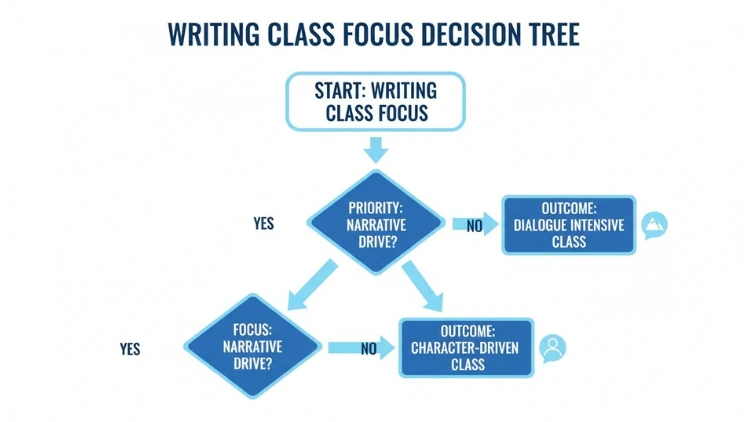
This decision tree can help you visualize where to focus your efforts as you sift through your options.
As the guide shows, simply identifying your story's primary engine—whether that’s a gripping plot, a compelling character, or snappy dialogue—is the key to choosing a class that will help you strengthen your specific weaknesses and build on your natural talents.
Comparison of Creative Writing Class Formats
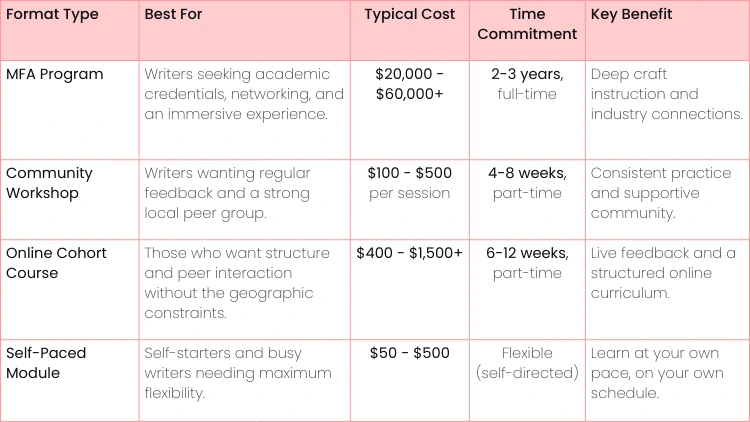
To help you sort through the main options, here’s a quick breakdown of what to expect from each format.
This table compares the key features of different types of creative writing classes to help you choose the best fit.
Ultimately, the right format depends on whether you thrive with deadlines and peer pressure or prefer to carve out your own path.
Turning Your Passion Into a Profession
Let's tackle the big question right away: can you actually make a living with a creative writing degree? It's a concern we hear all the time, and the answer is absolutely. But it might not look the way you imagine.
The skills you hone in a writing workshop—crafting a compelling story, building a world from scratch, writing believable dialogue—don't just prepare you to write the next bestseller. They make you incredibly valuable in a whole range of industries that are hungry for good storytellers.
Think about it: at its core, storytelling is how we connect. Businesses are desperate for people who can cut through the noise and create a clear, memorable narrative. The ability to structure a plot and create an emotional arc is directly transferable to many stable, well-paying career paths you might not have considered.
Weaving Your Skills Into the Job Market
The techniques you practice in class have surprisingly direct applications in the professional world. It's all about learning to see how one skill translates into another.
- Content Marketing: Who better to write a brand's story, create engaging blog posts, or script a captivating social media video than someone who understands narrative hooks and emotional arcs?
- User Experience (UX) Writing: This is all about guiding people through a website or app with clear, simple, and human language.
- Practical example: The process of simplifying a confusing error message like "Authentication Failure: Code 401" into "Incorrect password. Please try again." is pure UX writing, and it relies on empathy for the user—a skill you develop through character creation.
- Corporate Communications: Companies need people who can turn dry internal memos and complex jargon into stories that resonate with employees, investors, and the public.
- Grant Writing: Non-profits live and die by their ability to tell a powerful story. A grant writer's job is to persuade funders by narrating the organization's impact and mission in a way that’s impossible to ignore.
Actionable Insight: That skill you're learning for building a complex character? That’s the very same muscle you use to create a detailed "customer persona" for a marketing team. Understanding a character’s goals, fears, and motivations is exactly what a marketer does to connect with their audience. The next time you create a character sketch, try framing it as a customer persona to see the direct overlap.
Building Your Professional Portfolio from Day One
Every piece you write in a creative writing class is more than just homework—it’s a potential entry for your professional portfolio. That short story you agonized over isn't just an exercise; it’s proof that you can build a narrative from the ground up and, just as importantly, take constructive feedback.
The network you build in a creative writing class is often as valuable as the skills you learn. Your peers are your future collaborators, editors, and industry connections, while your instructors can become mentors who open doors to your first professional opportunities.
Start thinking like a pro from your very first class. Save your best work. Curate it. Present it in a clean, professional online portfolio that shows what you can do. A tangible collection of your writing will always speak louder than a line on a resume.
For anyone ready to make that leap, this guide on how to become a freelance writer offers a roadmap for turning those classroom skills into a real, paying career. Your journey starts now, with every word you write.
How Online Platforms Elevate Your Writing Journey
The leap to digital has completely changed the game for creative writing classes. They’ve moved out of stuffy university halls and into vibrant, accessible online spaces. Today’s platforms aren't just trying to copy a physical classroom; they’re built to give you unique advantages that can seriously fast-track your growth as a writer.
Imagine getting line-by-line feedback on your first chapter from a published novelist who lives three time zones away. That’s no longer a fantasy. The best online classes now offer direct access to industry pros, providing a level of mentorship that used to be locked away in elite, expensive programs. It’s all about immediate, practical application—turning abstract theory into a tangible craft you can use.
More Than a Course, It’s a Community
Let's be honest, a common fear with online learning is feeling isolated. But the best platforms have figured out how to build genuinely supportive communities. They’ve managed to capture the buzz of a great in-person workshop but with way more flexibility.
These digital circles give writers a real place to connect and grow together. You can dive deeper into this by checking out this guide to the best online community platforms out there right now.
Interactive tools and lively forums are the heart and soul of these programs. Instead of waiting a whole week for feedback, you can get almost instant thoughts on a tricky paragraph or a character’s messy motivation.
- Collaborative Documents: Many classes use tools like Google Docs, where your instructor and peers can drop comments right into your manuscript. It feels like a real-time editing session.
- Dedicated Forums: Think of these as a 24/7 writer’s café.
- Practical example: A forum might have a "First Line Friday" thread where everyone posts the opening sentence of their work-in-progress for quick feedback on its hook.
- Live Workshop Sessions: Video calls bring everyone together for face-to-face feedback, keeping that crucial, dynamic energy of a traditional workshop alive and well.
Project-Based Learning That Builds Real Confidence
The most effective online creative writing classes are designed around tangible results. They're built to help you produce finished work, not just tick off theoretical exercises.
- Practical example: A project-based course might challenge you to write a complete, 5,000-word short story over eight weeks. Each week would have a clear milestone: turn in your outline, submit the first draft, participate in peer review, revise based on instructor feedback, and then submit the final, polished piece. This approach gives you a clear return on your investment—a portfolio of work you can actually use.
Online platforms provide a structured pathway from a flickering idea to a finished piece. This focus on producing tangible work builds not just your skills but also the confidence and discipline you need to make it as a writer.
The demand for this kind of hands-on learning is exploding worldwide. Since the pandemic, there’s been a 25% rise in creative enrollments, signaling a huge shift in how people approach their careers. Uplyrn’s own model—connecting learners with experts and job opportunities—is a perfect reflection of this trend. It proves that structured, supportive online learning really works. This focus on results is what turns a simple class into a true career-building opportunity.

Common Questions About Creative Writing Classes
It's completely normal to have a head full of questions before diving into a creative writing class. You might be wondering if you have what it takes, what the difference is between a "workshop" and a "lecture" or if an online class can really deliver.
Let's clear up some of the most common worries and questions that aspiring writers have. Getting these answers straight is the best way to feel confident about your next move.
Do I Need Natural Talent to Succeed?
This is probably the biggest myth out there. While a bit of natural inclination never hurts, writing is a craft, plain and simple. It's a collection of skills that can be learned, practiced, and honed over time, just like any other.
Think of it this way: not everyone who picks up a guitar is a born rockstar. But with practice—learning the chords, understanding rhythm, and studying song structure—anyone can learn to play. A creative writing class gives you the "chords" and "scales" of storytelling, like plot frameworks and character arcs.
Writing is a skill built through deliberate practice, not a gift bestowed upon a chosen few. A class provides the blueprint and the tools; your dedication is what builds the house.
What’s the Difference Between a Workshop and a Lecture?
Knowing the difference here is crucial because it determines how you'll actually learn. A lecture-based class is what most of us picture when we think of "school". An instructor stands at the front of the room (or on your screen) and teaches the principles and theories of writing. You listen, take notes, and absorb the knowledge.
A workshop, on the other hand, is a hands-on laboratory. It's where you and your classmates share your own writing to get constructive feedback from the group and the instructor. It’s the difference between reading about how an engine works and actually getting your hands dirty fixing one.
The best creative writing classes almost always use a combination of both.
- Practical example: On Monday, the instructor delivers a lecture on crafting believable dialogue using examples from a published short story. For Wednesday's class, you bring in a two-page scene you wrote, and the group workshops it, applying the exact principles of subtext and pacing you just learned.
Are Online Writing Classes as Effective as In-Person Ones?
Absolutely. In fact, for many people, they’re even better. The old idea of online learning being a lonely, second-rate experience is long gone. Today’s platforms offer incredible flexibility, are often more affordable, and give you access to amazing instructors you'd never meet otherwise.
With features like live video sessions, discussion forums, and direct messaging, a strong sense of community is easier to build than ever. More importantly, it allows you to fit your writing education around your life, not the other way around.
- Actionable insight: Look for specifics on the feedback model. Before enrolling, ask: "Will I get direct line-edits from the instructor, or just a summary paragraph?" and "Are peer reviews structured with specific prompts, or is it a free-for-all?" The quality of the feedback is what makes a class effective, not whether it’s in a physical room or a virtual one.
How Much Do Creative Writing Classes Typically Cost?
Prices are all over the map, and it really depends on the format, the instructor's reputation, and the institution. The key is to match your investment to the value you're getting.
Here’s a rough guide to the landscape:
- Class Type: University MFA Program
- Typical Cost Range: $20,000 - $60,000+
- Who It's For: Aspiring academics or writers seeking deep industry networking.
- Class Type: Multi-Week Workshop
- Typical Cost Range: $200 - $500
- Who It's For: Writers who need focused feedback on a specific project.
- Class Type: Online Courses
- Typical Cost Range: $50 - $1,500+
- Who It's For: Anyone—from beginners needing flexibility to advanced writers wanting mentorship.
When you're weighing the cost, think about what you're actually paying for. A high price tag should come with direct access to a published author, a tight-knit community, and real career guidance. A more affordable course can be the perfect way to master a specific skill, like world-building or dialogue, without a huge commitment.
Ready to find a creative writing class that fits your goals and budget? At Uplyrn, we connect you with industry experts who provide practical, hands-on instruction to build your craft and confidence. Explore our courses and start writing your story today.


Leave your thoughts here...
All Comments
Reply