









Growth Mindset vs Fixed Mindset: Unlock Your True Potential

The whole growth mindset vs. fixed mindset conversation boils down to one simple question: do you believe your abilities can be developed, or are they set in stone? A growth mindset says you can improve with effort, while a fixed mindset assumes you’re born with a certain amount of talent, and that’s that.
This single belief dramatically changes how you handle just about everything—from challenges and feedback to your own success.
Jump To Section

Earn As You Learn
Earn 25% commission when your network purchase Uplyrn courses or subscribe to our annual membership. It’s the best thing ever. Next to learning,
of course.
Understanding the Core Beliefs
Your mindset is like the operating system running in the background of your mind. It quietly shapes your reactions, telling you whether a tough project is a threat to your reputation or a golden opportunity to get better. At its core, the difference between these two mindsets is all about what you believe about your own intelligence and talent.
Imagine two colleagues getting some tough feedback on a presentation.
- Practical Example (Fixed Mindset): The person with a fixed mindset might immediately get defensive. They hear the critique as a personal attack—"My boss thinks my ideas are bad"—and spend the rest of the day feeling defeated, avoiding the person who gave the feedback.
- Practical Example (Growth Mindset): The person with a growth mindset leans in. They see that same feedback as a gift—a set of instructions for how to nail it next time. Their first action is to ask clarifying questions like, "Could you give me an example of where the data wasn't clear? I want to make sure I understand."
Core Beliefs At A Glance
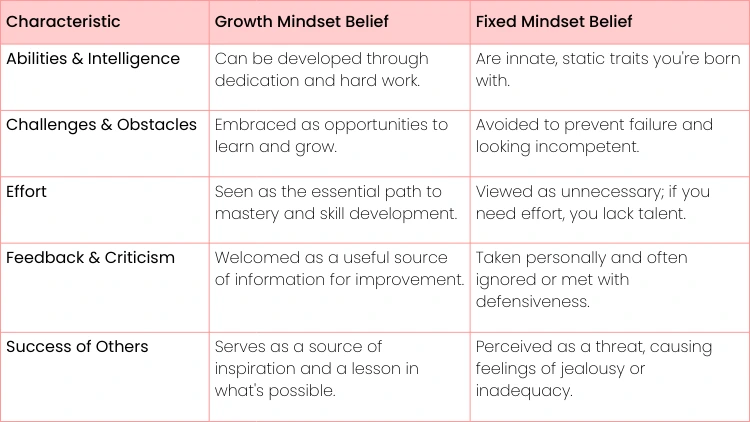
This table offers a quick snapshot of how these two mindsets show up in the real world. It's a handy reference for spotting these beliefs in yourself and others.
As you can see, this isn't just about having a positive attitude. The mindset you adopt actively shapes your reality. A growth mindset builds resilience and a path to constant improvement, while a fixed mindset can unintentionally put a cap on your potential.
- Actionable Insight: The next time you feel resistant to feedback, pause and ask yourself: "Am I reacting to the content of this feedback, or to the feeling of being judged?" This simple question can help you shift from a defensive stance to a learning one. Grasping the importance of beliefs is the first real step.
The Neuroscience of How We Learn and Adapt
The line between a growth mindset and a fixed mindset isn't just a matter of attitude—it's something we can actually see in the brain. Neuroscience shows that what we believe about our own intelligence physically changes how our brains react to new information, especially when we mess up. This isn't just about feeling better about failure; it's about whether our brains are wired to learn from it or just shut down.
When someone with a growth mindset makes a mistake, their brain lights up with activity. It treats the error less like a final verdict and more like a valuable piece of data.
On the other hand, a fixed mindset triggers a more defensive, self-protective neural response. The brain’s main job becomes managing the emotional sting of feeling judged, which pushes the actual learning process to the sidelines.
Your Brain on Mistakes
The real difference comes down to how each mindset handles challenges and feedback. Research shows that people with a growth mindset have greater activity in the parts of the brain tied to attention and fixing errors. They pay closer attention to what went wrong and are far more likely to get it right the next time.
This intense engagement is a cornerstone of neuroplasticity—the brain’s incredible capacity to rewire itself by forging new neural connections. When you look at a challenge as a chance to learn, you're literally telling your brain to grow and adapt. You can dive deeper into this fascinating process by exploring how the brain learns in our insightful journey.
- Practical Example: In one study, after a poor test performance, students with growth mindsets wanted to learn from peers who did better, actively seeking out study strategies. In contrast, those with fixed mindsets defensively looked at the scores of students who did worse, just to feel better about themselves.
From Brainwaves to Behavior
This neurological activity translates directly into how we act in the real world. A growth mindset encourages the brain to engage with mistakes, which naturally builds psychological resilience and strengthens motivation over the long haul. Every error becomes a stepping stone, not a stumbling block.
A growth mindset doesn't just change your perspective; it changes your brain's architecture. By repeatedly engaging with challenges, you strengthen the neural pathways associated with learning and problem-solving, making your brain more efficient at tackling future obstacles.
- Actionable Insight: To activate your brain's growth potential, make it a habit to reflect after every challenging task. Ask yourself two questions: "What went well?" and "What would I do differently next time?" This simple exercise trains your brain to focus on learning and improvement, strengthening those crucial neural pathways.
How Your Mindset Plays Out in Real-World Scenarios
It's one thing to understand the theory behind the growth mindset vs. fixed mindset dynamic, but the real magic happens when you see it in action. In our daily lives, our mindset is the invisible force shaping how we react to everything—from minor setbacks to career-defining challenges.
These beliefs aren’t just about how you feel; they directly drive what you do and, ultimately, where you end up. Let’s dive into a few high-stakes professional situations to see how these two mindsets create radically different outcomes.
The Developer Debugging Complex Code
Picture a software developer staring down a stubborn, complex bug. It’s threatening a major product launch, the pressure from management is mounting, and the fix is nowhere in sight.
- Fixed Mindset Response: The developer’s stomach is in knots. They see the bug as a direct reflection of their own ability, thinking, "I'm just not smart enough for this." This fear pushes them to work in isolation, afraid of looking incompetent. They might get defensive, quietly blaming messy legacy code or vague project specs.
- Growth Mindset Response: This developer sees a puzzle, not a personal failure. Their first thought is, "Okay, what can I learn here?" They don't hesitate to pull in a senior developer, try out new diagnostic tools, and frame the problem as a team challenge. Every failed attempt isn’t a dead end—it’s just more data.
The Manager Leading a Project Pivot
Imagine a project manager who has just been told that after a year of hard work, shifting market conditions mean their project needs a massive strategic pivot. Most of what the team has built is now obsolete.
A fixed mindset views a major pivot as a failure and a waste of time. A growth mindset sees it as a necessary adaptation—an opportunity to build a more relevant and successful product based on new information.
A manager with a fixed mindset might feel completely defeated. They could deliver the news with a tone of resentment, which instantly demoralizes the team. Their focus gets stuck on the wasted effort, breeding a culture of blame and killing motivation.
But a manager operating from a growth mindset frames the pivot as an exciting new mission. They’ll rally the team by saying, "This is our chance to build exactly what the market is asking for." They focus on the lessons learned from the initial work and how that knowledge gives them an edge in the new direction, fostering resilience and collaborative problem-solving.
The Entrepreneur Facing a Business Failure
An entrepreneur pours their heart and soul into a startup, only to see it fail to secure funding and shut down after a year of grueling work.
- Fixed Mindset Reaction: The entrepreneur takes the failure personally and completely. They conclude, "I guess I just don't have what it takes." This one experience becomes definitive proof of their lack of talent, making it highly unlikely they'll ever try again.
- Growth Mindset Reaction: While the disappointment is real, this entrepreneur sees the failed startup as the most valuable, real-world MBA they could have ever gotten. They immediately dive into a post-mortem, asking tough questions: "Where did our strategy miss the mark?" and "What skills do I need to sharpen for my next venture?" The failure isn't an endpoint; it's critical feedback that will fuel their future success.
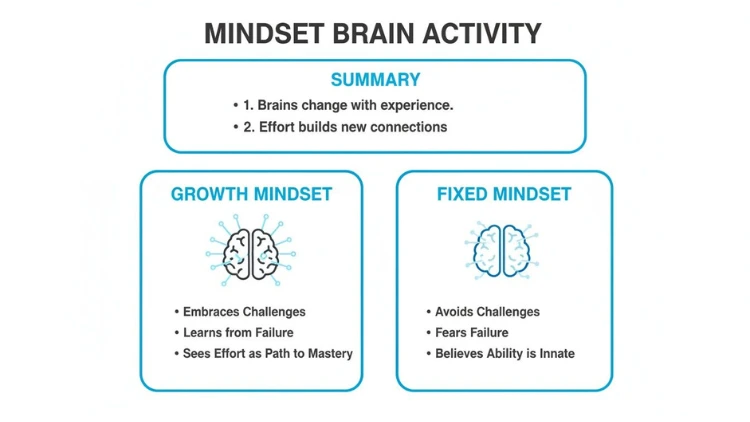
This infographic gives a great visual of the neurological differences, showing how a brain wired for growth is genuinely more active and ready to learn.
The big takeaway here is that a growth mindset primes your brain to learn from mistakes. A fixed mindset, on the other hand, can trigger a neural shutdown when you’re faced with an error, making it much harder to move forward.
The Measurable Impact of Mindset on Your Success
The difference between a growth and fixed mindset isn't just a feel-good concept—it creates tangible, measurable results. Major international studies have repeatedly drawn a powerful line connecting a person's mindset to their achievements in school and at work. Simply put, what you believe about your abilities is a direct predictor of what you'll accomplish.
This isn't just about "trying harder". It’s about how your brain is wired to respond to a challenge. The impact is profound, linking directly to greater resilience and grit in both students and adults. If you're serious about cultivating a growth mindset for resilience and perseverance, understanding this link is the first step.
The Data Behind Achievement
The evidence here is undeniable. Research consistently shows that students who believe their intelligence can be developed outperform their peers who see it as a fixed trait. This isn't a minor edge; it translates directly into higher test scores, sharper problem-solving skills, and a much greater ability to bounce back from academic setbacks.
A fascinating longitudinal study from Chile really brought this home, showing the real-world consequences of these mindsets. The study found that students with a growth mindset were three times as likely to score in the top 20% on their national achievement test.
On the flip side, students with a fixed mindset were four times more likely to land in the bottom 20%. The numbers speak for themselves. You can dive deeper into the data on how growth mindset leads to higher achievement from the study.
Believing you can improve isn't just a motivational tool; it's a strategic advantage. The data shows that a growth mindset fundamentally alters your trajectory, unlocking higher levels of success that remain inaccessible to those who believe their potential is limited.
This principle holds true far beyond the classroom. In the workplace, employees with a growth mindset are the ones who actively seek out tough projects, adapt quickly to change, and ultimately climb into leadership roles. Their hunger to learn makes them more agile and valuable assets in any industry.
- Actionable Insight: Identify one skill you've always believed you "just aren't good at". For the next week, dedicate just 15 minutes a day to practicing a tiny part of that skill. This consistent, small-scale effort demonstrates to your brain that improvement is possible, chipping away at the fixed belief. Realizing that you can either succeed or learn to succeed later is a powerful shift.

Your Action Plan for Cultivating a Growth Mindset
So, how do we actually move from a fixed mindset to a growth mindset? It's not a switch you flip overnight. It’s an active process, one that takes real, conscious effort and a few repeatable strategies to retrain that inner voice that holds you back. This isn’t just theory—these are practical tools you can start using today to build better mental habits.
The first step is simply awareness. You can't change a thought pattern you don't even notice. Think of yourself as a detective of your own mind, listening for that subtle voice of the fixed mindset whenever you hit a wall.
Step 1: Identify Your Fixed Mindset Triggers
We all have triggers—those specific situations that send us spiraling into fixed-mindset thinking. For some, it’s getting tough feedback. For others, it's seeing a colleague succeed where they stumbled, or facing a problem that feels absolutely impossible at first.
- Actionable Insight: For the next three days, keep a "mindset journal". Simply jot down any moment you feel frustrated, defensive, or intimidated. Next to it, write down the thought that popped into your head. For example: "Struggled in a meeting" -> "I'm not articulate enough". This practice will reveal your specific triggers.
Step 2: Reframe Your Internal Dialogue
Once you spot that fixed-mindset thought, you have a choice. You can either accept it or you can challenge it. Reframing isn’t about pretending something isn't difficult; it's about changing how you see that difficulty. It's moving from a statement of permanent failure to one of temporary struggle.
One of the simplest but most powerful tricks is to just add the word “yet” to the end of a negative thought.
- "I can't figure out this software" becomes "I can't figure out this software yet."
- "I'm not a good public speaker" becomes "I'm not a good public speaker yet."
See the difference? That one tiny word opens up a world of possibility. It turns a dead end into a path forward. The strategies in this guide on building a growth mindset in children are surprisingly effective for adults, too, and dive deeper into this kind of mental reframing.
Shifting your mindset is like building muscle. Every time you consciously reframe a fixed thought, you're doing a rep. You're strengthening the neural pathways that make a growth-oriented response your new default.
Step 3: Take Action and Seek Feedback
A growth mindset is nothing without action. It’s not just about thinking differently—it’s about doing differently. You have to turn those reframed thoughts into actual steps. So you're not a data analysis wizard... yet. What are you going to do about it?
- Break It Down: Don't just say "I'll learn data analysis". That's overwhelming. Instead, make it concrete: "I will finish one online tutorial on pivot tables by Friday". Much more manageable.
- Focus on the Process: Celebrate the effort, not just the win. Give yourself credit for putting in an hour of practice, even if you still feel clumsy. The work itself is the victory.
- Ask for Good Input: Don't just wait for feedback—go get it. Find a colleague you trust and say, "Hey, I'm working on my presentation skills. After the next team meeting, could you give me one or two things I could improve?"
Building these habits takes real dedication. It’s a core part of personal development, right alongside learning how to improve self-discipline. When you consistently apply these strategies, you’re not just changing your mind; you’re building a solid foundation for a lifetime of growth.
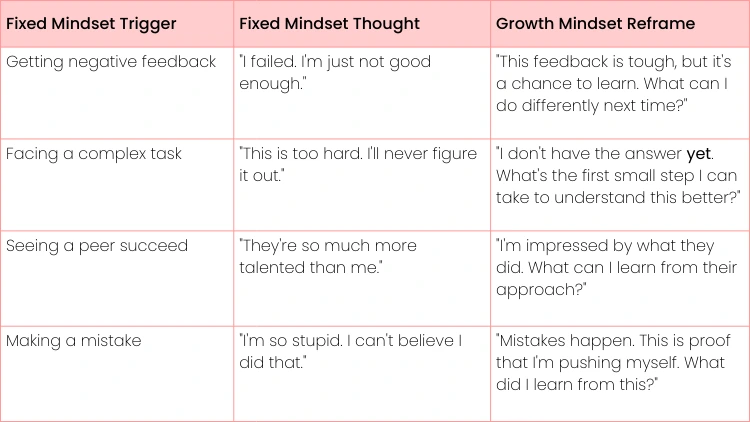
To make this easier, here's a little tool to help you practice catching and changing those thoughts on the fly.
Your Growth Mindset Reframing Tool
Use this table as a starting point. The more you practice these reframes, the more second-nature they become.
Got Questions?
Of course, even after digging into the nuts and bolts of growth vs. fixed mindsets, a few questions always seem to pop up. It's natural—some of these ideas can feel a bit tricky when you start applying them to real life.
Let's walk through some of the most common points of confusion and clear them up.
Can You Have a Mix of Growth and Fixed Mindsets?
Absolutely. In fact, it's the norm. Most of us are walking around with a blend of both mindsets.
- Practical Example: You might have a total growth mindset about learning a new instrument, eagerly practicing scales and watching tutorials. But you may hold a deeply fixed mindset about public speaking, avoiding every opportunity because you believe, "I'm just not a good speaker". Our beliefs are rarely universal; they're shaped by our experiences.
Maybe you were always praised for your artistic talent as a kid but consistently told you "just weren't a math person". It's no surprise, then, that you might see creativity as something you can develop, while your math ability feels set in stone.
- Actionable Insight: The real goal is self-awareness. When you can pinpoint the specific situations that trigger that fixed-mindset voice in your head, you can consciously choose to respond differently. It's about making small, intentional shifts where they matter most.
Is a Growth Mindset Just About Praising Effort?
No, and this is probably the single biggest misunderstanding out there. Praising effort for the sake of effort is not the goal. A genuine growth mindset is all about valuing effective effort.
What's the difference? It comes down to focusing on the process, not just the grind. This means championing things like:
- Trying new strategies when the first one stalls out.
- Actively seeking out feedback to figure out what needs to change.
- Learning from mistakes instead of just working harder at something that isn’t working.
Praise that actually fosters a growth mindset connects the effort to the strategy that created progress. It's about celebrating intelligent persistence.
True growth mindset praise sounds less like "You worked so hard!" and more like "I noticed you tried a different approach on that problem, and it really paid off." It validates the strategy, not just the struggle.
How Can I Encourage a Growth Mindset in Others?
The most powerful way is to lead by example. Be open about your own struggles. Talk through the process you used to overcome a challenge, including the dead ends and frustrations. When you normalize the learning process, you make it safe for everyone else to do the same.
- Practical Example: Instead of saying, "You're a natural leader", which points to a fixed trait, get more specific. Try something like, "The way you facilitated that tough conversation and guided the team to a consensus was really impressive. I especially liked how you made sure everyone's voice was heard." This praises a learnable skill.
- Actionable Insight: When giving feedback, always start by asking, "What was your process for this?" This question immediately shifts the focus from judging the outcome to understanding the effort and strategy behind it, creating a perfect opening for a growth-oriented conversation.
Ultimately, your job is to frame challenges as opportunities for the whole group to grow. Create an environment where mistakes are treated as data points for learning, not as failures to be swept under the rug. This approach is deeply connected to emotional intelligence; understanding and managing group dynamics is critical. You can learn more about what is emotional intelligence and see how it helps build a growth-oriented culture.
When you make the learning process visible and celebrate strategic effort, you actively nurture a growth mindset in your team, your family, or your entire organization. That’s how you unlock resilience and help everyone achieve more.
At Uplyrn, we believe that the right skills and a growth mindset are the keys to unlocking your potential. Explore our courses taught by industry experts and start your journey of continuous learning and career advancement today.


Leave your thoughts here...
All Comments
Reply