









Top Highest Paying Skills to Learn for a Six-Figure Career

In a competitive job market, your earning potential is directly tied to the value of your skills. Merely keeping up is not enough; true career growth comes from strategically acquiring abilities that are not only in demand but also command top-tier compensation. This guide is built to provide a direct, actionable roadmap to the highest paying skills to learn right now. Forget vague suggestions and surface-level tips. We are diving deep into what it actually takes to master these disciplines and get hired.
For each of the 10 skills covered, you will find concrete salary ranges, an analysis of current market demand, and a clear learning path. We will outline specific courses, certifications that carry weight, and portfolio-worthy projects that demonstrate your competence to employers. This article breaks down the steps to transition from a novice to a proficient professional. We will also highlight how resources, like those offered at Uplyrn, can support your journey from education to employment. This blueprint is for anyone ready to invest in themselves for a high-impact, high-income career.
Jump To Section

Earn As You Learn
Earn 25% commission when your network purchase Uplyrn courses or subscribe to our annual membership. It’s the best thing ever. Next to learning,
of course.
1. Artificial Intelligence and Machine Learning
Artificial Intelligence (AI) and Machine Learning (ML) are undeniably among the highest paying skills to learn, sitting at the core of modern technological progress. This field involves building systems that learn from data to make predictions or decisions without being explicitly programmed. From the recommendation engines on Netflix and Spotify to the autonomous driving systems developed by Tesla and Waymo, AI/ML is reshaping industries by automating tasks, uncovering insights, and creating new products.
Why It's a Top Skill
The demand for AI/ML expertise is immense because organizations are collecting more data than ever and need skilled professionals to turn that data into a competitive advantage. Roles like Machine Learning Engineer, Data Scientist, and AI Researcher command high salaries due to the specialized knowledge required. Proficiency in this area opens doors to work on impactful projects, whether it's developing life-saving diagnostic tools in healthcare or optimizing supply chains for global retailers. Businesses that apply AI effectively often see significant gains in efficiency and revenue, making experts in this domain a critical asset. For an example of its business application, see how AI is applied in marketing to drive growth.
Getting Started and Getting Hired
To break into this field, focus on building a strong foundation and practical experience.
- Master the Fundamentals: Start with linear algebra, calculus, probability, and statistics. Python is the dominant programming language, so learn it along with key libraries like NumPy, Pandas, and Scikit-learn.
- Actionable Insight: Don't just read about these topics. Implement a simple linear regression model from scratch using only NumPy to truly understand the underlying math.
- Build a Project Portfolio: Theory isn't enough. Create a GitHub portfolio with projects that demonstrate your skills. Tackle real-world datasets from platforms like Kaggle or build a unique application.
- Practical Example: Build a model that predicts housing prices from a public dataset or create an image classifier that distinguishes between different types of flowers.
- Validate Your Knowledge: To demonstrate proficiency and unlock high-paying roles in this field, pursuing certifications and leveraging resources like an AWS Certified AI Practitioner study guide can be a strategic move. This helps prove your ability to implement AI solutions on a leading cloud platform.
2. Cloud Architecture and DevOps Engineering
Cloud Architecture and DevOps Engineering represent another of the highest paying skills to learn, focused on designing, building, and maintaining scalable and resilient systems on cloud platforms. This field combines the strategic planning of cloud architecture with the agile, automation-driven practices of DevOps to speed up software delivery. Companies like Netflix, with its famous microservices architecture on AWS, and Spotify, which uses a multi-cloud strategy for global scale, show how effective cloud and DevOps practices are essential for modern business operations.
Why It's a Top Skill
The need for Cloud and DevOps experts is extremely high because nearly every enterprise is migrating to cloud infrastructure to reduce costs, improve scalability, and increase agility. Professionals who can design secure, cost-effective cloud environments and automate deployment pipelines are critical for a company's success. Roles like Cloud Architect, DevOps Engineer, and Site Reliability Engineer are very well-compensated due to the direct impact they have on a company's ability to innovate and compete. Mastering these skills allows you to build and manage the backbone of modern digital services.
Getting Started and Getting Hired
To enter this high-demand field, combine foundational knowledge with hands-on practice using industry-standard tools.
- Master the Fundamentals: Begin by understanding core networking, security, and system administration concepts. Learn a major cloud platform like AWS, Azure, or GCP. Scripting with Bash or Python is also essential for automation.
- Actionable Insight: Get a free-tier account on AWS and practice setting up a basic Virtual Private Cloud (VPC) with public and private subnets.
- Build a Project Portfolio: Set up personal projects that demonstrate practical skills. Use Infrastructure as Code (IaC) tools like Terraform or CloudFormation to build and manage an environment.
- Practical Example: Write a Terraform script to deploy a simple two-tier web application (a web server and a database) on AWS or Azure.
- Validate Your Knowledge: Certifications are highly regarded in this field. Earning a credential like an AWS Certified Solutions Architect or a Certified Kubernetes Administrator (CKA) proves your expertise to employers. Focus on mastering containerization with Docker and Kubernetes, as they are standard tools for building and deploying applications at scale.

3. Data Science and Advanced Analytics
Data Science and Advanced Analytics is a multidisciplinary skill that combines statistics, computer science, and business knowledge to extract meaningful insights from complex data. Practitioners clean, analyze, and interpret large datasets to uncover hidden patterns and inform strategic decisions. From Amazon using predictive analytics to manage inventory to financial institutions employing risk modeling for credit decisions, data science is the engine behind data-driven organizations.
Why It's a Top Skill
The demand for data scientists is exceptionally high because companies across all sectors recognize that data is a critical asset. Roles like Data Scientist, Data Analyst, and Analytics Manager earn high salaries due to the specialized ability to translate raw data into profitable business strategies. Mastery in this area allows professionals to solve important problems, such as predicting patient outcomes in healthcare or personalizing customer experiences in retail. Organizations that successfully apply data science often achieve a significant competitive advantage, making experts in this field essential. If you want to understand its core concepts, you can explore what data science and analytics involves.
Getting Started and Getting Hired
To enter the data science field, you need a mix of theoretical knowledge and hands-on application.
- Build the Foundation: Develop a strong understanding of statistics, probability, and linear algebra. Python is the industry standard, so become proficient with libraries like Pandas for data manipulation, Scikit-learn for modeling, and Matplotlib for visualization.
- Actionable Insight: Take a messy CSV file and practice cleaning it with Pandas by handling missing values, correcting data types, and removing duplicates.
- Practice with Real Data: Theory alone is insufficient. Spend significant time on projects using real-world datasets from sources like Kaggle.
- Practical Example: Download a dataset on customer churn and build a simple logistic regression model to predict which customers are likely to leave. Document your findings in a Jupyter Notebook.
- Learn to Communicate: Your analysis is only valuable if others can understand it. Practice presenting your findings to non-technical audiences.
- Actionable Insight: After completing a project, create a 5-slide presentation summarizing your problem, method, key findings, and business recommendation. This prepares you for stakeholder meetings.
4. Cybersecurity and Ethical Hacking
Cybersecurity is the practice of protecting digital systems, networks, and data from malicious attacks, damage, or unauthorized access. This discipline includes everything from penetration testing and vulnerability assessment to incident response and security architecture. With the increasing frequency and complexity of cyber threats, expertise in this area is one of the highest paying skills to learn, as organizations scramble to safeguard sensitive information and comply with strict regulations.
Why It's a Top Skill
The demand for cybersecurity professionals is soaring because a single data breach can cost a company millions in fines, reputational damage, and operational downtime. Roles like Security Analyst, Penetration Tester, and Chief Information Security Officer (CISO) offer high salaries due to the critical nature of their work. Experts in this field are essential for protecting everything from financial institutions against fraud to government agencies defending national interests. For instance, Google's Project Zero actively discovers critical security flaws, demonstrating the proactive defense required in this field.
Getting Started and Getting Hired
Breaking into cybersecurity requires a mix of foundational knowledge and hands-on, practical skills.
- Build Your Foundation: Start with core IT concepts like networking, operating systems, and basic programming. Certifications like CompTIA Security+ provide a solid entry-level credential that validates your fundamental understanding.
- Actionable Insight: Use a network scanning tool like Nmap to scan your own local network and understand what ports are open on your devices.
- Practice in a Homelab: Create a safe, isolated home lab environment using virtual machines to practice network security, system hardening, and ethical hacking techniques. This hands-on experience is invaluable.
- Practical Example: Set up two virtual machines—one running a vulnerable application like Metasploitable and the other running Kali Linux—and practice identifying and exploiting vulnerabilities.
- Engage with the Community: Participate in Capture The Flag (CTF) competitions on platforms like Hack The Box or TryHackMe to solve real-world security challenges and sharpen your skills. For those interested in offensive security, a guide on mastering ethical hacking with BlackArch Linux offers practical steps for using specialized tools.

5. Full-Stack Software Development
Full-stack development is another one of the highest paying skills to learn, involving the ability to build a complete web application from start to finish. This means handling both the frontend (what users see and interact with) and the backend (the server, database, and application logic). From the seamless user experience on Airbnb to the robust developer APIs offered by Stripe, full-stack developers are the architects behind modern digital platforms, capable of turning an idea into a fully functional product.
Why It's a Top Skill
The high demand for full-stack developers comes from their versatility. Businesses need professionals who can manage the entire development lifecycle, reducing the need for multiple specialized roles and streamlining project timelines. A single full-stack developer can build a minimum viable product (MVP), troubleshoot issues across the technology stack, and understand how different parts of an application connect. This end-to-end expertise makes them incredibly valuable, especially for startups and agile teams aiming to innovate quickly and efficiently.
Getting Started and Getting Hired
To enter this well-compensated field, you need a combination of broad knowledge and focused practical skills.
- Master a Core Stack: Don't try to learn everything at once. Focus on one popular stack, such as MERN (MongoDB, Express.js, React, Node.js) or LAMP (Linux, Apache, MySQL, PHP), to build a solid foundation.
- Actionable Insight: Choose the MERN stack and build a simple to-do list application where tasks can be created, read, updated, and deleted (a "CRUD" app).
- Build a Diverse Portfolio: Create several complete projects that solve different problems. A portfolio demonstrating a social media clone, an e-commerce site, and a productivity tool shows a wider range of abilities than three similar applications.
- Practical Example: Build a weather app that pulls data from a public API, a blog platform with user authentication, or a simple project management board.
- Deepen Your Knowledge: Beyond frameworks, learn about clean code principles, software design patterns, and database management. You can find a complete roadmap to learn how to get started with web development to guide your journey from beginner to job-ready professional.
6. Product Management and Strategy
Product Management and Strategy is another of the highest paying skills to learn, placing you at the intersection of business, technology, and user experience. This discipline involves guiding a product’s entire lifecycle, from conception and development to launch and growth. Product managers act as the ‘mini-CEO’ of a product, defining its vision, strategy, and roadmap while coordinating across engineering, design, marketing, and sales teams. Think of Steve Jobs defining Apple's product vision or Sundar Pichai leading Google Chrome's strategy.
Why It's a Top Skill
Effective product management directly drives company revenue and competitive positioning, making skilled practitioners highly sought after. Great product managers ensure that a company builds the right product for the right audience, preventing wasted engineering efforts and creating market-defining solutions. Because of their direct impact on business success, roles like Product Manager, Head of Product, and Chief Product Officer command premium salaries. Mastery in this area allows you to shape the future of products used by millions.
Getting Started and Getting Hired
To enter product management, you must cultivate a unique blend of strategic thinking, empathy, and execution.
- Build Customer Empathy: Learn to conduct user research, analyze feedback, and genuinely understand customer problems.
- Practical Example: Choose a popular app you use, identify a key pain point, and conduct 3-5 informal interviews with other users to validate the problem and brainstorm potential solutions.
- Develop a Strategic Mindset: Practice thinking long-term about a product's vision while also managing the tactical details of a sprint or launch.
- Actionable Insight: Read a book like Marty Cagan’s Inspired and write a one-page product strategy document for a hypothetical new feature for your favorite app.
- Become Data-Literate: While you don't need to be a data scientist, you must be comfortable with metrics. Learn to identify key performance indicators (KPIs) that truly reflect a product's health and use data to justify your decisions.
- Practical Example: For a new sign-up flow, define primary KPIs like "Conversion Rate" and secondary metrics like "Time to Completion" to measure its success.
7. Mobile App Development (iOS and Android)
Mobile App Development is one of the highest paying skills to learn, centered on creating applications for smartphones and tablets. With mobile internet usage far exceeding desktop, a strong mobile presence is essential for business survival and growth. This skill includes native development using Swift for iOS or Kotlin for Android, and cross-platform development with frameworks like React Native or Flutter. Success stories like Instagram, which adopted React Native for faster updates, and Uber's globally dominant ride-sharing app, show the power of expert mobile development.
Why It's a Top Skill
Demand for mobile developers is consistently high because companies need to reach customers where they spend the most time: on their phones. Roles such as iOS Developer, Android Developer, and Mobile Engineer offer excellent salaries due to the specific technical expertise required. A well-built app can directly increase revenue, improve customer engagement, and provide a critical competitive edge. Because of this direct impact on business performance, skilled mobile developers are viewed as indispensable assets in almost any industry.
Getting Started and Getting Hired
To enter the mobile development field, you must build tangible proof of your abilities.
- Choose a Path and Master It: Decide between native (iOS/Android) for higher performance and deeper platform integration, or cross-platform (React Native/Flutter) for broader reach with a single codebase.
- Actionable Insight: If you're new to programming, start with Flutter and Dart, as they are often praised for their beginner-friendly learning curve and fast development cycle.
- Build and Publish Real Apps: Create a portfolio by developing and launching 3-5 applications on the App Store or Google Play. This demonstrates your ability to navigate the entire development lifecycle.
- Practical Example: Build a simple unit converter app, a note-taking app that saves data locally, or a tip calculator.
- Focus on User Experience (UX): A successful app is more than just functional code; it must be intuitive and enjoyable to use. Study Apple's Human Interface Guidelines and Google's Material Design principles to create polished, user-friendly interfaces that drive retention.
8. Blockchain and Cryptocurrency Development
Blockchain and Cryptocurrency Development is a specialized skill focused on building decentralized systems and applications. This field involves creating smart contracts, new cryptocurrencies, and applications on platforms like Ethereum and Solana using languages such as Solidity. Its rise as one of the highest paying skills to learn stems from its potential to create more transparent, secure, and efficient systems for finance, supply chain management, and digital ownership. DeFi protocols like Aave and Compound, which manage billions in assets, showcase the power of this technology.
Why It's a Top Skill
Demand for blockchain developers is high because the technology is still new, and the pool of experienced talent is small. Companies are eager to explore how decentralized ledgers can reduce fraud, cut operational costs, and create new business models, making skilled developers extremely valuable. Roles like Blockchain Engineer, Smart Contract Developer, and a variety of Web3-focused positions offer substantial compensation. Proficiency in this area allows you to work at the forefront of financial innovation, build next-generation marketplaces like OpenSea, or develop critical infrastructure like the oracle provider Chainlink.
Getting Started and Getting Hired
Breaking into blockchain development requires a mix of fundamental knowledge and hands-on, security-focused practice.
- Master the Fundamentals: Begin by understanding core blockchain concepts like decentralization, consensus mechanisms, and cryptography. Then, focus on learning Solidity for Ethereum smart contract development.
- Actionable Insight: Use the Remix IDE to write and deploy a simple "Hello, World!" smart contract on an Ethereum testnet like Sepolia.
- Build a Project Portfolio: Practical experience is critical. Develop and deploy your own smart contracts on a testnet. Create a simple decentralized application (dApp).
- Practical Example: Build a dApp for a simple voting system where wallet addresses can cast a single vote for a set of proposals.
- Prioritize Security: In blockchain, vulnerabilities can lead to massive financial losses. Study common attack vectors and follow security best practices from organizations like OpenZeppelin.
- Actionable Insight: When building your voting dApp, incorporate OpenZeppelin's Ownable and ReentrancyGuard contracts to understand and prevent common security flaws.
9. UX/UI Design and User Experience Research
UX/UI Design is another of the highest paying skills to learn, focusing on creating intuitive, functional, and enjoyable digital products. This discipline combines psychology, aesthetics, and user-centric problem-solving. UX (User Experience) research involves understanding user behaviors and needs, while UI (User Interface) design centers on crafting the visual layout and interactivity of a product. In a crowded digital marketplace, a positive user experience is a powerful differentiator, directly impacting customer loyalty and a company's bottom line.
Why It's a Top Skill
Demand for skilled UX/UI professionals is high because businesses recognize that excellent design is a strategic advantage. A well-designed app or website can dramatically increase user engagement, conversion rates, and retention. Think of how Airbnb’s intuitive design overhaul built user trust and drove bookings. Roles like UX Designer, UI Designer, and UX Researcher offer high salaries because they are central to product success. These professionals ensure that a product is not just usable but also delightful, making them essential for any modern company aiming to compete effectively.
Getting Started and Getting Hired
To build a career in this creative and analytical field, you need to combine design theory with hands-on practice.
- Build a Process-Oriented Portfolio: Go beyond final mockups. Document your entire design process, including user research, wireframing, prototyping, and user testing. Show how you solved real problems.
- Practical Example: Redesign the login flow for a popular website, documenting each step: create user personas, sketch wireframes, build a clickable prototype in Figma, and write a summary of your design choices.
- Master Key Tools and Methods: Become proficient with design software like Figma or Adobe XD. Learn user research techniques such as interviews, surveys, and usability testing.
- Actionable Insight: Use Figma to create an interactive prototype for a simple mobile app idea and then use its "share" feature to get feedback from friends.
- Study Behavioral Design: Understand the psychological principles behind user actions. Knowledge of behavioral design helps create persuasive and habit-forming experiences.
- Actionable Insight: Analyze an app like Duolingo. Identify and document how it uses concepts like streaks (Commitment & Consistency) and rewards (Variable Reinforcement) to keep users engaged.

10. Executive Leadership and Business Consulting
Executive Leadership and Business Consulting represent the pinnacle of strategic influence, making them some of the highest paying skills to learn. This dual-sided skill set involves either steering a company’s direction from a C-suite position or providing expert external advice to help organizations solve complex problems. Leaders like Satya Nadella, who led Microsoft’s successful shift to cloud computing, and consulting firms like McKinsey & Company, which guide transformations for Fortune 500 companies, demonstrate the immense impact these roles have on financial performance and market position.
Why It's a Top Skill
The demand for strong leadership and expert consulting is perpetual because these skills directly drive profitability and growth. Executives and consultants who can successfully navigate market shifts, optimize operations, and inspire teams are invaluable assets. Their compensation reflects the massive responsibility they hold. A single strategic decision can add or subtract billions in market value, making expertise in this area a critical investment for any major organization. Proficiency in leadership and strategic thinking opens doors to roles with direct influence over a company’s future.
Getting Started and Getting Hired
Ascending to these roles requires a long-term commitment to building business acumen and a proven record of success.
- Master Financial Ownership: Get comfortable with profit and loss (P&L) statements early in your career. Volunteer for projects that give you budget management responsibilities.
- Actionable Insight: Ask your manager if you can help with the budget planning for your team's next project, even in a small capacity, to gain practical exposure.
- Build a Reputation for Impact: Focus on delivering measurable results in every role. Quantify your accomplishments, showing how you increased revenue, cut costs, or improved efficiency.
- Practical Example: Instead of saying "Improved a workflow", say "Redesigned the customer support workflow, which reduced average ticket resolution time by 15%."
- Cultivate Executive Presence: Developing strong leadership skills is fundamental to gaining influence and respect. Work on your communication, confidence, and ability to inspire others.
- Actionable Insight: Volunteer to present your team's project updates at the next department meeting to practice your public speaking and presentation skills. To get started, you can learn more about how to develop leadership skills and put them into practice.
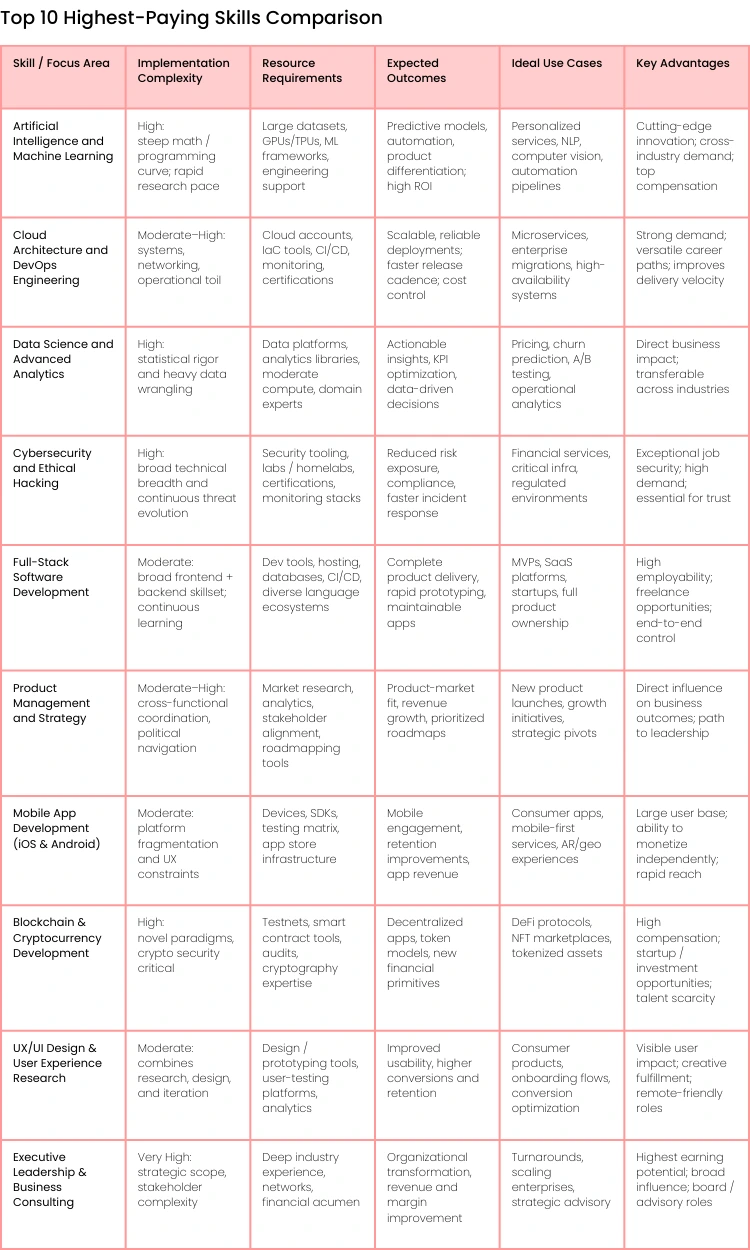
From Learning to Earning: Your Next Steps to a High-Income Career
We have explored ten of the most lucrative and in-demand skills shaping today’s job market, from the analytical depth of Data Science to the creative problem-solving of UX/UI Design. Each path, whether it's building secure systems in Cybersecurity or architecting scalable solutions in the cloud, represents more than just a job; it’s a gateway to a high-impact, high-income career. The common thread connecting all these fields is a commitment to continuous, practical learning.
The journey from novice to expert is not about memorizing facts. It is about actively applying knowledge. The most successful professionals in AI, software development, or product management are constant builders and problem-solvers. They understand that true mastery comes from the tangible experience of creating a project, debugging a complex issue, or refining a user journey based on real feedback. This is the crucial transition from passive consumption of information to active creation of value.
Turning Knowledge into Actionable Steps
The most significant barrier to entry is often not a lack of resources, but a lack of a clear, actionable starting point. Merely knowing the highest paying skills to learn is not enough. The key is to break down the monumental goal of "learning a new skill" into manageable, daily actions.
Here is a practical framework to begin your journey:
- Select Your Focus: Don't try to learn everything at once. Choose one skill from this list that genuinely sparks your interest. Passion is a powerful motivator through the inevitable challenges of learning something new. For instance, if you enjoy solving puzzles and thinking strategically, Cybersecurity might be a better fit than UX/UI Design.
- Start with a Foundational Project: Instead of just watching tutorials, immediately apply what you learn. If you're learning Full-Stack Development, build a simple to-do list application. If it's Data Science, find a public dataset on a topic you love-like sports or movies-and perform a basic analysis. This initial project becomes the cornerstone of your portfolio.
- Commit to Consistency: Dedicate a specific, non-negotiable block of time each week to your learning. Even 3-5 hours a week, applied consistently, will yield significant results over a few months. Consistency builds momentum and turns a daunting task into a manageable habit.
The Value of a Guided Path
While self-direction is admirable, a structured learning path can dramatically accelerate your progress and prevent common pitfalls. Following a curriculum designed by experts ensures you learn the right things in the right order, building a solid foundation before moving to advanced topics.
Key Insight: The fastest way to a high-paying role is not by taking shortcuts, but by following a proven, efficient path. Guided learning provides structure, mentorship, and project-based experience that employers look for. This transforms your learning from a random walk into a direct route toward your career goals.
Ultimately, investing in one of these skills is an investment in your own potential. The financial rewards are a direct result of the value you can create for businesses and users. By choosing a path, committing to practical application, and staying consistent, you are not just learning a skill; you are building a more secure and fulfilling professional future. Your journey to a six-figure salary starts now, with the first small step you take today.
Ready to turn your ambition into action? Uplyrn offers expert-led courses and guided career paths in many of the highest paying skills to learn. Start building your future today with practical projects and mentorship at Uplyrn.


Leave your thoughts here...
All Comments
Reply