









How to Become a Mentor and Guide Others to Success

To kickstart your mentoring journey, you first need to get clear on your value. This means digging into your unique experiences, honing your communication skills, and then building a framework to actually guide your mentee. It's about turning all that hard-won professional wisdom into actionable guidance that can genuinely shape someone's career.
Jump To Section

Earn As You Learn
Earn 25% commission when your network purchase Uplyrn courses or subscribe to our annual membership. It’s the best thing ever. Next to learning,
of course.
Defining Your Value as a Mentor
Before you can effectively guide anyone, you need a rock-solid understanding of what you bring to the table. This goes way beyond your job title or how many years you've been in the game. It’s about the unique blend of skills, knowledge, and perspectives you’ve picked up along the way. Your goal here is to build unshakable confidence in what you have to offer.
Being a great mentor isn’t about having all the answers. It’s about knowing which of your past experiences can light the way for someone else's future. To really grasp the impact you can have, it’s worth exploring the reasons why having a mentor is important for both professional and personal growth.
Pinpoint Your Unique Expertise
Often, your most valuable mentoring assets are born from the challenges you've overcome. Don't just list your wins; think about the tough projects, career pivots, and even the flat-out failures that taught you something critical. Those real-world trenches are where the best insights are found.
Actionable Insight: Grab a notebook and dedicate 30 minutes to a "career autopsy". Don't just list job titles. Instead, write down three major projects: one success, one failure, and one that changed your perspective. For each, jot down the key lesson you learned. This exercise will give you concrete stories and insights to share with a mentee.
- Hard Skills: List the technical stuff you've mastered. This could be anything from knowing a specific software inside and out (like Salesforce or the Adobe Creative Suite) to specialized skills like financial modeling or data analysis.
- Practical Example: You’re an expert in Google Analytics and can show a junior marketer how to build a custom dashboard to track campaign ROI.
- Soft Skills: What about your people skills? Think about your knack for negotiation, managing tricky stakeholders, giving feedback that actually helps, or leading a team through a chaotic period.
- Practical Example: You successfully mediated a conflict between two departments, and you can teach a new manager the framework you used.
- Navigational Experience: Jot down those pivotal career moments. Have you successfully navigated a corporate merger, jumped into a totally new industry, or built a professional network from the ground up?
- Practical Example: You transitioned from a stable corporate job to a fast-paced startup and can advise someone on what to expect and how to prepare.
A mentor's true value isn't just in their knowledge, but in their ability to contextualize that knowledge through lived experience. You aren't just sharing what you know; you're sharing how you came to know it.
This self-assessment is all about turning your career history into a library of teachable moments. It shifts your mindset from "I am a marketing manager" to "I can teach someone how to build a go-to-market strategy for a new product because I did it three times and learned exactly what works—and what doesn't."
Identify Your Ideal Mentee
Once you’ve got a firm handle on your value, the next step is figuring out who stands to benefit the most from it. Being a mentor for "anyone" really means you're a mentor for no one. Getting specific is your greatest advantage because it sets the stage for a truly productive relationship.
Think about the professional profile that syncs up with your expertise. A vague goal like "helping young professionals" is nowhere near as effective as a focused one.
Let's look at a practical example: Imagine you're a mid-level software engineer who recently moved from a massive corporation to a scrappy startup. You'd be the perfect mentor for:
- A junior developer who is thinking about making a similar jump and needs to understand the cultural and technical whiplash.
- A computer science student who wants advice on building a portfolio that will actually catch the eye of startup hiring managers.
To really nail down your value, it helps to understand the broader world of professional guidance. This clarity is what will attract mentees who are a perfect match, ensuring the mentorship is meaningful from day one.

Developing Your Core Mentoring Skills
Having a ton of experience is a fantastic starting point, but it doesn't automatically make you a great mentor. The real magic happens when you master the art of communication. It's less about having all the answers and more about creating a space where your mentee can find their own. Your job is to be a guide, not a director.
The impact of this shift is huge. It's why so many Fortune 500 companies have formal mentoring programs. Think about this: 84% of CEOs say their mentors helped them dodge costly mistakes, and 69% credit their mentors with helping them make better decisions. If you want to dive deeper into the data, these mentoring statistics are pretty eye-opening.
The Art of Powerful Questioning
Top-tier mentors rarely give direct advice. Instead, they ask questions that unlock insights and force their mentees to think for themselves. The goal is to move them from asking, "What should I do?" to exploring, "What are my options, and which one makes the most sense for me?" This approach helps them build their own problem-solving muscles for the long haul.
It’s a subtle but powerful change in conversation.
- Instead of saying: "You should apply for that project manager role."
- Try asking: "When you picture your career in two years, how does that project get you closer to that vision?"
- Instead of saying: "You need to speak up more in meetings."
- Try asking: "What’s one small thing you could try in the next team meeting to make sure your point of view is heard?"
Actionable Insight: Before your next mentoring session, prepare three powerful, open-ended questions related to your mentee's goals. Questions starting with "What" or "How" are often more effective than those starting with "Why" which can sometimes sound accusatory.
Master Active Listening
This is more than just waiting for your turn to talk. Active listening means tuning into the intent, emotion, and context behind the words. It's the absolute foundation of trust. When a mentee feels genuinely heard, they'll open up and be far more receptive to your guidance.
A simple technique to practice this is the "repeat and confirm" method. After your mentee shares a struggle, try summarizing it back to them in your own words.
You could say something like, "Okay, so if I'm hearing you right, you feel solid on the technical side of your job, but you're worried that a lack of visibility with senior leadership is what’s really holding you back. Do I have that right?"
This simple step accomplishes two critical things: it confirms you're on the same page and, more importantly, it shows them you're truly paying attention.
Giving Feedback That Inspires Action
Let's be honest—delivering constructive feedback can be nerve-wracking. The trick is to frame it as supportive mentoring, not criticism. Focus on observable behaviors and their potential impact, steering clear of personal judgments.
A great framework for this is Situation-Behavior-Impact (SBI).
- Situation: "In the project kickoff meeting yesterday..."
- Behavior: "...when the client asked about potential risks, you deferred the question to your manager."
- Impact: "...which might have given the impression that you weren't fully prepared to lead that part of the discussion."
The key is what comes next. Immediately follow up with a collaborative, forward-looking question: "How can we prep for that question next time so you feel ready to showcase your expertise?" This turns a critique into a growth plan. This kind of communication is deeply connected to self-awareness, which is a cornerstone of what is emotional intelligence.
Setting Clear and Healthy Boundaries
Right from your very first conversation, you need to set professional boundaries. This isn't about being rigid; it's about protecting both of you and keeping the relationship productive and respectful. A little clarity upfront prevents a lot of awkwardness down the road.
Actionable Insight: Create a simple, one-page "Mentorship Agreement" template for yourself. It doesn't need to be a formal legal document. Just outline your communication preferences, session frequency, and confidentiality clause. Sharing this during your first meeting sets a professional tone from the start.
- Communication Channels: Agree on how you'll communicate. Is it just scheduled calls? Is email okay? What about a platform messenger? Make it clear that late-night texts are off-limits.
- Session Frequency: Decide how often you'll meet. Is this a weekly, bi-weekly, or monthly thing?
- Confidentiality: State loud and clear that your conversations are a safe space and will remain confidential. This is essential for building trust.
- Scope of Mentorship: Be upfront about what you can and can't help with. You're their career guide and sounding board—not their therapist, recruiter, or on-demand problem-solver.
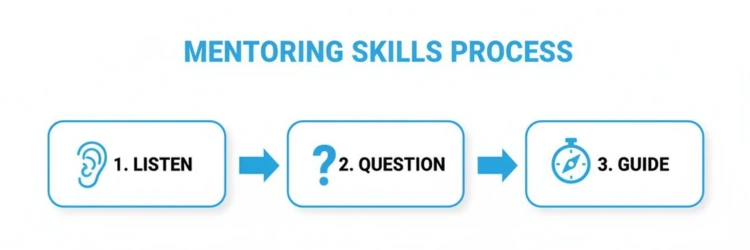
At its core, every mentoring session follows a simple but powerful process.
Structuring Your Mentorship Program
So, you’ve got the skills and the drive to be a mentor. That’s the most important part, but turning good intentions into actual progress requires a plan. A solid structure is the blueprint for your mentorship, giving both you and your mentee a clear path forward and making sure everyone's on the same page from day one.
Without a framework, it’s easy to fall into common traps like having aimless chats or dealing with mismatched expectations. Building this foundation first allows the real mentoring relationship to take off.
Choose Your Mentoring Model
How you actually deliver your guidance is just as important as the advice itself. There’s no single right way to do it. The best fit will depend on your personality, your schedule, and what your ideal mentee really needs.
Think about which of these common formats feels right for you:
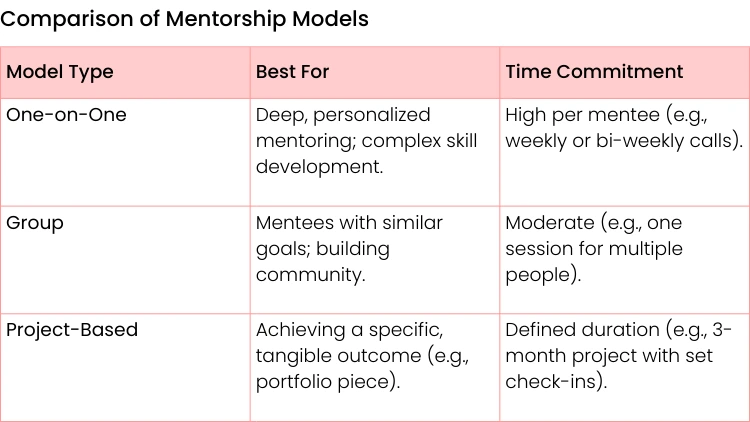
- One-on-One Sessions: This is the classic approach, perfect for deep, personalized guidance. It’s ideal when you’re helping someone tackle complex career hurdles or develop a skill that demands focused attention.
- Practical Example: A senior product manager might use this model to walk a junior PM through their first big product launch, with weekly 45-minute calls.
- Group Mentoring: This involves leading a small group of mentees at the same time. It's an efficient way to share your knowledge and has the added benefit of creating a peer support network.
- Practical Example: A freelance graphic designer could mentor three up-and-comers in a monthly group session on how to land clients and set their rates.
- Project-Based Mentorship: With this model, the entire mentorship is built around a specific, tangible goal.
- Practical Example: A software developer could mentor a student by guiding them through the process of building their first full-stack application over a three-month period.
The right model is all about alignment. A busy executive might only have time for a monthly one-on-one call, while a mentee who needs constant feedback would get more out of a project-based structure with weekly check-ins.
Define Your Mentorship Offering
Think of your mentor profile as your storefront. It needs to tell people exactly who you help, what problems you solve, and what results they can expect. Vague statements like "I help people grow their careers" just won't cut it.
You need to be specific. A powerful profile might say: "I mentor early-stage startup founders on securing their first round of seed funding by helping them refine their pitch deck and build investor relationships." See the difference? A potential mentee immediately knows if you're the right person for them, and you're defining the starting point and the desired destination for your mentee.
This really brings home the point that great mentorship isn't just about dishing out advice. It's a cycle of truly understanding your mentee's situation, asking the right questions to spark their own thinking, and then offering your guidance.
Next, make it official with a simple mentorship agreement. This isn't about getting bogged down in legal jargon; it's about setting clear expectations from the get-go. Your agreement should cover things like session frequency, how you'll communicate (e.g., Zoom calls only, no random texts), confidentiality, and the goals you've agreed to work towards. This one simple document builds a foundation of trust and professionalism right away.
To help you decide, here’s a quick breakdown of the different models. This table compares the key aspects of each so you can figure out what works best for your style and your mentee’s goals.
Ultimately, you can even mix and match. The key is to pick a structure that you can commit to and that provides real value.
Finding and Connecting With Your First Mentees
Okay, you've done the prep work. Your program is mapped out, and you know what you bring to the table. Now for the exciting part: finding the people you’re meant to guide.
This isn't a "build it and they will come" situation. It's about proactively, and more importantly, authentically, showing up where your ideal mentee already hangs out.
The good news? The demand is massive. Mentorship isn't just a "nice-to-have" anymore, especially for younger generations. A whopping 86% of Gen Z and 84% of millennials see mentorship as critical for their careers. In fact, for up to 79% of Gen Z, it's non-negotiable for success. People are actively looking for the guidance you have to offer. For a deeper dive, check out these insights on talent trends from Deloitte.
Start With Your Existing Network
Your first mentee is probably closer than you think. Forget cold outreach for a moment and look at your own professional circle, especially on a platform like LinkedIn. This isn't about sending spammy DMs; it's about subtle, strategic positioning.
Actionable Insight: Tweak your LinkedIn headline or "About" section to signal that you're open to mentoring. Instead of just listing your job title, try something more inviting: "Senior Data Scientist | Helping new analysts navigate the tech industry".
Next, start sharing content that showcases your expertise without being preachy. Post a quick story about a project challenge you recently solved or an interesting takeaway from an industry report. This positions you as a knowledgeable guide and naturally attracts the kind of people you want to help. If you want more ideas on this, take a look at this guide on how to network effectively.
Tap Into Formal Programs and Platforms
Beyond your personal connections, there are established channels designed to connect mentors with mentees. Many companies run internal mentoring programs that pair senior employees with newer team members. This is a fantastic, low-friction way to dip your toes in the water.
You should also look into industry associations and specialized platforms like Uplyrn. These platforms are goldmines for meeting motivated people outside your immediate circle. They handle a lot of the matchmaking, which lets you focus on what you do best: giving great advice.
Your mentor profile is your digital handshake. Be specific. A profile that says "I help junior software engineers prep for their first system design interview" is infinitely more compelling than one that just says "I am a software engineer".
Nailing Your Outreach
When you do find someone who seems like a great fit, your first message sets the tone for everything that follows. Keep it professional, personal, and focused on them, not you.
Here’s a simple template you can adapt:
- Subject: Following up on your post about [Topic]
- Body: "Hi [Name], I saw your recent comment in the [Industry Group Name] about struggling with [specific challenge]. I’ve navigated some similar situations in my own career as a [Your Role] and thought I'd reach out. If you're open to it, I'd be happy to chat for 20 minutes next week to share a few things that helped me. Let me know if that sounds useful."
Many of the same strategies for finding mentees overlap with finding clients for other services.
The All-Important Chemistry Call
Once someone shows interest, the very next step should be a quick "chemistry call". This is not a mentoring session. It's a casual, 15-20 minute chat to see if you actually click. The goal here is simple: establish rapport and make sure your experience truly matches their needs.
Actionable Insight: End your chemistry call with this question: "Based on our chat, what's the one thing you're hoping to get out of a mentorship with me?" Their answer will tell you immediately if your expertise aligns with their expectations.
- "What's the single biggest challenge you're dealing with right now?"
- "If we worked together, what would a 'win' look like for you in three months?"
- "How do you prefer to receive feedback—blunt and direct, or more collaborative?"
This short conversation is crucial. It ensures you both walk into the relationship with clear eyes and shared expectations, setting the foundation for a truly productive partnership right from the start.
Running Mentoring Sessions That Make an Impact
The real magic of mentorship happens in the conversations themselves. A well-run session is the difference between a nice chat and a career-defining moment. To consistently deliver that kind of value, you need a flexible framework that makes every meeting count.
This isn't about following a rigid script. Think of it more like a reliable game plan. It provides just enough structure to keep things focused and productive while leaving plenty of room for genuine connection and deep-dive problem-solving. It’s what keeps your sessions from drifting into aimless small talk and ensures the spotlight stays on your mentee’s growth.
An Adaptable Agenda for Every Session
Great mentoring sessions don’t just happen—they’re facilitated. Following a consistent structure brings a sense of purpose and predictability, allowing your mentee to show up prepared and ready to tackle their biggest challenges head-on.
Here’s a simple but incredibly effective three-part framework I've used for years:
- The Check-In (First 10–15 minutes): Kick things off by reviewing the action items from your last meeting. This isn't just a status update; it's about building accountability. Ask things like, "How did you get on with that goal we set?" or "What roadblocks did you hit?" This immediately grounds the conversation in real-world progress.
- The Deep Dive (Middle 30–40 minutes): This is the heart of the session. Let your mentee bring their most urgent problem to the table. Your job here is to be a guide, not a problem-solver. Listen intently and ask powerful, open-ended questions.
- Practical Example: If they’re dealing with a difficult stakeholder, you could ask, "What does a successful outcome look like here, and what's one small step you can take to move in that direction?"
- The Action Plan (Final 5–10 minutes): A meeting without clear next steps is a missed opportunity. Always wrap up by summarizing the key insights and defining 1-2 specific, achievable action items.
- Actionable Insight: Instead of you assigning the actions, ask your mentee: "So, based on our conversation, what's one action you'll commit to taking before we next meet?" This fosters ownership.
Your goal as a mentor is not to provide a map but to help your mentee build their own compass. Each session should empower them to navigate their own path with greater confidence and clarity.
Keeping Discussions Focused and Productive
It's natural for conversations to wander, especially when you have great rapport. As the mentor, you have to be the one to gently steer things back on course.
If your mentee starts going down a rabbit hole, a simple phrase can work wonders. Try something like, "That's a really interesting point, and I want to be sure we have enough time for the main challenge you wanted to tackle. Can we park that for now and circle back if we have time?" It’s respectful but firm.
When you're navigating sensitive topics like imposter syndrome or workplace conflict, lead with empathy, not advice. Validate their feelings first. You might say, "It sounds incredibly frustrating to feel like your work isn't being seen. Tell me about a specific time that happened." This creates a safe space for a more honest and productive conversation.
Measuring the Impact of Your Mentorship
So, how do you know if any of this is actually working? True success isn't about the number of sessions you hold; it's about the tangible progress your mentee makes in their career.
From the very beginning, you need to define what success looks like—together. This transforms fuzzy goals into something you can actually measure.
- Skill-Based Metrics: Maybe your mentee wants to get better at public speaking.
- Practical Example: A concrete goal could be: "Confidently present at the quarterly all-hands meeting in three months, with no more than five filler words (like 'um' or 'ah') per minute."
- Project-Based Metrics: Perhaps they're leading a big project for the first time.
- Practical Example: Success could look like: "Deliver the project on time and within budget, with positive feedback from key stakeholders."
- Career-Progression Metrics: If they're aiming for a promotion, a metric might be: "Secure three new high-visibility responsibilities in the next six months to build a case for a senior role."
Feedback is another essential tool. Don't just wait for the relationship to end to ask how it went. Create a continuous feedback loop. At the end of each session, ask a simple question: "What was the most valuable part of our conversation today?" This will tell you what's landing and where you can offer even better support next time.
For more on this, check out this guide on giving fit-for-purpose feedback while doing no harm. Constantly refining your approach is what turns a good mentorship into a great one.
Got Questions About Mentoring?
Stepping into a mentor role for the first time brings up a ton of questions. It's totally normal. You're wondering about the practical side of things, where the lines are drawn, and how to handle tricky situations. Let's tackle some of the most common questions head-on so you can move forward with confidence.
How Much Experience Do I Actually Need?
This is the big one that holds so many people back. There’s a myth that you need to be a grizzled industry veteran or a C-suite exec to be a mentor. That's just not true.
The real key is having specific, actionable experience that can help someone who’s just a few steps behind you. Think about it: if you've successfully pulled off a career change, mastered a tricky piece of software, or figured out how to lead a small team, you're sitting on a goldmine of valuable knowledge.
Practical Example: A marketing pro with five years under their belt can be an absolute game-changer for a recent grad trying to land their first job. They can provide timely resume advice, conduct mock interviews, and share insights about company culture that a CEO who hasn't interviewed for a junior role in 20 years simply can't.
It's not about the number of years on your resume; it's about the value you can provide right now. Your authenticity and willingness to help will always trump a long CV.
What's the Real Difference Between a Mentor and a Coach?
People throw these terms around interchangeably, but they're not the same thing. Knowing the difference is crucial to defining your role.
Here's the simplest way to think about it: a mentor guides, while a coach facilitates.
A mentor is in it for the long haul, building a relationship and sharing wisdom from their own journey to help a mentee with their overall growth. A coach, on the other hand, is usually brought in for a specific, shorter-term goal—like nailing a presentation or prepping for a big promotion interview.
Practical Example: A mentee might work with a mentor for a year to navigate their overall career path. During that year, they might hire a coach for three sessions to specifically practice for an upcoming high-stakes negotiation.
What Are the Big Ethical Lines I Shouldn't Cross?
Ethics are everything. Without them, you don't have trust, and without trust, you don't have an effective mentoring relationship. This part is non-negotiable.
Here are the core principles you absolutely must live by:
- Confidentiality is Sacred: What's said in your sessions, stays in your sessions. Full stop. Your mentee needs to know they have a safe space to be honest about their struggles without it becoming office gossip.
- Draw Clear Boundaries: This is a professional relationship. That means avoiding conflicts of interest (like mentoring someone you directly manage) and never, ever using the relationship for your own personal or financial benefit.
- Be Honest, Not Just Nice: Your job is to provide direct, truthful, and constructive feedback. Sometimes that's tough, but your role is to bring clarity and perspective, not just to make them feel good.
- Know Your Limits: Stick to what you know. It is perfectly okay—in fact, it's essential—to say, "I'm not the right person to advise you on that, but let's figure out who is."
What if My Mentee Ignores My Advice?
It’s going to happen. You'll spend time crafting what you feel is the perfect piece of advice, and your mentee will go in a completely different direction. The urge to push back can be strong, but resist it.
Remember, you're a guide, not their boss.
When this happens, shift from being critical to being curious. This is a huge opportunity for growth. Ask them an open-ended question like, "That's an interesting way to go. Talk me through how you landed on that decision."
Actionable Insight: Frame this situation in your own mind as a success. Your goal isn't compliance; it's to foster independent critical thinking. By making their own choice, even if it differs from your advice, they are demonstrating the very autonomy you aim to build.
You might find their reasoning is rock-solid. Or, you might uncover a gap in their thinking that you can help them explore together. Ultimately, your success isn't measured by whether they follow your advice, but by whether you've helped them develop the confidence to make their own well-reasoned decisions. That's the real win.
Ready to turn your expertise into impact? On Uplyrn, you can create a mentor profile, connect with motivated mentees from around the world, and build your mentoring practice on a platform designed for growth. Start sharing your knowledge and shaping the next generation of leaders today.


Leave your thoughts here...
All Comments
Reply