









How to Become a Corporate Trainer: A Step-by-Step Guide

So, you've decided to take your expertise and teach it to others? Fantastic choice. Welcome to the incredibly rewarding world of corporate training.
Let's be clear: a successful career in this field is about so much more than just being a good public speaker. It’s about being a detective—diagnosing skill gaps, designing learning experiences that actually stick, and delivering sessions that create real, measurable change. Companies today don't see training as an expense; they see it as a critical investment in their people, and ultimately, their bottom line.
Your role as a trainer is to be a catalyst for growth, helping employees level up and adapt. To do that well, you need a solid plan. It all comes down to building a strong foundation across four key areas that will support your entire career.
Jump To Section

Earn As You Learn
Earn 25% commission when your network purchase Uplyrn courses or subscribe to our annual membership. It’s the best thing ever. Next to learning,
of course.
Charting Your Path in Corporate Training
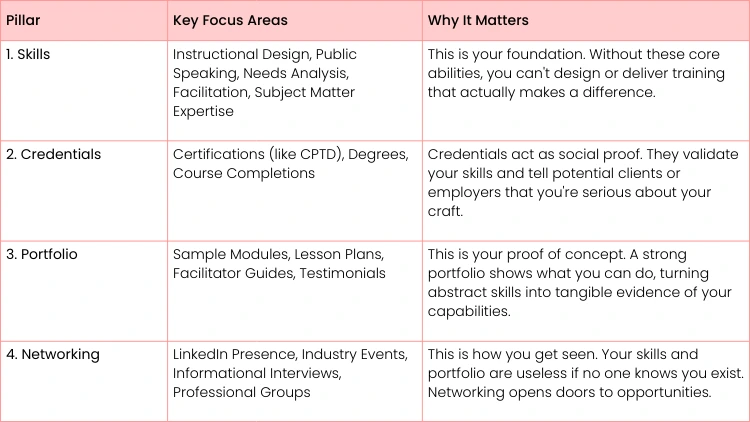
To build a sustainable career as a corporate trainer, you need to focus on four distinct but interconnected pillars. Think of it like building a house—skip one part, and the whole thing gets a little wobbly.
This really drives home the point that becoming a great trainer is a multi-faceted gig. Your raw skills have to be backed up by credentials, showcased through a killer portfolio, and amplified by a strong professional network. Each pillar supports the others. This framework holds true whether you're aiming for an in-house role or thinking about starting your own coaching business.
The Four Pillars of a Successful Corporate Trainer Career
Here’s a quick breakdown of what each pillar involves and why it's so important to give each one your attention.
Let's see how they all connect. Amazing facilitation skills mean less if you don't have a portfolio to prove it to a hiring manager. A great portfolio won't get noticed without effective networking.
A successful corporate training career isn’t built on just one thing. It’s the smart integration of what you know (Skills), how you prove it (Credentials), what you can show (Portfolio), and who knows you (Networking).
Thinking about your career development through these four lenses ensures you're building a well-rounded and resilient path forward. This guide will walk you through building each one, starting with the most critical component of all: the core skills that make a trainer truly effective.
Mastering the Core Skills of a Top Trainer
Great trainers aren't just walking encyclopedias; they're masters of communication, psychology, and adult learning. If you want to become a truly sought-after corporate trainer, you have to move beyond simply knowing your topic inside and out. It all boils down to a trifecta of non-negotiable skills: subject matter expertise, instructional design, and top-notch facilitation.
This isn't about some abstract theory you learn in a book. We're talking about building practical, real-world abilities that let you command a room with confidence and, most importantly, deliver training that actually sticks.
Go Beyond Surface-Level Expertise
Being a subject matter expert (SME) is the price of admission. You simply can't teach what you don't deeply understand. But for a trainer, real expertise is about so much more than rattling off facts and figures. It’s about knowing the common pitfalls, the real-world applications, and the "why" behind every concept you teach.
- Practical Example: If you're training a sales team on a new CRM, you don't just walk them through the features. You anticipate their biggest objection—"Great, another tool to create more admin work!"—and show them exactly how a specific feature will help them close deals faster and make more money. Your expertise becomes a tool for relevance and persuasion.
- Actionable Insight: Volunteer to write the onboarding documentation for new hires in your current department. This forces you to distill complex processes into simple, digestible steps and anticipate common questions—a core function of any great trainer.
Embrace the Science of Instructional Design
Knowing your stuff is one thing. Structuring it so other people can actually learn and retain it? That’s a completely different ballgame. This is the art and science of instructional design, and it’s about creating a logical, engaging, and memorable learning journey from start to finish.
In fact, at the heart of any effective training is solid instructional design; digging into a guide to course instructional design is a great way to grasp how to build powerful learning experiences. Without this skill, even the most knowledgeable expert can end up delivering a session that's confusing and totally ineffective.
A tried-and-true framework you can lean on is the ADDIE model:
- Analysis: Who are you training? What do they already know? What's the business goal we're trying to achieve?
- Design: What are the specific learning objectives? How will you structure the content and activities to meet them?
- Development: Time to create the materials. This means the slides, workbooks, handouts, and any e-learning modules.
- Implementation: This is showtime—delivering the actual training session.
- Evaluation: Did it work? How will you measure success (think quizzes, on-the-job observation, or performance metrics)?
Actionable Insight: For your next project or presentation, consciously apply the ADDIE model. Before you create a single slide, write down your answers for each of the five stages. This simple planning exercise will make your final product dramatically more focused and effective.
Develop Dynamic Facilitation Skills
Facilitation is where all your preparation meets performance. It's your ability to manage the energy in the room, encourage participation, and pivot your delivery in real-time. This is so much more than just public speaking; it’s about cultivating an environment where people feel comfortable and ready to learn.
- Practical Example: A great facilitator notices participants are getting quiet after lunch. Instead of just pushing through the slides, they'll call for a quick "stand and stretch" or pivot to a 10-minute small group activity to re-energize the room and get people talking again.
Here are a few practical ways to start building this muscle:
- Lead team meetings: Volunteer to run them. Practice guiding the discussion, keeping everyone on track, and making sure every voice is heard.
- Volunteer for a non-profit: Offer to lead a short workshop for a cause you care about. It’s a fantastic, low-stakes way to get your reps in.
- Record yourself: It might feel awkward, but film yourself explaining a concept for just five minutes. Watch it back to spot any verbal tics (like "um" or "like") or habits you want to work on.
Strong facilitation is directly tied to your presentation skills. If you're looking for more ways to sharpen how you deliver your content, this guide on how to improve presentation skills is packed with tips. By mastering these three pillars, you’ll have the competence and confidence you need to become an exceptional corporate trainer.

Choosing Your Credentials and Education Wisely
Once you’ve started sharpening your core skills, the next move is to get them validated. Let's be honest, in a competitive field, the right credentials are a powerful signal to employers and clients. They prove you have a formal grasp of adult learning principles and training methodologies.
The real question isn't if you need credentials, but which ones give you the best return on your investment of time and money.
Navigating this can feel a bit overwhelming. Should you go for a formal degree? A specific certification? Both? The right answer really hinges on your career goals, where you're starting from, and whether you see yourself in-house or flying solo as a freelancer. A human resources degree might be the ticket for a corporate L&D track, but a targeted certification is often much faster and more practical.
Degrees vs. Certifications: What's the Real Difference?
A formal degree—think a bachelor's or master's in Human Resources, Organizational Development, or Adult Education—gives you a deep, theoretical foundation. Big corporations often look for these when hiring for senior Learning & Development management roles. This path makes a lot of sense if you're early in your career and have your sights set on climbing the corporate ladder.
Certifications, on the other hand, are all about specialized, tactical skills. They show you’re proficient in a specific area like instructional design, coaching, or training delivery. They're a fantastic way for professionals switching from another field to quickly gain credibility and learn the specific lingo and frameworks of the training world.
- Practical Example: A marketing manager with 10 years of experience doesn't need to go back for an HR degree to become a trainer. Instead, they could get an ATD certification in instructional design, which directly leverages their existing marketing expertise and quickly makes them a credible candidate for a marketing training role.
You can explore a wide variety of relevant online professional development courses to round out your existing skills.
Comparing Top-Tier Training Certifications
When you're ready to put your money down on a certification, you'll find several respected organizations out there. Each one has a different focus, price tag, and level of industry clout. Knowing these differences is absolutely key to picking the right one for your journey to become a corporate trainer.
- Actionable Insight: Before committing to a program, go on LinkedIn and search for job titles like "Corporate Trainer" or "Instructional Designer" at companies you admire. Look at the profiles of people in those roles and see which certifications they list. This is real-world data telling you what holds the most value in your target market.
This kind of strategic thinking ensures your investment pays off. Ultimately, the right credentials do more than just add a line to your resume. They fill your toolkit with proven methods and give you the confidence to design and deliver training that actually makes a difference.
Here’s a quick breakdown of three of the most recognized players to help you see how they stack up:

Building a Portfolio That Proves Your Value
Credentials on a resume are one thing, but a hiring manager’s biggest question will always be, "Can you actually do the job?"
This is where your portfolio comes in. It’s the definitive answer to that question—the tangible, undeniable proof that turns your claimed abilities into demonstrated value. It makes it incredibly easy for a decision-maker to visualize you in the role.
Think of it as the ultimate sales tool for your career. A well-crafted portfolio shifts the conversation from what you say you can do to what you can show them you've done. This is especially vital if you're trying to break into corporate training without formal experience; it’s your chance to completely level the playing field.
Create Your Signature Training Module
The cornerstone of any powerful training portfolio is a complete, ready-to-deliver sample training module. Don't try to boil the ocean here. Pick one specific topic you know inside and out—something you could talk about for hours without any notes. That genuine expertise will shine through in the quality of your materials.
- Practical Example: A seasoned sales manager could create a 60-minute module on "Overcoming Price Objections". A software developer could build a workshop on "An Introduction to Agile Project Management for Non-Technical Teams". The topic itself is less important than how well you execute the entire package.
A truly complete module needs three core components:
- The Facilitator Guide: This is your playbook. It should map out learning objectives, timing for each section, key talking points, detailed activity instructions, and probing questions to ask participants. It's the behind-the-scenes magic.
- The Participant Workbook: This is what the learners actually interact with. It needs exercises, dedicated space for notes, key models or frameworks, and a solid summary of the main takeaways.
- The Presentation Slides: Keep them clean, visual, and professional. Remember, the slides should support you, not replace you. Use them to highlight key data, powerful images, and high-level concepts.
Putting this package together instantly demonstrates your command of instructional design from A to Z.
Gaining Experience When You Have None
Okay, you have a killer sample module. Now what? Your next step is to get real-world feedback and results. Waiting around for a paid gig to get experience is a classic catch-22. The solution is simple: create your own opportunities to build that all-important social proof.
One of the most effective ways to do this is by offering a free workshop. Reach out to a local non-profit, a small business in your network, or even a different department at your current company. Frame it as a no-cost professional development session—a win-win.
- Practical Example: A project manager looking to transition into training could offer a free 90-minute "Productivity Hacks for Busy Professionals" workshop to their local Chamber of Commerce. This not only gives them valuable facilitation practice but also generates testimonials and adds a real event to their portfolio.
- Actionable Insight: After delivering a free session, immediately send a follow-up email with a simple three-question survey using Google Forms: 1) What was your biggest takeaway from today's workshop? 2) On a scale of 1-10, how likely are you to recommend this session? 3) Would you be willing to provide a short testimonial I can use on my LinkedIn profile? This makes it easy to collect valuable social proof.
Showcase Your Skills with Digital Assets
In today's training world, digital and virtual facilitation skills are non-negotiable. Your portfolio has to reflect this reality. The good news is you can create compelling digital assets with minimal equipment—often just your smartphone and a quiet room.
Here are a few actionable ideas to get you started:
- Create a Micro-Learning Video: Record a punchy 3-5 minute video of you teaching one single concept from your sample module. Upload it to LinkedIn or YouTube. This is a fantastic way to showcase your on-camera presence and your ability to be concise.
- Develop a Compelling "One-Sheet": This is a single-page document that summarizes who you are, what topics you train on, and what makes you unique. It's an incredible leave-behind for networking events. For a step-by-step walkthrough, check out this guide on how to create a great speaker one-sheet.
- Write a How-To Article: Publish a short article on LinkedIn or a personal blog that teaches a specific skill. This immediately positions you as an expert and demonstrates your ability to communicate complex ideas clearly in writing.
These assets prove your versatility and show hiring managers you understand how to create modern, engaging learning content. By combining a signature module, real-world testimonials, and sharp digital examples, you build a portfolio that doesn't just list your skills—it proves them.
Landing Your First Corporate Trainer Role or Client
You’ve built the skills and polished your portfolio. Now it's time for the exciting part: turning all that hard work into a paying gig. This is where you shift from preparation to promotion, and it all boils down to one key decision.
Are you looking for the stability and deep institutional impact of a full-time, in-house trainer? Or does the freedom, variety, and entrepreneurial spirit of freelancing call to you? There’s no wrong answer, but each path requires a completely different game plan.
Securing a Full-Time Corporate Trainer Position
Getting an in-house job is a two-part challenge: first, you have to get past the automated resume screeners (the ATS bots), and second, you have to win over a real human hiring manager.
Let’s be clear: you must tailor your resume for every single application. This isn't just good advice; it's essential. Scour the job description for the exact keywords and skills they’re looking for and weave them into your experience.
- Actionable Insight: Copy the text from a job description and paste it into a word cloud generator online. The biggest words that appear are the keywords you absolutely must include in your resume and cover letter (as long as you have the relevant experience, of course).
Once you land an interview, be ready for those "tell me about a time when..." questions. The STAR method (Situation, Task, Action, Result) is your best friend here. It gives your answers structure and proves you don’t just know the theory—you’ve actually done the work.
- Practical Example: Imagine the interviewer asks, "Tell me about a time you had to train a resistant audience."
A killer STAR answer would be: "At my last job (Situation), I was asked to train the veteran sales team on a new CRM system they were convinced would slow them down (Task). I kicked off the session by validating their concerns, then immediately showed them how two specific features would automate their weekly reports, saving them at least an hour each (Action). Within 30 days, adoption rates hit 95%, and a few of the most skeptical reps actually thanked me for making their jobs easier (Result)."
Winning Your First Freelance Client
When you're a freelancer, you are the business. Your most important job, especially at the beginning, is constantly networking and pitching. It's a hustle, but a rewarding one.
The single most important thing you can do is define your niche. Don't be a "corporate trainer". Be the "go-to trainer for presentation skills for tech startups" or the "leadership development expert for manufacturing firms". A specialist is memorable; a generalist is forgettable.
The great news is that companies are pouring money into training. Some research shows that businesses dedicate around 11% of certain HR budgets just to training and development, proving the demand is there.
Ready for a simple, actionable plan to get that first client?
- Supercharge Your LinkedIn Profile. Your headline needs to sell your specialty. Think: "Freelance Trainer | I Help SaaS Sales Teams Deliver Killer Technical Demos."
- Make a Hit List. Identify 20 companies in your niche you'd be thrilled to work with. Find the department heads or HR managers and connect with them.
- Craft a Killer Pitch. Keep it short, focused on their problem, and dripping with value.
Here's a simple email template you can steal and adapt:
Subject: Quick question about [Company Name]'s sales training
Hi [Contact Name],
I saw on LinkedIn that [Company Name] is expanding its sales team. I specialize in helping B2B tech companies onboard new sales reps faster with a hands-on, simulation-based training program.
Companies I've worked with have seen a 20% reduction in ramp-up time.
Would you be open to a brief 15-minute call next week to discuss how I might be able to support your new hires?
Best, [Your Name]
This approach instantly positions you as a strategic problem-solver, not just another vendor. Building these relationships is everything, and you can pick up more great tips in this guide on how to network effectively. Whether you go the employee or entrepreneur route, a targeted, strategic approach will get you there faster.

Understanding Your Career Path and Salary Potential
So, you're wondering about the money and where this career can actually take you. Good. It’s one of the most important parts of planning your future as a corporate trainer. Let's get real about what you can expect to earn and what your career path could look like down the road.
The great news is that corporate training is a solid, in-demand field. You're not chasing a fad here. Companies always need to upskill their people, and they're willing to pay for experts who can deliver real results.
So, What Can You Actually Earn?
Your salary as a corporate trainer isn't a single, fixed number—it's a range that depends heavily on your experience, where you live, the industry you're in, and whether you're working for a company or for yourself.
To give you a concrete starting point, the U.S. Bureau of Labor Statistics projects that employment for Training and Development Specialists will grow by 6% between 2022 and 2032, which is faster than the average for all occupations. This signals that skilled trainers are going to be in high demand for years to come. For a closer look, you can always check out current corporate trainer salary benchmarks.
Here’s a rough breakdown of what you might see at different stages:
- Getting Started (Training Specialist/Coordinator): When you're just breaking in, your focus is on learning the ropes, handling logistics, and maybe co-facilitating sessions. Expect a starting salary in the $50,000 to $65,000 range.
- Hitting Your Stride (Corporate Trainer/Instructional Designer): After a few years, you're not just assisting—you're the one in the driver's seat, designing and delivering your own training programs. Your pay will likely climb to between $65,000 and $85,000.
- Leading the Way (Senior Trainer/Training Manager): At the senior level, your role becomes much more strategic. You’re managing training teams, setting the learning strategy for the department, and tackling big-picture business challenges. Salaries here can push from $85,000 to well over $110,000.
Practical Example: A freelancer specializing in cybersecurity awareness training for financial institutions can command a higher daily rate (e.g., $3,000/day) than a generalist offering soft skills training, because the problem they solve is highly specific and has significant financial risk attached.
This Isn't a Dead-End Job—It's a Launchpad
One of the best things about being a corporate trainer is that it's not a terminal role. The skills you master—from public speaking and instructional design to strategic thinking and stakeholder management—are incredibly valuable and transferable. You're not just teaching; you're learning how the entire business works from the inside out.
This opens up a ton of doors for advancement. Your career path can branch out in several exciting directions.
You move from executing tasks to owning the strategy. A Training Specialist might deliver a pre-written workshop, but a Director of Learning & Development is the architect behind the entire company's learning culture, ensuring every program aligns with the highest-level business goals.
Ultimately, this career progression allows you to scale your impact—from improving the skills of one employee to shaping the performance and culture of an entire organization.

Got Questions About Becoming a Corporate Trainer?
As you start to seriously consider a career in corporate training, the practical, "what if" questions are bound to pop up. That's a good thing. Getting these sorted out early will save you headaches down the road and help you move forward with a clear head.
Let's dive into some of the most common questions we hear from people just starting out.
Do I Really Need a Specific Degree?
Honestly? Not always. While a degree in something like HR, education, or organizational development certainly looks good on paper, it's far from a deal-breaker. We've worked with incredible trainers who came from sales, engineering, and even the arts. Their superpower wasn't their diploma; it was their deep, real-world experience in their field.
- Practical Example: A former accountant who becomes a trainer on financial software is instantly credible because they've "lived in the trenches" and understand the end-user's daily frustrations and challenges in a way an academic never could. That real-world empathy is their biggest asset.
How Can I Get Experience When I Have No Experience?
The key is to stop waiting for permission and start creating your own training opportunities right where you are.
- Look for chances at your current job. Offer to help onboard the new hires. Pitch a "lunch and learn" session on a software you've mastered. These small internal gigs are gold.
- Offer a free workshop. Reach out to a local non-profit or a small business you admire. A free, one-hour session on communication or time management is an amazing way to get real facilitation hours under your belt.
- Document everything. For every little session you run, create a simple facilitator guide and a one-page handout for participants. Boom. You've just started building your portfolio with tangible proof of your skills.
What’s the Real Difference: In-House vs. Freelance?
This really boils down to your work style and career goals. Think of it like this:
An in-house trainer is a full-time employee. You're part of the team, working for one company and focusing entirely on its people. You'll gain a really deep understanding of that company's culture and needs. The work is stable, the paycheck is steady, and you know who you're working with every day.
A freelance trainer, on the other hand, is a business owner. You're your own boss, working with multiple companies on different projects. This path offers incredible flexibility, a ton of variety, and usually a higher earning potential. The trade-off? You have to be good at sales and marketing to keep your pipeline full of clients.
- Actionable Insight: Not sure which path is for you? Try a "micro-freelance" project. Offer a single, paid 2-hour workshop to a small local business. This gives you a taste of the freelance world—from pitching and pricing to delivery—without having to quit your day job. It's the perfect way to test the waters.
At Uplyrn, we know that building a great career is about having the right skills and a clear roadmap. Our platform is packed with courses led by industry pros who teach you the practical, real-world abilities you need to crush it as a corporate trainer. Take a look at our courses today and make your next career move.


Leave your thoughts here...
All Comments
Reply