









Online Professional Development Courses That Boost Careers

Feeling stuck in your career can be paralyzing, but online professional development courses are the perfect way to start building the future you want, one skill at a time. Think of them as focused, flexible learning sprints designed to teach you specific, job-ready abilities—everything from mastering project management software to finally understanding data analytics.
Jump To Section

Earn As You Learn
Earn 25% commission when your network purchase Uplyrn courses or subscribe to our annual membership. It’s the best thing ever. Next to learning,
of course.
Why Online Professional Development Matters Now
The old career ladder is gone. In its place is a dynamic grid of opportunities that requires you to constantly learn and adapt. Relying on a college degree alone just doesn't cut it anymore. To stay competitive, you have to keep adding new skills to your professional toolkit, and online courses are by far the most efficient way to get it done.
This isn't just a fleeting trend; it's a massive economic shift. The global e-Learning market was valued at around $165 billion back in 2014. By 2025, it's expected to explode to $325 billion. That incredible growth highlights a fundamental change in how we all—from individual professionals to entire companies—approach learning new skills.
Bridging the Skills Gap
One of the biggest roles online learning plays is closing the ever-widening skills gap. Technology moves so fast that many of today's jobs demand skills that didn't even exist five years ago. Online courses offer a direct, practical solution.
- For Individuals: They create a clear path to upskill for a promotion, reskill for a complete career change, or simply become better at your current job.
- For example, a marketing manager noticing the rise of AI could take a specialized course on "AI for Marketers". They could immediately apply new skills by using AI tools to analyze campaign data, predict customer behavior, and automate content creation, giving them a significant edge.
- For Companies: Businesses are turning to these courses to train their existing teams. This ensures their people have the skills needed to drive growth and innovation, all without the high cost and hassle of hiring externally.
- A practical example is a construction company enrolling its project managers in an online course for new green building certification standards, ensuring compliance and opening doors to new, eco-friendly contracts.
This gap is a real challenge for the modern workforce. You can learn more about this crucial topic in this guide on the skills gap and why workers need upgrading.
The real magic of an online professional development course isn't just the certificate you get at the end. It's the immediate, real-world application of what you learn. You can master a new coding language on Tuesday and use it on a work project by Wednesday.
A Toolkit for Career Advancement
Picture your career as a high-performance car. To keep it running smoothly and winning races, you need regular maintenance and upgrades. Online professional development courses are those precision upgrades. For anyone looking to understand this new landscape of professional growth, exploring expert insights on sites like Buddypro's blog can offer some valuable perspective.
Whether it’s a quick microcredential to prove your expertise in a specific tool or an intense bootcamp designed to launch you into a new field, these learning formats are built for one thing: impact. They give you the practical, targeted knowledge you need to take your next career step with total confidence.
Choosing Your Path to Professional Growth
Picking the right online professional development course is a lot like choosing the right tool for a job. You wouldn't use a sledgehammer to hang a picture frame, right? In the same way, the best course for you hinges entirely on what you want to achieve, how much time you have, and your personal learning style.
The sheer number of options can feel a little overwhelming at first, but most courses fall into a few key categories. Getting a handle on what makes each one different is the first step toward making a smart investment in your career. Let's break down the most common formats to help you find your perfect fit.
Microcredentials: Quick Wins for Specific Skills
Think of microcredentials as laser-focused training sprints. They’re designed to validate a single, specific skill—like mastering a new piece of software or a niche project management technique that’s suddenly in high demand.
- A practical example is a human resources generalist earning a microcredential in "Inclusive Hiring Practices". This gives them immediate, verifiable proof of a specialized skill they can use to improve their company's diversity and inclusion initiatives during the very next hiring cycle.
Professional Certificates: Signaling Deeper Expertise
A step up from that, professional certificates offer a much deeper dive into a broader subject. These programs, often backed by universities or big names in the industry, show you’re serious about mastering a particular field.
- A great example is a junior graphic designer who enrolls in a UX/UI Design Professional Certificate. Over several months, they’ll cover everything from user research to wireframing and prototyping. That final certificate sends a clear signal to hiring managers that they have a well-rounded and validated skill set ready to go.
Intensive Bootcamps: For a Full Career Change
For anyone looking to make a big career leap, intensive bootcamps are built for speed and transformation. These are high-energy, immersive programs designed to take you from beginner to job-ready in a hot field like data analytics, cybersecurity, or full-stack web development.
- Imagine this practical scenario: an administrative assistant who wants to break into tech enrolls in a 12-week coding bootcamp. The curriculum is all about hands-on, project-based work, so they graduate with a portfolio of three completed web applications they can actually show to employers, creating a direct pipeline to a brand-new career.
Your learning style is just as important as your learning goal. The structure of a course—whether you work alone or with a group—can make or break your experience and determine whether you actually finish.
Self-Paced vs. Cohort-Based Learning
One of the biggest forks in the road is choosing between a self-paced and a cohort-based program. Neither one is automatically better; it all comes down to your personality and your schedule.
- Self-Paced Courses give you total freedom. You start when you want and work through the material on your own time, which is perfect for busy parents or professionals juggling a heavy workload.
- Actionable Insight: To succeed here, use a calendar app to block out non-negotiable "study time"—even just 30 minutes, three times a week. Treat these blocks like important meetings to maintain momentum.
- Cohort-Based Courses put you in a virtual classroom with a group of peers who start and finish the program together. This creates built-in accountability, structure, and a community to lean on.
- Actionable Insight: When you join, actively participate in the group forums or Slack channels from day one. Introduce yourself and ask a question. This early engagement builds connections that will help keep you motivated when the material gets challenging.
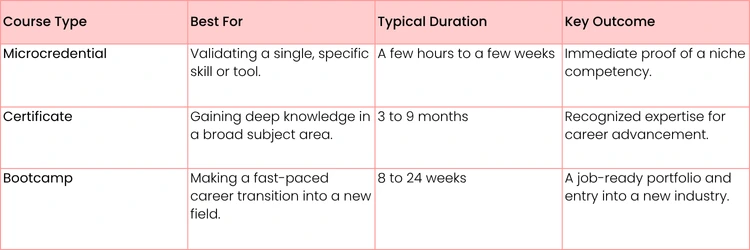
Comparing Online Professional Development Course Formats
To help you sort through the options, here's a side-by-side comparison of the most common online course types. Think about your specific career goals and learning style to see which path makes the most sense for you.
Ultimately, whether you choose a quick microcredential to sharpen a skill or a full-blown bootcamp to launch a new career, the goal is the same: investing in yourself to stay relevant and competitive.
The Real-World Benefits of Learning Online
Sure, flexibility is the most obvious perk of learning online, but that’s just scratching the surface. The real power of online professional development courses is the tangible, measurable return you get on your investment of time and money. Think of these courses less as a convenient way to learn and more as strategic tools for unlocking serious career growth and boosting a company's bottom line.
For you as an individual, a new certification can completely change the game. It’s hard proof of your skills, turning your ambition into something you can put on a resume or bring up in a performance review. It’s not just a confidence booster; it’s a powerful bargaining chip.
For companies, the logic is just as strong. Investing in your team’s skills is a direct investment in your most valuable asset: your people. When you build talent from within, you create a workforce that’s more skilled, more engaged, and ready for whatever comes next. You can dig deeper into the many benefits of investing in employees to see just how powerful this can be.
Fueling Individual Career Growth
Picture this: you're in your annual review. Instead of just talking about what you did last year, you pull out a brand-new certificate in Data Visualization. Suddenly, the conversation shifts. You’re not just an employee doing their job; you're actively growing, learning, and positioning yourself for bigger things.
Actionable Insight: Don't just say you took a course. Frame your new skills in terms of the value they bring to the company. Instead of saying, "I completed a course", try "This new project management certification has given me the tools to lead the upcoming product launch more effectively, and I think we can cut our timeline by 15%."
See the difference? That simple shift turns a personal achievement into a business advantage, making your case for a promotion or raise almost undeniable. And if you’re looking to switch fields, a specialized skill set can be the key that opens the door to a whole new industry.
What’s fascinating is that online learning actually works with our brains, not against them. Studies have shown that digital learning can boost retention rates to 25-60%. Compare that to the paltry 8-10% you often get from a traditional lecture hall. The numbers don't lie—self-paced, interactive content just sticks better.
Boosting a Company's Bottom Line
From a business perspective, the ROI of online professional development is crystal clear. When people see their company investing in their growth, they become more invested in its success. This translates directly to higher engagement and much better retention, saving a fortune in recruitment and onboarding costs.
It’s also the smartest way to close critical skill gaps. Instead of throwing money at a tough hiring market, you can cultivate the exact expertise you need right inside your own walls. This helps you build a more agile, innovative team that can pivot on a dime when the market changes.
Here’s a real-world example of how this plays out:
- The Challenge: A mid-sized tech company was struggling to find data analysts. Their recruiting budget was stretched thin, and hiring senior talent was proving to be slow and expensive.
- The Solution: Instead of continuing the frustrating external search, the leadership team looked inward. They identified five motivated employees from different departments who had a knack for analytical thinking and enrolled them in a comprehensive online data analytics certificate program.
- The Outcome: In just six months, the company had its own in-house data team. Not only did this slash their recruitment spending by 40% for the year, but it also sent a powerful message to the entire staff: we believe in promoting from within. Morale soared.
How to Find a Course That Delivers Real Value
Let's be honest: investing your time and money into an online course is a big deal. With a million options out there, it’s easy to get sucked in by flashy ads and vague promises of success. To actually move your career forward, you need to know how to cut through the marketing fluff and figure out which programs are the real deal.
A great course is way more than just a playlist of video lectures. It’s a complete learning experience, built from the ground up to give you skills you can actually use. Get this choice right, and you'll walk away with a solid portfolio, some new professional connections, and abilities you can put to work on Monday morning.
Assess the Instructor's Expertise
The person teaching the course can make or break everything. Don't just look at their academic credentials; you want to find instructors who have recent, real-world experience in the field. A truly great teacher is also a practitioner who can explain not just what to do, but the why and how behind it, all based on their own work.
- Actionable Insight: Jump on LinkedIn and look up the instructor's name. Are they currently working in the industry they're teaching? Look for recent projects, articles, or conference talks that show they're still in the game.
- A practical example is choosing a course on content marketing taught by the current Head of Content at a successful startup over one taught by a professor who hasn't actively practiced in a decade.
Dissect the Curriculum and Learning Outcomes
Think of the course syllabus as your roadmap. If it's vague or poorly structured, that's a huge red flag. The best programs lay out crystal-clear learning outcomes, spelling out exactly what you'll be able to do once you've finished.
Those outcomes should line up perfectly with what employers are actually looking for.
- Practical Example: Let's say you're eyeing a digital marketing course. Pull up three job descriptions for roles you want. Does the course curriculum cover the key skills they mention, like "SEO keyword research", "Google Analytics 4 reporting" and "A/B testing"? If so, you've found a winner.
Verify Accreditation and Recognition
While not every course needs a formal stamp of approval, accreditation can add some serious weight to your credential, especially in technical or highly specialized fields. When a program is backed by a recognized industry body or a university, it’s a strong signal that it has met tough quality standards.
The real value of a course isn’t just in the knowledge you gain, but in the proof you can show. A verifiable credential from a respected institution gives you that proof, turning your new skills into a currency you can trade for career opportunities.
Prioritize Hands-On Projects
Kicking back and watching videos will only get you so far. Real skill development happens when you get your hands dirty. Any course worth your money will include hands-on projects, case studies, or labs where you have to apply what you've learned to solve actual problems. For more on creating these kinds of effective learning experiences, check out this guide on the best practices for distance education.
These projects are absolutely non-negotiable. Why? They lock in what you've learned and build out your professional portfolio at the same time. A hiring manager will always be more impressed by a project you actually built than a multiple-choice quiz you aced.
- Practical Example: A UX design course that makes you build a complete, clickable prototype for a mobile app is infinitely more valuable than one that just quizzes you on design theory. You finish with a real asset you can show off to employers.

Putting Your New Skills into Action
Finishing an online professional development course feels great, but let's be honest—the certificate is just the beginning. The real magic happens when you start turning that newfound knowledge into actual career opportunities. This is where your investment starts to pay you back.
The whole idea of professional growth is changing, and online courses are a massive part of it. In fact, projections show that by 2025, online learning will make up 15.9% of the entire global education market. That surge is happening because people are hungry for career-ready skills.
What does that mean for you? It means a lot more people are upskilling, so you need to make sure your new abilities get noticed.
Showcase Your Credentials Where It Counts
Think of your LinkedIn profile as your professional billboard. It’s the first place recruiters and hiring managers will look, so don't just bury your new certificate at the bottom. Make it a headline.
- Add it to 'Licenses & Certifications'. This is the official spot. Make sure you include the institution and completion date.
- Update your headline. This is prime real estate! Go from "Marketing Manager" to "Marketing Manager | Certified in Google Analytics 4". It immediately signals your new expertise.
- Write a post about it. Share a picture of your certificate and write a quick note about what you learned and how you plan to use it. This broadcasts your achievement to your entire network.
Turn Projects into Compelling Case Studies
Those projects you completed during your course? They aren't just homework—they’re proof you can do the work. Frame them as mini-case studies that show off your problem-solving skills.
The best way to do this is with the STAR method: Situation, Task, Action, and Result. This simple framework turns a class assignment into a powerful story about your capabilities.
For instance, instead of just saying, "Completed a final project on data analysis", try this:
- Situation: I was tasked with analyzing a large dataset to figure out why customers were leaving.
- Task: My goal was to identify the top three drivers of customer churn.
- Action: Using Python and SQL, I cleaned the data, identified key patterns, and built a predictive model.
- Result: The model showed that a clunky onboarding process was the biggest issue. My analysis provided a clear path to reducing churn by an estimated 15%.
See the difference? One is a statement; the other is a story of your impact.
Confidently Discuss Your Skills in Interviews
Having the skills is one thing; talking about them is another. You need to be ready to articulate the value you bring in a clear and confident way.
Actionable Insight: Before an interview, prepare two specific stories (like the STAR example above) that demonstrate your new skills. Practice telling them out loud. This ensures you won't just say you have the skill—you'll prove it with a compelling, real-world example.
- Interviewer: "I see you recently completed a course in UX Design. Can you tell me about that?"
- You: "Absolutely. I took that course because I saw a direct connection between great UX and user retention. I led a project where we redesigned a mobile app's checkout flow, which involved everything from building user personas to wireframing and usability testing. I'm excited to bring that hands-on experience here to help improve user engagement."
The final piece of the puzzle is weaving this new knowledge into your everyday work. For some great strategies on how to do that, check out this guide on how to learn effectively in the flow of work. When you actively apply what you've learned, your new skills stop being something you know and start becoming part of who you are as a professional.

Common Questions About Professional Development Courses
Even with all the benefits laid out, it's natural to have a few questions before jumping into an online professional development course. Let's be honest, it's an investment of your time and money. Getting these common concerns sorted out is the best way to move forward with confidence and make a smart choice for your career.
Here are a few of the most frequent questions we hear from professionals just like you.
Are Online Professional Development Certificates Worth It?
Yes, but with a big caveat: their value is directly tied to their relevance and reputation. A certificate in a high-demand skill from an institution that employers actually respect? That’s gold. Its real worth is measured by how closely it matches what hiring managers are looking for right now.
- Actionable Insight: Try this little experiment. Copy the syllabus from a course you're interested in and paste it into a word cloud generator. Now, do the same thing for three to five job descriptions you’d love to land. If the word clouds look like twins—showing a big overlap in key skills and tech—that certificate is almost certainly a solid investment.
How Do I Find Time for an Online Course with a Full-Time Job?
This is the big one, isn't it? The secret is consistency, not cramming. The most successful learners don't magically find huge blocks of free time. Instead, they choose a self-paced course and weave learning into their existing routine, rather than trying to blow up their whole schedule.
- Actionable Insight: Use the "five-minute rule". Just commit to logging in and looking at the material for five minutes a day. That's it. You'll be surprised how often that small first step turns into a productive 30-minute session. The hardest part is just getting started. Schedule these little learning blocks in your calendar like they're appointments to build a habit that actually sticks.
The people who really succeed with online learning don't find time; they create small, consistent pockets of it. This approach avoids burnout and makes picking up a new skill feel totally manageable.
How Can a Company Measure the ROI of Employee Courses?
To really measure the return on investment, you have to connect the training directly to real-world business results. This means tracking specific Key Performance Indicators (KPIs) before the training and then again after.
- For example, if your customer service team takes a course on de-escalation techniques, you can track whether their average call resolution time improves or if customer satisfaction scores go up in the following quarter.
We dive deep into this topic in this guide on how to measure training effectiveness.
- Actionable Insight: After an employee finishes a course, ask them to fill out a simple "application plan". Have them list three specific ways they plan to use their new skills in their job over the next 90 days. This creates instant accountability and draws a straight line from the training to on-the-job performance, making the ROI crystal clear.
Ready to find a course that delivers real skills and a real career boost? At Uplyrn, we connect you with expert-led online professional development courses, dedicated mentors, and job opportunities to make sure your new knowledge turns into tangible success. Explore our courses today!


Leave your thoughts here...
All Comments
Reply